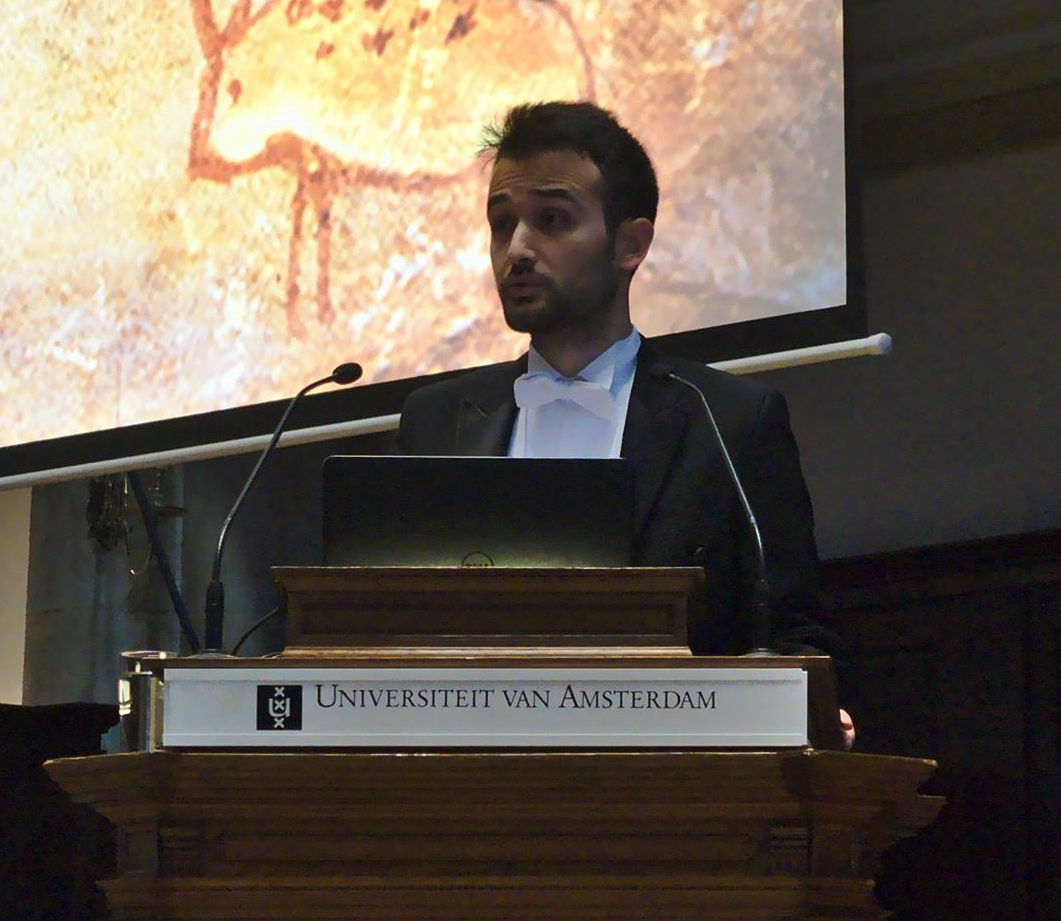
Mohammad Aliannejadi is an Assistant Professor at the IRLab (formerly ILPS) within the Informatics Institute at the University of Amsterdam. His research focuses on Information Retrieval (IR), machine learning, natural language processing (NLP), and conversational systems, particularly in modeling user information needs on mobile devices and conversational search systems. He holds a Ph.D. in Informatics from Università della Svizzera italiana (USI), Lugano, Switzerland, and a M.Sc. in Computer Engineering from Tehran Polytechnic. During his Ph.D., he visited the CIIR Lab at the University of Massachusetts Amherst, USA. His research interests include conversational search systems, recommender systems, unified search frameworks, and user-centric evaluation methodologies. Notable contributions include work on clarifying questions in open-domain dialogues, contextual suggestion systems, and cross-market recommendation. Aliannejadi has organized major shared tasks and workshops, including the IGLU Contest (NeurIPS 2021) and XMRec Workshop (RecSys 2021). He serves on program committees of top IR conferences like SIGIR, CIKM, and ECIR, and has authored over 50 peer-reviewed publications in these areas. His work has received recognition, including top performance in TREC Contextual Suggestion tracks (2015, 2016). He actively contributes to the IR community through teaching, including courses on Information Retrieval and Human-in-the-Loop Machine Learning at the University of Amsterdam.
Dr. Ting-Feng Lin is an Assistant Professor at the Cell Biology, Neurobiology and Biophysics department within the Faculty of Science at Utrecht University, Netherlands. His research focuses on understanding the mechanisms of learning and memory formation in the cerebellum, particularly how synaptic and intrinsic plasticity mechanisms coordinate to regulate neuronal signaling and behavior. He employs advanced microscopy, optogenetic, and chemogenetic techniques in transparent zebrafish models to study these processes in vivo, with implications for neurodevelopmental disorders like autism spectrum disorder (ASD) and schizophrenia. 2025: Assistant Professor, Utrecht University 2019-2025: Postdoctoral Researcher, University of Chicago 2015-2019: PhD in Neuroscience, Neuroscience Center Zurich (ZNZ) 2010-2014: MS in Physiology, National Taiwan University 2006-2010: BS in Sports Medicine, China Medical University His work investigates how sensory experiences shape cerebellar processing during development, focusing on climbing fiber pathways and their role in sensory prediction errors. His group also studies the interaction between synaptic, intrinsic, and structural plasticity mechanisms in neural circuits, using zebrafish models with genetic modifications (e.g., Grid2 knockout) to model human neurological conditions. Dr. Lin has received scientific recognition including the SfN Trainee Professional Development Award for his work on Purkinje cell plasticity and the JNS Meeting Award for research on parallel fiber ramping activity and LTD. His publications span topics from cerebellar plasticity to voltage-gated K+ channel dynamics, reflecting his interdisciplinary approach to neurobiology.
David Peeters is an Associate Professor at Tilburg University's Department of Communication and Cognition, part of the Tilburg School of Humanities and Digital Sciences. His research focuses on multimodal communication, multilingualism, and digital communication, leveraging immersive virtual reality (VR) technologies combined with EEG, eye-tracking, and fMRI. He explores neurobiological underpinnings of language, including neuropragmatics, non-verbal communication, and multilingualism. His work is supported by grants such as the NWO Veni and Tilburg University Fund. Peeters teaches courses on virtual reality, language psychology, and digital literature integration in education. He is a Research Fellow at the Donders Institute and President of the Tilburg Young Academy. Key research interests include the role of gesture and iconicity in second language acquisition, bilingual language switching in immersive environments, and the impact of dataism on academic publishing. He collaborates with libraries and schools to integrate digital literature into curricula and public collections. His scientific awards include the NWO Veni Grant and a Fellowship from the International Max Planck Research School for Language Sciences. His research bridges cognitive science, linguistics, and technology, emphasizing ecologically valid experimental paradigms.
Laura Maruster is an Assistant Professor at the Faculty of Economics and Business, University of Groningen, Netherlands. She holds an MSc from the West University of Timisoara, Romania, and a PhD in Technology Management from Eindhoven University of Technology, Netherlands. Her research focuses on process mining, process modelling, and healthcare networks, with applications in operations research and data science. She collaborates extensively with industry and public sector partners on projects like the Casimir initiative (RuG and Gasunie). Teaching areas include business processes, data mining, and research methodology. Recent work includes studies on healthcare logistics optimization and process mining beyond traditional workflows. Her publications appear in leading journals such as BMJ Open , IEEE Transactions on Engineering Management , and Computers in Industry . Research interests span healthcare networks, emergency medical services analytics, and enterprise process optimization. Notable recent contributions include analyzing interhospital patient transfers and redesigning engineering design processes using data-driven methods.
Marie-Colette van Lieshout is a Professor of Spatial Stochastics at the Faculty of Electrical Engineering, Mathematics and Computer Science, University of Twente, and a Scientific Staff Member in the Stochastics group at Centrum Wiskunde & Informatica (CWI), Amsterdam. She has been active in research since 1997 and is a leading expert in stochastic geometry, spatial statistics, and image analysis. Her educational and professional background includes positions at the University of Warwick and the Free University Amsterdam. She is currently engaged in advanced research on point processes, random fields, and tessellation models, with applications in seismic hazard, fire risk, and machine learning. Her research interests include: Stochastic Geometry Spatial Statistics Image Analysis Point Process Modeling Seismic Risk Assessment Machine Learning for Spatial Data Her recent publications (2023–2025) focus on spatial intensity estimation, marked point processes, and data-driven risk modeling, showing a strong integration of classical spatial statistics with modern computational and machine learning techniques. Key themes include adaptive kernel smoothing, infill asymptotics, and applications in environmental and public safety domains. She has received significant recognition, including: Elected Fellow, International Statistical Institute (ISI) She has been awarded multiple research grants from NWO and other agencies, including the KLEIN grant for fire risk management and the DeepNL grant for seismicity prediction in Groningen. She has supervised or collaborated with researchers such as C. Lu, Z. Baki, and R. Markwitz. She is also active in academic service, serving on editorial boards (e.g., Methodology and Computing in Applied Probability), advisory boards (InHolland University), and councils of learned societies (Bernoulli Society, KWG). She leads and participates in research clusters such as STAR and contributes to outreach and education through courses and public lectures on earthquake modeling and spatial statistics.
Mila N. Koeva is a Vice Dean Research and senior Associate Professor at the University of Twente's Faculty of Geo-Information Science and Earth Observation (ITC), Department of Urban and Regional Planning and Geo-Information Management. Her research focuses on 3D modeling and Digital Twins for land management and urban planning, integrating geospatial technologies, UAV data, and AI/ML methods. PhD in architectural photogrammetry MSc in Engineering (Geodesy) Research Themes: Digital Twinning for urban ecosystems AI-driven cadastral boundary extraction 3D modeling with LiDAR and satellite data Global partnerships in Rwanda, Kenya, and Ethiopia Interoperability standards for local digital twins Scientific Contributions: Geospatial World Innovation Award 2021 Copernicus Masters Competition (3rd place 2016) Editorial roles in Photogrammetric Records and MDPI journals Keynote speaker at 3D GeoInfo, GI Forum, and FIG events Her educational impact includes developing courses, lecturing, and supervising students whose work has received top awards in The Netherlands and international competitions.
Elisa Perrone is an Assistant Professor in the Department of Mathematics and Computer Science at Eindhoven University of Technology. Her research focuses on dependence modeling, copula theory, and their applications in fields such as public transport analysis, environmental risk assessment, and renewable energy forecasting. Academic Rank: Assistant Professor University: Eindhoven University of Technology (TU/e) Department: Mathematics and Computer Science Elisa’s work explores discrete copulas, zero-inflated data, optimal experimental design, and uncertainty quantification. She has contributed to modeling dependence structures in complex datasets, particularly in transportation systems and climate science. Recent research outputs highlight copula-based statistical post-processing for weather forecasts, analysis of multi-way contingency tables, and uncertainty reduction in LED health management. Her publications span top-tier journals and conferences in statistics and applied mathematics. Scientific Award : Second Best Poster Presentation Award (2015) Elisa actively organizes workshops like the Eurandom Workshop on Dependence Modeling and contributes to editorial activities. She teaches courses on linear statistical models, regression models, and dependence modeling.
George Vosselman is a Full Professor at the University of Twente, Faculty of Geo-Information Science and Earth Observation (ITC), specializing in Geo-Information Extraction with Sensor Systems. Educated with honours at Delft University of Technology (1986) and PhD in Photogrammetry from Rheinische Friedrich Wilhelms University of Bonn (1991), he has held academic roles at the University of Stuttgart, University of Washington, and Delft University of Technology (1993–2004). Since 2004, he has been a key figure at ITC, serving as department head (2012–2018, 2023–). Education: Delft University of Technology (BSc with honours, 1986), Rheinische Friedrich Wilhelms University of Bonn (PhD with honours, 1991) His research focuses on leveraging sensor technology advancements for large-scale geo-information production. Key expertise includes quality analysis of laser altimetry data, point cloud segmentation/classification, 3D building/road modeling, and model-driven imagery analysis. He has published over 220 papers and co-edited the textbook Airborne and Terrestrial Laser Scanning (2010). Recent work integrates deep learning with geospatial data, addressing semantic segmentation, visual question answering, and drone-based mapping. Recent publications (2025–2023) highlight trends in deep learning for remote sensing , including multimodal question answering benchmarks (HRVQA), vectorized building extraction (RoIPoly), latent diffusion for road modeling (LDPoly), and drone obstacle avoidance systems. His work bridges photogrammetry , computer vision , and robotic mapping , with applications in urban planning, disaster management, and informal settlement monitoring. Scientific Awards : Hansa Luftbild (1993), ISPRS Otto von Gruber (2000), Schwidefsky Medal (2012), Karl Kraus Medal (2012), ASPRS Fairchild Award (2015), ISPRS Fellow (2020) As an educator, Vosselman has taught photogrammetry, remote sensing, and laser scanning at Delft University of Technology and globally. He chaired the ITC Examination Board (2015–2023) and modernized geo-information education in Asia/Africa. His software for point cloud processing is commercialized in Europe, and he currently leads ISPRS working groups on point cloud methodologies. Labs/teams include the Earth Observation Science Chair Group at ITC, collaborating on UAV-based datasets (UAVid, UAVPal) and indoor laser scanning systems. Recent activities (2025) involve invited talks on pulse matching limitations in laser scanning and deep learning for point cloud classification.
Dr. Irfan Ahmad serves as an Associate Professor in the Department of Information and Computer Science at King Fahd University of Petroleum and Minerals (KFUPM), Dhahran, Saudi Arabia, where he teaches undergraduate and graduate courses in Computer Science and Software Engineering while conducting research and advising graduate students. His academic service includes committee roles on graduate studies, program development, and competitions. His research expertise centers on Pattern Recognition with specialized focus on Document Image Analysis , Handwriting Recognition , and Machine-Printed Text Recognition . He actively explores Machine Learning applications including Deep Learning and Natural Language Processing , with significant contributions across Artificial Intelligence, Computer Vision, Data Mining, Neural Networks, and Computational Linguistics as evidenced by his PeerJ subject area specializations. Recent publications reveal a strategic emphasis on adaptive deep learning architectures for document analysis, particularly generative methods for handwritten text recognition and knowledge distillation techniques. His editorial work on feature extraction and multilingual fake news detection further demonstrates applied research bridging theoretical machine learning with real-world language processing challenges. As an active Academic Editor for PeerJ Computer Science with 1,205 contribution points, Dr. Ahmad provides substantial service to the scholarly community through manuscript evaluation and editorial oversight across emerging technologies in data science and artificial intelligence.
Gilles Bonnet is an Assistant Professor at the Bernoulli Institute for Mathematics, Computer Science and Artificial Intelligence within the University of Groningen , Netherlands. He is also affiliated with the Groningen Cognitive Systems and Materials Center (CogniGron) . His academic journey includes a PhD from University of Osnabrück (2016) under Prof. Matthias Reitzner, followed by a postdoc at Ruhr University Bochum (2016-2021) . Research Interests: His work bridges Probability Theory and Convex Geometry , focusing on high-dimensional stochastic structures. Key areas include random polytopes , Poisson hyperplane tessellations , and geometric inequalities . He has explored phase transitions in random polytopes and combinatorial diameter bounds. Scientific Contributions: Co-organized the Workshop On Randomness and Discrete Structures (2025) and the Spring School and Workshop on Polytopes (2019). His 2016 paper on Poisson tessellation earned a best poster award at the 18th Stochastic Geometry workshop. Awards: Best poster award (2016) Teaching: Delivers courses on Probability and Measure , Random Geometry , and Stochastic Processes at the University of Groningen and Ruhr University Bochum.
Laura Toni is an Associate Professor in the Department of Electronic & Electrical Engineering at University College London (UCL). She serves as Director of the MSc in Telecommunications and Internet Engineering and the MRes in Telecommunications. Additionally, she is a Turing Fellow at the Alan Turing Institute and a member of ELLIS (European Lab for Learning and Intelligent Systems). Her research focuses on coding, streaming technologies, machine learning for immersive communications, decision-making under uncertainty, and large-scale signal processing. She leads the LASP (Learning And Signal Processing) group at UCL. Education: MSc (2005) and PhD (2009) from the University of Bologna, followed by postdoctoral research at UC San Diego and EPFL under Professors L. Milstein, P. Cosman, and P. Frossard. Key roles include Technical Program Chair at ACM MM 2022, Keynote Co-Chair at ACM MMSys 2022, and leadership in organizing workshops on graph-based machine learning and emerging technologies in performing arts. She is a Senior IEEE Member and holds editorial roles in IEEE Multimedia Magazine and EURASIP Journal on Signal Processing. Her work bridges communication systems and machine learning, with contributions to adaptive streaming, network optimization, and graph signal processing. She actively promotes diversity and inclusion in technical conferences, including roles as Diversity Chair at MMSys 2021 and PIMRC 2020.
Sezer Karaoglu is a Lecturer and part-time postdoctoral researcher at the Computer Vision Group, Informatics Institute, University of Amsterdam. He is also the CTO and Co-Founder of 3DUniversum, a technology spin-off of the University of Amsterdam that provides state-of-the-art 2D/3D computer vision solutions. Additionally, he has co-founded other startups including Scanm and 3DHealthScan. Dr. Karaoglu received his PhD from the Computer Vision Group, Informatics Institute, University of Amsterdam, with research funded by the COMMIT project. His educational background includes a double master's degree: an optics, image and vision master's degree from University Jean Monnet in France and a media technology master's degree from Gjovik University College in Norway. He completed his undergraduate studies with honors at Istanbul Technical University in Telecommunication Engineering. His research focuses on Artificial Intelligence and 3D Computer Vision, with specific interests in SLAM, re-localization, 3D reconstruction, 3D object detection and segmentation, synthetic media, generative AI, deep fake creation and detection, and VR/AR technologies. His work has significant applications in healthcare, particularly in using deepfake technology for therapy for victims of sexual violence-related PTSD and moral injury, as documented in a Frontiers in Psychiatry article. Analyzing his recent publications reveals a strong trend toward neural scene reconstruction, intrinsic image decomposition, and the application of diffusion models to computer vision problems. His research increasingly integrates 3D scene understanding with language models, as evidenced by his work on language-to-3D scene generation. The applications span from healthcare (deeptherapy.ai) to media authenticity (deepfake detection) and industrial applications. ICT.OPEN Poster Award (3rd Position), Oct'13 Pascal VOC'12 Classification challenge, 2nd Position, Sep'12 Pascal VOC'12 Detection challenge, 3rd Position, Sep'12 Best project award at Nokia and CIMET project competition Outstanding reviewer at CVPR'21 PROVADA Future Startup Battle winner Best Dutch AI startup by Valuer Dr. Karaoglu has supervised numerous PhD, Master's, and Bachelor's students, demonstrating his commitment to academic mentorship. His research has attracted significant media attention, with features on Dutch national TV programs including NPO, VPRO, RTL, and international outlets like BBC News. He has received research funding through the COMMIT project during his PhD studies and has successfully translated his research into commercial applications through his startups. His work on deepfake technology has been applied in innovative therapeutic contexts through DeepTherapy.ai, showing the real-world impact of his research. Dr. Karaoglu leads research efforts at the Computer Vision Group Amsterdam and through his company 3DUniversum, which has developed applications like weScan, DeepTherapy, and FairFake.ai. His team collaborates with various institutions including the Netherlands Film Academy for grief therapy applications using deepfake technology. The DeepTherapy project represents a particularly impactful application of his work, using deepfake technology to help victims of sexual violence confront perpetrators in therapeutic settings.
Prof. I. Toni (Ivan) is a Professor of Cognitive Psychology at the Donders Institute for Brain, Cognition and Behaviour, Radboud University Nijmegen. He leads the Intention & Action research group, focusing on the neural mechanisms underlying instrumental and communicative actions. Research Interests: Integration of perceptual, conceptual, and rule-based information into sensorimotor processes Neural substrates of goal-directed movements (object prehension, tool use) Computational models of communicative innovation and shared symbol systems Role of lateral occipito-temporal, inferior parietal, and premotor cortices in action planning Research Grants: 2022-2027: ERC Advanced Grant (€2.5m) for "Human communication as joint epistemic engineering" 2021-2027: NWO-STW Open Competition Grant (€0.75m) on social-emotional regulation 2017-2022: NWO Language in Interaction Consortium Grant (€1.5m) for "Creating a shared cognitive space" 2011-2015: NWO Grant (€500k) on mental simulation 2009-2014: NWO-MAGW VICI Grant (€1.3m) for "Raising glasses and pointing fingers" Editorial Roles: Senior Editor, The Journal of Neuroscience (since 2012)
Dr. Wim Korevaar serves as a part-time university researcher at the Signal Processing Systems (SPS) Group of Eindhoven University of Technology (TU/e), while concurrently working as a Senior Telecommunications System Engineer at TNO (Dutch Applied Research Institute) in Delft since April 2019. At TNO, he designs optical and quantum satellite communication systems for ground-to-satellite and satellite-to-satellite links, contributing to standardization efforts at CCSDS and ESA. He earned his PhD, cum laude, from Eindhoven University of Technology for pioneering work on Hermite-based multi-user communication schemes as an alternative to Fourier-based systems. During his doctoral studies, he founded two companies subsequently acquired in 2007 and 2019. Dr. Korevaar's research centers on optical satellite communications, quantum communications, and signal processing for telecommunications, with specific expertise in end-to-end system performance analysis, modem design, and signal processing techniques for space-based systems. His work actively bridges academic research and industrial applications through collaborations between universities, research institutes, and private sector partners. Analysis of his 2022-2024 publications reveals a concentrated focus on advancing space communication technologies, particularly in channel modeling under atmospheric turbulence, latency-constrained fading mitigation, end-to-end performance of coherent optical feeder links, and high-speed channel coding architectures. These contributions target robust high-capacity systems for next-generation satellite networks with dual-use government and commercial applications. He currently participates in the LaiQa project (2024-2026) advancing quantum key distribution space components, and maintains active engagement with students on groundbreaking communication system innovations despite no formal advisee listings.
Norman Kerle is a Professor at the Faculty of Geo-Information Science and Earth Observation (ITC) of the University of Twente, holding the chair of Geoinformatics for Disaster Risk Management within the Earth Systems Analysis department. He earned Masters degrees in geography from the University of Hamburg and Ohio State University, and a PhD in volcano remote sensing from the University of Cambridge (2002). His research spans volcanology, landslide detection, and quantitative geomorphology, with a focus on object-oriented remote sensing methods for disaster risk management. He leads the ITC Object-Based Image Analysis research group and coordinates EU-funded projects like RECONASS and INACHUS , emphasizing UAV-based structural damage mapping. Recent work includes post-disaster recovery assessment using remote sensing and macro-economic modeling. His scientific contributions include over 221 research outputs (peer-reviewed articles, book chapters, conference papers) and datasets such as Evaluating Resilience-Centered Development Interventions with Remote Sensing (2020). He has received the 2011 Lloyd's Science of Risk Prize (Natural Hazards) and served as Associate Editor for journals like Remote Sensing and Natural Hazards and Earth Systems Sciences . Prof. Kerle’s professional affiliations include the European Geosciences Union (EGU), American Geophysical Union (AGU), International Society for Photogrammetry and Remote Sensing (ISPRS), and Remote Sensing and Photogrammetry Society (RSPS). He has examined PhD theses and reviewed proposals for Horizon 2020, STEREO, and UNESCO.