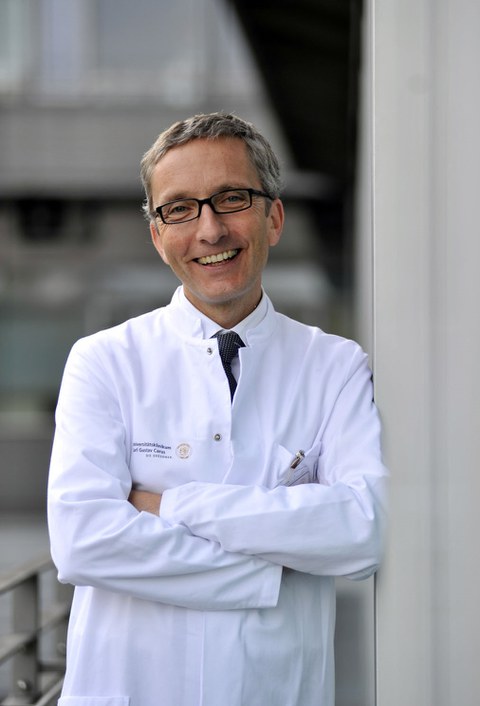
Reinhard Berner is a Professor of Pediatrics at the University Hospital Carl Gustav Carus, Technische Universität Dresden, Germany. He serves as Chairman and Director of the Department of Pediatrics and leads the University Center for Rare Diseases (USE). His research spans molecular epidemiology, genetic susceptibility to infections, and autoinflammatory disease diagnostics.
Prof. Dr. Michael Steinert is a Professor at the Institute of Microbiology within the Faculty of Life Sciences at Technische Universität Braunschweig. His research focuses on molecular infection biology, investigating pathogen-host-environment interactions across multiple biological levels. Key research areas include Legionella pneumophila, Clostridioides difficile, Streptococcus pneumoniae, Paenibacillus larvae, and Hymenoscyphus fraxineus. His work spans antibiotic-associated infections, honeybee health, plant-pathogen dynamics, and pneumococcal pathogenesis. Collaboration with the Helmholtz-Center for Infection Research (HZI) strengthens his interdisciplinary approach. Notable methods include microfluidic models, genomic tools, and advanced microscopy. Recent research highlights include studies on von Willebrand factor's role in pneumococcal adhesion, plasminogen-binding proteins in pathogen survival, and innovative strategies for managing ash dieback. He advises PhD students like Dorothea Meyland and Anna Kopenhagen. His lab actively engages in international collaborations, including EU-funded networks and projects supported by BMBF and FNR grants. Teaching contributions include advanced microbiology courses.
Professor Stephen D. Bentley is a Principal Staff Scientist and Team Leader for the Genomics of Pneumonia, Meningitis and Neonatal Sepsis team within the Parasites and Microbes programme at the Wellcome Sanger Institute. He joined the Institute in 1998 and has dedicated his career to decoding the genomics of disease-causing bacteria, with a particular focus on pathogens associated with respiratory infections that have a major disease burden in resource-poor settings. Dr. Bentley's research interests center on using bacterial pathogen genomics to understand patterns of colonization, transmission, and genetic associations with disease. His early work focused on the antibiotic-producing soil bacterium Streptomyces coelicolor and the rare human pathogen Tropheryma whipplei , providing insights into mechanisms of horizontal gene transfer and antigenic variation. This was followed by research into Streptococcus pneumoniae and Neisseria meningitidis , revealing how gene and genome variation occurs between loci and species. Since the development of high-throughput sequencing, his research has focused on population genomics with pioneering papers on MRSA (2010) and the pneumococcus (2011) that revealed patterns of international spread, vaccine escape, and the acquisition of antimicrobial resistance. His work has been instrumental in understanding how bacterial pathogens evolve in response to clinical interventions like vaccines and antibiotics. Professor Bentley's team has made significant contributions to pneumococcal research, particularly through sequencing the capsular biosynthesis genes for all known serotypes of S. pneumoniae , which enabled molecular methods for determining serotype and brought important new understanding of pneumococcal colonization and transmission. His recent work examines within-host genetic diversity, serotype replacement following vaccine introduction, and the global spread of antibiotic-resistant strains, with publications spanning multiple continents and involving extensive international collaborations. Throughout his career, Professor Bentley has mentored numerous early-career scientists and fostered strong global collaborations through initiatives like the Global Pneumococcal Sequencing Project. His work has been pivotal in applying next-generation sequencing technologies to bacterial pathogens, revolutionizing our understanding of how these organisms evolve and adapt in response to selective pressures from vaccines and antibiotics, with direct implications for public health interventions worldwide.
Prof. Dr. Peter Kremsner is a distinguished Professor at the University Hospital Tübingen, where he serves as Partner Site Speaker in Tübingen and Deputy Coordinator for Malaria and Neglected Tropical Diseases research. He leads the Clinical Trial Unit focused on tropical medicine and infectious diseases, with particular emphasis on malaria research and vaccine development. Dr. Kremsner's research interests center on malaria, neglected tropical diseases, infectious disease epidemiology, and clinical trial methodology. His work spans basic research on parasite biology to translational studies and large-scale clinical trials. He has made significant contributions to understanding malaria pathogenesis, antimalarial drug development (including fosmidomycin research), and vaccine strategies against malaria and other tropical diseases. His recent work has expanded to include pandemic responses, with important contributions to understanding COVID-19 therapeutics and vaccination strategies. Analysis of Dr. Kremsner's publication record reveals a strong focus on tropical medicine with consistent contributions over three decades. His research shows increasing interdisciplinary collaboration, particularly in vaccine development and pandemic response. While malaria remains his core focus, his expertise has been applied to emerging infectious disease threats including COVID-19 and influenza in resource-limited settings. His work demonstrates a consistent pattern of high-impact clinical research with practical applications for disease control in endemic regions. Dr. Kremsner has been involved in numerous international collaborative research projects, particularly in Africa where much of his field work takes place. His leadership in coordinating multi-center clinical trials has been instrumental in advancing malaria treatment guidelines and vaccine development. While specific grant details aren't provided in the available text, his extensive publication record in high-impact journals suggests substantial research funding support. He leads or is closely affiliated with the Clinical Trial Unit at University Hospital Tübingen, which focuses on malaria and neglected tropical diseases research. This unit conducts both laboratory-based research and field studies in endemic regions, particularly in Central Africa. The team collaborates extensively with international partners including research institutions in Gabon and other African nations where field studies are conducted.