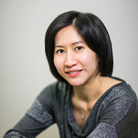
Jennifer Chen is an Associate Professor in the Department of Chemistry at York University's Faculty of Science. She leads a research group focused on designing nanomaterials for optical sensing, biomedical diagnostics, and solar energy conversion , with an emphasis on plasmonic nanostructures and hybrid materials. Research spans analytical, inorganic, and physical chemistry Eligible supervisor for Physics and Astronomy graduate students Key funding: CFI, NSERC, Ontario Research Fund Her work bridges fundamental studies of materials interfaces with applications in healthcare and sustainability. Recent publications explore charge transfer mechanisms and DNA-nanoparticle interactions for biosensing. 2022: J. Mater. Chem. A on Mn-doped quantum dots 2020: Analyst and ACS Appl. Nano Mater. on DNA-based sensing 2018: JPCC on interfacial charge dynamics 2013: JACS on plasmonic microRNA detection Major awards include the Canadian Society for Chemistry Fred Beamish Award (2019), Nano Ontario Early-Career Award (2018), and Top 40 Under 40 Analytical Scientist (2018). Her group has trained 15+ graduate students, including PhD graduates Brian and Anthony.
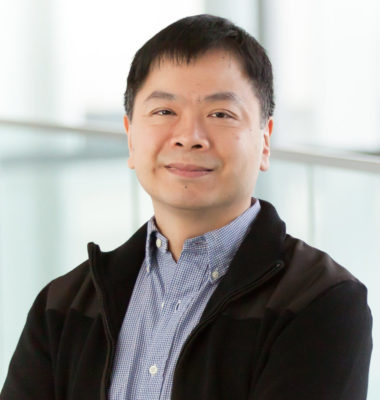
Roger Tam is an Associate Professor in the School of Biomedical Engineering (SBME) at the University of British Columbia (UBC), with a joint appointment in the Department of Radiology. He is also the Associate Director of Graduate Studies. His research focuses on machine learning and computer vision applied to medical imaging, particularly in personalized medicine and quantitative image analysis. Tam earned his PhD in computer science from UBC in 2004, specializing in computational geometry and visualization. Education: PhD in Computer Science, UBC (2004) MSc in Computer Science BSc (Honors) Research Interests: Medical imaging biomarkers Machine learning applications in healthcare Quantitative image analysis Personalized medicine His work bridges computer science and clinical medicine, emphasizing translational approaches to improve diagnostic accuracy and patient outcomes. Recent Research Trends: Focus on myelin content analysis in neurological disorders (e.g., multiple sclerosis) Development of efficient machine learning models for medical image classification Impact of physical activity on white matter health Labs & Programs: Directs the Engineers in Scrubs program, which integrates engineering principles into biomedical education. Active in collaborative research initiatives like the Centre for Brain Health and the Canadian Prospective Cohort Study (CanProCo).
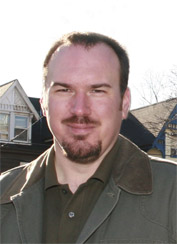
Professor Timothy P. Bender is a distinguished faculty member at the University of Toronto, holding a primary appointment in the Department of Chemical Engineering and Applied Chemistry with cross-appointments in the Department of Chemistry and the Department of Materials Science and Engineering. His research laboratory focuses on developing novel organic electronic materials for applications in sustainable energy technologies, particularly organic solar cells and light-emitting devices. Professor Bender earned his B.Sc. and Ph.D. from Carleton University before joining the University of Toronto faculty in 2006. Prior to his academic appointment, he was a research staff member at the Xerox Research Centre of Canada from 2000-2006, where he filed over 65 US patents and published numerous peer-reviewed papers. His industrial research experience provides valuable perspective on the commercialization pathway for academic discoveries. Professor Bender's research program centers on the design, synthesis, and engineering of new materials for organic electronic devices, particularly organic photovoltaics (OPVs) and organic light-emitting diodes (OLEDs). His group has made significant contributions to the understanding and application of boron subphthalocyanines (BsubPcs) and silicon phthalocyanines (SiPcs), establishing methodologies for tailoring their chemical structure to optimize device performance. The Bender Lab employs a comprehensive 'applied chemistry-device continuum' approach, integrating computational modeling, synthetic chemistry, physical characterization, and device engineering to establish molecular structure-property relationships. Their research spans fundamental chemistry to applied device engineering, with strong emphasis on sustainability considerations throughout the materials development process. Analysis of Professor Bender's recent publications reveals a strong focus on developing BsubPcs as triplet harvesting materials in organic photovoltaics, engineering silicon phthalocyanines for enhanced electron transport, and exploring halogen bonding to control solid-state arrangements of these materials. His work demonstrates how molecular engineering can overcome traditional limitations in organic electronic materials, particularly regarding solubility, charge transport, and environmental stability. The research shows consistent progression toward higher efficiency devices with improved longevity. 2008 Professor Diran Basmadjian Teacher of the Year Award from the Department of Chemical Engineering and Applied Chemistry Corporate Special Recognition Award from Xerox Corporation for photoreceptor technology that enabled 'life of machine' parts Professor Bender actively mentors a diverse team of highly qualified personnel (HQP), including undergraduate students, graduate students, and post-doctoral fellows. His laboratory fosters cross-disciplinary collaboration between chemists, materials scientists, and chemical engineers, allowing students to engage with the complete research cycle from molecular design to environmental testing. He has secured funding from NSERC, SABIC Corporation, and other sources to support his research program, which maintains strong industrial partnerships with companies including SABIC Corporation, Siltech Corporation, and Xerox Corporation. His research bridges fundamental academic discoveries with practical commercial applications in the growing field of organic electronics. The Bender Laboratory maintains comprehensive infrastructure for organic synthesis, materials characterization, and device fabrication. Their facilities enable complete development cycles from molecular design to environmental testing of organic electronic devices. The lab's 'applied chemistry-device continuum' approach ensures that fundamental discoveries are rapidly translated into practical device applications, with particular emphasis on sustainability considerations throughout the materials development process. Current research directions include accelerated materials development, sustainable chemical processes, and life cycle analysis of organic electronic devices in real-world environments.
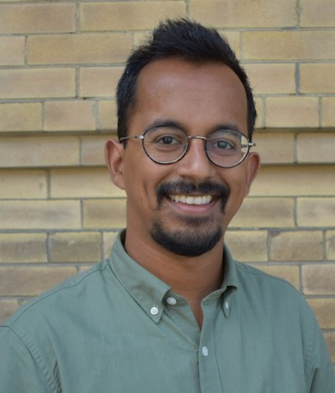
Asif Zaman is an Associate Professor in the Faculty of Arts and Science at the University of Toronto. His research focuses on Analytic Number Theory , Probabilistic Number Theory , and Arithmetic Statistics , with applications to Algebraic Structures , L-functions , and Modular Surfaces . He has contributed to problems involving the distribution of prime numbers, zeros of L-functions, and mass equidistribution. Research highlights include work on the Chebotarev Density Theorem , Random Multiplicative Functions , and Binary Quadratic Forms . His recent publications address advanced topics such as Artin L-functions , GL(n) Sieve Methods , and Multiplicative Chaos in number theory. Zaman has co-authored articles with prominent researchers like James Thorner and Robert J. Lemke Oliver, focusing on non-vanishing properties, explicit density estimates, and Siegel zeros. Zaman teaches mathematics courses at the University of Toronto, including MAT237 Multivariable Calculus with Proofs and MAT198 Cryptology . His teaching philosophy emphasizes active learning, collaboration, and analytical skill development, inspired by resources like Mathematical Mindsets and the American Mathematical Society blog series.
Dr. Kibret Mequanint is a full Professor at Western University's Department of Chemical and Biochemical Engineering, with cross-appointments in Biomedical Engineering. Holding a PhD from University of Stellenbosch and postdoctoral experience at Technical University of Darmstadt and McMaster University, his research bridges polymer science, materials engineering, and life sciences with applications in Biomaterials , Tissue Engineering , and Regenerative Medicine . His work spans both fundamental and translational research in cell-material interactions , polymer biomaterial design , and therapeutic radiation dosimeters , with technologies transferred to commercial applications. Leading scholar and educator with awards from NSERC, CIHR, and Western University Fellow of: American Institute for Medical and Biological Engineering (AIMBE), Ethiopian Academy of Sciences, International Union of Societies for Biomaterials Science and Engineering, Canadian Academy of Engineering Extensive editorial and panel service for NSERC, CIHR, and international journals His research program has produced over 170 refereed publications, focusing on conductive hydrogels , bioadhesives , and vascular tissue engineering . Recent work on endoscopy-deliverable bioadhesives and snake venom-derived hemostatic gels has attracted global media attention. He has served in leadership roles at the Canadian Biomaterials Society and university governance bodies including Senate and Board of Governors.
Reed Essick is an Assistant Professor at the Canadian Institute for Theoretical Astrophysics (CITA), University of Toronto. His research focuses on experimental gravity, astrophysical signals, and nuclear physics, with particular emphasis on neutron stars, black holes, and gravitational waves. He develops advanced statistical methods like hierarchical Bayesian inference and nonparametric analysis for interpreting observational data from pulsars and gravitational wave detectors. Dr. Essick collaborates extensively with international observatories such as LIGO, Virgo, and KAGRA, contributing to cutting-edge projects like multimessenger astronomy and precision cosmology. His work bridges computational astrophysics with observational techniques, addressing fundamental questions about dense matter and strong-field gravity. Key contributions include studies on gravitational wave equation-of-state constraints, pulsar timing analysis, and the application of machine learning to detector data. His research leverages both ground-based interferometers and space-based observations to explore extreme astrophysical environments.
Régis Pomès is a Professor in the Department of Biochemistry at the University of Toronto, where he leads an active research program since 1999. His work focuses on computational biophysics, studying the structure-dynamics-function relationships of biomolecules. Canada Research Chair (Tier 2) in Physical Chemistry (2001-2011) Teaches courses: BCH 2107H: Introduction to Biomolecular Simulations BCH 2105H: Cystic Fibrosis: The Cause, The Treatment BCH 2024H: Introduction to Biomolecular Simulations JBB2026H: Protein Structure, Folding and Design BCH473Y: Advanced Research Project in Biochemistry BCH422H: Membrane Proteins: Structure and Function Research Interests: The Pomès Lab specializes in computational methods development and their application to biomolecular systems, particularly: Membrane proteins and ion channels Protein-lipid interactions Protein folding and aggregation Statistical mechanics of biomolecular systems Molecular dynamics simulations across multiple scales Structural biology of disordered proteins Awards: Canada Research Chair (Tier 2) in Physical Chemistry (2001-2011)
Dr. Martin Scanlon is a Professor and Dean of the Faculty of Agricultural and Food Sciences at the University of Manitoba. His work focuses on physical and structural changes in plant materials during food processing, particularly in oilseed-based systems and cereal products. Education: Operative Miller Certificate (with Distinction), City & Guilds (London), England PhD (Food Science), University of Leeds, England BSc Hons (Food Science), University of Leeds, England His research spans modeling process-ingredient interactions, aerated food materials, ultrasonic analysis, and grain-legume science. Recent projects include novel canola oil extraction methods and mitigating acrylamide precursors in wheat. Analysis of his publications reveals expertise in sustainable processing (supercritical CO₂, microemulsions), dough rheology, antioxidant recovery, and bubble dynamics in cereal systems. No scientific awards are explicitly mentioned. Dr. Scanlon is not currently accepting graduate students and has not disclosed specific grant funding or lab affiliations in the provided texts.
Noriko Yui is a Professor of Mathematics at Queen's University in Kingston, Ontario. She holds academic affiliations within the Department of Mathematics and Statistics under the Faculty of Arts and Science. Her research bridges number theory, algebraic geometry, and mathematical physics, with a focus on arithmetic geometry and mirror symmetry, particularly in the modularity of Calabi-Yau threefolds. Yui earned her B.S. from Tsuda College (1966) and her Ph.D. in Mathematics from Rutgers University (1974), supervised by Richard Bumby. She has held visiting roles at the Max-Planck-Institute in Bonn and Newnham College, University of Cambridge. Her work includes collaborations with Fernando Q. Gouvêa, notably proving the modularity of rigid Calabi-Yau threefolds over Q. Her research areas span arithmetic geometry, number theory, algebraic/differential geometry, and particle physics theory. Key contributions include studies on L-functions, mirror symmetry, and the applications of Calabi-Yau manifolds in physics. Since 2007, she has served as managing editor of the journal Communications in Number Theory and Physics . Yui co-authored influential works such as Generic Polynomials: Constructive Aspects of the Inverse Galois Problem and edited volumes like Mirror Symmetry V . Her research emphasizes interdisciplinary connections between mathematics and theoretical physics, particularly in string theory contexts.
David A. Hood is a Full Professor and former Canada Research Chair in Cell Physiology (2003–2024) at York University, affiliated with the School of Kinesiology and Health Science. He is the Founding Director of the Muscle Health Research Centre (MHRC) and supervises graduate students in the Biology Graduate Program. Research Interests: His research focuses on mitochondrial biogenesis, turnover, and function in skeletal muscle. He investigates how exercise, aging, and muscle disuse affect mitochondrial health, with a particular interest in mitophagy, lysosomal function, and cellular signaling. His work spans human, animal, and cellular models, integrating physiological, biochemical, and molecular biology approaches. Recent Publication Trends: Recent publications emphasize transcriptional regulation (e.g., TFEB, TFE3, ATF4, p53), organelle crosstalk (mitochondria-lysosome interactions), and the role of exercise as 'mitochondrial medicine.' His lab explores therapeutic interventions like mitochondrial transplantation and nutrient signaling in muscle health. Scientific Awards: Canada Research Chair in Cell Physiology (2003–2024) Finalist for a prestigious national award Advising and Grants: Dr. Hood actively mentors graduate students and postdoctoral fellows. He has secured significant funding, including a $1 million CIHR grant to study mitochondria and lysosomes in muscle. His lab fosters interdisciplinary collaboration and contributes to major reviews in the field. Labs and Teams: He leads the Hood Lab at York University and co-founded the Muscle Health Research Centre (MHRC), a multidisciplinary hub promoting research on muscle function, exercise, and aging. The MHRC facilitates collaboration across departments and institutions.
Dr. David Anekwe is an Assistant Professor of Teaching and Academic Site Lead for the Master of Physical Therapy North (MPT-N) program at the University of Northern British Columbia (UNBC), located in Prince George. He holds an Affiliate Lecturer position in the Northern Medical Program and oversees academic operations for the MPT-N program. His clinical background includes roles as Clinical Head at Federal Medical Centre, Nigeria, and teaching at McGill University’s MPT Program. Education: PhD in Rehabilitation Sciences (McGill University), MPT-N Academic Site Lead, postdoctoral training at Concordia University. Research shifted from respiratory physiology and critical care rehabilitation to distributed health professions education and student learning outcomes. Key responsibilities include managing MPT-N academic operations, coordinating Cardiorespiratory content, and training Clinical Skill Assistants. His recent publications focus on ICU mobilization strategies, rural health disparities, and critical care educational tools. Collaborations include contributions to Canadian cardiovascular rehabilitation guidelines and development of learning needs assessment tools for physiotherapists.
Gourab Ray is an Associate Professor in the Department of Mathematics and Statistics at the University of Victoria, Faculty of Science. He holds a PhD from the University of British Columbia, Vancouver. His research focuses on the intersection of probability theory, geometry, and mathematical physics, particularly large-scale patterns in stochastic models inspired by physics. Key areas include random planar maps, random walks, lattice spin models, dimer models, Gaussian free field properties, and Liouville quantum gravity. Recent work emphasizes establishing Gaussian free field-like behaviors in dimer models across various graphs and surfaces. He teaches courses such as MATH 236: Introduction to Real Analysis and MATH 555: Topics in Probability. His publications span leading journals including Inventiones Mathematicae , Annals of Probability , and Probability Theory and Related Fields . Notable contributions include studies on unimodular hyperbolic triangulations, half-planar map classifications, and conformal invariance in dimer models. No specific awards are listed for Dr. Ray, though his work has been recognized in peer-reviewed venues. He actively contributes to academic service, including roles on graduate committees and research collaborations. His research group engages with theoretical and applied aspects of probability theory, often bridging discrete and continuous mathematical frameworks.
Monica Maly is a Part-Time Associate Professor in Rehabilitation Science within the Faculty of Health Sciences at McMaster University. Her academic profile demonstrates extensive expertise in biomechanics and rehabilitation, with particular focus on knee osteoarthritis research. She maintains an active research program with numerous recent publications spanning rheumatology, biomechanics, and rehabilitation science. Dr. Maly's research interests center on understanding the biomechanical and physiological factors contributing to knee osteoarthritis progression and developing effective interventions. Her work examines knee joint mechanics, muscle strength and capacity, gait analysis, pain management strategies, and the impact of exercise interventions on OA symptoms. She has conducted significant research on sex differences in OA, racial disparities in pain experiences, and the relationship between obesity, inflammation, and joint function. Her methodological approaches include biomechanical analysis, clinical trials, systematic reviews, and innovative technologies like soft robotics for knee bracing. Analysis of her recent publications (2023-2025) reveals a strong focus on understanding knee osteoarthritis mechanisms through biomechanical and physiological lenses, with increasing attention to social determinants of health and health disparities. Her work spans multiple disciplines including rheumatology, biomechanics, rehabilitation science, and public health, demonstrating interdisciplinary collaboration. Key trends include examining racial disparities in pain experiences, developing novel interventions like soft robotic knee braces, and investigating the complex relationships between joint loading, biomarkers, and cartilage changes. Dr. Maly has collaborated extensively with researchers across multiple institutions, as evidenced by her numerous publications in high-impact journals such as Osteoarthritis and Cartilage, Arthritis & Rheumatology, and Clinical Biomechanics. Her work often utilizes data from large longitudinal studies including the Osteoarthritis Initiative and the Canadian Longitudinal Study on Aging. While specific grant information isn't detailed in the provided text, her extensive publication record suggests successful funding of multiple research projects.
Tianyu Guan is an Assistant Professor in the Department of Mathematics and Statistics at York University, Faculty of Science. He previously served as an Assistant Professor at Brock University and joined York University in 2024. He holds a PhD in Statistics from Simon Fraser University (2020), an MSc in Actuarial Science from the same institution (2014), and a BSc in Statistics from Jilin University (2011). PhD in Statistics, Simon Fraser University, 2020 MSc in Actuarial Science, Simon Fraser University, 2014 BSc in Statistics, Jilin University, 2011 His research centers on sports analytics, functional data analysis, and nonparametric statistics, with strong applications in machine learning and data science. He applies statistical methodologies to understand sports performance, player behavior, and game dynamics. His work also extends to theoretical developments in sparse modeling and functional regression. The recent publications highlight a clear trend toward integrating advanced statistical techniques with real-world sports and entertainment data. His work combines functional data analysis, machine learning, and probabilistic modeling to extract insights from complex longitudinal and high-dimensional datasets. Topics span soccer, rugby, football, and movie reviews, demonstrating interdisciplinary reach. While no formal scientific awards are listed in the provided text, his publications in high-impact journals such as Annals of Applied Statistics and Statistics and Computing reflect strong academic recognition. Tianyu Guan actively advises multiple graduate students at both MSc and PhD levels, primarily at Brock and Simon Fraser Universities. His teaching portfolio includes advanced courses in nonparametric statistics, sampling theory, and experimental design at the undergraduate and graduate levels. He has not received external grant information in the provided text, but his research output suggests active engagement in funded or independent research projects. He leads methodological and applied research in sports analytics, often co-supervising students with colleagues across institutions. His lab or research group appears focused on developing and applying statistical tools for performance analysis and decision-making in sports, supported by computational implementations such as the R package ngr .
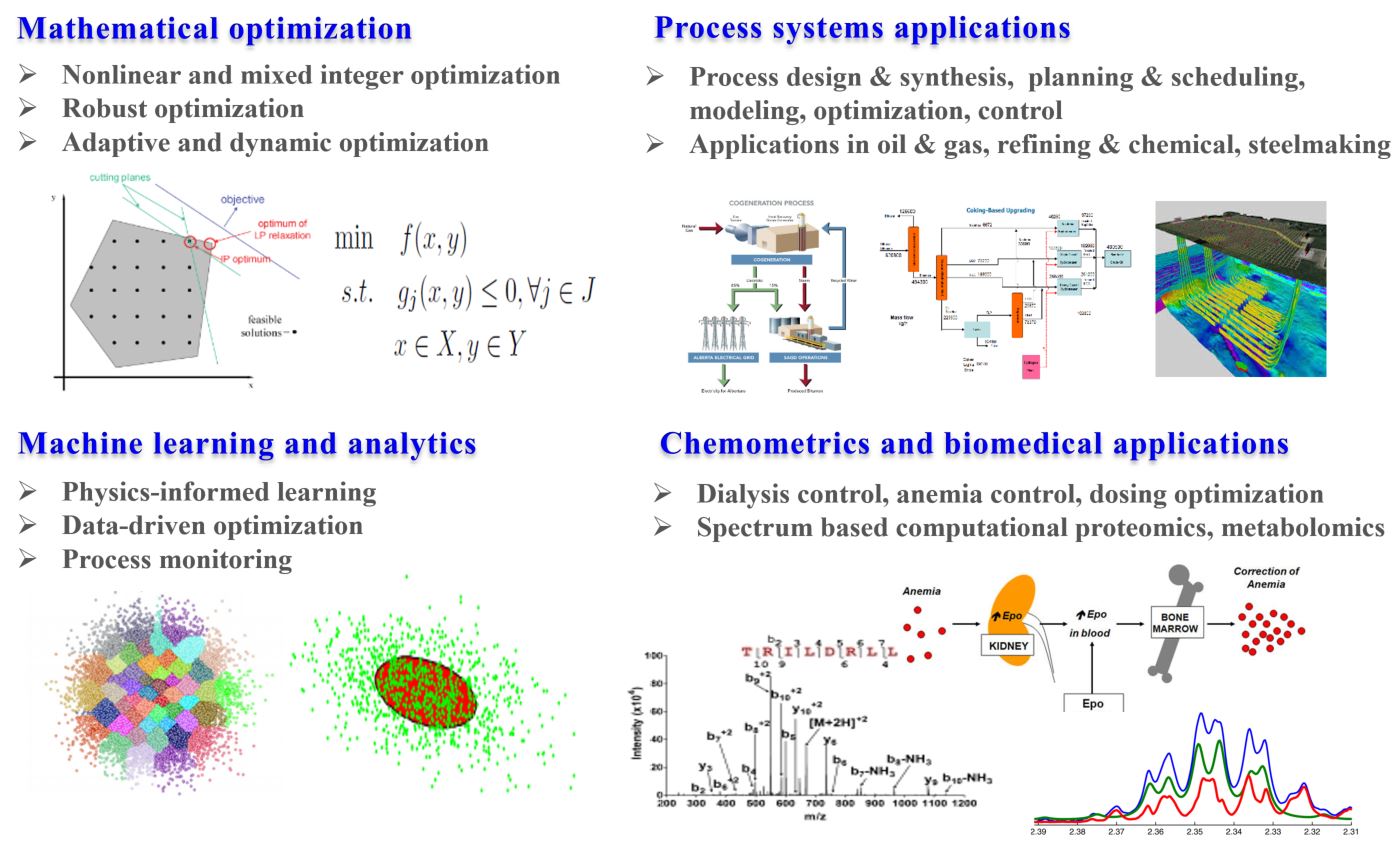
Zukui Li is a Professor in the Department of Chemical and Materials Engineering at the University of Alberta's Faculty of Engineering, where he leads a research group focused on mathematical optimization, machine learning, and process systems engineering. His work spans oil sands extraction, steel production, biomedical applications, and advanced optimization methods. Education: Ph.D. in Chemical Engineering, Rutgers University (2010) M.Sc. in Control Theory and Control Engineering, University of Science and Technology of China (2005) B.Sc. in Automatic Control, University of Science and Technology of China (2002) Postdoctoral Training: Princeton University (2010-2012) Research Focus: Dr. Li's research integrates mathematical optimization and machine learning for complex process systems. His primary areas include: Advanced optimization techniques (robust, stochastic, and distributionally robust optimization) Machine learning applications in process monitoring and biomedical systems Industrial applications in energy, manufacturing, and resource extraction Specific innovations include physics-informed ML for anemia treatment, adaptive optimization for steel production, and distributionally robust methods for uncertainty management. Publication Trends (2019-2023): Recent articles demonstrate a strong focus on uncertainty-aware optimization methods, with increasing integration of machine learning techniques. Dominant themes include distributionally robust optimization, adaptive decision-making under uncertainty, neural network approximations for complex constraints, and applications in industrial process control and biomedical systems. Theoretical advancements are consistently coupled with practical implementations in energy and manufacturing sectors. Research Group: Leads an active team developing optimization frameworks and machine learning solutions for process engineering challenges. Group website: Dr. Zukui Li's Research Group