Christoph H. Keitel is a Professor and Director at the Max Planck Institute for Nuclear Physics, with an honorary professorship at Heidelberg University. His research spans quantum electrodynamics, laser-matter interactions, and precision atomic physics. He leads investigations into radiation reaction, particle acceleration, and fundamental symmetries using high-intensity lasers and atomic spectroscopy. Keitel has received the Willis E. Lamb Award and Gustav Hertz Prize for pioneering contributions to laser science and quantum optics. His group develops advanced theoretical frameworks for testing QED and particle physics through high-precision experiments.
Nishant Agarwal is an Associate Professor in the Department of Physics & Applied Physics at the University of Massachusetts Lowell (UML). He is affiliated with the Kennedy College of Sciences, contributing to theoretical cosmology and quantum field theory research. His academic background includes a Ph.D. in Astronomy and Space Sciences from Cornell University (2011), and prior degrees from institutions like the Indian Institute of Technology Kanpur and St. Stephen's College, Delhi. Agarwal's research focuses on theoretical cosmology, particularly inflationary models, dark energy, quantum field theory in curved spacetime, and large-scale structure formation. His work explores the interplay between quantum mechanics, gravity, and cosmological observations, with contributions to understanding cosmic microwave background anisotropies and non-Gaussian features in the early universe. His publications span topics ranging from open quantum cosmological systems to constraints on massive gravity theories, reflecting his expertise in both theoretical frameworks and observational implications. Notable contributions include studies on cosmic expansion dynamics and the development of novel methods for analyzing large-scale structure surveys. Education: Ph.D., Astronomy and Space Sciences, Cornell University, 2011 M.S., Astronomy and Space Sciences, Cornell University, 2009 M.S., Physics, Indian Institute of Technology Kanpur, 2006 B.S., Physics, St. Stephen's College, Delhi University, 2004 Agarwal has received several honors, including the Institute for Gravitation and the Cosmos Postdoctoral Fellowship (2014) and a Gravity Research Foundation essay award (2013). His research is supported by grants such as the Templeton Foundation-funded 'CosmoArchaeology: Digging for the Initial State' (2012), emphasizing interdisciplinary exploration of cosmic origins. His work bridges fundamental physics and cosmological observations, with ongoing projects addressing quantum gravitational effects, early universe dynamics, and observational tests of gravity theories. Agarwal collaborates widely, contributing to initiatives like the Sloan Digital Sky Survey III and advancing theoretical methods in cosmology.
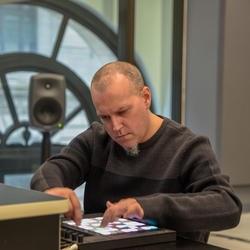
Shawn Greenlee is a Professor and Department Head for Digital + Media at Rhode Island School of Design (RISD), where he also leads the Studio for Research in Sound & Technology (SRST). His academic and artistic career spans over two decades, with significant contributions to the fields of sound art, computer music, and spatial audio research. Greenlee's educational background includes: BFA from Rhode Island School of Design MA from Brown University PhD in Computer Music and New Media from Brown University Greenlee's research interests focus primarily on spatial audio , high density loudspeaker arrays , and erratic sound synthesis techniques . His work explores the intersection of technology and sound art, with particular attention to how sound behaves in physical space and how it can be manipulated through computational methods. He has developed custom software for rhythm composition based on geometric principles from Godfried T. Toussaint's work, demonstrating his interest in algorithmic approaches to music creation. His research also extends to soundscape ecology, as evidenced by his Polar Lab Residency project "Edges in the Alaskan Soundscape," where he conducted ambisonic field recordings in Alaska's Kenai Peninsula and Denali National Park. Analysis of Greenlee's recent artistic output reveals a consistent exploration of spatial sound phenomena and computational approaches to sound creation. His works span from live electronic improvisation to carefully composed spatial sound installations. A notable trend is his focus on environmental sound documentation and transformation, particularly evident in projects like "Sifting" which emerged from his Alaskan field recordings. His technical expertise in ambisonic recording and high-density speaker arrays enables him to create immersive sound experiences that challenge conventional listening perspectives. Greenlee's recognition includes: Polar Lab Residency supported by the Anchorage Museum (2018) for "Edges in the Alaskan Soundscape" As Department Head for Digital + Media at RISD and leader of the Studio for Research in Sound & Technology, Greenlee guides multiple research initiatives and mentors students in sound art and technology. His upcoming presentations at ICMC 2025 in Boston demonstrate ongoing research collaborations, particularly in loudspeaker array design and spatial audio techniques. His work with students is evident in projects like the "Sound Design for Mobility" group, which produced binaural field recordings during the 2020 pandemic. Greenlee directs the Studio for Research in Sound & Technology (SRST) at RISD, which serves as a hub for experimental work in spatial audio, sound installation, and computational sound design. The studio supports research in high-density loudspeaker arrays, ambisonic recording techniques, and novel approaches to sound synthesis. Recent projects from the studio include work presented at major conferences like ICMC and NIME, demonstrating its active research agenda and technical innovation in the field of computer music.
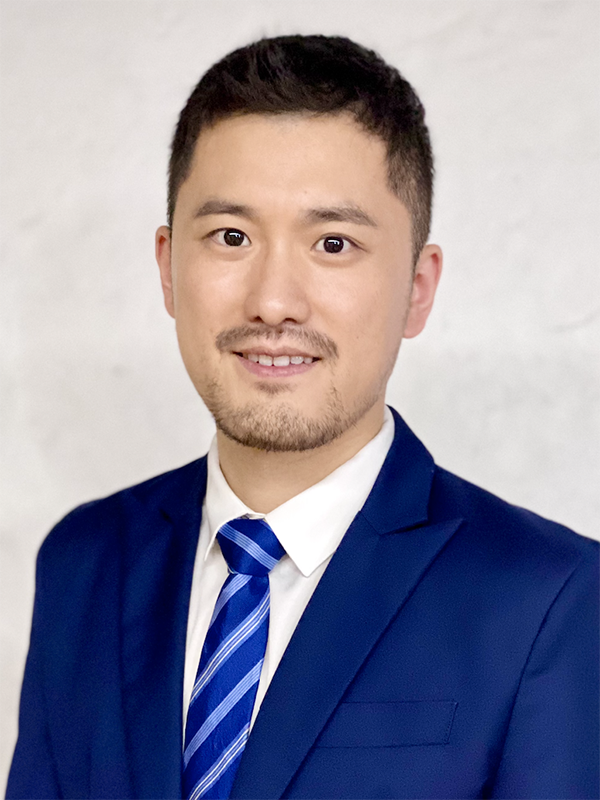
Tomoko Matsuo is an Associate Professor in the Ann and H.J. Smead Department of Aerospace Engineering Sciences at the University of Colorado Boulder. She holds an affiliate faculty position in the Department of Applied Mathematics and is a member of the Colorado Center for Astrodynamics Research (CCAR). A H. Joseph Smead Faculty Fellow, her research focuses on data assimilation, predictability of geophysical systems, and space physics. She earned a PhD in Atmospheric Science from SUNY Stony Brook (2003), MS in Physics from Nagoya University (1998), and BS in Geophysics from Hokkaido University (1995). Affiliations: CCAR, Smead Aerospace, Department of Applied Mathematics Awards: NSF CAREER Award (2019), multiple teaching awards, and fellowships Education: PhD, Atmospheric Science, SUNY Stony Brook, 2003 MS, Physics, Nagoya University, Japan, 1998 BS, Geophysics, Hokkaido University, Japan, 1995 Research Interests: Advanced methods in data assimilation for space weather forecasting, ionospheric dynamics, and geophysical predictability. Her work bridges atmospheric sciences, space physics, and statistical learning. Current projects include the DYNAMIC mission concept (NASA-selected Phase-A study) and the AMGeO data science platform. Grants & Collaborations: NSF CAREER Award (2019), NASA-funded projects (e.g., DYNAMIC mission), and collaborations with JHU APL, NCAR, and international institutions. Advises students on remote sensing and STEM outreach programs. Labs/Teams: Leads her own research group and contributes to CCAR. Develops tools for assimilative mapping of geospace observations (AMGeO). Active in citizen science initiatives like Aurorasaurus.
Felipe Hernández is an Assistant Professor in the Department of Mathematics at Pennsylvania State University. He is affiliated with the Department of Mathematics, located in McAllister Building, and can be contacted at felipeh@psu.edu. His research interests span Mathematical Physics, Partial Differential Equations, and Probability, with a focus on quantum systems, stochastic processes, and theoretical analysis of complex systems. His work explores topics such as quantum diffusion in disordered systems, decoherence dynamics, and the interplay between classical and quantum mechanics. He also investigates computational methods like neural networks to enhance accuracy in quantum chemistry calculations and explores foundational questions in quantum computing, such as BosonSampling complexity. Recent contributions include studies on Hodge systems, divergence-free vector fields, and endpoint estimates in functional analysis. While no specific awards or grants are listed, his research demonstrates a commitment to advancing mathematical physics and computational methods through rigorous theoretical analysis and interdisciplinary approaches.
Xiaomei Yang is a Lecturer/Researcher at the Soil Physics and Land Management Group of Wageningen University & Research, focusing on soil contaminants including pesticides and microplastics. Her work examines contaminant interactions with soil processes, their environmental fate, and impacts on soil-water-plant systems. She actively contributes to the International Land and Water Management Program (BSc/MSc), mentoring students in thesis research and internships. Key Projects: MINAGRIS: Investigating microplastic sources, fate, and ecosystem impacts in agricultural soils. ISQAPER: Developing interactive soil quality assessments for Europe and China. Soils4Africa: Creating an open-access soil information system for African agricultural resilience. Research Themes: Soil management, ecotoxicology, environmental monitoring, and agroecosystem sustainability. Specific interests include pesticide transport dynamics, microplastic behavior, and ecological risk assessment in agricultural systems. Achievements: Clarivate Highly Cited Scientist (2023) Top 2% Global Scientists (Elsevier/Stanford, 2024) Lead researcher on EU-China collaborative projects (e.g., ISQAPER) Teaching: Oversees MSc thesis supervision, internships, and courses like Sustainable Soil Management: Soil4Life and Land Degradation and Remediation .
Russell Thompson is an Associate Professor at the University of Waterloo, affiliated with the Waterloo Institute for Nanotechnology. His research focuses on theoretical physics, with expertise in self-consistent field theory, density functional theory, quantum foundations, and atomic physics. He holds a Doctorate in Theoretical Physics and Applied Mathematics from the University of Western Ontario (1998), complemented by a BSc (Honours Physics) from the University of Ottawa (1994) and an MSc in Physics from the University of Regina (1994). Thompson teaches advanced courses such as NANO 600 (Introduction to Nanotechnology), NE 216/217 (Advanced Calculus and Numerical Methods), and PHYS 234 (Quantum Physics 1). His recent publications (2020–2025) explore quantum foundations, polymer physics, and materials science, with a focus on integrating theoretical frameworks like DFT and SCFT into nanotechnology applications. His articles highlight advancements in quantum entanglement visualization, polymer foaming models, and atomic shell structure predictions. He has no listed scientific awards or grants in the provided data but remains active in interdisciplinary research at the intersection of quantum theory and polymer science.
Dr. Yue Zhang is an Assistant Professor in the Department of Atmospheric Sciences at Texas A&M University, affiliated with the College of Geosciences. His research focuses on understanding the physicochemical properties of atmospheric aerosols, their interactions with gases, and impacts on climate and air quality. He holds a Ph.D. in Environmental Sciences and Engineering from Harvard University (2015) and a B.S. in Environmental Sciences from Peking University (2010). Research interests include: (1) chemical evolution of organic aerosols using environmental chambers, (2) climate effects of aerosols (e.g., cloud condensation nuclei, ice nucleation), (3) spatial-temporal distribution of organic gases and health impacts, and (4) aerosol modeling integration into regional/global climate models. Current projects explore nanoplastics, PFAS, and volatile chemical products (VCPs) in the atmosphere. Awards include the NSF CAREER Award (2025), Texas A&M Montague-CTE Scholar Award (2024), and multiple postdoctoral fellowships. His lab uses advanced instruments like the 10 m³ environmental chamber, SP-ToF-AMS, and mobile laboratories for field measurements. Collaborations include Professors Daniel Cziczo (Purdue) and Jason Surratt (UNC). Lab Facilities: Environmental chamber, oxidation flow reactor, aerosol mass spectrometers, and health implications studies via electrostatic precipitators. Grants: NSF Environmental Chemical Sciences, DOE ASR, TCEQ AQRP Program, and EPA grants for VCP and air toxin measurements. Future Work: Aerosol-cloud interactions in the Southeast U.S., mobile sampling campaigns in California/North Carolina, and emerging pollutants like microplastics.
Dr. Shaoyu Zhao is a Research Fellow (Level A) at RMIT University's School of Engineering. His research focuses on advanced composite structures, mechanical metamaterials, graphene nanocomposites, and molecular dynamics simulations. He holds an ARC DECRA Fellowship and has over 40 journal publications with 2000+ citations (h-index 26). Awards include the ICES2024 Best Paper Award and 2025 DECRA. He supervises Masters/PhD students in areas like metaconcrete and functionally graded structures. Editorial roles include Early Career Board Member for Engineering Structures (Q1), International Journal of Structural Integrity (Q1), and others. Teaching includes the course MIET1076 - Mechanical Vibrations. His work bridges nanoscale simulations (e.g., graphene interfaces) with macro-scale engineering applications (e.g., 3D-printed composites and metamaterial energy absorption). Research spans multi-physics phenomena in perovskite materials and machine learning-driven material analysis. Key Projects: Metaconcrete composites, origami metamaterials, graphene-reinforced nanocomposites Lab Focus: Multiscale modeling for aerospace composites and smart materials
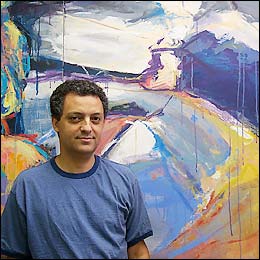
Shlomo Ta'asan is a Professor Emeritus in the Department of Mathematical Sciences at Carnegie Mellon University, affiliated with the Mellon College of Science. He holds a Ph.D. from The Weizmann Institute of Science. His research spans computational materials science and systems biology, with a focus on grain growth dynamics and immune response modeling. Collaborations include work with David Kinderlehrer, R. Suter Lab, and materials science faculty at CMU. Key research areas include bridging microscopic dynamics to macroscopic equations, grain boundary evolution, and immune system modeling. His work on inverse problems using HEDM data and entropy-based theories of grain boundary character distribution has advanced materials science. In biology, he develops models for circulatory system instabilities and shock mechanisms. Notable contributions include mesoscale simulations of grain growth and multigrid optimization methods for aerodynamics. His interdisciplinary approach integrates computational mathematics with experimental data from materials and biological systems.
Larissa V. Bravina is a Professor of Theoretical Physics at the Department of Physics, University of Oslo (2003-present). Her career spans institutions across Russia, Norway, and Germany, including post-doctoral work at the University of Bergen and fellowships at the University of Frankfurt. Education PhD in Physics and Mathematics (1990, Moscow State University) Master Degree in Physics (1982, Moscow State University) Bravina specializes in theoretical modeling of relativistic heavy-ion collisions, focusing on Quark-Gluon Plasma formation, hydrodynamic evolution, jet quenching, and anisotropic flow. Her work integrates computational physics for simulating pp, Pb+Pb, and A+A collisions at LHC energies. Article Trends Her recent publications emphasize Monte Carlo simulations , shear viscosity , Unruh effect , and QCD phase transitions , with collaborations on laser-induced fusion and hyperon polarization . Key keywords include Nuclear Physics , Computational Modeling , and Quantum Chromodynamics . Scientific Awards Alexander von Humboldt Fellowship (1997) 3rd Prize, SINP MSU Young Scientists Competition (1989) 1st Prize (Group), SINP MSU Young Scientists Competition (1987) Advising & Collaborations She has supervised 4 doctoral students to completion (Konrad Tywoniuk, Ionut Arsene, Mads S. Nilsson, Gylnara Eyyubova) and currently mentors 2 unnamed students. Bravina organizes the annual international conference New Frontiers in Physics and collaborates with institutions like Los Alamos National Laboratory, Niels Bohr Institute, and ITEP Moscow.
Prof. Dr. Maik Schmeling is a Professor of Finance at the Department of Finance, Goethe University Frankfurt, and a Research Fellow at the Centre for Economic Policy Research (CEPR) in London. His research focuses on empirical asset pricing, machine learning applications in finance, international finance, FX markets, monetary policy impacts on financial markets, and textual analysis in finance. He supervises BSc and MSc theses through a centralized allocation process, emphasizing empirical analysis and collaboration with institutions like the SAFE Data Room. Research Areas: Empirical Asset Pricing, Machine Learning in Asset Pricing, International Finance and FX, Monetary Policy and Financial Markets, Analysis of Option-Implied Information, Banks and Global Dollar Funding, Non-bank Financial Intermediation, Textual Analysis in Finance, Money Markets. His recent publications span geophysics topics like melt migration, mantle convection, and subduction zone dynamics, though these appear unrelated to his current finance role. All articles are classified under geophysics and geodynamics keywords. No scientific awards or student names are mentioned in the provided texts.
David Salac, PhD, is an Associate Professor in the Department of Mechanical and Aerospace Engineering at the University at Buffalo, part of the School of Engineering and Applied Sciences. His research focuses on computational fluid dynamics, material systems with moving interfaces, numerical methods, directed self-assembly, and high performance computing. He holds a PhD and MS from the University of Michigan (2007) and a BS from Michigan Technological University (2002). Education: PhD in Mechanical Engineering, University of Michigan, 2007 MS in Mathematics, University of Michigan, 2007 BS in Mechanical Engineering, Michigan Technological University, 2002 His research interests span computational modeling of fluid-structure interactions, vesicle dynamics, and advanced material systems. He has developed numerical methods for partial differential equations and explored applications in biophysics and materials science. Recent work includes studies on microplastic transport, ceramic matrix composites, and membrane physics. Salac has received the NSF CAREER Award (2013) for his work on electrohydrodynamics of vesicles. His publications emphasize interdisciplinary approaches to fluid dynamics and materials science challenges. His advising and grants include contributions to NSF-funded research and collaborative projects in computational engineering. He maintains active research in labs focusing on computational mechanics and soft matter systems.
Dr. Serhat Hosder is the James A. Drallmeier Centennial Professor in the Department of Mechanical and Aerospace Engineering at Missouri S&T. He serves as Director of the Aerospace Simulations Laboratory, focusing on computational aerothermodynamics, hypersonic flow modeling, and uncertainty quantification for planetary entry systems. Professor of Aerospace Engineering (2019–present) Director, Aerospace Simulations Lab Advisor to students receiving NASA Space Technology Research Fellowships and Amelia Earhart Fellowships Research funded by NASA, DoD, and NSF Research Interests: Computational aerothermodynamics, hypersonic flow modeling, uncertainty quantification, multi-fidelity methods, directed energy applications, planetary entry systems, and aerodynamic shape optimization. His work combines numerical methods with robust design principles for high-speed vehicles. Scientific Awards: Missouri S&T Outstanding Faculty for Contributions to Graduate Studies Award (2022) Fellow of the Royal Aeronautical Society (2021) NASA Langley Research Center Henry J. E. Reid Award (2018) Associate Fellow of AIAA (2017) Missouri S&T Faculty Research Awards (2015, 2012) Advising & Grants: His students have secured positions at NASA, Sandia National Labs, and academia. Research funded by DoD Joint Hypersonics Transition Office, NASA (Langley, JPL), Missile Defense Agency, NSF, and industry partners like M4 Engineering, Inc.
Dr. Sudip Seal is a Joint ORNL-UT Faculty in the Department of Electrical Engineering and Computer Science at the University of Tennessee, Knoxville, and leads the Systems and Decision Sciences Group at Oak Ridge National Laboratory (ORNL). He holds dual PhDs in Computer Engineering (Iowa State University) and Theoretical High Energy Physics (New Mexico State University). His expertise spans scalable algorithms, AI-driven methods for large-scale science, and high-performance computing. He has led over $55M in multidisciplinary projects and currently leads the FORESEE initiative for extreme-scale computing ecosystems. Education: PhD in Computer Engineering, Iowa State University, 2007 PhD in Theoretical High Energy Physics, New Mexico State University, 2002 Research Interests: Design and optimization of scalable algorithms for extreme-scale scientific computing, AI/ML workloads, parallel simulations, architecture-aware algorithms, numerical methods, computational fusion and materials science, and energy-efficient computing. Awards: Best Paper Award (ACM SIGSIM PADS 2024) Paramount Accomplishment Award (ORNL 2024) Significant Event Awards (ORNL 2017 & 2014) Multiple Best Paper Finalist/Runner-up recognitions (2010–2024) Indian Government Fellowships (NTPC, UGC, CSIR) Leadership & Grants: Principal Investigator (PI) and Co-PI for multi-million dollar projects, including the ExaLearn Co-design Center. Leads ORNL's CCSD LDRD FORESEE initiative. Serves as Associate Editor for the Journal of Parallel and Distributed Computing and chairs major HPC conference committees. Labs/Teams: Systems and Decision Sciences Group (ORNL), collaborating with the Computer Science and Mathematics Division on foundational HPC research.