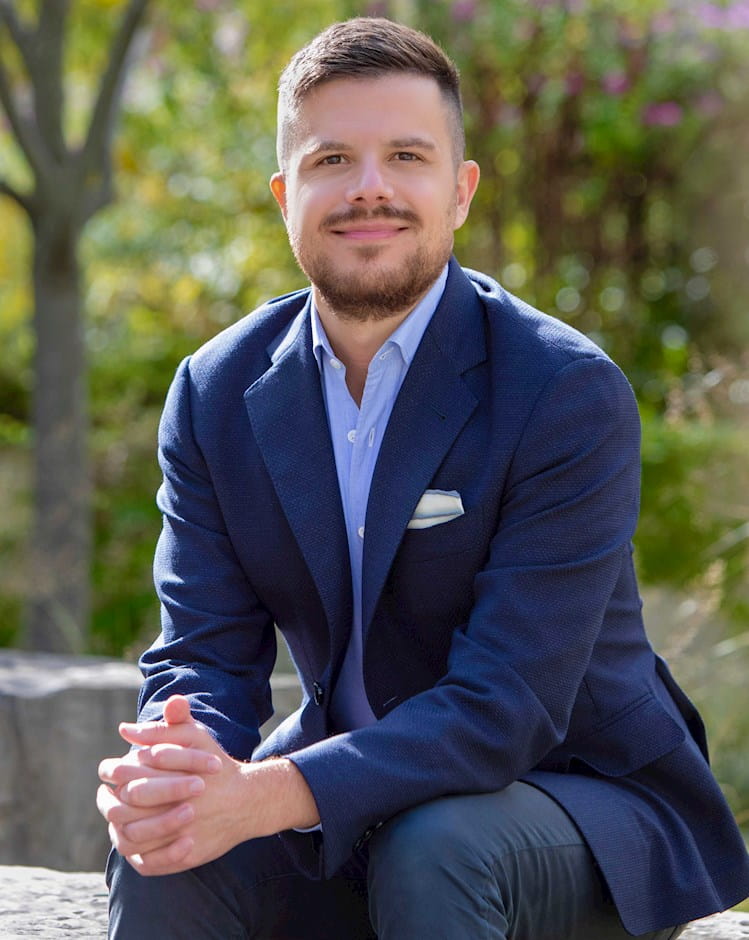
Giovanni Compiani is an Associate Professor at the University of Chicago Booth School of Business, specializing in Marketing. His research bridges industrial organization and quantitative marketing, focusing on advanced econometric methods. PhD, MPhil, MA in Economics from Yale University BSc, MSc in Economics from Bocconi University Previous Assistant Professor at Haas School of Business His work explores unstructured data integration in demand estimation, consumer search behavior on online platforms, risk preferences in cryptocurrency markets, and time perception in behavioral economics. He has published in top journals including Journal of Political Economy , Marketing Science , and Review of Economic Studies . Recent publications emphasize machine learning applications in econometrics, equilibrium modeling of lotteries, and crypto mining's economic impact. His research portfolio spans demand analysis, structural modeling, and behavioral insights. Editor's Choice Award, The Review of Asset Pricing Studies (2024) Developed nonparametric demand estimation frameworks Advances dynamic model identification with instrumental variables Compiani teaches Data Science for Marketing Decision Making at Booth and maintains active collaborations with researchers across econometrics, computer science, and behavioral disciplines.
Josep Llach is a Senior Lecturer at the Barcelona School of Management, Universitat Pompeu Fabra, and a part-time Professor Agregat in the Department of Business Administration, Management and Product Design at the University of Girona. He is an active researcher in innovation management, organizational innovation, sustainability, and operations, with extensive involvement in European and national research projects. University: University of Girona Department: Department of Business Administration, Management and Product Design Secondary Affiliation: Barcelona School of Management, Universitat Pompeu Fabra Academic Rank: Senior Lecturer Part-Time: Yes His research focuses on the intersection of innovation, quality, and sustainability in manufacturing and service firms. He studies how lean practices, digital transformation, circular economy strategies, and green technologies impact firm performance. His work often employs advanced statistical methods such as structural equation modelling and fuzzy-set qualitative comparative analysis. The recent publications highlight a strong trend toward sustainability, digital transformation, and methodological robustness in empirical models. His work spans industries including manufacturing, hospitality, and education, with a methodological emphasis on survey-based research and configurational analysis. Scientific Awards: Emerald Literati Awards – Most Outstanding Paper in 2018 for 'Creating value through the balanced scorecard: how does it work?' Top Downloaded Paper 2018–2019: 'Socially responsible companies: Are they the best workplace for millennials?' Josep Llach has directed five doctoral theses and actively mentors PhD students. He collaborates with the Catalan University Quality Assurance Agency (AQU) as a methodological secretary in accreditation processes. His research is supported by multiple national and European grants, particularly through participation in the European Manufacturing Survey. He is a member of the Grup de Recerca Avançada sobre Dinàmica Empresarial i Impacte de les Noves Tecnologies a les Organitzacions (GRADIENT), a research group focused on organizational dynamics and the impact of new technologies.
Luis Merino Cabañas is a Professor at the Universidad Pablo de Olavide , affiliated with the Deporte e Informática department and leading the SRL Service Robotics Laboratory . His research focuses on robotics, systems engineering, and automation, with a specialization in human-robot interaction and path planning. Education : PhD in Systems Engineering from the Universidad de Sevilla (2007), where his thesis explored cooperative perception techniques for multiple unmanned aerial vehicles in forest fire detection. Research Trends : Recent work (2023–2025) emphasizes 3D path planning, sensor fusion (LiDAR, radar, inertial systems), neural distance fields for safe navigation, and socially aware robotics. His studies integrate AI, genetic programming, and multi-modal perception for applications in construction, healthcare, and GNSS-denied environments. Labs & Teams : He leads the SRL Service Robotics Laboratory , contributing to projects like the Skyeye team and BIM2ROS integration for construction robotics.
Cristobal Pagan Canovas is a Permanent Professor (tenure-track) at the Department of English Philology, University of Murcia, where he co-directs the Daedalus Lab and the Murcia Center for Cognition, Communication, and Creativity. He is also a member of the international consortium Red Hen Lab, focusing on multimodal communication research. Education includes: PhD in Ancient and Modern Greek Literature from University of Murcia BA+MA in Classics and BA+MA in English from University of Murcia MA in Classics from University College London His research explores human cognition and communication through interdisciplinary approaches combining humanities and sciences. Primary interests include: Conceptual integration networks in emotional expression Multimodal communication patterns across language, gesture, and prosody Temporal representation in creative artifacts Cognitive foundations of poetic metaphor and verbal art Cultural evolution of integrative patterns in social interactions Recent publications demonstrate consistent focus on temporal cognition, multimodal communication, and creativity across domains including poetry, music, and gesture. Research employs corpus analysis, big data approaches, and cognitive modeling to examine how humans integrate perceptions into meaningful wholes. Scientific awards and fellowships: Ramón y Cajal Grant (elite national scheme) Alexander von Humboldt Fellowship in Quantitative Linguistics EURIAS Fellowship at Netherlands Institute for Advanced Studies FBBVA Leonardo Fellowship Marie Curie Fellowship ENSAYA'10 Award for scientific essay He leads multiple research grants including ERASMUS PLUS KA220-HED (MULTIDATA) and national grants MULTIFLOW and CREATIME. Supervised trainees include postdoctoral researchers (Marie Curie, Juan de la Cierva), MA students, undergraduates, and data scientists. The Daedalus Lab develops interdisciplinary methods to study cognition and communication, while Red Hen Lab enables large-scale multimodal dataset analysis through international collaboration.
Dr. Jose Manuel Sánchez Peña is a Full Professor at Universidad Carlos III de Madrid (UC3M), affiliated with the Grupo Universitario de Tecnologías de Identificación (GUTI). His research focuses on precision agriculture technologies, optoelectronics, and neuroscientific interfaces. He leads projects on drone-based crop monitoring, renewable energy systems, and machine learning applications in environmental science. Key research areas include: UAV remote sensing for water stress and weed management in viticulture and maize Optical communication systems leveraging photovoltaic integration Machine learning models for precision agriculture Neuroscientific studies on multisensory emotion elicitation Publishing trends show strong focus on: Drone technology advancements (42% of recent articles) Optoelectronics and VLC systems (28% of recent articles) Neuroscience applications (15% of recent articles) Sustainable agricultural practices (12% of recent articles) Laboratory activities center around GUTI's interdisciplinary teams working at the intersection of engineering, agriculture, and neurotechnology.
Beatriz Naranjo Sanchez is a researcher at the University of Murcia, Spain, currently affiliated with the Translation, Didactics and Cognition research group and previously with the Translation, Lexicology and Writing Group. Her work bridges translation studies, cognitive psychology, and musicology through experimental methodologies. She earned her PhD from the University of Murcia in 2017 with the dissertation La influencia de la música sobre la calidad y la creatividad en traducción literaria (inglés-español, inglés-italiano) una aproximación estético-psicológica , supervised by Dr. Ana María Rojo López. Her research centers on psychological and emotional dimensions of translation processes, particularly examining how background music influences literary translation creativity, how anger affects decision-making with offensive content, and emotional processing in dubbing. She employs cognitive-experimental approaches to investigate narrative engagement, vocal qualities in emotionally charged scenes, and pandemic-related stressors on evaluative language translation. Analysis of her 2015-2023 publications reveals consistent focus on music-translation interactions and emotional variables, with methodological emphasis on laboratory experiments, psycholinguistic measurements, and cognitive assessments. Her work demonstrates interdisciplinary innovation through the fusion of aesthetic theory, cognitive science, and translation practice. Scientific awards: No awards documented in provided sources. Regarding advising and grants, while she supervises research within university groups, no specific students or funded projects were mentioned. Her institutional affiliation suggests collaborative research within translation psychology frameworks. She actively contributes to the Translation, Didactics and Cognition research group, which investigates cognitive-affective translation processes through experimental paradigms, likely involving lab-based studies on emotional and musical variables in professional translation contexts.
Jose Ismael Crespo Martinez is a distinguished Professor of Political Science at the University of Murcia, Spain, where he serves as Director of the Department of Political Science and Administration within the Faculty of Law. His academic career spans over two decades with significant contributions to political science, particularly focusing on Latin American politics and electoral processes. He leads the Political Analysis Group and directs MásPoderLocal, a digital magazine dedicated to political communication and electoral behavior in Spain and Latin America. Dr. Crespo earned his PhD in Political Science from Complutense University of Madrid in 1995 with a thesis on Uruguayan political relations. His educational background established the foundation for his expertise in comparative politics and electoral systems across Latin America. He has maintained strong academic ties with institutions throughout the region, contributing to his comprehensive understanding of political dynamics in both Spanish and Latin American contexts. Crespo's research interests center on political communication, electoral behavior, and campaign strategies, with particular emphasis on Latin American political systems. His work examines how political messages are crafted and received in different cultural contexts, the evolution of campaign techniques in the digital age, and the relationship between media strategies and voter decision-making. He has pioneered research on crisis communication within public administration, especially during the pandemic period, analyzing how governments communicate effectively during emergencies. His scholarly output shows a clear trajectory from foundational studies on Latin American electoral systems toward contemporary analyses of digital political communication. The recent publications demonstrate increasing focus on crisis communication, permanent campaigning in the digital era, and the evolving relationship between citizens and political institutions. His work bridges theoretical political science with practical campaign management, making significant contributions to both academic understanding and real-world political practice. Among his notable recognitions are: Comendador of the Order of the Southern Cross Order with plate of the Civil Order of Alfonso X, the Wise Honorary Professor designations from multiple universities Special acknowledgments from Peruvian and Argentine universities Throughout his career, Crespo has secured significant research funding and directed numerous projects examining electoral processes across Latin America. He has served as a consultant for governments and institutions in Spain, Argentina, Brazil, Costa Rica, Mexico, Peru, Uruguay, and Venezuela. His leadership extends to directing the Spanish Agency for Quality Assessment and University Accreditation (2002-2004) and serving as Director General of Universities for the Spanish government (2000). As president of ALICE (Latin American Association of Electoral Campaign Researchers) since 2012, he has fostered international collaboration among political scientists. Crespo leads the Political Analysis Group at the University of Murcia and oversees the MásPoderLocal initiative, which serves as a hub for research on municipal political communication. His work connects academic research with practical political consulting, creating a dynamic environment where theory informs practice and real-world challenges drive new research directions. The integration of his academic, governmental, and consulting experiences creates a unique perspective on political processes across the Iberian and Latin American spheres.
Dr. Jesus Barreal Pernas serves as Assistant Professor in the Department of Quantitative Economics at the Faculty of Economic and Business Sciences, University of Santiago de Compostela. His research bridges environmental policy, tourism economics, and educational innovation with significant regional impact in Galicia and broader European relevance. His academic foundation includes a 2015 PhD from the University of Santiago de Compostela with thesis "Wildfires in Galicia: causality, forest policy and risk in forest management" supervised by Dra. Maria L. Loureiro. This environmental economics work established his expertise in spatial analysis of forest systems. Barreal Pernas' research program demonstrates three converging trajectories: First, environmental economics focusing on wildfire patterns and forest policy in Galicia using spatial econometrics. Second, tourism economics examining sustainable financing mechanisms (particularly green tax willingness), international tourist segmentation, and PDO region development. Third, educational innovation through gamification techniques for teaching statistics in economics and tourism degrees. His recent publications reveal increasing emphasis on gender perspectives in financial inclusion and pandemic-related economic impacts. Analysis of his 2023-2025 publications shows methodological sophistication in spatial modeling and survey-based behavioral research, with strong policy relevance for Galician regional authorities and European tourism sectors. Key thematic clusters include sustainable tourism financing (12% of recent output), educational technology applications (18%), wildfire management (8%), and gender economics (7%). No scientific awards are documented in the provided materials, though his collaborative network spans multiple European institutions as evidenced by co-authorship patterns. His advisory role appears focused on thesis supervision within USC's economics programs, with research projects frequently addressing practical challenges in Galician tourism and environmental management. Current initiatives suggest expansion into post-pandemic tourism recovery and advanced gamification frameworks for quantitative education.
David Pavon Gamero is a Professor in the Department of Geography at the University of Girona, specializing in Human Geography. He is affiliated with the Institute of Environmental Sciences and is an active member of the Research Group on Socio-Environmental Change. His research focuses on socio-environmental transformations, territorial dynamics, and human perception of environmental change. These interests align with broader themes in human geography and sustainability science. The available publications suggest a consistent engagement with socio-geographical issues, particularly in the context of environmental change, though specific titles are not detailed in the current data. Dr. Pavon Gamero contributes to academic life through teaching and research, with no indication of retirement or emeritus status. He maintains scholarly visibility via his ORCID identifier (0000-0001-5185-0214). He advises students and participates in research grants through his role in the Research Group on Socio-Environmental Change, contributing to collaborative environmental research projects. He is part of the Grup de Recerca en Canvi Socioambiental, which investigates the interplay between social processes and environmental change, particularly in local and regional contexts.
Anna Serra Salvi serves as a Lecturer in the Department of Specific Didactics at the University of Girona, specializing in Didactics of Social Sciences. She teaches primary and secondary teacher education programs and conducts research through the GRECA group (Research Group in Scientific and Environmental Education) within the Institute of Educational Research. Her academic qualifications include: Doctorate in Education from University of Girona (2019) Bachelor's in Philosophy and Letters (Geography and History) from University of Girona (1998) Teaching Diploma in Primary Education (Social Sciences specialty) from University of Girona (1993) Dr. Serra Salvi's research centers on sustainability education through social dimensions, particularly gender perspectives and vulnerable groups, alongside heritage/citizenship education and landscape didactics. Her work emphasizes integrating Sustainable Development Goals into teacher training while promoting proactive citizenship through gender-sensitive geographical approaches. She examines how urban environments function as learning spaces and investigates emotional dimensions of heritage education in Catalan contexts. Analysis of her 15 most recent publications reveals consistent focus on socially transformative educational practices. Her work demonstrates strong methodological preference for qualitative case studies and intergenerational analyses, particularly examining Girona's urban spaces. Key thematic clusters include pandemic-era adaptations of sustainability education (2020-2023), gender-responsive urban geography pedagogy (2021-2022), and heritage education frameworks for early childhood (2019-2020), all reflecting commitment to contextually grounded, socially just educational praxis. As faculty, she advises undergraduate and master's students in teacher education programs while contributing to GRECA's research on scientific and environmental education. Her professional trajectory spans university teaching (2015-present), secondary education (2011-2024), and primary education (1993-2011) within Catalonia's education system, providing rich practical foundations for her academic work. She actively participates in GRECA's collaborative projects examining science and environmental education innovations, with particular focus on community-based learning approaches in Girona's urban landscape. Her current research continues exploring intersections between educational practice, urban geography, and social justice frameworks.
Cecilio Angulo Bahón is a full Professor at the Polytechnic University of Catalonia (UPC), affiliated with the Barcelona School of Industrial Engineering (ETSEIB) and the Department of Systems, Automatics and Industrial Informatics Engineering . He leads research in Artificial Intelligence and Robotics , with significant contributions to healthcare data analytics, digital twins, and human-robot collaboration. His research spans machine learning for medical data harmonization, generative adversarial networks in health informatics, and evolutionary algorithms for control systems. Recent publications focus on synthetic healthcare data generation, climate-resilient agriculture , and UMAP-based data analysis . His work bridges AI theory with practical applications in industrial and healthcare domains. Scientific awards include the Sant Jordi 2023 Digital Polytechnic Initiative Award . He has supervised doctoral candidates like Carlos Flores-Vázquez and N. Raya, with key collaborations at the IDEAI-UPC Intelligent Data Science and AI Research Group and the Institute of Robotics and Industrial Informatics (CSIC-UPC).
Ramón Luis Rizo Aldeguer is a University Professor in the Department of Computer Science and Artificial Intelligence at the Higher Polytechnic School of the University of Alicante. He has held this position since 1996 and continues to be actively involved in teaching and research as recently as 2025. He previously served in various leadership roles including Director of the Department of Computer Science and Artificial Intelligence (1997-2004) and Deputy Director of the Institutional Projects Area at the University of Alicante (2012-2020). His educational background includes a PhD in Computer Science from the Polytechnic University of Valencia (1992) and a degree in Mathematics from the University of Valencia (1977). He has been a member of the Spanish Association for Artificial Intelligence since 1990 and has held leadership positions within the organization. Rizo Aldeguer's research focuses on artificial intelligence with particular emphasis on swarm robotics, UAV deployment, and deep reinforcement learning. His work bridges theoretical foundations with practical applications in robotics and autonomous systems. He has made significant contributions to educational methodologies, particularly in integrating computational tools into engineering education. His publication record shows a consistent trajectory in swarm intelligence and robotics, with recent publications (2018-2023) demonstrating increasing sophistication in applying deep reinforcement learning to complex multi-agent systems. His research spans both theoretical advancements and practical implementations in robotics and autonomous systems. Fifteen five-year research periods (trienios) Six teaching merit periods Five six-year research periods (sexenios) President of Organizing Committee of VI Conference of Spanish Association for Artificial Intelligence (1995) President of Scientific Committee of CAEPIA (1999) Rizo Aldeguer has supervised 14 doctoral theses, with many receiving the highest honors (SOBRESALIENTE CUM-LAUDE). He has participated as a researcher in over 30 competitive public research projects, serving as principal investigator in 12 of them. His educational projects include innovative teaching methods and the development of computational tools for engineering education. He has been instrumental in the design and implementation of computer science programs at both the University of Alicante and the Polytechnic University of Valencia. He is a founding member of the University Institute for Computer Research and directed the Industrial Computing and Artificial Intelligence research group from 1992 to 2004. His current research continues to focus on swarm robotics and intelligent systems, with active participation in the Valencian Graduate School and Research Network of Artificial Intelligence since 2021.
Luis Antonio Azpicueta Ruiz is an Associate Professor in the Department of Signal Theory and Communications at Carlos III University of Madrid. He leads research in the Signal Processing and Learning Group (GTSA) and Machine Learning for Data Science (ML4DS) group, focusing on interdisciplinary applications spanning acoustics, telecommunications, and machine learning. Research Interests: His work bridges signal processing theory with practical applications in environmental acoustics, adaptive filtering systems, and machine learning. Key research themes include: Advanced adaptive filtering architectures for nonlinear systems Distributed estimation in sensor networks Acoustic echo cancellation and room equalization Psychoacoustic evaluation methods Machine learning applications in noise monitoring and sound analysis Research Projects: Principal investigator for multiple funded projects including: Diagnóstico del ruido de chorro en aeronaves (AEI, 2022-2025) LearnINg FLow and Noise Dynamics via AI (COMUNIDAD DE MADRID, 2024-2026) BODYinTRANSIT - Sensory-driven Body Transformation (EUROPEAN COMMISSION, 2022-2026) Aprendizaje Automático para análisis Big Data (MINISTERIO DE ECONOMÍA, 2018-2021)
Amparo Cervera Taulet is a Full Professor at the Department of Marketing and Market Research, Faculty of Economics, University of Valencia. She holds a PhD from the same university and leads the SIV (Service, Innovation, Value) research group. She has held leadership roles including Director of the Interuniversity Institute of International Economics (2016–2023), Director of the City of Valencia Chair (2013–2015), and Director of the Sustainable Economic Model Chair (2017–2019). She currently coordinates the PhD in Marketing at the University of Valencia and co-directed the international iMBA program (2009–2012). She is Editor-in-Chief of the International Review on Public and Nonprofit Marketing (Springer) and Vice President of the International Association on Public and Nonprofit Marketing. Education: PhD in Marketing and Market Research, University of Valencia (1998) Research stays at Harvard Business School, University of Birmingham, Victoria University (NZ), and others Her research focuses on strategic marketing, service marketing, innovation, public and nonprofit marketing, and sustainable tourism . She explores how organizations in both public and private sectors create value through customer orientation, branding, and innovation. Her work integrates theoretical models with practical applications in tourism, public services, and higher education. The analysis of her recent publications reveals a consistent focus on value co-creation, customer orientation, brand personality, and innovation in service contexts . Her work spans sectors including airlines, hotels, higher education, and public administration. She frequently employs relationship marketing and stakeholder theory to understand organizational dynamics. Recent trends show growing emphasis on digital services, inclusive tourism, and sustainability . Scientific Awards: Best Paper in Industrial Marketing Management (2008) Outstanding Paper Award in Industrial Management & Data Systems (2010) Multiple presentation awards at GIKA, AIRSI, and international tourism congresses Three Extraordinary Doctorate Prizes awarded to her PhD students Best Spanish Thesis in Entrepreneurship (awarded to her student) Amparo Cervera has supervised 13 doctoral theses and numerous master's projects, many funded by public and private institutions, reflecting strong knowledge transfer. She has participated in over 25 research projects, including European (ENPI) and public-funded initiatives on sustainable tourism and urban development. She has evaluated research for ANEP, DEVA-AAC, and the European Commission. She is actively involved in academic governance as a member of ANECA PEP commission, faculty board, and university gender and sustainability commissions. She leads the SIV (Service, Innovation, Value) research group and has directed competitive projects like Newcimed (sustainable Mediterranean tourism) and cruise tourism sustainability in the Valencian Community. Her international collaborations span institutions in the US, UK, Portugal, Chile, and France.
Luis Miguel Bergasa is a Full Professor at the Department of Electronics, University of Alcalá (UAH), with a career spanning over 25 years. He leads the RobeSafe Lab (since 2010) and serves as Director of Digital Transformation at UAH (since 2022). His academic roles include heading the Department of Electronics (2004–2010) and coordinating multiple educational programs. He teaches Perception Systems (Master in Industrial Engineering) Intelligent Control Systems (Computer Science) Computer Vision (Computer Science) His research focuses on Perception Systems for Intelligent Vehicles , emphasizing driver behavior analysis, scene understanding, and sensor fusion via deep learning. He has authored over 300 papers and holds 9 patents. Notable recognitions include being ranked #81 in Computer Science (Spain) by Research.com (2025) and receiving 30+ awards in Robotics/Automotive fields. Recent publications highlight advancements in Transformer-based driver action recognition (2025) Infrastructure-vehicle cooperative frameworks (2025) 3D semantic segmentation for autonomous perception (2024) Simulation-to-reality gap bridging (2024) Scientific Leadership Senior Editor, IEEE Transactions on ITS (2025) International Program Committee roles in 15+ conferences (2024–2025) Co-founder of Vision Safety Technologies Ltd (2009–2016) He supervises 9 active PhD students and has advised 14 former PhD candidates. His group collaborates with institutions in Germany, USA, China, and Spain, including KIT, UC Berkeley, and Northwestern Polytechnic University.