Markus Kuba is a Professor (FH-Professor) at FH-Technikum Wien in Vienna, Austria, where he leads the Department of Applied Mathematics and Physics. He holds a habilitation (Privatdozent) from TU Wien's Faculty of Mathematics and Geoinformation, granting him the venia docendi. He is also a teacher at HTL-Spengergasse, a higher technical institute, specializing in mathematics and computer science. His academic journey includes a PhD in Mathematics from TU Wien (2006) and a habilitation in 2013. His research focuses on theoretical computer science, analysis of algorithms, analytic combinatorics, and random structures. Notable specializations include tree structures, urn models, multiple zeta values, and SAT-problems. His work bridges combinatorial theory with practical applications in network analysis and stochastic processes. Key contributions include studies on urn models, tree growth models, and interdisciplinary projects like integrating traffic simulation tools. His publications span prestigious journals such as Theoretical Computer Science , Combinatorics, Probability and Computing , and Journal of Combinatorial Theory . Teaching spans secondary schools and universities of applied sciences since 2009, with a focus on mathematics and programming. Collaborations include co-authors from institutions worldwide, reflecting his active role in international academic networks.
Sergey Kitaev is Professor of Mathematics in the Department of Mathematics and Statistics and Associate Dean (Research) in the Faculty of Science at the University of Strathclyde. He leads the Mathematical and Stochastic Analysis Group, the Applied and Discrete Analysis Group, and the Strathclyde Combinatorics Group. He is an editor of prominent journals including the Journal of Combinatorial Theory, Series A (JCTA), Proceedings of the Edinburgh Mathematical Society (PEMS), and Enumerative Combinatorics and Applications (ECA). University: University of Strathclyde School: Faculty of Science Department: Department of Mathematics and Statistics Leadership Roles: Associate Dean (Research), Head of multiple analysis and combinatorics groups His research centers on combinatorics, graph theory, discrete analysis, formal languages, and optimization. He is a pioneer in the theory of word-representable graphs and the study of patterns in permutations and words. His influential books Patterns in Permutations and Words (2011) and Words and Graphs (2015) are foundational in these areas. His recent work includes projects on optimal resource distribution and shortening universal words for DNA sequence assembly. The most recent articles reflect a strong focus on word-representable graphs, permutation patterns, enumeration, and their applications in computer science and bioinformatics. There is a consistent trend in exploring structural graph properties via combinatorial representations, with increasing application-oriented directions such as algorithm analysis and DNA assembly. Scientific awards and recognitions include: Best of Science award, University of Strathclyde Teaching Excellence Awards, 2025 Leverhulme Research Fellowship, 2023 Strathclyde Teaching Excellence Award, 2018 Most cited article in JCTA, 2018 “Abel Extraordinary Chair”, 2010 Kitaev has supervised several PhD students including Marc Glen, Kittitat Iamthong, and Najlaa Alalwan, and has mentored postdoctoral researchers such as Amy Glen and Vit Jelinek. He has secured substantial research grants, including £45,267 from the Leverhulme Trust and over £44,000 from various UK mathematical societies and EPSRC. He is actively involved in academic leadership, serving on research committees, editorial boards, and organizing major international conferences such as the Permutation Patterns Conference and the British Combinatorial Conference. He is a key figure in the Strathclyde Combinatorics Group , the Mathematical and Stochastic Analysis Group , and the Applied and Discrete Analysis Group , fostering collaborative research and international partnerships. His work is supported by strong computational tools developed by collaborators, such as software for verifying word-representability and finding graph representations.
Einar Steingrimsson is a Research Professor at the University of Strathclyde , affiliated with the Faculty of Science and the Department of Mathematics & Statistics . His research spans enumerative combinatorics, permutation patterns, poset theory, and the Abelian sandpile model, with interdisciplinary connections to physics and algebraic combinatorics. Research Focus: Permutation pattern posets, Möbius function classification, and physics-inspired combinatorial models. Projects: Led grants including the Leverhulme Trust Fellowship (2018-2020) and EPSRC-funded Maths DTP (2020-2025). Professional Roles: Editor for Enumerative Combinatorics and Applications , participant in major conferences like Formal Power Series and Algebraic Combinatorics. Scientific Awards: Excellence Grant from the Icelandic Research Fund (2006, 2009).
Markus Fulmek is an Associate Professor at the Faculty of Mathematics, University of Vienna , with a focus on combinatorial mathematics and discrete structures. He has contributed extensively to enumerative combinatorics, lattice path enumeration, and algebraic combinatorics through his research. His work centers on combinatorics , particularly in lattice path enumeration , permutation patterns , and determinant identities . He has explored tiling problems for symmetric hexagons, nonintersecting lattice paths, and bijective proofs for Schur function identities, often linking these to broader areas like graph theory and discrete geometry . Recent publications (2021–2023) emphasize tiling configurations for damaged or dented hexagons, permutation matrices, and determinant-based combinatorial identities. His methodology frequently relies on nonintersecting lattice paths and bijective combinatorics .
Peter R. W. McNamara is a Professor of Mathematics in the Department of Mathematics & Statistics at Bucknell University in central Pennsylvania. He received his Ph.D. from MIT in 2003 under the supervision of Richard Stanley, following undergraduate studies at Trinity College Dublin. His academic career includes postdoctoral positions at LaCIM (Université du Québec à Montréal), Instituto Superior Técnico in Lisbon, and visiting positions at MIT, UC Berkeley, and Trinity College Dublin. Ph.D.: MIT (2003), Advisor: Richard Stanley B.A.: Trinity College Dublin McNamara's research focuses on combinatorics, particularly algebraic and order-theoretic aspects. His work centers on symmetric and quasisymmetric functions, P-partitions, edge labellings of posets, and bijective combinatorics. He has made significant contributions to understanding positivity and equality questions in symmetric function theory and the combinatorial topology of partially ordered sets. His recent publications demonstrate continued productivity in algebraic combinatorics, with a focus on quasisymmetric functions, P-partitions, and the structure of various posets. The publications show a consistent research trajectory with increasing collaboration and sophisticated applications of combinatorial methods to algebraic structures. Presidential Award for Teaching Excellence (2025) Simons Foundation Collaboration Grant (2012-2018) Charles W. and Jennifer C. Johnson Prize (2003) MIT Presidential Fellowship (1999-2000) McNamara has successfully mentored numerous undergraduate researchers, including several honors thesis students who have gone on to pursue doctoral studies. His teaching portfolio at Bucknell is extensive, covering courses from calculus to advanced combinatorics and algebra. He has also been actively involved in university service, chairing multiple departmental and university committees, and organizing academic conferences including sessions at the American Mathematical Society meetings. His professional activities include extensive conference organization, editorial reviewing for major combinatorics journals, and participation in the Mathematical Olympiad community.
Amanda Redlich is an Assistant Professor in the Department of Mathematics & Statistics at the University of Massachusetts Lowell (UML), part of the Kennedy College of Sciences. She holds a PhD in Mathematics from the Massachusetts Institute of Technology (2010) and a BA in Mathematics from the University of Chicago (2005), with additional studies at the Budapest Semesters in Mathematics (2003). Her research focuses on probabilistic combinatorics, randomized algorithms, random graphs, and applications to biological and social networks. Her work explores allocation processes, graph decomposition, and stochastic systems, with notable contributions to balanced and unbalanced allocation models. Publications highlight advancements in load balancing, graph theory, and combinatorial analysis. Redlich has been recognized with prestigious fellowships, including the NSF Mathematical Sciences Postdoctoral Research Fellowship (2010) and the Akamai Presidential Fellowship (2005). Her academic journey includes postdoctoral work at Rutgers University and the Institute for Computational and Experimental Research in Mathematics (ICERM) at Brown University, as well as teaching roles at Bowdoin College. She actively engages in research seminars and workshops, presenting on topics like network science and combinatorial games.
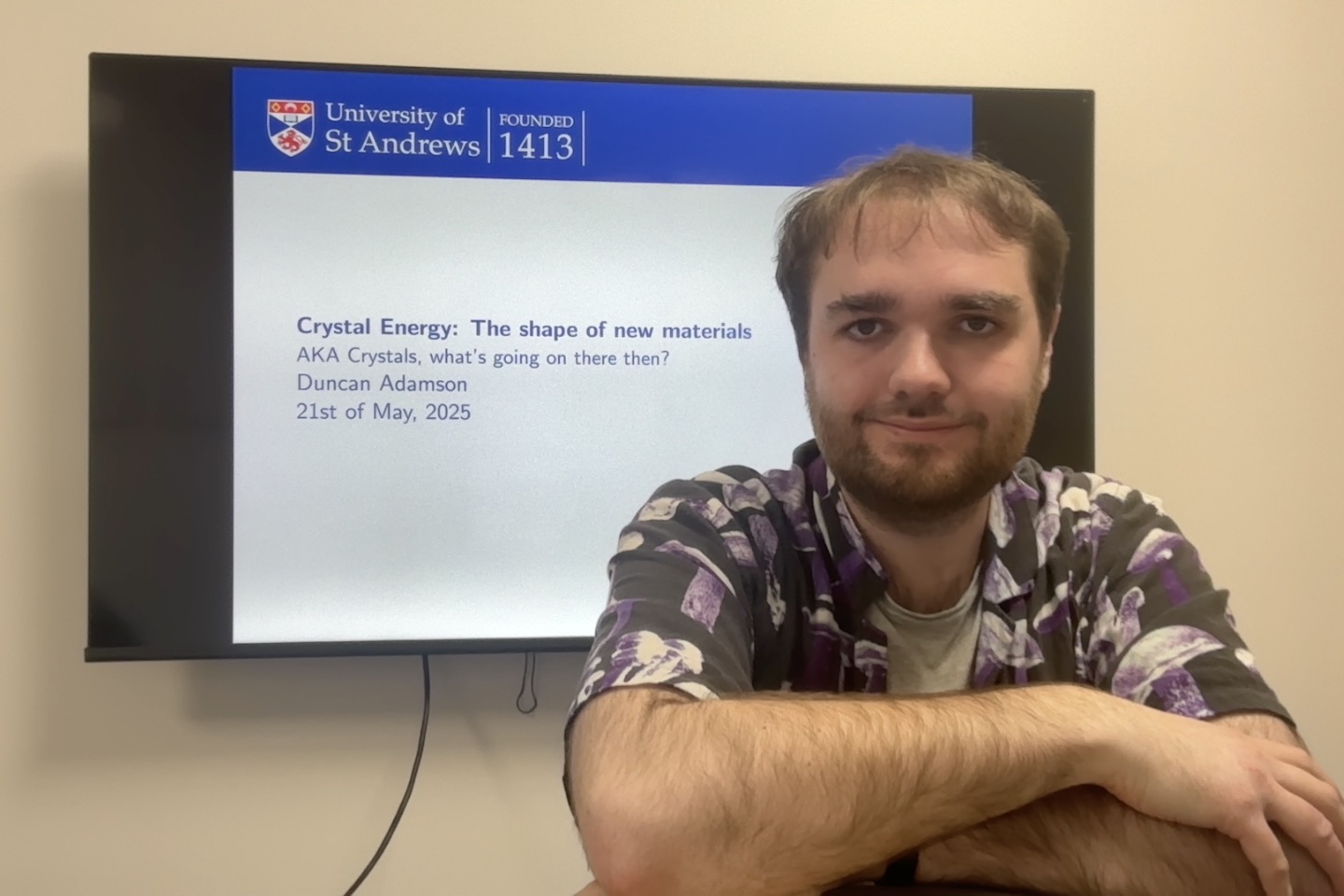
Duncan Adamson is a Lecturer in the School of Computer Science at the University of St Andrews, United Kingdom. He has held prior research positions at the Leverhulme Research Centre for Functional Materials Design, the University of Göttingen, Reykjavik University, and the University of Liverpool. His academic foundation includes a PhD from the University of Liverpool supervised by Prof. Igor Potapov and undergraduate studies at the University of Glasgow. His research lies at the intersection of theoretical computer science and discrete mathematics, with a focus on combinatorics on words , algorithm design , crystal structure prediction , and temporal graphs . He explores symmetry in multidimensional words, develops algorithms for combinatorial enumeration, and investigates computational hardness in materials science. His work often bridges abstract theory with real-world applications in chemistry and robotics. The recent publications show a strong trend in combinatorial algorithms , particularly in enumeration, ranking, and optimization over structured words, graphs, and sequences. A significant portion of his work involves the k-centre problem for implicitly defined combinatorial classes and temporal graph colouring , with increasing emphasis on algorithmic complexity and practical implementation. His 2024 paper on harmonious colourings in temporal matchings was awarded best paper at SAND 2024, highlighting the impact of his research. Scientific Awards: Best Paper Award, SAND 2024 – 'Harmonious Colourings of Temporal Matchings' Duncan Adamson has been supported by the Leverhulme Research Centre for Functional Materials Design during his PhD and postdoctoral work. While no formal advisees are listed, his supervision by leading researchers and collaborative projects suggest active mentorship and team integration. He teaches core computer science modules at St Andrews, including CS2001 and CS3302, and maintains a busy research schedule with weekly meetings and supervisory responsibilities. His research is conducted within the Algorithms and Complexity group at St Andrews, continuing collaborations with international teams in Iceland, Germany, and beyond. Projects often involve interdisciplinary efforts, especially in applying computational techniques to materials science and chemistry.
Ricky Liu is an Associate Professor at the University of Washington, following roles at North Carolina State University, the University of Michigan, and the University of Minnesota. He earned his Ph.D. in Mathematics from MIT (2010) under Alexander Postnikov. His research focuses on algebraic combinatorics, particularly its intersections with algebraic geometry, combinatorial geometry, and representation theory. He has taught advanced courses in combinatorics, algebraic structures, and problem-solving, including special topics on Schubert calculus, dynamical algebraic combinatorics, and Hopf algebras. Education: Ph.D. in Mathematics from MIT (2010), advised by Alexander Postnikov. Earlier coursework includes roles as a teaching assistant at MIT (2007–2008) and research mentor at the University of Minnesota Duluth’s REU (2006–2008). Research interests span algebraic combinatorics with a focus on Schubert polynomials, polytopes, and their connections to representation theory. Key areas include birational rowmotion dynamics, Gelfand-Tsetlin polytopes, Kronecker coefficients, and Fomin-Kirillov algebras. His work bridges abstract algebraic structures with geometric and combinatorial interpretations. Teaching highlights include courses on combinatorial game theory, algebraic combinatorics, and problem-solving strategies. He has been a regular instructor at the Mathematical Olympiad Summer Program since 2007.
Andrew Baxter is an Associate Teaching Professor in the Department of Mathematics at Pennsylvania State University, part of the Eberly College of Science. He is also the Director of the Pennsylvania Mathematics Initiative (PMI), a professional development program for elementary school teachers. Baxter holds a B.A. from Millersville University (2005) and a Ph.D. in Mathematics from Rutgers University (2011). Educations: B.A., Millersville University, 2005 Ph.D., Rutgers University, 2011 Research Interests: His work spans Enumerative Combinatorics (focusing on permutation patterns and enumeration schemes), Scholarship of Teaching & Learning (pedagogical strategies for mathematics education), and Teacher Preparation . He has contributed to studies on Wilf-equivalence, ascent sequences, and algorithmic approaches to permutation analysis. Teaching & Grants: Senior Personnel for an NSF S-STEM Grant Co-developer of Cultural Perspectives on Mathematics (CAMS 197N) Active member of the Biocalculus instructional team Lead of the PSU Math Department’s Teaching Seminar Awards: None explicitly mentioned in provided texts. Advising & Mentorship: Mentored undergraduate researchers including Charles Walker (PSU) and Ross Nycum (PSU) Directed research projects for Jonathan Eskreis-Winkler and Ethan McCarthy at Rutgers Labs & Teams: Directs the Pennsylvania Mathematics Initiative, advancing teacher training in mathematics through collaborative workshops and curricula.
Marc Noy is a Professor at the Department of Applied Mathematics II, Polytechnic University of Catalonia (UPC), affiliated with the School of Mathematics and Statistics. He is the Director of the Barcelona Graduate School of Mathematics (BGSMath) and leads the 2015-2019 Excellence program BGSMath/María de Maeztu. His research focuses on Combinatorics and Graph Theory, including asymptotic enumeration, random graphs, discrete geometry, and Tutte polynomials. He has advised multiple PhD and Master’s students and contributes to editorial roles for the Electronic Journal of Combinatorics and the Catalan Mathematical Society’s Bulletin. His teaching spans undergraduate and graduate courses in Combinatorics, Graph Theory, Complex Analysis, and Discrete Mathematics at UPC. He has participated in numerous international conferences and workshops, including the ICM 2014 and FOCM 2017. His work emphasizes the probabilistic analysis of graph structures, limit laws, and enumerative combinatorics. His recent publications explore topics like logical limit laws in graph classes, random planar graphs, and Tutte polynomial evaluations. He maintains active collaborations in combinatorial enumeration, with contributions to understanding graph properties in minor-closed classes and random geometric configurations.
Sajin Koroth is an Assistant Professor in the Department of Computer Science at the University of Victoria, Canada. He holds a PhD from the Indian Institute of Technology Madras and has held postdoctoral positions at Simon Fraser University and the University of Haifa. His research focuses on theoretical computer science, particularly complexity theory, communication complexity, and circuit complexity. He has received the IBM India Outstanding Ph.D. Thesis Award for his doctoral work. Education: PhD and Master's from IIT Madras, postdoctoral research at SFU and Haifa University. Research interests include circuit lower bounds, communication complexity, and probabilistically checkable proofs (PCPs). Key contributions involve lifting theorems, query-to-communication complexity, and lower bounds for De Morgan formulas. Awards: IBM India Outstanding Ph.D. Thesis Award (2017). Teaching: Courses on communication complexity and computational complexity theory at UVic. Active in academic conferences and workshops, including presentations at STOC, CCC, and ICALP.
Eirini Chavli is a Researcher at the University of Stuttgart’s Institute for Discrete Structures and Symbolic Computation, affiliated with the Department of Algebra and Number Theory under Prof. Meinolf Geck. Her research focuses on algebraic structures such as Hecke algebras, braid groups, complex reflection groups, and representation theory. She holds a Ph.D. in Pure Mathematics from Université Paris Diderot (2016), supervised by Prof. Ivan Marin, and has held postdoctoral and teaching roles at institutions including Universität Stuttgart and Université de Picardie Jules Verne. Education: Ph.D. in Pure Mathematics, Université Paris Diderot (2016) MSc in Pure Mathematics, University of Athens (2010) Bachelor in Mathematics, University of Athens (2007) Her research interests span generic Hecke algebras, decomposition matrices, Brauer algebras, and combinatorial approaches to algebraic problems. She has authored over 10 peer-reviewed publications and contributed to computational tools for verifying conjectures in algebra. Notable awards include the Best Teaching Award (2023) and a Best Poster Award (2019). She actively organizes conferences, such as the 2024 Darstellungstheorietage and the 2023 Fresh Algebra and Geometry workshop, and serves on the advisory board of Greek Women in Mathematics. Her work bridges theoretical algebra with computational methods, emphasizing the interplay between abstract structures and concrete examples. Recent trends in her publications include applications of combinatorial techniques to representation theory and the study of Nakayama algebras through permutation patterns.
Jonathan Noel is an Assistant Professor in the Department of Mathematics and Statistics at the University of Victoria. His research focuses on extremal combinatorics, probabilistic combinatorics, and combinatorial limits, with applications to quasirandomness, Ramsey theory, and graph theory. He holds a DPhil (PhD) from the University of Oxford and teaches courses such as MATH 122 (Logic and Foundations) and MATH 529 (Topics in Discrete Mathematics). His research interests include extremal set theory, graph colouring, graph homomorphisms, bootstrap percolation, and computational complexity. He explores how local patterns in discrete structures influence global properties, such as the interplay between edge densities and cycle counts in graphs. Recent work emphasizes quasirandomness through permutation patterns and entropy methods, alongside bootstrap percolation dynamics in hypercubes and cellular automata. His articles often bridge combinatorial limits with analytic approaches, such as the Szemerédi Regularity Lemma. No awards are listed for Jonathan Noel in the provided text. He advises no formally listed students but contributes to academic supervision through course instruction.
Alex Roitershtein is an Instructional Associate Professor in the Department of Statistics at Texas A&M University, part of the College of Arts & Sciences. His research focuses on probability theory, stochastic processes, and their applications in statistical models, combinatorics, and complex systems. He has contributed to areas including random walks, Markov processes, evolutionary dynamics, and network science. His work often bridges theoretical developments with practical applications in infrastructure resilience, genetic models, and algorithmic combinatorics. Roitershtein’s recent publications explore topics ranging from optimal resource allocation strategies in financial systems to extinction dynamics in evolutionary models. He has also investigated network robustness through Markovian influence graphs and studied combinatorial patterns in permutations and words. His research frequently employs probabilistic methods, generating functions, and stochastic analysis to address both foundational and applied questions. His articles reflect a multidisciplinary approach, with contributions to statistical physics (e.g., avalanche dynamics in excitable networks), computational biology (e.g., Wright-Fisher population models), and discrete mathematics (e.g., enumeration of staircase patterns). While no specific awards are listed, his extensive publication record demonstrates sustained scholarly activity in probability and its applications.
Marni Mishna is a Full Professor in the Department of Mathematics at Simon Fraser University’s Faculty of Science. Her academic roles include Associate Dean, Equity, Diversity, and Inclusion (2023–2028) and PIMS Deputy Director (2019–2021). She has held visiting positions at institutions such as CNRS (France), LaBRI (University of Bordeaux), and the Fields Institute. Education: PhD in Mathematics (Université du Québec à Montréal, 2003), MSc in Pure Math (SFU, 2000), BMath (University of Waterloo, 1997). Her research spans analytic and enumerative combinatorics , focusing on generating functions , lattice paths , D-finite symmetric functions , and algorithmic solutions . She explores the intersection of combinatorics with art and design for mathematical communication. Recent articles analyze differential transcendence , Kronecker coefficients , and lattice path universality classes , emphasizing computational methods and asymptotic analysis. Her work often bridges graph theory , symmetric functions , and algebraic structures . She supervises students and postdocs in projects related to combinatorial theory , graph enumeration , and symmetric function applications . Her teaching includes advanced courses like MATH 443/743 (Combinatorics) and MATH 322 (Complex Analysis).