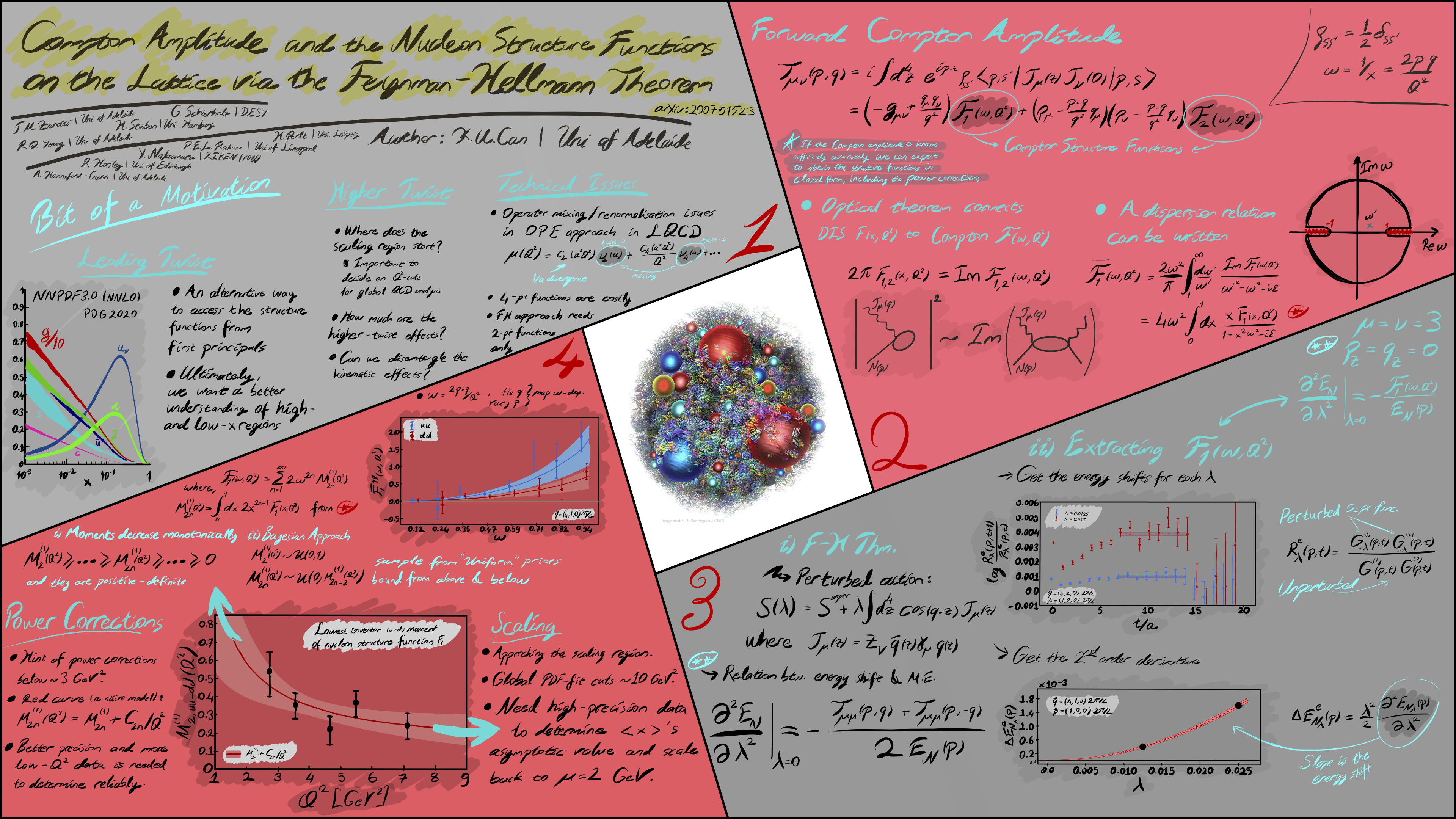
Dr. Kadir Utku Can is a Researcher at the University of Adelaide, affiliated with the School of Physics, Chemistry and Earth Sciences within the Faculty of Sciences, Engineering and Technology. His primary research focus is investigating the nature of strong interactions using lattice Quantum Chromodynamics (QCD), particularly studying hadron structure functions, form factors, and spectra through computer simulations. Current research interests include nucleon structure via Compton amplitudes, charmed baryon spectra, and generalized parton distributions. His work emphasizes computational methods to explore quark-gluon dynamics, with recent studies focusing on nucleon structure functions, parity-odd interactions, and transition matrix elements. He is eligible to supervise Masters and PhD students in theoretical and computational particle physics. Key contributions include lattice QCD calculations of charmed baryon spectra and Compton amplitude analyses, published in high-impact journals and conference proceedings. Recent publications (2022–2025) highlight advancements in lattice techniques for parton distribution functions, Feynmann-Hellmann theorem applications, and renormalization group equations. His research bridges computational simulations with experimental data, contributing to fundamental particle physics understanding.
Milind Diwan is a Distinguished Scientist in the Physics Department at Brookhaven National Laboratory, where he leads research in particle physics, neutrino physics, and detector development. He has made significant contributions to rare kaon decays, neutrino physics, and the development of advanced detectors. Diwan is particularly known for initiating and organizing the US long-baseline neutrino program that evolved into the LBNF/DUNE project, now the highest priority fundamental science project in the United States. Education: University of Colorado at Boulder, BA (Physics), 1982 Brown University, Sc.M. (Physics), 1984 Brown University, Ph.D. (Physics), 1988 Dr. Diwan's research spans experimental nuclear and particle physics with focus on rare kaon decays, neutrino interactions, and neutrino oscillations. His work encompasses detector development, particularly with scintillation detectors, liquid scintillators, and photo-multiplier tubes. He has pioneered techniques in readout electronics and data analysis, with particular expertise in organizing large-scale scientific projects. His research has significantly advanced our understanding of neutrino properties and rare particle decay processes. Analysis of Diwan's recent publications reveals a strong focus on neutrino physics, particularly sterile neutrino searches, long-baseline neutrino experiments, and far-forward neutrino production at the LHC. His work bridges theoretical predictions with experimental verification, with emphasis on precision measurements that test the boundaries of the Standard Model. The publications demonstrate expertise in both accelerator-based and reactor-based neutrino experiments. Scientific Awards: Science and Technology award from Brookhaven National Laboratory (2017) for 'Important experimental contributions to understand the properties of neutrinos.' Co-recipient Break Through Prize for Daya Bay collaboration (2015) 'For the fundamental discovery and exploration of neutrino oscillations, revealing a new frontier beyond, and possibly far beyond, the standard model of particle physics.' Sociedade Brasileira de Fisica (SBF) and American Physical Society (APS) award for visiting professorship (2015) Fellow of the American Physical Society (2009) Dr. Diwan has served as analysis leader in multiple major collaborations including E787 (rare kaon decays) and MINOS (neutrino oscillations), and as spokesperson for several experiments including LBNE. He has chaired important review panels for the DOE and served on the HEPAP sub-panel on planning for the future of U.S. high energy physics. His leadership was instrumental in developing the national study that formed the basis for the LBNF/DUNE project approval. Diwan leads research activities involving detector commissioning for the ICARUS liquid argon detector at Fermilab, analysis of neutrino oscillations data, and design of photo-sensor systems for next-generation neutrino experiments. His work spans both hardware development and sophisticated data analysis techniques, with particular emphasis on creating robust methodologies for extracting physics results from complex detector systems.
Jorge Segovia González is a Professor at Universidad Pablo de Olavide, affiliated with the Department of Physical, Chemical and Natural Systems within the College of Engineering. His research focuses on Applied Physics, Particle Physics, and Quantum Chromodynamics, particularly in the study of quark models, meson spectroscopy, and multiquark systems. He earned his PhD in 2012 from the Universidad de Salamanca, where he studied spectroscopy and decay mechanisms of heavy quark mesons under the supervision of Dr. David Rodríguez Entem. His work spans topics like Constituent and chiral quark models Tetraquark and pentaquark systems Generalized Parton Distributions Strong decay formalisms Proton-antiproton scattering Electromagnetic form factors of hadrons . Recent publications (2024–2025) emphasize theoretical advancements in tetraquark systems, Monte Carlo simulations, and applications of QCD to meson structure. His research contributes to understanding hadron stability, quark interactions, and experimental signatures at facilities like the Jefferson Lab and Electron-Ion Collider (EIC).
Pavel Nadolsky is a Professor in the Department of Physics & Astronomy at Michigan State University . His research focuses on theoretical particle physics , particularly elementary particle phenomenology within and beyond the Standard Model, perturbative quantum chromodynamics , and statistical applications for high-energy physics (HEP) data analysis. As a member of the CTEQ collaboration , he contributes to the development of parton distribution function (PDF) parametrizations such as the CT10 and PDF4LHC sets. His work bridges theoretical predictions for colliders like the Large Hadron Collider (LHC) and the Electron-Ion Collider (EIC) with statistical techniques including uncertainty quantification, Monte Carlo methods, and reproducibility studies in HEP. Keywords: Quantum Chromodynamics , Electroweak Interactions , Parton Distribution Functions , AI/ML in Data Analysis , Higgs Boson Physics , Collider Physics
Volodymyr Aushev is Professor in the Department of Nuclear Physics, Faculty of Physics, Taras Shevchenko National University of Kyiv, Ukraine. He simultaneously maintains a senior-researcher affiliation with the Institute for Nuclear Research of the National Academy of Sciences of Ukraine. His career spans four decades, beginning in 1978 at the Institute for Nuclear Research (Kyiv) and expanding through long-term visiting-scientist engagements at DESY (Germany), the Max-Planck Institutes, and Fermilab (USA). Education & Training: PhD studies focused on polarised recoil β-active nuclei and nuclear spin physics at low energies. Extensive specialised training in Quantum Chromodynamics, heavy-flavour physics, top-quark physics and neutrino physics through participation in HERA-B, ZEUS, D0, LHCb, Belle II, DUNE, WA105 and FCAL collaborations. Research Interests: Professor Aushev leads the Kyiv high-energy physics group whose principal goal is understanding the fundamental constituents of matter and their interactions at the highest energies. His work centres on experimental particle physics , with major themes including: Quantum Chromodynamics and parton distribution functions; Production and decay of charm, beauty and top quarks; Neutrino oscillations and astrophysical neutrinos; Development of radiation-hard detectors and advanced instrumentation for collider and neutrino experiments. Recent Publications Overview (2010-2016): The twelve highlighted papers reflect an intensive focus on HERA ep/γp data (ZEUS), Tevatron pp̅ data (D0) and early DUNE/Belle-II planning . Analyses span precision measurements of structure functions, heavy-quark cross-sections, top-quark properties and searches for exotic hadrons, underlining a commitment to multi-TeV energy-frontier physics and long-baseline neutrino science. Scientific Awards & Recognition: Author of ≈120 peer-reviewed papers in high-energy physics and ≈30 in nuclear physics, averaging 33.4 citations each. Group leader for Ukrainian participation in ZEUS, D0, Belle II, DUNE, WA105 and FCAL collaborations. Advising & Outreach: Professor Aushev mentors a vibrant team of post-doctoral researchers, PhD and master’s students within the Kyiv high-energy physics group. He teaches lecture courses on High-Energy Physics , Nuclear Astrophysics , Dark Matter , Neutrino Physics and Modern Experiments in High-Energy Physics , and leads outreach programmes to inspire school pupils and undergraduates. Laboratories & Teams: He heads the Kyiv High-Energy Elementary Particle Physics Group , comprising three faculty members, post-docs, PhD students and undergraduates. The group is responsible for detector R&D (radiation-hard calorimeters, micro-strip monitors), software development and physics analyses for international experiments in Europe, the United States and Japan.
Dr. Trevor Vickey is a Reader in Particle Physics and Astrophysics at the School of Mathematical and Physical Sciences, University of Sheffield. He is an active researcher working with the ATLAS collaboration at CERN's Large Hadron Collider, focusing on precision measurements of the Higgs boson and searches for physics beyond the Standard Model. His research interests span multiple areas of high energy physics, including Higgs boson properties, searches for Beyond Standard Model Higgs bosons, investigations of new physics in tau lepton final states (including graviton, third-generation leptoquarks, Z' bosons, and supersymmetry), top quark properties, tau lepton identification techniques, and silicon detector technology. His work leverages the full capabilities of the ATLAS detector to probe fundamental questions in particle physics. Dr. Vickey's publication record shows consistent productivity with numerous high-impact papers in leading journals including Journal of High Energy Physics, Physics Letters B, and Physical Review D. His recent work (2023-2025) demonstrates expertise across multiple frontiers of particle physics, from precision Higgs measurements to exotic searches for new particles. The publications reveal a strong focus on analyzing data from LHC Run 2 and early Run 3, with particular emphasis on Higgs physics, top quark physics, and searches for new phenomena. As a member of the ATLAS collaboration, Dr. Vickey contributes to one of the largest scientific collaborations in history, working alongside thousands of researchers worldwide. His position at the University of Sheffield places him within a strong UK particle physics community that has made significant contributions to the ATLAS experiment since its inception.
Yuri Kovchegov is a Professor in the Nuclear Theory Group within the Physics Department at The Ohio State University. He specializes in theoretical nuclear and particle physics, focusing on Quantum Chromodynamics (QCD) at high energy and small-x phenomena. His research explores topics such as gluon helicity evolution, spin physics, and the interplay between QCD and heavy-ion collisions. Education: Ph.D. Physics, Columbia University (1998) M. Phil. Physics, Columbia University (1996) M.A. Physics, Columbia University (1995) B.S. Physics, Moscow Institute of Physics and Technology (1993) Research Interests: Kovchegov's work delves into the dynamics of QCD at high energies, including parton saturation, proton spin structure, and the application of small-x evolution equations. He is a key contributor to the theoretical framework for the Electron-Ion Collider (EIC), emphasizing studies of nucleon and nuclear structure. Publications: His recent work addresses cutting-edge topics like gluon helicity distributions, spin-dependent odderon effects, and the analysis of polarized DIS/SIDIS data. He has pioneered helicity evolution equations and their implications for proton spin physics. Awards: AAAS Fellowship (2020) APS Fellowship (2020) Sackler Prize in Physics (2021) Teaching and Service: Kovchegov has taught advanced courses on quantum field theory, particle physics, and electromagnetic field theory. He actively participates in collaborations like the OSU Relativistic Heavy Ion Group and the EIC User Group. Labs & Teams: He is affiliated with the Nuclear Theory Group at OSU and contributes to international efforts in QCD theory, including the development of the Electron-Ion Collider's theoretical framework.
Gail Dodge is Dean of the College of Sciences and Professor of Physics at Old Dominion University (ODU), where she has served since 1995. An experimental nuclear physicist, she investigates proton/neutron structure using high-energy electron beams at Jefferson Lab, focusing on quark-gluon dynamics. She previously chaired ODU's Physics Department (6 years), managed NSF's $17M nuclear physics program, and currently chairs the Nuclear Science Advisory Committee advising DOE/NSF on funding priorities. Education: Ph.D. in Physics, Stanford University (1993) M.S. in Physics, Stanford University (1988) B.A. in Physics, Princeton University (1986) Her research explores nucleon substructure, spin asymmetries, and exotic hadronic states, with grants exceeding $7M from NSF/DOE. Recent projects include CLAS detector experiments measuring deuteron spin structure and color transparency in ρ⁰ electroproduction. Her work advances understanding of quark-hadron transitions and nuclear correlations. Publications emphasize precision measurements of spin-dependent cross sections, nucleon resonances, and electroproduction processes. Dominant themes include spin structure functions (e.g., g₁ ), generalized parton distributions, and validation of QCD predictions via polarization observables and exclusive reactions. Awards: Outstanding Faculty Award, State Council of Higher Education for Virginia (2015) Gene W. Hirschfeld Faculty Excellence Award (2012) College of Sciences Faculty Excellence Award (2003) Luise Meyer-Schutzmeister Memorial Award (1991) She advises major initiatives like the CLAS spectrometer experiments and directs the From Quarks to Nuclei NSF grant ($2.3M). At Jefferson Lab, she leads teams studying neutron structure via spectator tagging and develops radial TPCs for BONuS experiments.
Dr Aaron Bundock serves as a Research Fellow in the School of Physics at the University of Bristol, actively contributing to the CMS Collaboration at CERN. His research focuses on experimental particle physics using Large Hadron Collider data, with expertise in precision measurements of fundamental particles and interactions. His research interests include: Standard Model validation through precision measurements Higgs boson production mechanisms Lepton and muon physics in high-energy collisions Top quark pair production dynamics Cross section analysis for W/Z bosons Advanced particle identification techniques Recent publications (2025) demonstrate consistent focus on Standard Model tests using CMS data, featuring Higgs boson studies, top quark measurements, and muon identification algorithms. His work employs sophisticated statistical methods and machine learning for analyzing proton-proton collision datasets at 13-13.6 TeV energies. As a core member of the international CMS Collaboration, Dr Bundock participates in one of physics' largest experimental efforts, operating cutting-edge detector systems to probe fundamental particle interactions and search for physics beyond the Standard Model.
Dr. Yongsun Kim is a Professor at the Department of Physics and Astronomy , Sejong University. Holding a Ph.D. from MIT (2013) and a B.S. from the University of Illinois Urbana-Champaign (2007), he conducted postdoctoral research at Korea University (2013-2017) and UIUC (2017-2018). His work bridges high-energy physics and nuclear structure , focusing on heavy-ion collisions , quark-gluon plasma , and Higgs boson phenomenology . Research Interests Heavy Ion Collisions at LHC/RHIC Nuclear Symmetry Energy in Rare Isotopes High-Density Nuclear Physics Detector Development for sPHENIX and ECCE Scientific Contributions With over 1073 research outputs , his recent publications include measurements of W+W- production, studies of top quark entanglement , and searches for exotic Higgs decays . His work spans CMS detector upgrades, charm hadronization, and QCD investigations . Scientific Awards No specific awards mentioned in the provided data.
Germán Rodrigo is a tenured Research Professor at the Instituto de Física Corpuscular (IFIC) , a joint centre of the Spanish National Research Council (CSIC) and the University of Valencia . After earning his PhD in 2003 under Arcadi Santamaria, he held post-doctoral positions at KIT Karlsruhe and CERN before returning to Valencia in 2008. He currently leads the quantum–phenomenology group within the theoretical physics department. His research straddles high-energy collider phenomenology and quantum computing. Rodrigo is internationally recognised for turning multi-loop Feynman integrals into causal, loop-tree-dual forms and for implementing the resulting algorithms on real quantum hardware. Key achievements include the first quantum calculation of loop integrals, quantum jet clustering at the LHC, and quantum amplitude estimation with error mitigation. Recent work (2022-2025) focuses on: Quantum integration of decay rates and fragmentation functions Graph-based quantum algorithms for causal multi-loop configurations Adaptive importance sampling on quantum annealers and gate-based devices Factorisation-breaking studies in triple-collinear splitting with massive partons He advises three doctoral students and is PI on a national Spanish grant supporting the group’s quantum-technologies programme. No personal e-mail is publicly listed; contact is handled through the IFIC secretariat.
Prof. Dr. Vladimir Braun leads the Theoretical Physics chair at the University of Regensburg's Faculty of Physics. His research group investigates nonperturbative aspects of quantum chromodynamics and hadronic structure. Key research areas include: QCD factorization for hard exclusive processes Conformal symmetry applications Light-cone distribution amplitudes Lattice QCD computations Recent publications focus on higher-order corrections to deeply virtual Compton scattering, precision determinations of meson/baryon structure, and renormalization challenges in lattice simulations.
Andrew Hanlon is an Assistant Professor of Physics at Kent State University. His research focuses on theoretical nuclear and particle physics, particularly using Lattice Quantum Chromodynamics (QCD) to study hadron interactions and structure. He investigates nucleon/nuclei structure, meson-baryon scattering, and QCD dynamics requiring supercomputer simulations. Hanlon holds a Ph.D. in Physics from the University of Pittsburgh (2017) and a B.Sc. in Physics and Computer Science from Michigan State University (2013). His work bridges experimental data with QCD theory, emphasizing numerical methods for complex systems. Research interests include hadron resonance spectroscopy, multi-hadron systems, and the application of lattice QCD to understand QCD phenomena at both high and low energies. Key topics involve nucleon-nucleon interactions, exotic meson states (e.g., K₀*(700), a₀(980)), and Λ(1405) resonance dynamics. His computational work leverages supercomputers to model systems requiring precise finite-volume and quark mass treatments. Publications emphasize lattice QCD predictions for scattering amplitudes, parton distribution functions, and resonance pole structures. Recent studies explore two-pole nature of Λ(1405), quarkonium spectroscopy in quark-gluon plasma, and pion/kaon form factors at high momenta. He collaborates on projects involving SU(3) flavor symmetry and distillation methods for baryon-baryon interactions. Hanlon co-edits the Delocalized Editorial blog via Theory Girls, promoting science communication. His grants and advising focus on advancing lattice QCD techniques for precision nuclear physics. Ongoing work targets QCD predictions for meson electromagnetic form factors and NN scattering dynamics at physical quark masses.
Nestor Armesto Perez is a Professor at the University of Santiago de Compostela, affiliated with the Department of Particle Physics within the Faculty of Physics. He is a member of the Galician Institute of High Energy Physics (IGFAE) and leads the TEOFPACC research group focusing on Theoretical Physics, Particle Physics, and Astroparticles. His research emphasizes Quantum Chromodynamics (QCD), nuclear parton distribution functions, and high-energy collider physics. He obtained his PhD from the University of Santiago de Compostela in 1995 with a thesis on string interactions in particle models under Dr. Carlos Pajares Vales. His work explores small-x dynamics, gluon saturation, and jet quenching mechanisms in heavy-ion collisions. He actively contributes to designing future collider experiments like the Electron-Ion Collider (EIC) and Large Hadron Electron Collider (LHeC), emphasizing precision measurements of parton distributions and medium effects. His recent publications address theoretical frameworks for particle production in proton-nucleus collisions, azimuthal asymmetries, and detector concepts for next-generation facilities. Armesto's research bridges formal theory with experimental validation, with strong emphasis on cold nuclear matter effects, partonic structure extraction, and multi-particle correlations. He collaborates internationally on initiatives like the Future Circular Collider (FCC) and Heavy-Ion Theory programs. No specific awards are listed, though his sustained contributions to high-energy physics are well-recognized in the field.
T. Beyrouthy is a prominent researcher in high-energy physics with 313 publications, an h-index of 25, and over 3,000 citations. As a key contributor to the CMS experiment at CERN's Large Hadron Collider, his work spans Higgs boson characterization, supersymmetry searches, heavy ion collisions, and detector development. His research primarily focuses on experimental validation of the Standard Model and exploration of physics beyond it through proton-proton and Pb-Pb collision data. His research interests include: Particle detection methodologies for collider experiments Quantum chromodynamics in extreme energy regimes Searches for new particles and phenomena beyond the Standard Model Precision measurements of electroweak parameters Development of advanced detector systems for high-radiation environments Analysis of his recent publications reveals sustained contributions to CMS experimental programs across multiple frontiers: Higgs physics (width measurements, off-shell production), heavy flavor studies (J/ψ spectroscopy), and searches for right-handed currents. His work consistently appears in high-impact journals including Nature, Physical Review Letters, and Journal of High Energy Physics. Beyrouthy operates within the CMS collaboration's international framework, evidenced by extensive co-authorship networks with leading institutions worldwide. His technical contributions to detector development for LHC Run 3 highlight expertise in experimental infrastructure. The absence of student listings or teaching-focused publications suggests a primary research orientation within large-scale experimental collaborations rather than traditional academic advising roles.