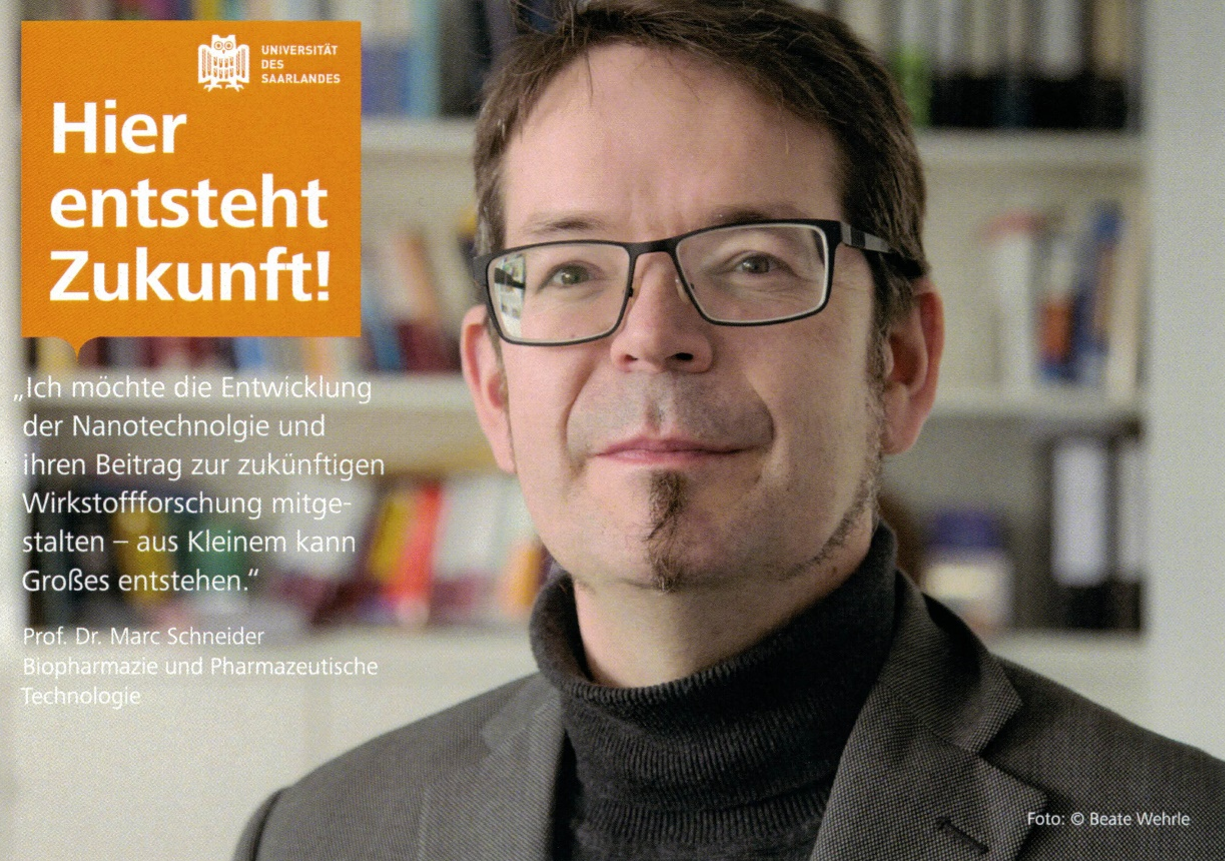
Prof. Dr. Marc Schneider holds a professorship in Biopharmaceutics and Pharmaceutical Technology at Saarland University's College of Pharmacy . His research focuses on colloidal drug delivery systems, particularly nanostructured and non-spherical particle engineering for overcoming biological barriers in pulmonary and transdermal applications. He leads an internationally recognized lab in Saarbrücken, collaborating with Helmholtz Institute for Pharmaceutical Research Saarland (HIPS) and trinational institutions. Research Highlights: Development of inhalable nano/microparticle systems Surface modification of gelatin nanoparticles Characterization of mucus-penetrating particles 3D printing for microneedle fabrication Atomic Force Microscopy (AFM) for nanoparticle analysis Selected Scientific Awards: European Journal of Pharmaceutics and Biopharmaceutics Best Paper Award (2018) for mucus-penetrating nanoparticles Recognized in 'Ausgezeichnete Orte im Land der Ideen' competition (2018) for 'Nano-Mais' drug delivery system Collaborative Networks: Co-editor for Advanced Drug Delivery Reviews special issue on biological barriers Key participant in trinational Master's program in Biomedicine with Strasbourg, Mainz, and Luxembourg Active in Controlled Release Society (CRS) conferences and local chapters
Ralph Blumenhagen is a Senior Researcher and Research Group Leader at the Max-Planck-Institut für Physik (Werner-Heisenberg-Institut) in Munich. He holds the position of Privatdozent at the Ludwig Maximilian University of Munich since 2007. His academic career includes a PhD from the University of Bonn (1994), postdoctoral positions at the University of North Carolina, Institute for Advanced Study in Princeton, Humboldt-Universität zu Berlin, and University of Cambridge. Research Interests: Superstring Theory and its various formulations String model building including heterotic strings, D-brane models, and M/F-theory vacua Flux compactifications focusing on moduli stabilization and string cosmology String phenomenology addressing low energy effective actions, D-brane instantons, and swampland conjectures Non-geometric string backgrounds involving double field theory and non-commutative geometry His publications reveal a strong focus on theoretical foundations of string theory with applications to particle physics and cosmology. Blumenhagen's work often bridges abstract mathematical structures with potential physical implications, particularly in connecting string theory to observable phenomena. Advising: Dr. Blumenhagen has supervised numerous PhD and Master's students, with thesis topics spanning swampland conjectures, string inflation, non-geometric backgrounds, flux compactifications, and D-brane physics. His students have produced significant contributions to string phenomenology and mathematical aspects of string theory. Research Group: He leads a research group at the Max Planck Institute focused on theoretical aspects of string theory, with particular emphasis on connecting string theory to observable physics through model building and phenomenological investigations. The group maintains active collaborations with researchers worldwide.
Max Fathi is a Professor of Mathematics at Université Paris Cité, affiliated with the Laboratoire Jacques-Louis Lions (LJLL) and Laboratoire de Probabilités, Statistique et Modélisation (LPSM). He concurrently holds a part-time teaching position at the Department of Mathematics and Applications (DMA) at École Normale Supérieure (ENS). Since 2023, he has been a member of the Institut Universitaire de France (IUF), a prestigious national research fellowship in France. He completed his PhD in 2013 at Université Pierre et Marie Curie under Cédric Villani, followed by a postdoctoral position at the University of California, Berkeley with Lawrence C. Evans and Fraydoun Rezakhanlou. Previously, he was a CNRS researcher at the Institut de Mathématiques de Toulouse before joining Université Paris Cité. His habilitation thesis (2019) focuses on optimal transport applications in analysis and probability. Fathi's research centers on optimal transport theory, particularly its applications to analysis, probability, and statistical physics. Key topics include interacting particle systems, functional inequalities (e.g., Poincaré, log-Sobolev), high-dimensional phenomena, Ricci curvature in discrete/continuous spaces, Stein's method, concentration of measure, and numerical methods for stochastic dynamics. His work is supported by the ANR project 'Conviviality.' He has delivered courses on functional analysis at ENS and participated in summer schools, including an MSRI course on functional inequalities and localization techniques. His teaching materials include lecture notes on optimal transport and stochastic processes. His contributions have been recognized through awards such as the IUF membership. Notable research collaborations include work with Thomas Courtade, Matthias Erbar, and Gabriel Stoltz on topics ranging from stability estimates of inequalities to hypocoercivity and numerical analysis of stochastic systems.
Lena Funcke is an Assistant Professor of Theoretical Physics at Bonn University. Her research focuses on quantum computing, lattice field theory, and machine learning applications in physics. She explores topics such as topological phases, gauge theories, and quantum simulations. Her work bridges high-energy physics and computational methods, with a particular emphasis on overcoming noise challenges in quantum algorithms and leveraging machine learning for optimization tasks. Funcke’s research projects include C01 and C03, focusing on Hamiltonian lattice formulations and quantum computing methods for gauge theories. She investigates hybrid approaches combining Monte Carlo simulations with quantum computing to study quantum electrodynamics and topological systems. Her contributions highlight the interplay between theoretical physics and cutting-edge computational tools. Her publications span quantum algorithms for particle physics experiments, error mitigation strategies, and the application of normalizing flows to complex systems like the Hubbard model. She actively contributes to advancing the theoretical foundations of quantum computing and its practical implementation in solving fundamental physics problems.
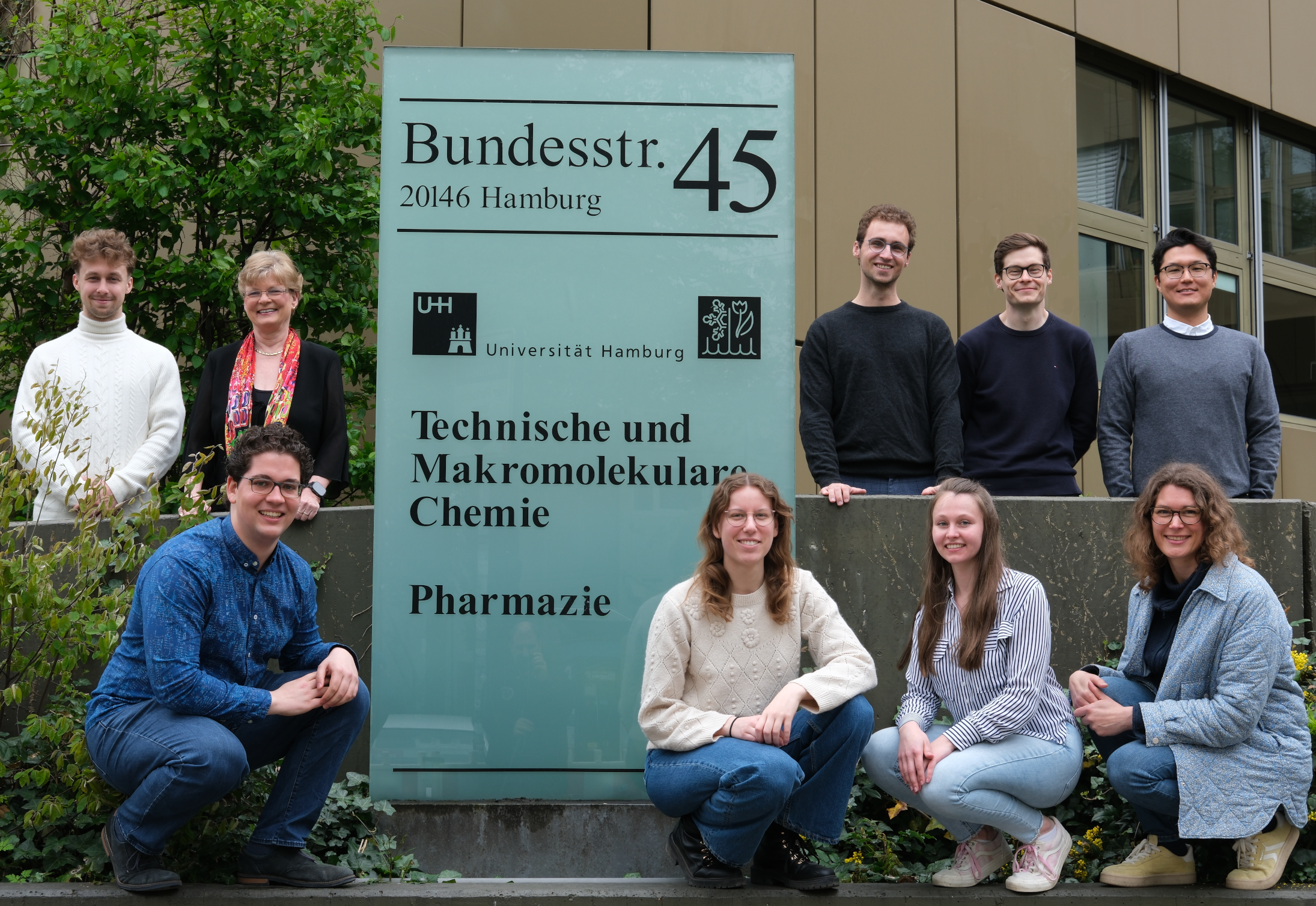
Professor Claudia S. Leopold serves as Professor and Head of the Institute of Pharmacy within the Department of Chemistry at the University of Hamburg's MIN Faculty. With over 35 years of academic experience, she leads the Pharmaceutical Technology Department and maintains an active research program focused on advanced pharmaceutical manufacturing processes and drug delivery systems. Her educational background includes a pharmacy degree from Heinrich-Heine-University Düsseldorf (1981-1985), followed by pharmacist certification in 1987. She completed her doctoral research in 1992 on skin penetration enhancement, conducted postdoctoral research at Stanford Research Institute and UC San Francisco, and achieved her habilitation in pharmaceutical technology in 1999. Her academic progression includes professorial positions at Leipzig University (2000-2005) before joining the University of Hamburg in 2005. Prof. Leopold's research program centers on pharmaceutical technology innovations, particularly in tablet formulation and manufacturing processes. Her laboratory investigates optimization of process flows during tableting, use of co-processed excipients, characterization of dustiness within containment systems, control of drug release through polymer interactions, and improving water solubility of active ingredients through co-amorphization techniques. Her work bridges fundamental pharmaceutical science with practical manufacturing applications, addressing critical challenges in modern pharmaceutical production. Her recent publications (2022-2025) demonstrate a strong focus on continuous manufacturing technologies, co-amorphous drug systems, and advanced process analytical techniques. These works reveal trends toward real-time monitoring of pharmaceutical processes, spatial analysis of powder behavior, and sophisticated approaches to enhancing drug solubility and stability. Her research group has made significant contributions to understanding powder flow dynamics, tablet coating mechanics, and the application of novel spectroscopic methods in pharmaceutical manufacturing. Habilitations-Förderpreis der Deutschen Pharmazeutischen Gesellschaft (1997) Ehrendoktorwürde (Dr. h.c.) (2020) Prof. Leopold has supervised over 25 doctoral students throughout her career, with recent dissertations focusing on powder characteristics, co-amorphous systems, continuous manufacturing optimization, and advanced tablet technologies. Her laboratory maintains strong industry connections through contract research in formulation development, tableting process optimization, drug release measurements, and expert consultation on pharmaceutical-technological issues. The research group operates specialized equipment for pharmaceutical technology studies and collaborates with international partners in continuous manufacturing and drug delivery research. The Leopold research group (AG Leopold) operates within the Institute of Pharmacy at the University of Hamburg, maintaining a comprehensive suite of equipment for pharmaceutical technology research. The team includes multiple scientific associates, research assistants, technical staff, and visiting scientists working collaboratively on various aspects of pharmaceutical development and manufacturing. The laboratory environment supports both fundamental research and applied contract work for industry partners, with particular expertise in tableting processes, drug delivery systems, and analytical method development for pharmaceutical applications.
Dr. Mark D. Soucek is a Professor and Interim Director at the School of Polymer Science and Polymer Engineering at the University of Akron. With over 140 publications in coating science, his work spans UV-curable systems, hybrid organic-inorganic coatings, and sustainable polymer technologies. Previously held positions include: NASA Langley Research Center (1990-1993) North Dakota State University (1993-2001) University of Akron (2001-present) Education : Ph.D. in Inorganic Chemistry, University of Texas at Austin (1990) M.S. in Organic Chemistry, Illinois State University (1986) B.S. in Chemistry, Eastern Illinois University (1983) Research Focus : Developing environmentally benign coatings through nanotechnology and bio-based materials. Specializes in crosslinked systems including UV-curable, thermosetting powder, and hybrid coatings with enhanced properties like corrosion resistance and self-healing capabilities. Current projects emphasize creating a UV-Curable Powder Coatings Research Center for industrial collaboration. Scientific Contributions span 25+ years of coating innovations, with recent emphasis on: Seed oil-based reactive diluents Smart corrosion-inhibiting coatings Hybrid inorganic/organic systems Photopolymerization kinetics Awards & Roles : Sundar L. Aggarwal Endowed Professor Cleveland Coating Society President (2009) Grants include: Industry/University Cooperative Research Center in Coatings (1995-2001) UV-Curable Epoxidized Linseed Oil Based Coatings (2002-2005)
Dr. Stephan Stieberger is a Permanent Staff Member and Research Group Leader at the Max Planck Institute for Physics (Werner-Heisenberg-Institut) in Munich, Germany. He is also an Associate Member of the Arnold Sommerfeld Center for Theoretical Physics at Ludwig-Maximilians-Universität München and participates in the Elite Graduate Program "Theoretical and Mathematical Physics." As Scientific Head of the institute library, he oversees one of the most comprehensive physics collections in Europe. Stieberger's research focuses on cutting-edge theoretical physics with emphasis on Celestial and Carrollian conformal field theories , flat-space holography , and asymptotic symmetries . His work explores new formulations and amplitude techniques in gauge and gravity theories , including soft-theorems, spinors, and twistors. He investigates relations between gravitational and gauge amplitudes , perturbative string theory with implications for field theory, and non-perturbative effects in superstring theory such as instanton corrections and string dualities. His research also extends to string phenomenology with applications to the LHC and number theory with connections to arithmetic algebraic geometry. Analysis of Stieberger's recent publications reveals a strong focus on celestial holography and amplitude techniques, with increasing attention to mathematical structures like multiple zeta values and modular forms. His work bridges high-energy physics with advanced mathematics, particularly in the context of string theory and quantum gravity. The trend shows growing interest in the connections between scattering amplitudes, conformal field theory, and mathematical structures from number theory. Stieberger actively contributes to the theoretical physics community through numerous international lectures and workshops. He has organized significant events including the Workshop on Celestial Amplitudes and Flat Space Holography at the Corfu Summer Institute and has been involved in major conferences such as STRINGS 2012 and Amplitudes 2013. His academic service includes participation in the Research Seminar "Strings and Fields" and leadership roles in organizing major international events in theoretical physics. Based at the Max Planck Institute for Physics in Garching near Munich, Stieberger works within one of the world's leading centers for theoretical particle physics. His office is located in Room 323 at the institute, where he leads his research group focused on string theory, amplitude techniques, and related mathematical structures. The institute provides a vibrant research environment with strong connections to both the Ludwig-Maximilians-Universität München and the broader international theoretical physics community.
Elena Simone is a Full Professor at the Department of Applied Science and Technology (DISAT) of Politecnico di Torino, Italy, where she serves as Vice Coordinator of the PhD programme in Chemical Engineering. She holds an ERC fellowship and leads the Crystallization & Crystal Engineering Laboratory. Her research integrates crystal engineering, process technology, and materials science for applications in food and pharmaceutical industries. Research Interests: Fundamental crystallization mechanisms and polymorph control Food and pharmaceutical crystal engineering Process analytical technology development Sustainable manufacturing of functional crystalline materials Particle design for emulsion stabilization and delivery systems Her recent publications (2023-2025) demonstrate strong focus on experimental and computational approaches to crystallization control, with applications spanning confectionery fats, pharmaceutical polymorphs, electrocatalysts, and emulsion systems. The work frequently employs advanced characterization techniques including synchrotron X-ray scattering. Awards & Leadership: Excellence Award in Crystallization 2017 (EFCE) Steering Committee Member: EFCE Crystallization Working Party Steering Committee Member: British Association of Crystal Growth Editor: Food and Bioproducts Processing Guest Editor: Crystal Growth & Design She currently supervises five PhD students and leads multiple research projects including the ERC-funded CryForm (2021-2026) on crystallization fundamentals, AdvinPro (2024-2026) on insect processing, and NewOilFactory (2024-2026) on crystalline oleogels.
Dr. Ingo Kampen is a researcher and lecturer at the Institute for Particle Technology within the Faculty of Mechanical Engineering at Technische Universität Braunschweig. He serves as Head of Division for "Pharma and Bio Particle Technology" and has been leading the Research Group "Mechanical Biotechnology" since 2006. His academic background includes a doctoral degree (Dr.-Ing.) in 2005 with research on "Einfluss der Zellaufschlussmethode auf die Expanded Bed Chromatographie" (Influence of Cell Disruption Method on Expanded Bed Chromatography). He completed his studies in Biotechnology at TU Braunschweig between 1995 and 2001, following professional education as a chemical-technical assistant from 1992 to 1994. Dr. Kampen's research interests span across particle technology with applications in biotechnology and pharmaceutical engineering. His work focuses on: Mechanical properties of biological particles and cells Particle analysis in micro and nanometer ranges Process engineering for biotechnological applications Pharmaceutical particle technology Cell disruption methods and their effects Biomechanical characterization of microorganisms His publication record demonstrates significant contributions to understanding enzyme crystal mechanics, particle separation techniques, and the impact of mechanical processing on microbial systems. His research shows a strong interdisciplinary approach combining mechanical engineering principles with biotechnology and pharmaceutical sciences, with practical applications in drug formulation, probiotic production, and biocatalyst development. Dr. Kampen teaches several courses including "Grundlagen der Umweltschutztechnik" (Fundamentals of Environmental Protection Technology), "Mechanische Verfahrenstechnik" for biotechnologists, and specialized courses on microscopy and particle analysis in the micron and nanometer range.
Roland Bodmeier is a Professor of Pharmaceutical Technology at the College of Pharmacy, Freie Universität Berlin. He holds a Ph.D. from the University of Texas at Austin (1986) and a habilitation from the University of Regensburg (1993). Previously, he served as an Assistant/Associate Professor at the University of Texas at Austin (1986–1994) and held visiting positions at the Upjohn Company and the University of Nancy, France. His research focuses on innovative drug delivery systems, including controlled release, biodegradable implants, microencapsulation, and multiparticulate dosage forms, resulting in over 215 publications, patents, and book chapters. His educational background includes a pharmacy degree from Ludwig-Maximilians-Universität München (1977–1982). Key research interests include oral drug delivery systems, coating technologies, and nanoparticle-based drug carriers. His work emphasizes practical applications in pharmaceutical formulations, such as extended release pellets, floating drug delivery systems, and mucosal delivery. Bodmeier’s research has led to advancements in biodegradable materials, cubic phase drug delivery systems, and the use of polymers like Eudragit and PLGA. His lab facilities include equipment for microencapsulation, hot melt extrusion, and analytical methods like DSC and HPLC. He has advised over 40 doctoral students, many focusing on topics like nanoparticle design, drug release mechanisms, and formulation optimization. While no specific awards are highlighted, his extensive publication record and contributions to drug delivery systems reflect significant academic and industry impact. His work bridges fundamental research and practical drug development, addressing challenges in solubility enhancement, controlled release, and biocompatibility.
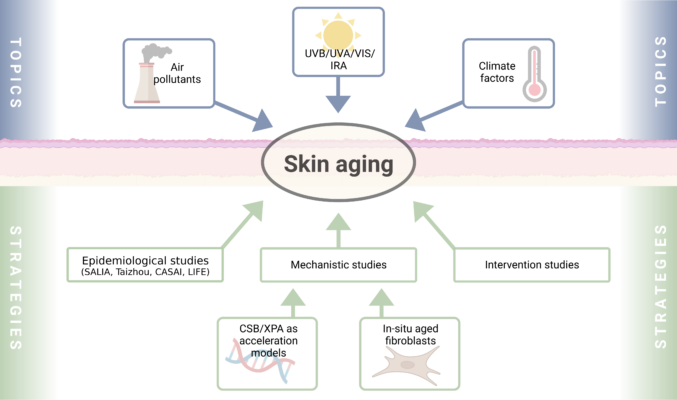
Prof. Dr. Jean Krutmann leads the Molecular Aging Research group at the Leibniz Research Institute for Environmental Medicine in Düsseldorf. His research focuses on environmentally-induced skin aging , DNA repair deficiency syndromes (Xeroderma pigmentosum, Cockayne syndrome), and air pollution effects on skin . Key projects include DFG FOR5489 exploring AHR-retinoid crosstalk and RTG 2624 developing biostatistical toxicology methods. Research Themes Mitochondrial DNA repair mechanisms Particulate matter dermatotoxicity Cutaneous exposome characterization 3D organoid modeling for UVB responses International environmental health collaborations (India, China) Key Discoveries ICAM-1 regulation in UV-damaged cells Ectoine-based lung disease prevention Near-infrared radiation's role in wrinkle formation Two microbiota cutotypes in Han Chinese AHR as UVB radiation target Collaborations Prof. Klaus Unfried (ectoine research) WG Esser, Schikowski, Schins International dermatology experts (Henry Lim, Akimichi Morita) Core Unit GEMD (iPSC organoids) Training & Leadership : Coordinates DFG research units FOR5489 and RTG 2624 . Supervises PhD student Jennifer Schindler and postdocs. Publications span J. Exp. Med , Nature Cell Biology , and Environmental International .
Gerhard W. Bruhn is a Professor in the Department of Mathematics at Technische Universität Darmstadt. His work focuses on theoretical physics, mathematics, and critical analysis of pseudoscientific claims. He has authored critiques of non-mainstream scientific topics such as perpetual motion, homeopathy, and grand unified field theories. Notably, he has challenged flawed methodologies in studies claiming efficacy of homeopathy and exposed academic misconduct in research. His analyses often emphasize rigorous statistical practices and adherence to scientific principles. Research interests include electrodynamics, logic in scientific reasoning, and debunking pseudoscience. He has written extensively on perpetual motion devices, critiqued unproven theories like Myron Evans' GCUFT, and analyzed controversies surrounding homeopathy in veterinary medicine. His work highlights ethical research practices and the importance of peer review in maintaining academic integrity. Publications span critical reviews of studies, logical fallacies in media, and methodological critiques. He engages with interdisciplinary debates, emphasizing mathematical rigor and empirical evidence. His contributions underscore the necessity of skepticism and evidence-based approaches in both academic and public discourse.
Miriam Schulte is a Professor at the University of Stuttgart’s Institute for Parallel and Distributed Systems, leading the Institute for the Simulation of Large Systems. She holds a Carl von Linde Junior Fellowship and has held academic roles since 2002, including heading the CFD Group at TUM. Her expertise spans computational fluid dynamics (CFD), high-performance computing (HPC), and numerical methods for PDE solvers. She earned her diploma (1997) and PhD (2001) in mathematics from TUM, followed by habilitation in Computer Science (2010). Her research focuses on optimizing algorithms for efficient simulation software, integrating mathematics and computer science. Key areas include fluid-structure interactions, multi-physics coupling, and scalable parallel computing. She has contributed to frameworks like Peano for adaptive Cartesian grids and developed methodologies for partitioned fluid-structure interaction simulations. Publications highlight advancements in HPC, multi-physics coupling, and parallel algorithms. Awards include the Bayerische Begabtenfoerderung (1993–1997). Her work bridges computational methods with real-world applications, emphasizing scalability and efficiency in large-scale simulations.
Dr. Sabine Hossenfelder is a Researcher at Ludwig-Maximilians-Universität München (LMU), where she explores foundational questions in physics. She holds a PhD in Physics from the University of Frankfurt (2003) and has conducted research across particle physics, quantum gravity, dark matter, and quantum foundations. Her current work focuses on superdeterminism and locality in quantum mechanics, challenging conventional assumptions about Bell’s theorem and finetuning. Dr. Hossenfelder is also a prominent science communicator, hosting the YouTube channel “Science without the Gobbledygook” and authoring books like *Lost in Math* (2018) and *Existential Physics* (2022), which critique biases in theoretical physics and explore the philosophical dimensions of science. Her research interests include the mathematical and philosophical underpinnings of quantum mechanics, with recent emphasis on experimental tests of superdeterminism and its implications for locality. She has also contributed to astrophysics studies, such as analyzing dark matter profiles in galaxies using superfluid models. Through her writing and media work, she advocates for scientific rigor and skepticism of unfalsifiable theories.
apl. Prof. Dr. Miriam Breunig is Associate Professor (apl. Prof.) of Pharmaceutical Technology at the University of Regensburg, Germany, and heads a research group developing nanoparticle-based drug- and vaccine-delivery systems. Since 2023 she serves as Co-Editor-in-Chief of the European Journal of Pharmaceutics and Biopharmaceutics and in 2024 was appointed Galenus Foundation Guest Professor at MIT. Education & Career: 1996-2001: Undergraduate pharmacy studies, Ruprecht-Karls-University Heidelberg 2002-2005: Graduate researcher, Univ. Regensburg (Prof. Göpferich) 2008 & 2009: Post-doctoral fellow, MIT (Prof. Robert Langer) 2013: Habilitation in Pharmaceutical Technology, Univ. Regensburg since 2012: Akademische Rätin (Associate Professor), Dept. Pharmaceutical Technology, Univ. Regensburg Research Focus: The Breunig group engineers innovative delivery platforms for small molecules, proteins and nucleic acids. Core projects include silica- and mesoporous-silica nanoparticle vaccines against HIV-1 and SARS-CoV-2 , injectable hydrogels that provide sustained nanoparticulate antigen release for single-dose immunisation, and nanoparticle-based glaucoma therapy targeting the trabecular meshwork/Schlemm's canal with siRNA or ROCK inhibitors. Publication Trends: Recent articles (2020-2024) concentrate on multivalent antigen display on silica nanoparticles to enhance B-cell activation and durable antibody responses, long-acting hydrogel depots for HIV vaccines, ocular nanoparticle targeting for glaucoma, and mechanistic studies on nanoparticle functionalisation, ECM penetration and controlled release. Editorial & Honours: Co-Editor-in-Chief, Eur J Pharm Biopharm (since 2023) Co-Editor, same journal (2013-2023) Galenus Foundation Guest Professor, MIT (2024) Collaborations & Funding: She coordinates projects within the HIVacToGC consortium, collaborates with Prof. Mika Lindén (mesoporous silica), Prof. Rudolf Fuchshofer (ocular pharmacology) and partners at MIT, and has secured funding for vaccine and glaucoma nanomedicine initiatives.