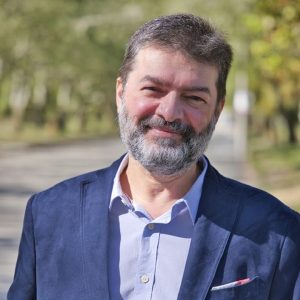
Ioannis Milis is a Professor at the Department of Informatics, Athens University of Economics and Business (AUEB), part of the School of Information Sciences and Technology. He holds a BS in Electrical Engineering from Democritus University of Thrace (1983) and a PhD in Computer Science from AUEB (1989). His research focuses on algorithms, computational complexity, and optimization for computer/communication networks, combinatorial optimization, graph theory, and game theory. He has conducted postdoctoral research at LRI (1992-94), INRIA-Sophia Antipolis (1994-95), and NTUA as a Marie Curie fellow (1995-96). His teaching includes courses on Algorithms, Advanced Algorithms, and Topics in Algorithms at both undergraduate and graduate levels. He co-authored a textbook on Distributed Systems with Java (2005). His conference involvement includes organizing the Athens Colloquium on Algorithms and Complexity (ACAC) since 2006, the Euro-Par 2012 conference, and the ISCO 2012 symposium. His research has addressed scheduling algorithms, energy-efficient computing, and combinatorial optimization problems in networks.
Michael Eichberg is a Professor at Technische Universität Darmstadt, Germany, where his work centers on software engineering, static analysis, programming languages, and secure software development tools. He is the principal architect of the OPAL framework for Java bytecode analysis and has an extensive publication record spanning PLDI, ICSE, ESEC/FSE, ISSTA, ASE, FSE, SOAP, and other premier venues. Research Interests: Static program analysis and its scalability to real-world code bases Software security, particularly cryptographic API misuse and Android app repackaging detection Concurrent and parallel programming models, including deterministic concurrency in Scala Software architecture conformance, drift and erosion detection, and rule reuse Development of open extensible tools and frameworks (OPAL, LectureDoc, QScope, Sextant, XIRC, IRC) Publication Trends: His recent work (2015-2022) demonstrates a strong focus on empirical evaluation of static analysis techniques, modular composition of analyses, and security-related program understanding. Key themes include unsoundness in call graph construction, purity and immutability analyses, parallelization of static analyses, and large-scale studies of cryptographic API misuse. Tools & Frameworks: OPAL – A flexible Java bytecode analysis and manipulation framework (core developer until 2019) LectureDoc 2 – Web-based lecture material authoring and presentation system QScope – Open extensible metrics framework for modern software projects Sextant – Eclipse-integrated software exploration tool XIRC/IRC – Frameworks for enforcing system-wide properties and architectural constraints
Professor Chatziantoniou Damianos holds a position at the Athens University of Economics and Business (AUEB) within the Department of Management Science and Technology (DMST), School of Business. He earned a B.Sc. in Applied Mathematics from the National & Kapodistrian University of Athens (1991), M.Sc. from New York University's Courant Institute of Mathematical Sciences, and a Ph.D. from Columbia University. His research focuses on big data systems, business intelligence, query processing, and real-time data analysis, with contributions influencing commercial database systems like Microsoft SQL Server and Oracle. As Director of AUEB's Master’s program in Business Analytics and Big Data, he previously served as an Assistant Professor at Stevens Institute of Technology (1997–1999). His industry collaborations include co-founding Panakea Software and VoiceWeb SA, and consulting roles at Aster Data Systems (now Teradata). He leads big data projects for companies like Cosmote, Piraeus Bank, and HEDNO. His research has been published in top venues including VLDB, ICDE, and SIGMOD, emphasizing practical applications in large-scale analytics and OLAP systems. He advises on strategic partnerships for the MSc program and maintains an active role in academic administration, including steering committees and quality assurance initiatives.
Stefanos Papadakis serves as a Research Staff Scientist at the Telecommunications and Networks Laboratory (TNL) of the Institute of Computer Science at Foundation for Research and Technology-Hellas (FORTH) and holds an Adjunct Lecturer position in the Department of Computer Science at the University of Crete. Since 2001, he has pioneered hardware and software prototyping at TNL-FORTH, currently leading the Software Defined Radio (SDR) group he established to drive vertical integration from physical layer design to application development. His educational foundation includes a Physics degree (2001) and M.Sc. (2004) and Ph.D. (2009) in Computer Science, all earned at the University of Crete. Teaching responsibilities encompass core courses CS-330: Introduction to Telecommunication Systems Theory and CS-435: Network Technology & Programming. Papadakis' research spans wireless innovation frontiers including software-defined/cognitive radios, spectrum sharing, heterogeneous networking, position location, radio propagation modeling, and emergency communications. His work emphasizes practical implementation, yielding functional prototypes across the entire communications stack. Notable contributions include GPU-accelerated SDR frameworks, robust spectrum virtualization techniques, and emergency response communication systems validated through international competitions. Analysis of his 15 most recent publications (2010-2016) reveals dominant themes in SDR optimization for IoT and critical communications, with significant focus on GPU parallelization, interference management in dense networks, and real-time spectrum sharing mechanisms. His experimental approach consistently bridges theoretical models with hardware validation, particularly in emergency response and heterogeneous network scenarios. Key recognitions include: Ericsson Award of Excellence in Telecommunications for position location research First place in PENED doctoral proposal competition Fourth place in IEEE DySPAN 2015 5G Spectrum Challenge Second place in Virginia Tech ShaRC 2016 with the 'Skynet' cognitive radio system Mentorship spans 16 undergraduate projects (11 completed), 8 M.Sc. students (3 completed theses), and 1 Ph.D. candidate. His research is sustained through major EU and national projects including REDComm (emergency communications), EU-MESH (metropolitan networks), RERUM (IoT security), and Heraklion smart city initiatives. The SDR group maintains critical infrastructure like the Heraklion metropolitan wireless network, FORTH campus network, and specialized mobile emergency nodes equipped with multi-radio SDR platforms, satellite transceivers, and high-performance computing resources.
Wei Yang is an Associate Professor in the Department of Computer Science at the University of Texas at Dallas, actively contributing to software engineering research through program committee roles at ICSE, FSE, ASE, and ISSTA conferences since 2015. His research focuses on software testing innovation , particularly in mobile security, GUI testing, and AI-driven test automation. Key contributions include frameworks for malware analysis (MalScan), UI exploration (Guardian, Vet), and neural network testing (DeepPerform, EREBA), addressing critical challenges in test oracle generation, flaky tests, and resource-constrained environments. Recent work demonstrates a strategic shift toward LLM and foundation model applications for testing, with 2023-2026 publications exploring vision-language models for GUI testing, parameter ownership in collaborative AI development, and instruction alignment in large language models. This evolution reflects the field's broader trajectory toward AI-integrated quality assurance.
Lindsey Kuper is an Assistant Professor in the Computer Science and Engineering Department at the Baskin School of Engineering, University of California, Santa Cruz. She received her Ph.D. from Indiana University in 2015 and leads the CASL (Concurrency and Safety Lab) research group, which is part of the larger Languages, Systems, and Data (LSD) Lab. Her research focuses on programming-language-based approaches to building concurrent and distributed software systems that are elegant, correct, and efficient. Key research areas include: Library-level choreographic programming (in Haskell, Rust, and TypeScript) Dependently-typed diagrams for inductive reasoning about concurrent executions Expressing and verifying causal message delivery with refinement types Lindsey's research has been recognized with an NSF CAREER Award, a Stellar Development Foundation Academic Research Grant, a Google Faculty Research Award, and support from Amazon Web Services. Her work on "HasChor: functional choreographic programming for all" received the ICFP 2023 Distinguished Paper Award. She teaches courses in programming languages and distributed systems at UC Santa Cruz, including Foundations of Programming Languages and graduate/undergraduate Distributed Systems. Her undergraduate distributed systems lectures from 2020-2021 have been viewed over 200,000 times on YouTube. Lindsey co-founded the !!Con and !!Con West conferences of ten-minute talks on the joy, excitement, and surprise of computing, and serves on the board of the Exclamation Foundation. She has chaired numerous workshops and served on program committees for major programming languages conferences including PLDI, POPL, ICFP, and OOPSLA. Her current PhD students include Jonathan Castello, Tim Goodwin, Nathan Liittschwager, Patrick Redmond, Gan Shen, and Yan Tong. Recent graduates include Shun Kashiwa (MS, 2024) and Ali Ali (BS, 2024).
Professor Toby Murray is a leading academic in the School of Computing and Information Systems at the University of Melbourne, Australia. He serves as Director of the Defence Science Institute and Co-Lead of the Computer Science Research Group. With a D.Phil. in Computer Science from Oxford University (awarded in 2011), Murray has established himself as a prominent researcher in security and program verification. His research focuses on building highly secure computing systems cost-effectively, with expertise spanning security assessment, vulnerability detection, secure system design, and formal verification. Murray's work bridges theoretical foundations with practical applications, particularly in information flow security for concurrent systems and neural network robustness. Murray's publication record shows a strong trajectory in security and formal methods, with recent work on verified neural network robustness (CAV 2025), EDEFuzz for detecting excessive data exposure (ICSE 2024 Distinguished Paper), and security separation logic for concurrent C programs. His research consistently addresses critical challenges in secure system development, with increasing focus on machine learning security in recent years. Scientific Awards: Distinguished Paper Award at ICSE 2024 for EDEFuzz Murray actively supervises numerous PhD students and has advised many successful researchers who have gone on to faculty positions at institutions including Swansea University and LMU Munich. His service to the community includes being an Associate Editor for IEEE Security & Privacy and ACM Transactions on Privacy and Security, as well as Program Chair for CSF 2025. Murray leads several significant research initiatives including Verisimilar (Verified, Secure Machine Learning), EDEFuzz (Detecting excessive data exposure), and COVERN (Proving information flow security of concurrent programs), demonstrating his commitment to translating theoretical security research into practical tools and methodologies.
Michael F. P. O'Boyle is a Professor of Computer Science at the University of Edinburgh's School of Informatics. He is a leading researcher in compiler technology, specializing in optimizing compilation, machine learning for compilation, and heterogeneous systems. His work addresses the critical challenges of compiling software for increasingly diverse hardware architectures in the post-Moore's Law era. Professor O'Boyle's research interests focus on: Optimizing compilation techniques Machine learning applications in compilation Heterogeneous computing systems Program synthesis Neural machine translation for code Hardware/software co-design His recent publications demonstrate a strong focus on tensor optimization, compiler infrastructure for heterogeneous systems, and machine learning applications in program analysis and transformation. O'Boyle's work bridges traditional compiler techniques with modern AI-driven approaches to code optimization, addressing the growing complexity of hardware-software interfaces. Professor O'Boyle has received several notable honors and awards: ACM CGO Test of Time award (2017) Senior EPSRC Research Fellow Fellow of the British Computer Society (BCS) He holds significant leadership roles including Director of the ARM Research Centre of Excellence at Edinburgh and Director of the EPSRC Centre for Doctoral Training in Pervasive Parallelism. O'Boyle is also a founding member of HiPEAC, a European network for high-performance and embedded architecture and compilation, and has delivered keynote addresses at major conferences including PPoPP 2019 where he presented his vision for "Rethinking Compilation in a Heterogeneous World."
Georgios Manis is an Associate Professor in the Department of Computer Science and Engineering at the School of Engineering, University of Ioannina, Greece. He holds a PhD from the National Technical University of Athens and has been a faculty member at the University of Ioannina since 2002, progressing from Lecturer to Associate Professor in 2018. He has also served as temporary teaching staff at the University of Patras, University of Crete, and University of Ioannina in the late 1990s and early 2000s. Education: B.Sc. in Computer Engineering (Diploma), National Technical University of Athens (NTUA), 1987–1992 MSc in Advanced Methods in Computer Science (Distributed and Parallel Systems), Queen Mary, University of London, 1992–1993 PhD in Computer Engineering, NTUA, School of Electrical and Computer Engineering, 1993–1997 His research interests lie at the intersection of Biomedical Engineering and Computing Systems , with a strong emphasis on Biomedical Signal Processing , Entropy Analysis , and Machine Learning . He has pioneered work in Bubble Entropy —a parameter-free entropy measure—and developed fast algorithms for entropy computation. His work also extends to compiler design and parallel computing, particularly in the automatic parallelization of recursive functions and loops. The trends in his recent publications reflect a dual focus: (1) biomedical applications involving entropy, heart rate analysis, and disease diagnosis using machine learning (especially Random Forests and SVMs), and (2) high-performance computing, including parallelization techniques and compiler optimizations for multi-core and SVP architectures. His research is highly interdisciplinary, combining signal processing, algorithm design, and clinical applications. Scientific Leadership and Recognition: Guest Editor, Special Issue on “Entropy in Biomedical Engineering”, Entropy (MDPI) Member of the IPAN Laboratory, University of Ioannina Active contributor to IEEE, Elsevier, and MDPI journals He has supervised several graduate students and is involved in funded research projects such as Palimpsest and Homore , focusing on smart systems for cultural interaction and elderly monitoring. His advising contributions are evident in co-authored papers with students like Evanthia Tripoliti and Aristeidis Mastoras. He teaches both undergraduate and postgraduate courses, including Compilers I/II and Biomedical Data Analysis . Laboratories and Teams: He is a member of the IPAN lab at the University of Ioannina, which supports interdisciplinary research in informatics and biomedical applications. His collaborative network includes researchers from Greece and abroad, particularly in the fields of biomedical signal analysis and entropy-based methods.
Antonios Deligiannakis is a Professor at the Department of Electronic and Computer Engineering, Technical University of Crete. His research focuses on databases, sensor networks, online analytical processing (OLAP), approximate query processing, and distributed systems. He holds a Ph.D. in Computer Science from the University of Maryland (2005), an M.Sc. from the same institution (2001), and a Diploma in Electrical & Computer Engineering from the National Technical University of Athens (1999). His career includes postdoctoral work at the University of Athens (2006–2007), a lecturer position there (2007), and an internship at AT&T Labs-Research (2003). He leads the Software Technology and Network Applications Laboratory , contributing to projects like extreme-scale analytics platforms (INFORE) and federated learning systems. Research areas span IoT workflow optimization, communication-efficient distributed learning, and real-time maritime event detection. His work emphasizes scalability, efficiency, and practical implementations for big data challenges. Courses taught include Structured Programming . Notable contributions include DAG* algorithms for IoT workflows, federated learning frameworks, and systems for proactive streaming analytics at scale. He has pioneered methods for outlier detection in sensor networks and efficient query processing over distributed streams.
Vassilios V. Dimakopoulos is a Professor of Parallel Processing at the Department of Computer Science and Engineering, University of Ioannina, Greece. He has been affiliated with the university since 1998, initially as an adjunct professor and later as a regular faculty member. Currently, he serves as the Dean of the School of Engineering and Chairman of the Technical Council of the University of Ioannina. His academic journey includes a Diploma in Computer Engineering from the University of Patras (1990), and M.A.Sc. and Ph.D. degrees in Electrical and Computer Engineering from the University of Victoria, Canada (1992 and 1996, respectively). His research focuses on parallel and distributed systems, parallel programming models, systems software, computer architecture, embedded systems, and performance analysis. He has held administrative roles such as Deputy Chairman of the Department (2014–2017) and Director of Graduate Studies (2016–2020). His contributions include pioneering work on OpenMP runtime systems, adaptive scheduling for embedded multicore architectures, and probabilistic search protocols in dynamic networks. Dimakopoulos is a member of the IEEE and the Technical Chamber of Greece. His work emphasizes bridging compiler design, runtime systems, and hardware constraints to optimize parallel computing efficiency. Recent research trends include hybrid OpenMP-MPI offloading strategies, adaptive task scheduling in heterogeneous environments, and fog computing cost modeling. His administrative leadership spans multiple institutional committees, reflecting his dual role as an academic leader and researcher. His research group collaborates on projects involving high-performance numerical optimization, task-based global optimization for protein folding, and embedded systems integration.
Manolis G.H. Katevenis is a Professor at the Department of Computer Science, University of Crete, and the founder and Head of the Computer Architecture and VLSI Systems (CARV) Laboratory at the Institute of Computer Science (ICS), Foundation for Research and Technology – Hellas (FORTH) in Heraklion, Crete, Greece. He has held academic positions since 1986 and played a pivotal role in establishing the Computer Science Department at the University of Crete. His research spans computer architecture, interconnection networks, VLSI systems, and high-performance computing, with a strong focus on scalable, low-power, manycore systems and RISC-V. He has led numerous European R&D initiatives, including serving as Coordinator of the ExaNeSt project. PhD in Computer Science, University of California, Berkeley (1983) MSc in Electrical Engineering and Computer Science, University of California, Berkeley (1980) Diploma of Electrical Engineering, National Technical University of Athens (1978) Manolis Katevenis's research focuses on advancing scalable system architectures for high-performance and big data computing. His work in computer architecture includes RISC-V, exascale computing, and manycore systems. He has made foundational contributions to interprocessor communication, particularly through remote-write, remote-DMA, and remote-enqueue mechanisms, and has pioneered innovations in interconnection networks and low-latency network interfaces. His research integrates hardware and software co-design to optimize performance, energy efficiency, and scalability in large-scale computing systems. The recent publications highlight a strong trend in exascale computing, interconnection networks, and FPGA-based prototyping of manycore systems. His work emphasizes scalable, low-power architectures, with recurring themes in congestion management, fair scheduling, crossbar design, and hardware-software integration for HPC. The articles span high-impact journals such as IEEE/ACM Transactions on Networking, IEEE Micro, and Computer Networks, reflecting sustained contributions to computer architecture and networking. ACM Doctoral Dissertation Award (1984) David J. Sakrison Memorial Prize (1983) IBM PhD Fellowship (1981–1983) Greek State Fellowship (1973–1978) Stelios Pichoridis Award for Outstanding University Teaching (2015) Member of Academia Europaea (elected 2012) Award by the Secretary General of the Region of Crete (2003) IEEE Milestone recognition for the RISC Project (2015) Manolis Katevenis has supervised over 50 graduate theses and mentored many prominent Greek computer architects, including recipients of the ACM Maurice Wilkes Award. He has served as Principal Investigator or co-PI in over 30 R&D projects with a total budget exceeding 18 million euros, including major European initiatives such as ExaNeSt (which he coordinated), EuroEXA, EcoScale, SARC, ENCORE, and multiple HiPEAC Network of Excellence projects. His leadership extends to project coordination, architectural design, FPGA prototyping, and systems software development. Katevenis founded and leads the CARV Laboratory at FORTH-ICS, a major research team with 80–100 members focused on computer architecture and VLSI systems. The lab has spun off the Distributed Computing Systems (DCS) Laboratory and is central to European exascale computing efforts, including participation in the European Processor Initiative. CARV has developed large-scale prototypes such as the 768-core ExaNeSt system and the Formic FPGA platform for manycore research.
Vasilios V. Dimakopoulos is a Professor at the Department of Computer Engineering and Informatics, University of Ioannina, and has served as Dean of the Polytechnic School (School of Engineering) from 2017 to 2024. He holds a Diploma from the University of Patras, and a Master's and PhD from the University of Victoria, Canada. His research focuses on parallel processing, distributed systems, embedded systems, and performance analysis, leading the research group at ParaGroup . Administrative Roles: Dean of the Polytechnic School (2017-2024) Deputy Chair of the Department of Computer Engineering and Informatics (2014–2017) Director of Graduate Studies (2016–2020) President of the Technical Council of the University of Ioannina (2020–2023) His research group explores system software, computer architecture, and performance optimization , with contributions to both theoretical and applied aspects of parallel computing.
Florian Kübler is a researcher at Technische Universitat Darmstadt, Germany, specializing in Programming Languages and Static Analysis . He has contributed to major conferences including PLDI, ISSTA, ESEC/FSE, and SOAP, focusing on topics like abstract interpretation, call graph construction, and modular program analysis. His work addresses challenges in code optimization, soundness evaluation, and runtime reusability in static analysis frameworks. Research Interests: Florian's research spans Abstract Interpretation for static analysis Modularization techniques in program analysis Call graph algorithms for Java Parallelization of static analyses Intermediate representation design Compiler and toolchain optimization Conference Contributions: His publications highlight expertise in static analysis frameworks (OPAL, SootKeeper), semi-implicit parallelization, and systematic evaluation of analysis soundness. Recent work (2022) explores collaborative program analysis, while earlier studies (2018-2020) focus on lattice-based modularization and call graph algorithms.
Alexandros Dimopoulos is an Assistant Professor at the Department of Informatics and Telematics, Harokopio University of Athens, with expertise in reliable embedded systems, FPGA design, and bioinformatics applications. He graduated from the National Technical University of Athens (NTUA) in 2004 with a degree in Electrical and Computer Engineering and earned his PhD in 2009 in intelligent embedded systems. Current academic roles: Assistant Professor at Harokopio University (since 2012), Lecturer at the Naval Academy (2020–2025). Collaboration: Alexander Fleming Biomedical Sciences Research Center (since 2012). His research focuses on: Reliable embedded systems for biomedical applications FPGA-based solutions in bioinformatics Machine learning for RNA-Seq data analysis Internet of Things (IoT) architecture Energy systems fault detection via pattern recognition His publications demonstrate interdisciplinary work bridging computer engineering, bioinformatics, and electrical systems. He coordinates the Greek national hub ELIXIR-GR and has extensive teaching experience in both undergraduate and postgraduate programs, with a focus on course modernization.