Lina von Sydow is a Professor in Computational Science at Uppsala University's Department of Information Technology. She serves as Section Dean for the Mathematical-Computer Science Section since July 2023. Her academic journey includes becoming an Associate Professor in 2000, Senior Lecturer since 1997, and leading the Department of Information Technology from 2018 to 2023. PhD in Domain Decomposition Methods (1995, Uppsala University) Postdoctoral Fellow at Oxford University (1996-1997) Her research spans computational science with dual focuses on Computational Finance and Ice Sheet Modeling . In finance, she develops numerical methods for option pricing using PDEs, radial basis functions, and stochastic volatility models. In climate science, she contributes to ice sheet dynamics through full Stokes models and adaptive time-stepping approaches, particularly in simulating grounding line migration. Recent publications (2025) address gender disparities in IT education, including comparative analysis of admission trends and intervention studies to boost female enrollment. Earlier works (2020-2015) focus on high-order finite difference methods for financial derivatives, BENCHOP benchmarking projects, and preconditioning techniques for PDEs. Scientific awards include Excellent Teacher (2013) She actively collaborates on educational reforms, co-authoring studies like Gender-aware course reform in Scientific Computing (2013). Her leadership roles include Head of Department (2018-2023) and Section Dean (2023-present), influencing academic governance and interdisciplinary research. Labs and teams: Works with Uppsala University's Computational Science group, Elmer/ICE project collaborators (e.g., Per Lötstedt, Gong Cheng), and international partners in numerical finance and climate modeling.
Damir Isovic is an Associate Professor and Vice-Chancellor for Internationalization at Mälardalen University's Academy of Innovation, Design and Technology. Previously, he served as Dean of the School of Innovation, Design and Engineering. His roles include leadership in academic administration and participation in national boards. He holds a PhD and has extensive international teaching experience. Research focuses on real-time systems, embedded systems design, and scheduling algorithms. Notable contributions include seminal work in real-time scheduling recognized by the IEEE Technical Community on Real-Time Systems. He has organized major conferences and delivered keynotes globally. His publications emphasize hybrid scheduling approaches, real-time operating systems (RTOS), media processing in resource-constrained systems, and MPEG standards. Recent work integrates memetic algorithms with fuzzy controllers and explores multi-core scheduling fairness. His research bridges theoretical scheduling models with practical embedded system implementations. No scientific awards explicitly listed in the text. Advising activities include supervising PhD students, though specific names are not provided. Lab affiliations include the Division of Networked and Embedded Systems, where he develops frameworks like GENESIS for embedded system engineering. His work emphasizes cross-disciplinary collaboration and industry partnerships in education and technology development.
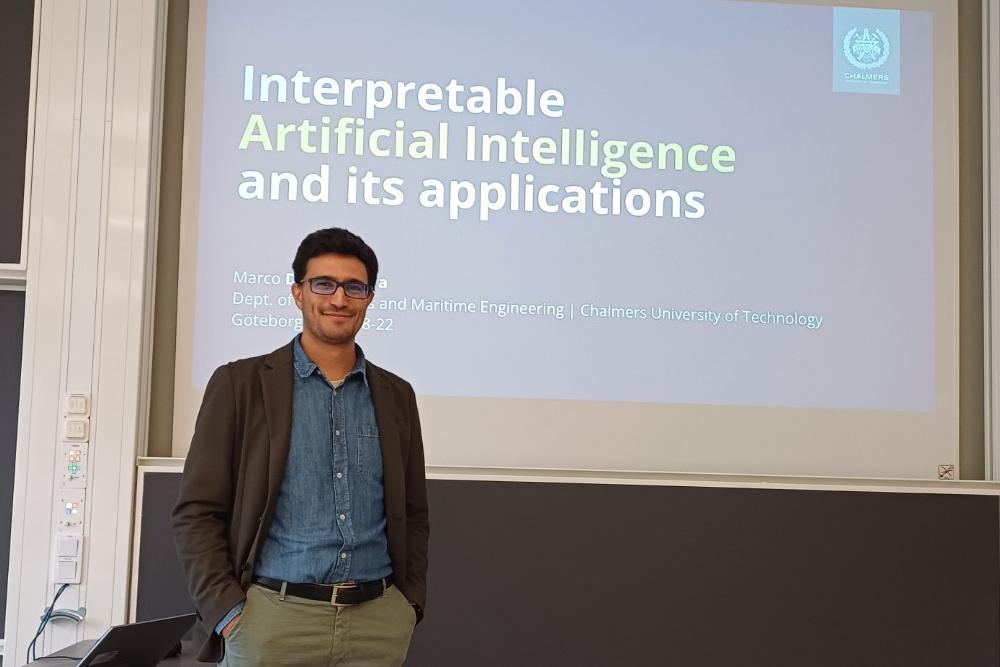
Marco L. Della Vedova is a Senior Lecturer in Applied Artificial Intelligence at Chalmers University of Technology, Sweden. He works in the Vehicle Engineering and Autonomous Systems division within the Department of Mechanics and Maritime Sciences, as part of Prof. Mattias Wahde's research group. Since 2025, he has served as Director of the Data Science and AI master's programme (MPDSC) at Chalmers, where he teaches courses including Introduction to Artificial Intelligence and Digitalization in Sports. Dr. Della Vedova earned his academic foundation at the University of Pavia, Italy, where he completed his BSc (2006), MSc (2009), and PhD (2013) in Computer Engineering. His doctoral research focused on "Real-Time Physical Systems and Electric Load Scheduling" under Prof. Tullio Facchinetti. During his PhD studies, he spent a year at U.C. Berkeley hosted by Prof. Francesco Borrelli at the Model Based Predictive and Distributed Control Lab. His research spans multiple AI domains with a strong emphasis on interpretability. Dr. Della Vedova develops interpretable methods for conversational AI, naturalness evaluation of forests using canopy height models, and geospatial applications. His work bridges theoretical AI with practical societal benefits, particularly in environmental monitoring, transportation systems, and orienteering. He has previously contributed to cloud computing, hate speech detection, and cyber-physical energy systems, demonstrating his interdisciplinary approach to AI research. Dr. Della Vedova's publication record reveals a consistent trajectory of impactful research across multiple domains of artificial intelligence. His recent work shows a strong focus on interpretability in AI systems, with significant contributions to natural language processing, geospatial analysis, and causal inference. The research demonstrates both theoretical depth and practical applications, particularly in environmental monitoring and social media analysis. His methodology often combines traditional machine learning approaches with novel interpretability techniques, creating bridges between complex AI systems and human understanding. Dr. Della Vedova has received several prestigious recognitions for his work: Best PhD thesis award from the Order of the Engineers of Bergamo (2013) Italian champion of Il Cervellone (2012) Top Italian performer in IEEEXtreme 6.0 programming competition (148th overall globally, 2012) Premio Arturo Schena award from Fondazione Credito Valtellinese (2010) With over 50 students supervised through bachelor's and master's theses, Dr. Della Vedova has established himself as a dedicated mentor in the AI community. His current PhD students include Minerva Suvanto working on interpretable NLP and Vivien Lacorre developing AI for railway infrastructure inspection. His supervision spans diverse topics from forest naturalness evaluation to hate speech detection and transportation optimization. Beyond formal supervision, he actively contributes to educational initiatives including serving as Director of Chalmers' Data Science and AI master's program and developing innovative teaching methods that connect theoretical concepts with real-world applications. Dr. Della Vedova is deeply embedded in both academic and professional communities. He leads the Applied Artificial Intelligence research group at Chalmers while maintaining strong connections with European research networks through projects like the ERASMUS+ EUrienteering initiative. His interdisciplinary approach is reflected in collaborations across computer science, environmental science, and social sciences. Notably, he applies his AI expertise to orienteering both as a researcher developing localization methods and as a licensed Event Advisor for the International Orienteering Federation, demonstrating how his professional and personal interests converge in innovative ways.
Mattias Villani is Professor of Statistics at Stockholm University, specializing in Bayesian statistics and machine learning. He obtained his PhD in Statistics from Stockholm University in 2000 and has held positions at Sveriges Riksbank and Linköping University. Villani develops computationally efficient Bayesian methods for inference, prediction and decision-making with flexible probabilistic models. Research Interests: His work spans Bayesian computation (MCMC, HMC, variational inference), machine learning (Gaussian processes, mixture models), and applications in neuroimaging, transportation, and econometrics. Research focuses on scalable Bayesian methods for large datasets and complex models. Publication Focus: Recent articles concentrate on Bayesian neuroimaging analysis, transportation network modeling, and efficient MCMC algorithms. Methodological innovations in subsampling techniques for large-scale Bayesian computation represent a significant research trend. Student Advising: Supervises PhD students in statistical methodology development and applications. Current research groups focus on spatiotemporal modeling, locally stationary processes, and neuroimaging statistics.
Tino Weinkauf is a Professor of Visualization and Head of the Division of Computational Science and Technology at KTH Royal Institute of Technology in Stockholm. His work bridges computer science and applied mathematics, with a focus on visualization and topological data analysis. He leads research in visualizing complex data from fields like fluid dynamics, neurobiology, and human-computer interaction. Education: Ph.D. in Computer Science (not explicitly stated in provided texts, but inferred from career trajectory). Research interests include flow visualization, topological methods for data analysis, and interactive visualization techniques. He develops tools like the TopoInVis Toolkit (TTK) and contributes to infrastructure such as the Swedish Research Infrastructure for Visualization Support (InfraVis). His work emphasizes applications in turbulence modeling, biomedical imaging, and user-centered design. Teaching: Responsible for courses such as Advanced Topics in Visualization and Computer Graphics , Information Visualization , and Introduction to Visualization and Computer Graphics . Supervises degree projects in Computer Science and Engineering across specializations like Machine Learning and Interactive Media Technology. Publications focus on topological data analysis, flow segmentation, and algorithm optimization. Notable projects include binary segmentation of turbulent flows and interactive reward tuning systems for preference elicitation. Labs/Teams: Leads the Division of Computational Science and Technology at KTH, fostering interdisciplinary research in computational methods and visualization technologies.
Tony Hansson is a Professor in the Department of Physics at Stockholm University, focusing on chemical physics and surface reaction dynamics. His research employs advanced spectroscopic techniques like femtosecond photoelectron spectroscopy and sum frequency generation to study molecular interactions with laser pulses and catalytic surfaces. Research Areas: Ultrafast laser-matter interactions, hydrocarbon decomposition, catalyst passivation, and excited state molecular relaxation. Methodologies: Combines experimental approaches (TPD, SFG, XPS, STM) with computational methods (DFT, molecular dynamics). Recent publications highlight his work on naphthalene dehydrogenation on nickel surfaces, sulfur's role in carbon formation, and oxide-derived gold electrode characterization. His studies bridge fundamental atomic-level processes with industrial catalysis applications. Key collaborations include Oliver Schalk and Ting Geng, with affiliations to Stockholm University's Fysikum facility. Contact: thansson@fysik.su.se
Hamed Nemati is an Assistant Professor at the Division of Network and Systems Engineering under the School of Electrical Engineering and Computer Science at KTH Royal Institute of Technology in Stockholm, Sweden. He was previously a Visiting Assistant Professor at Stanford University and a Research Group Leader at the Helmholtz Center for Information Security (CISPA) , where he also worked as a PostDoc and Research Fellow. Education : PhD in Computer Science from KTH Royal Institute of Technology Research Interests : Security of systems software, formal methods and program logics, interactive theorem proving, machine code analysis, applied machine learning Current Projects : Systematic verification of multi-language security protocols, hardware-software co-design for Spectre mitigation, capability-based access control models Scientific Awards : WASP (Wallenberg AI, Autonomous Systems and Software Program) faculty member Teaching Activities : Formal Methods in Security (Fall 2020-2023) at CISPA/Saarland University Digital Forensics and Incident Response (EP2780) (Fall 2024) at KTH
Karl Palmskog is a Lecturer at KTH Royal Institute of Technology in the Division of Theoretical Computer Science and the STEP research group. His work focuses on program verification and proof engineering, with particular emphasis on developing techniques and tools based on proof assistants for constructing functionally correct and secure software systems. Palmskog received his Ph.D. in Computer Science in 2014 from KTH, advised by Mads Dam, and his M.Sc. in Computer Science and Engineering from KTH in 2007. Prior to his current position, he was a postdoc at The University of Texas at Austin and University of Illinois at Urbana-Champaign. His research interests span programming languages, software engineering, and formal verification, with a particular focus on developing techniques and tools based on proof assistants. He is an avid user of the Coq proof assistant for both proving and programming, often complemented by OCaml, and also utilizes HOL4 and other ML family dialects. His work bridges theoretical foundations with practical applications, particularly in the domains of blockchain systems, distributed systems, and automotive software verification. Analysis of his recent publications reveals a strong focus on Coq-based verification, with significant contributions to proof engineering tools and methodologies. His work includes developing tools for regression proving, change impact analysis, mutation testing for Coq projects, and lemma name suggestion using deep learning. There's also a growing trend toward applying formal methods to real-world systems like blockchain protocols and automotive software. Palmskog has been involved in several research projects, including Coq-community Proof Engineering and Distributed Components. His past projects include Trustfull (SSF), Model-based Event Driven Scalable Programming for the Mobile Cloud (NSF), Highly Adaptable and Trustworthy Software (EU FP7), and 4WARD Future Internet (EU FP7). As an educator, Palmskog has served as examiner, course responsible, teacher, and assistant for various courses including Algorithms, Data Structures and Complexity; Degree Projects; Game Theory; Parallel and Distributed Computing; and Programming Paradigms. His work on Chip, a Coq formalization of change impact analysis, demonstrates his commitment to creating practical, certified tools that bridge formal methods with software engineering practice.
Professor Per Stenström is affiliated with the Department of Computer Science and Engineering at Chalmers University of Technology . His research focuses on computer architecture , memory systems optimization , and energy-efficient computing , with significant contributions to DNN accelerator design and cache management . Research Trends : His recent publications emphasize Memory compression techniques for energy efficiency Hardware-software co-design for DNN acceleration Security in microarchitectural optimizations Hybrid memory systems for near-memory computing These works span both theoretical and applied aspects of computer architecture, with a particular focus on data redundancy elimination , parallel processing , and quality-of-service constraints . His work has influenced the development of energy-aware resource management frameworks and resilient EU HPC systems , as evidenced by his long-standing contributions to the field since the early 2010s.
Olaf Hartig is a Senior Associate Professor at Linköping University's Department of Computer and Information Science (IDA), affiliated with the Database and Information Techniques (ADIT) division. He is also an Amazon Scholar collaborating with the Neptune graph database team. His research focuses on data management, semantic web technologies, graph databases, and distributed data systems. Hartig holds a PhD from Humboldt-Universität zu Berlin and is a Docent at Linköping University. He has received numerous awards, including the SWSA Distinguished Dissertation Award and eight best paper awards, and was selected as a Wallenberg Academy Fellow in 2024. Education: PhD in Computer Science (Humboldt-Universität zu Berlin), Docent (Linköping University). Research interests span query processing for Linked Data, federated systems, RDF and GraphQL semantics, and knowledge graph construction. He leads research groups in Database and Web Information Systems and Semantic Web Technologies at IDA. Key achievements include pioneering traversal-based query execution, developing Triple Pattern Fragments, and contributions to standards like RDF* and SPARQL*. His work has been recognized through grants, patents (e.g., on graph acceleration techniques), and leadership roles in conferences like ISWC and ESWC. Teaching: Course leader for database technology courses (TDDD12, TDDD37) and advanced topics like big data analytics and bioinformatics databases. Active in curriculum design and interdisciplinary education. Labs/Teams: Database and Web Information Systems Group, Semantic Web Research Group, Sports Analytics Group (IDA) Grants: Wallenberg Academy Fellowship, Swedish Research Council funding
Marina Papatriantafilou is an Associate Professor in the Department of Computer Science and Engineering at Chalmers University of Technology and University of Gothenburg. Her research focuses on distributed computing, fault-tolerance, parallel algorithms, and concurrency control. She has contributed to methods for fault-tolerant distributed systems, visualization tools for distributed algorithms, and scalable overlay networks. Her academic roles include teaching advanced courses on distributed systems, computer communication, and operating systems. She advises graduate students in areas like distributed algorithms and parallel computing. Key research interests include lock-free synchronization, memory reclamation, and self-stabilizing systems. She has authored over 100 publications in top-tier conferences and journals, with recent work on data streaming frameworks, energy-sharing optimization, and vehicular network processing. Professional involvement includes roles in program committees for conferences like OPODIS, SWAT, and SSS, plus membership in research evaluation boards for Swedish and European funding agencies. She pioneered educational tools like the Lydian environment for distributed algorithm visualization.
Philippas Tsigas is a Professor at the Department of Computer Science and Engineering at Chalmers University of Technology. He leads the Distributed Computing and Systems Research Group and has held roles as co-leader of research initiatives such as the PEPPHER project. His research spans distributed/parallel computing, information visualization, and fault-tolerant communication mechanisms. He has supervised numerous PhD students, including Yi Zhang, Håkan Sundell, and Farnaz Moradi. Research interests include lock-free data structures, multicore algorithms, secure network services, and visualization tools like Lydian and DataMeadow. Notable awards include Best Paper Awards at IPDPS 2003 and SNS 2012. His work has been published in top venues like IEEE Transactions on Parallel and Distributed Systems and ACM Journal of Experimental Algorithmics. Awards highlight contributions to lock-free algorithms and network modeling. Students have contributed to projects like NBmalloc (memory reclamation) and GPU Quicksort. Collaborations with institutions like SSF and VR have supported his research. Tsigas is also involved in teaching distributed systems and mentoring early-career researchers.
Professor Javid Taheri is a leading academic at Karlstad University (2019–present), previously serving as Associate Professor (2015–2019) and Senior Lecturer (2015). His research focuses on cloud computing, edge computing, distributed systems, and AI-driven networking. He holds a Ph.D. in Information Technologies from The University of Sydney (2007) and an M.Sc./B.Sc. in Electrical Engineering from Sharif University of Technology (2000/1998). Research interests include cloud-edge continuum systems , resource optimization , 5G/6G networking , and AI for IoT . Notable contributions include frameworks like PerfSim (microservice performance simulation) and MultiScaler (auto-scaling for cloud applications). Publications highlight innovations in edge computing optimization, security for distributed systems, and machine learning for resource management. He has co-authored over 150 papers across top venues like IEEE Transactions and ACM conferences. Academic leadership includes roles as conference chair (IC2E 2023) and editorial work for journals on cloud and edge computing.
Niclas Jansson is a researcher at the PDC Center for High Performance Computing at KTH Royal Institute of Technology. He holds an M.S. in Computer Science (2008) and a Ph.D. in Numerical Analysis (2013) from KTH. His career spans roles such as postdoctoral researcher at RIKEN Advanced Institute for Computational Science (2013-2016) and visiting scientist at RIKEN (2018-2021), where he contributed to the Japanese exascale program Flagship 2020. A core focus of his research involves extreme-scale computing and numerical method development. He is a key developer of RIKEN's multiphysics framework CUBE , the HPC branch of FEniCS , and the spectral element flow solver Neko . His work is currently supported by a Swedish Research Council Starting Grant aimed at enhancing high-order spectral element methods for exascale fluid simulations. Niclas has published extensively on topics such as GPU acceleration , adaptive finite element methods , in situ visualization , and extreme-scale turbulence modeling . He also teaches Computational Fluid Dynamics (SG2212) at KTH.
Atila Alvandpour serves as Professor and Head of the Integrated Circuits and Systems Division at Linköping University's Department of Electrical Engineering (ISY), concurrently holding the position of Vice Head of the Department. He joined the university in 2003 following senior research scientist roles at Intel Corporation's Circuit Research Lab (1999-2003). His educational foundation includes M.S. and Ph.D. degrees earned from Linköping University in 1995 and 1999 respectively. Alvandpour's research centers on advanced nano-scale integrated circuit design , with pioneering work in data converters (ADCs/DACs) , RF transceivers , and ultra-low-power systems . His expertise spans sensor interfaces, energy-harvesting architectures, and multi-GHz digital circuits, driving innovations for IoT and biomedical applications through novel analog/mixed-signal techniques. Recent publications (2024-2025) reveal a strategic focus on system-level integration for emerging technologies, particularly energy-efficient SoCs for wireless optical sensing, RF energy harvesting, and bio-implantable devices. This trend emphasizes circuit miniaturization, power optimization, and multi-functional integration in cutting-edge CMOS processes. No formal scientific awards are documented in the source materials. As Division Head and active researcher with 24 U.S. patents, Alvandpour leads a significant research group within the Division of Electronics and Computer Engineering (ELDA). His IEEE senior membership and editorial roles for flagship journals like IEEE Journal of Solid-State Circuits demonstrate substantial professional influence, though specific grant details remain unspecified.