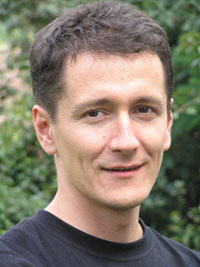
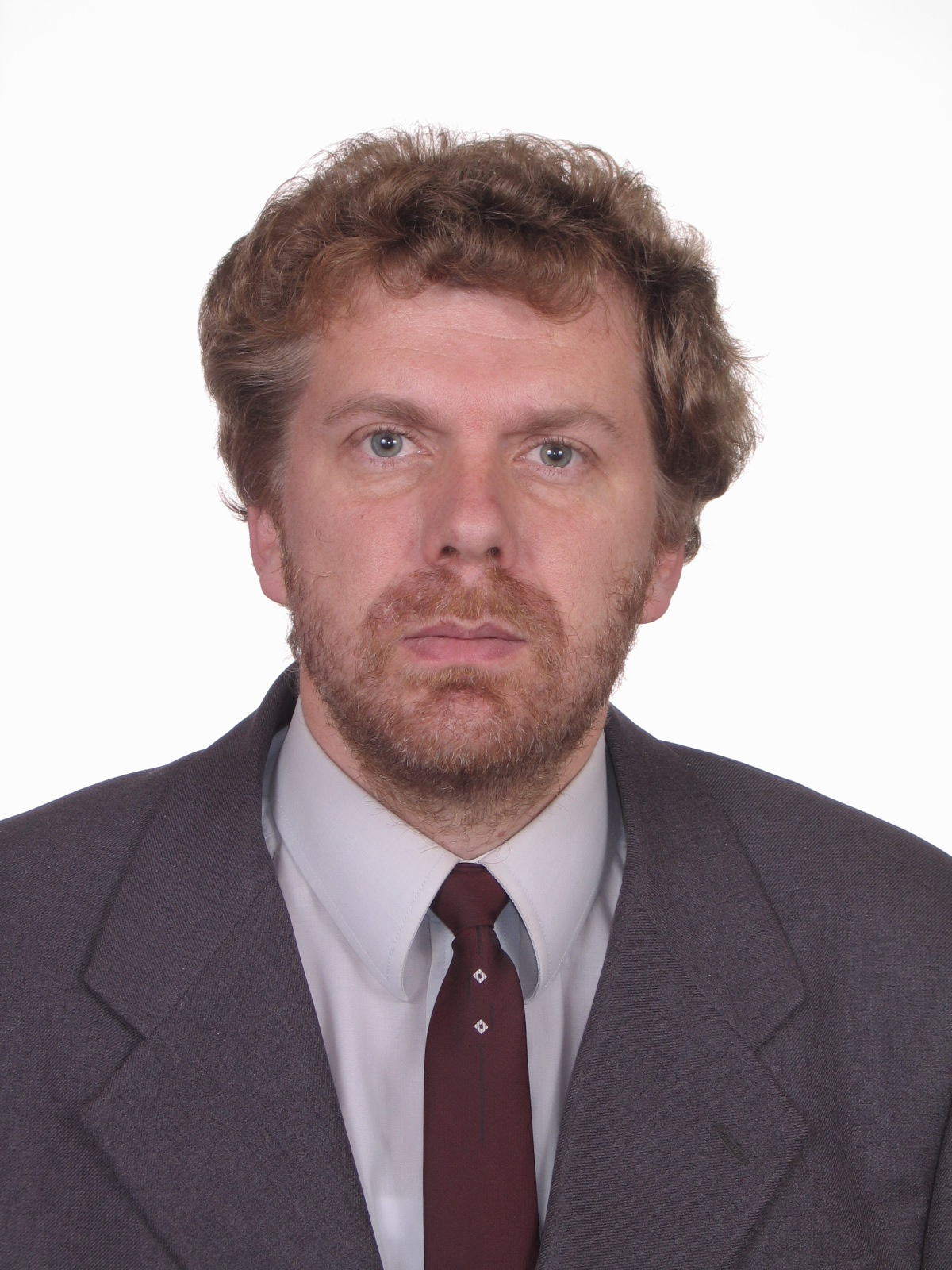
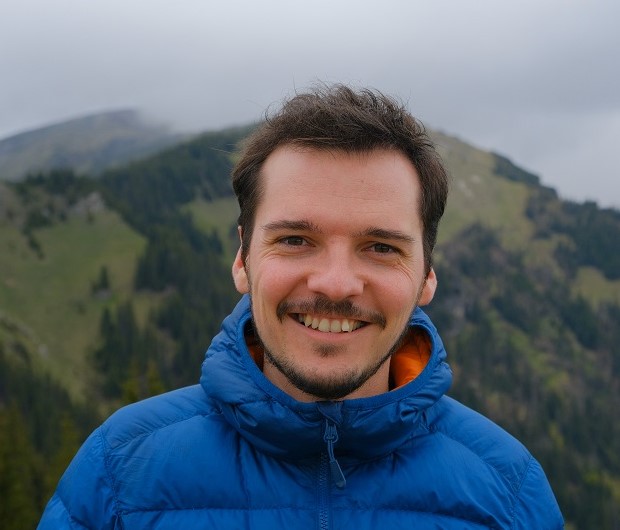
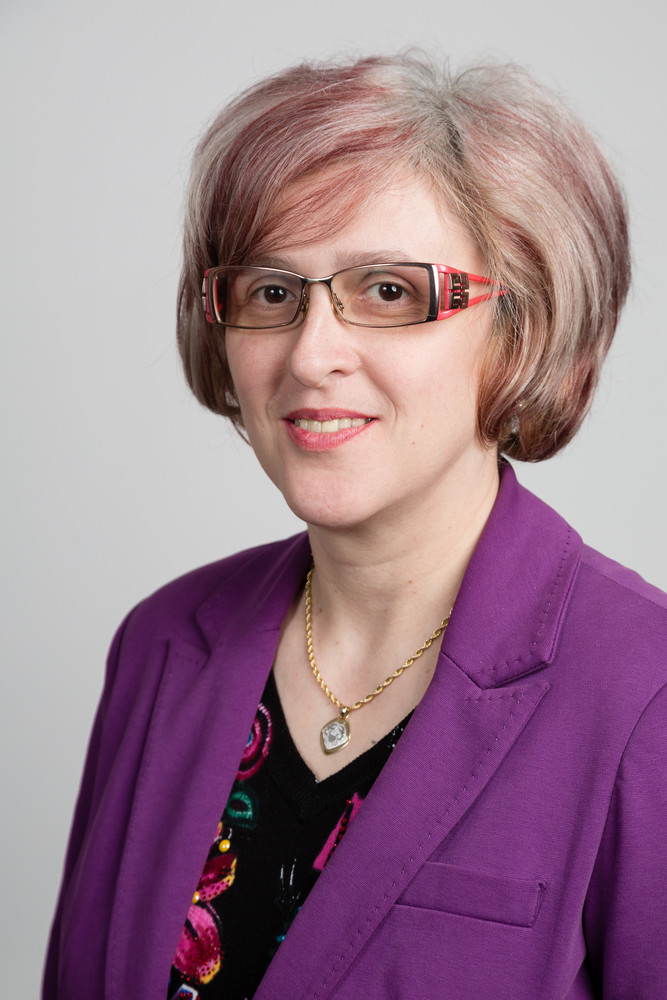
Lehel Csató is a Professor at the Faculty of Mathematics and Informatics of Babeș-Bolyai University in Cluj-Napoca, Romania. His academic journey includes a PhD from Aston University and a postdoctoral position at the Max Planck Institute for Biological Cybernetics. He specializes in Machine Learning, Probabilistic Robotics, and Nonparametric Bayesian Methods, with a focus on Gaussian Processes and their applications in data analysis and robotics. Teaching includes courses in Logic and Functional Programming (Hungarian), Numerical Modelling in Data Analysis (English), and Artificial Intelligence (Hungarian). His research emphasizes sparse Gaussian Process approximations and their use in reinforcement learning, robotics, and medical image analysis. He contributed to the development of the Sparse Online Gaussian Process toolbox. Publications span topics from deep learning architectures to optimization techniques in neural networks. He has organized the ClujUAV drone navigation competition and collaborated on interdisciplinary projects involving robotics, vision, and medical data analysis.
Zalán Bodó is an Associate Professor at the Faculty of Mathematics and Computer Science , Babeș-Bolyai University, Cluj-Napoca, Romania. His research focuses on Artificial Intelligence, Machine Learning, Information Retrieval, Natural Language Processing, Formal Languages, and Computer Vision . He holds an Erdős number of 4 and maintains an active presence in academic networks like Google Scholar and DBLP. His work bridges theoretical and applied computer science, with contributions to malware analysis, explainable AI, and dataset compilation. He has published extensively on topics such as graph-based malware detection, automated code generation, and medical imaging applications. His office is located at Mathematicum Building (room 207), and he can be reached via zalan.bodo@ubbcluj.ro or zalan.bodo@gmail.com .
Zsolt Darvay is an Associate Professor at Babeş-Bolyai University in Cluj-Napoca, Romania. He is affiliated with the Faculty of Mathematics and Computer Science, specifically the Department of Mathematics and Computer Science of the Hungarian Line. His academic career spans over two decades, with roles including Lecturer and Assistant Professor before his current position since 2019. His research focuses on optimization theory, particularly interior-point methods for linear and symmetric cone complementarity problems, algorithm design, and computational mathematics. He has authored numerous publications in top-tier journals and conference proceedings, contributing to the advancement of numerical optimization techniques and their implementations in programming languages like Java. Darvay has presented his work at conferences such as the International Symposium on Operational Research (SOR) and the Hungarian Scientific Days in Transylvania. His teaching activities include courses on advanced programming, optimization techniques, and software design patterns. Despite extensive contributions to academia, no specific scientific awards are explicitly mentioned in the provided information.
Anna Soós is an Associate Professor at the Hungarian Mathematics and Informatics Institute, Faculty of Mathematics and Informatics, Babes-Bolyai University (Cluj-Napoca, Romania). She holds a PhD in Mathematics (2002) and has been active in stochastic analysis, fractal theory, and approximation methods. Her academic career includes leadership roles such as Vice-Rector for Curriculum and Hungarian Studies (2012–present) and Vice-Dean of the Faculty of Mathematics and Informatics (2008–2012). Education: MSc in Mathematics (Babes-Bolyai, 1982), MSc in Computer Science (Eötvös Loránd University, 1996), PhD in Mathematics (Babes-Bolyai, 2002) Her research focuses on deterministic and random fractals, stochastic differential equations, and homogenization on fractal structures. She has contributed to stochastic analysis through: Developing contraction methods in probabilistic metric spaces Wavelet approximations for SDE solutions Fractal interpolation techniques Scientific awards include: Bolyai János Research Fellowship Erasmus and CEEPUS Fellowships Domus Hungarica Scientiarum et Artium Grants World Bank Project Participation Anna Soós has coordinated international research projects like ERASMUS IP DSL2013 and FP7/MASCIL, while organizing conferences including the International Symposium on Numerical Analysis and Approximation Theory and Central European Functional Programming Summer Schools.
Prof. Dr. Adrian-Olimpiu Petruşel is a distinguished Professor at the Faculty of Mathematics and Informatics, Babes-Bolyai University in Cluj-Napoca, Romania. Currently serving as Prorector of the university (since 2020) and appointed as Interim Rector starting in 2025, he has held numerous academic leadership positions including Dean of the Faculty of Mathematics and Informatics (2012-2020) and Pro-Dean (2008-2012). A highly respected researcher in fixed point theory and nonlinear analysis, he ranks among the top 2% most influential scientists worldwide according to Stanford University's analysis (2020-2023). Educational Background: Undergraduate Studies: 1982-1986, Faculty of Mathematics and Informatics, Babes-Bolyai University Cluj-Napoca Doctoral Studies: 1990-1994, Faculty of Mathematics and Informatics, Babes-Bolyai University Cluj-Napoca PhD Thesis: "Technica punctului fix în teoria operatorilor multivoci şi aplicaţii la incluziuni diferenţiale" (Fixed Point Technique in the Theory of Multivalued Operators and Applications to Differential Inclusions) Prof. Petruşel's research primarily focuses on Fixed Point Theory , Nonlinear Operators , and Differential Equations . His work spans theoretical developments in metric fixed point theory, applications to differential and integral equations, and interdisciplinary connections with dynamical systems. He has made significant contributions to the theory of multivalued operators, particularly in the areas of weakly Picard operators, fiber contraction principle, and Ulam-Hyers stability. His research demonstrates exceptional depth in both pure mathematical theory and practical applications across various scientific domains. Analysis of Prof. Petruşel's recent publications (2024-2025) reveals continued innovation in fixed point theory, with particular emphasis on multi-valued Feng-Liu operators, vector-valued metric spaces, and applications to differential equations. His work maintains strong connections between abstract fixed point results and concrete problems in mathematical physics, optimization, and integral equations. The interdisciplinary nature of his research is evident in collaborations spanning mathematics, physics, and engineering applications. Scientific Recognition: Premiul Universitatii "Babes-Bolyai" (2002) for the seminal book "Fixed Point Theory 1950-2000: Romanian Contributions" Profesor Bologna distinction (2021) awarded by AOSR student organization Ranked among the top 2% most influential scientists worldwide (2020-2023) by Stanford University and SciTech Strategies Full member of Academia Oamenilor de Stiinta din Romania (since 2020), previously associate member (2016) and corresponding member (2018) As an academic advisor, Prof. Petruşel has successfully supervised 15 PhD students since 2004, contributing significantly to the next generation of mathematicians specializing in nonlinear analysis. His editorial leadership is remarkable, serving as Editor-in-Chief of "Fixed Point Theory - An International Journal" and co-Editor-in-Chief for several other prestigious journals including "Fixed Point Theory and Applications" (Springer). He has coordinated numerous national and international research programs, demonstrating sustained excellence in both theoretical research and academic leadership.
Mihai Nechita is a Lecturer at the Department of Mathematics, Babeș-Bolyai University, and a Researcher at the Tiberiu Popoviciu Institute of Numerical Analysis (Romanian Academy). He holds a PhD in Mathematics from University College London (2020), where he focused on unique continuation problems and stabilized finite element methods under the supervision of Erik Burman and Lauri Oksanen. His research interests span numerical analysis, partial differential equations, inverse problems, and scientific computing. Education: PhD in Mathematics, University College London (2016–2020) Master in Applied Mathematics, Babeș-Bolyai University (2014–2016) Bachelor's Degree in Mathematics and Computer Science, Babeș-Bolyai University (2011–2014) Research focuses on developing numerical methods for PDEs and inverse problems, including finite element methods and physics-informed neural networks. Key contributions include work on Helmholtz problems, convection-diffusion equations, and data assimilation under PDE constraints. He actively collaborates internationally, co-organizing conferences like the 2024 Numerical Analysis and Approximation Theory conference in Cluj-Napoca. Recent publications emphasize stabilization techniques for ill-posed problems and applications of machine learning in scientific computing. Awards include the Medalia Distincţia Culturală (2020) and multiple scholarships from UCL and Babeș-Bolyai University. Teaching responsibilities include Mathematical Analysis and Numerical Analysis courses for undergraduate students at Babeș-Bolyai University. He has held postdoctoral positions at Inria Paris (2020–2022) and Babeș-Bolyai University (2022–2023), and has contributed to projects like the European Commendia team.
Lorand Gabriel Parajdi is a Lecturer at the Department of Mathematics, Faculty of Mathematics and Computer Science, Babeș-Bolyai University in Cluj-Napoca, Romania. He holds a Ph.D. in Mathematics (2019) and has held academic positions including Postdoctoral Researcher at West Virginia University (2021–2025) and roles such as Assistant Professor and Associate Assistant Professor at Babeș-Bolyai University. His research focuses on mathematical modeling in hematology and oncology, particularly in chronic myeloid leukemia and solid tumors. Education: Ph.D. in Mathematics (2019), Babeș-Bolyai University M.Sc. in Applied Mathematics (2015), Babeș-Bolyai University B.Sc. in Pure Mathematics (2013), Babeș-Bolyai University Research Interests: Mathematical modeling of cell dynamics, differential equations, optimal control in medical contexts, hematopoiesis, leukemia progression, and biomathematical systems. He actively contributes to theoretical and computational studies of stem cell transplantation, treatment optimization, and residual disease assessment in chronic myeloid leukemia. Research Projects: Includes work on clonal hematopoiesis, chemical reaction networks, and DSR cycles in biochemical systems. His projects often integrate numerical methods and stability analysis for biomedical applications. Affiliations: Member of research groups such as the WVU Mathbio Research Group and the Nonlinear Operators and Differential Equations Group at Babeș-Bolyai University. Professional memberships include the American Mathematical Society and European Society for Mathematical and Theoretical Biology. Grants: Supported by projects like POCU 153310 (STEAM+Health) for optimal control in cell dynamics. His work aligns with interdisciplinary research in STEM+Health. Labs/Teams: Collaborates with interdisciplinary teams in mathematical biology, computational medicine, and systems biology at both national and international levels.
Dr. Romulus Valeriu Flaviu Turcu is an Associate Professor at the Department of Physics, Babeș-Bolyai University, and Director of the National Institute for Research and Development of Isotopic and Molecular Technologies (NIRD-IMT) since 2019. He holds a Ph.D. in Physics from Babeș-Bolyai University, a master’s in Material Science, and a bachelor’s in engineering. With over 17 years in academia and R&D, his interdisciplinary expertise spans Nuclear Magnetic Resonance (NMR), materials science, medical imaging, and high-pressure engineering. His research has been conducted across institutions in Europe and North America, including the Pacific Northwest National Laboratory (USA) and Los Alamos National Laboratory. He also serves as a visiting professor at the University of Rochester’s Ain Center for Entrepreneurship. Dr. Turcu’s work focuses on advanced materials, energy technologies, and innovative instrumentation, with contributions to carbon sequestration studies and biomedical applications of MRI. Key research areas include NMR methodologies for material characterization, development of nanostructured composites, and applications of machine learning in energy systems. His publications reflect a strong emphasis on interdisciplinary approaches, combining experimental physics, computational modeling, and engineering solutions. Dr. Turcu leads strategic initiatives at NIRD-IMT, advancing Romania’s technological capabilities in isotopic and molecular technologies. He has coordinated numerous R&D projects for enterprises and international collaborations, demonstrating expertise in transitioning research into practical innovations.
Prof. Monica Leba holds a Professorship in the Department of Automation, Computers, Electrical and Power Engineering at the University of Petroșani's Faculty of Mechanical and Electrical Engineering. Her work bridges multiple disciplines including robotics, AI-driven systems, cybersecurity, and sustainable technologies. She leads research in areas such as brain-computer interfaces (BCI), exoskeleton control, agritourism innovation, and smart grid integration for electric vehicles. Her academic training and professional experience are deeply rooted in engineering with a focus on practical applications. Recent research emphasizes human-centric technologies like wearable motion capture systems for industrial safety, AI-enhanced gait analysis for neurodegenerative disease management, and BCI-controlled robotics for neurorehabilitation. She also explores socio-technical systems such as agritourism 4.0 frameworks and project management methodologies (SAFe®/Agile) for tech innovation. Leba's publications reflect a multidisciplinary approach, with over 30+ peer-reviewed papers since 2020 addressing topics like: Energy-efficient cryptography designs Autonomous vehicle navigation systems Wildlife conflict prevention via IoT Fuzzy logic-based startup risk assessment Smart grid integration for mining regions Her work often combines hardware-software co-design principles with real-world implementation in industrial heritage revitalization (e.g., Petrila mining area), wearable healthcare systems, and rural technology adoption. Current projects include AI-driven burnout monitoring devices and collaborative robotics for manufacturing. Leba collaborates with industry partners on applied research in: Underground mine communication systems Autonomous drone navigation Medical exoskeleton control Smart tourism platforms Her research philosophy emphasizes sustainability, human-centered design, and translational innovation across engineering, healthcare, and agritourism sectors.
Corneliu Mandrescu is an Associate Professor at the Faculty of Mechanical and Electrical Engineering of the University of Petroșani, Department of Automation, Computers, Electrical and Power Engineering. His work focuses on control systems, electrical engineering, and automation, with a strong emphasis on sensorless control, motor control, and optimization techniques. He has contributed to advancements in vector control systems, Kalman filter applications, and system stability analysis. His research interests include the modeling and simulation of control systems, particularly in mining and industrial contexts, such as coal flow analysis in longwall mining systems and electric vehicle motion control. He has also explored sensor technology, transducers, and continuous process control, reflecting his interdisciplinary approach to automation challenges. Mandrescu’s publications span from foundational studies on system identification and estimator design to applied work in electrical drive systems and induction motor control. His work often integrates theoretical models with practical implementation, addressing real-world engineering problems. While no specific grants or awards are noted, his extensive publication record highlights sustained contributions to the field. He has advised no listed students, and his professional activities, including lab affiliations or ongoing projects, are not detailed in the provided text.
Dr. Buimaga-Iarinca Luiza Tania is a Researcher (R3) at the National Institute for Research and Development of Isotopic and Molecular Technologies (INCDTIM) in Cluj-Napoca, Romania. She works in the Materials, Energy and Advanced Technologies department, leading the Quantum Engineering research team. Her expertise spans theoretical and computational approaches in materials science, quantum computing, and energy storage systems. PhD in Physics (2011), Master's in Biophysics (2005), and Bachelor's in Physics (2004) – all from Babeș-Bolyai University Her research focuses on quantum materials , 2D nanosystems , and computational design of advanced materials . She applies Density Functional Theory (DFT) and Quantum Monte Carlo simulations to study molecular electronics, superconducting qubits, and battery electrode optimization. Her recent projects include error-corrected quantum computing architectures and stability analysis of organic electrode materials. Current work trends emphasize quantum engineering applications in energy systems ( lead-acid batteries , Lithium-ion MOFs ), topological superconductivity in transition metal dichalcogenides, and computational design of antimicrobial peptides . She collaborates internationally with institutions like École Normale Supérieure de Lyon and Universität Innsbruck.
BOGDANFFY Lorand is a Professor and Head of the Department of Automation, Computers, Electrical and Power Engineering at the Faculty of Mechanical and Electrical Engineering, UPET.RO. He holds a PhD and specializes in IoT systems, control engineering, renewable energy, and e-learning technologies. His research integrates simulation, modeling, and sensor networks into practical applications like smart urban management, solar tracking systems, and underground mining safety. His work spans interdisciplinary areas such as: IoT-enabled environmental monitoring for sustainable cities Computational methods in mining safety and risk analysis Development of e-learning platforms and educational software Advanced motor control systems and sensorless vector control His recent publications highlight trends in: Smart infrastructure and energy optimization Data-driven decision-making in insurance and risk management 360° imaging systems and mobile teleoperation No scientific awards are listed in the provided texts. His advising and grants focus on engineering education and industrial automation projects. He leads teams in developing control systems and renewable energy solutions.
Dr. Rada Andrei is an Assistant Professor at the Faculty of Mechanical and Electrical Engineering , UPET.RO , affiliated with the Department of Automation, Computers, Electrical and Power Engineering. His research focuses on energy security, power systems optimization, electrostatic filtration technologies, and industrial automation. He has contributed extensively to studies on energy sector dynamics, centrifugal pump performance modeling, and energy efficiency in mining operations. His academic work spans experimental measurements of industrial equipment (e.g., pumps, transformers), simulation of thermal systems, and critical analysis of national/international energy policies. Notable collaborations include projects with the Institute of „Ioan Ursu” and energy companies of national strategic importance. Key research directions include: Power crisis mitigation strategies Electrostatic particle charging mechanisms Virtual instrumentation in engineering design Energy balance calculations for industrial systems Industry 4.0 implementation in production processes Dr. Andrei has developed a laboratory guide for electric machines and pioneered real-time electricity balance analysis at lignite coal mines. His work emphasizes bridging theoretical models with practical industrial applications.
Ionel Rovenţa is a Lecturer in the Department of Mathematics at the Faculty of Mathematics and Computer Science, University of Craiova, Romania, where he has been teaching since 2007. He previously served as a Junior Teaching Assistant and Teaching Assistant from 2005 to 2007. He also holds the administrative position of Head of the Department of Mathematics. His research interests span several core areas of pure and applied mathematics, including Mathematical Analysis , Functional Analysis , Convex Geometry , Dynamical Systems , and Operator Theory . His work also extends into computational domains such as Scientific Computing , Algorithms , and Graph Theory . He is an active member of the mathematical community, holding memberships in the Romanian Mathematical Society (since 2003) and the American Mathematical Society (since 2006). Ionel Rovenţa received early recognition for his mathematical talent, including a Third Prize in the Traian Lalescu National Mathematics Competition and an Honorable Mention at the 10th International Mathematics Competition for University Students, both in 2003. He has supervised various undergraduate and graduate-level courses and seminars, including Real Analysis, Differential Calculus in Several Variables, Lebesgue Integration, Ergodic Theory, and Computational Logics. His educational background includes a PhD from the University of Craiova on convexity in curved geometry under the supervision of Prof. Dr. Constantin Niculescu, a Master's in Dynamical Systems and Evolution Problems, and an undergraduate degree from the same institution. He is involved in academic service and leadership as Head of the Department of Mathematics, contributing to the administration and academic direction of the department.
Sorin Micu is a Professor in the Department of Mathematics at the Faculty of Mathematics and Natural Sciences, University of Craiova, Romania. He is actively involved in research and teaching, with a strong focus on partial differential equations and their control. University: University of Craiova School: Faculty of Mathematics and Natural Sciences Department: Department of Mathematics Email: sd_micu@yahoo.com Office: Room 309, Central Building, AI Cuza 13, 200585 Craiova, Romania Research Interests: His primary research areas include the control of partial differential equations (PDEs), numerical analysis of PDEs, and mathematical modeling. He investigates controllability properties of various PDEs such as the heat, wave, Schrödinger, and Korteweg-de Vries equations, often using tools like Carleman estimates, duality methods, and finite element approximations. His work bridges theoretical analysis with numerical simulation, particularly in the context of semidiscretized and discrete systems. Publication Trends: The articles span from 1995 to 2017, showing sustained contributions in control theory for PDEs. The research evolves from classical equations (heat, wave) to more complex models (nonlocal, degenerate, nonlinear), with increasing focus on numerical approximation and discrete controllability. Keywords consistently revolve around controllability , stabilization , numerical methods , and nonlinear dynamics . Scientific Projects: Bilateral Contract Romania-France (2009–2010), Capacities Program, Module III Bilateral Project Romania-France (English version) Project PN-II-ID-PCE-2011-3-0257 Teaching and Advising: Professor Micu teaches courses such as Numerical Analysis, Algorithmics and Numerical Simulation in C++, Modeling and Simulation, and Finite Element Methods at both undergraduate and master’s levels. While formal advisees are not listed, his teaching and research supervision likely involve mentoring graduate students. He offers consultations every Thursday from 15:00 to 16:00 in Room 309. Laboratories and Teams: He is affiliated with research groups working on PDE control and numerical analysis at the University of Craiova. His collaboration with French institutions indicates participation in international research networks focused on applied mathematics and control theory.