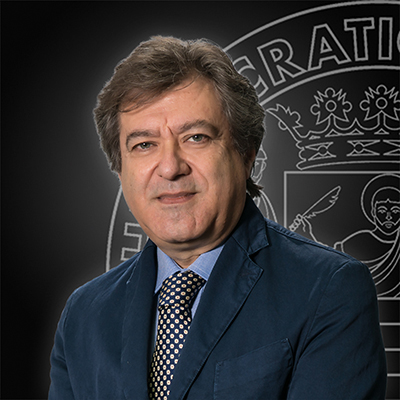
Gianvincenzo ALFANO is a Researcher at the Department of Computer Engineering, Modelling, Electronics and Systematics (DIMES) at the University of Calabria. His work focuses on abstract argumentation frameworks, epistemic reasoning, and computational complexity. University: University of Calabria Department: Department of Computer Engineering, Modelling, Electronics and Systematics Academic Rank: Researcher Research Interests: Gianvincenzo specializes in abstract argumentation, exploring formal foundations, complexity analysis, and applications in artificial intelligence. His research spans epistemic reasoning, preference handling, and incremental computation in dynamic knowledge bases. Recent Publications: Over the past two years, he has published extensively on topics such as physics-informed neural networks in federated learning, credulous acceptance in high-order frameworks, and complexity of epistemic argumentation. His work emphasizes formal logic, algorithm design, and uncertainty handling in AI systems.
Giulia Bruno is an Associate Professor at the Department of Management and Production Engineering (DIGEP) of Politecnico di Torino, where she also serves as a Junior project manager and is a member of both the Interdepartmental Center J-Tech@PoliTO and the Joint Committee on Teaching. Her academic expertise lies in Manufacturing Technologies and Systems (IIND-04/A) within Industrial and Information Engineering. She holds formal recognition in ERC sectors including Artificial Intelligence, Manufacturing Engineering, and Production Technology. Dr. Bruno's research focuses on the integration of digital technologies with manufacturing systems, exploring how discrete event simulation, Industrial IoT, and Industry 4.0 principles can transform traditional manufacturing through lean approaches. Her work spans manufacturing execution systems, product lifecycle management, and increasingly incorporates machine learning applications for quality control and predictive maintenance in production environments. Recent publications reveal expanding interest in applying manufacturing principles to agricultural technology, particularly in aeroponics and vertical farming systems. Her publication record demonstrates a clear trend toward human-centric approaches to digitalization in manufacturing, with emphasis on sustainable production practices and the integration of AI with traditional manufacturing processes. Recent work shows strong interdisciplinary connections between manufacturing systems and agricultural technology. Burbidge Award for the Best Paper - APMS'14 (International Federation for Information Processing) Mentoring Polito Project (M2P) badge issued August 25, 2023 Dr. Bruno actively supervises five PhD students working on advanced manufacturing technologies and systems. She currently leads the HANDS project (Human-centric Agile Next-gen Digitalization System, 2024-2026) as Scientific Manager and contributes to regional research initiatives. Her teaching spans PhD, Master's, and Bachelor's levels with focus on machine learning applications in manufacturing, production systems management, and business information systems. She leads research groups focused on Knowledge engineering management and Management of production systems within DIGEP, contributing to the advancement of manufacturing technologies and sustainable production practices.
Alessandro Chiaraviglio serves as an External lecturer and teaching assistant within the Department of Management and Production Engineering (DIGEP) at the Polytechnic University of Turin. He holds dual affiliations as a core member of the College of Management and Production Engineering and an invited member of the College of Mechanical, Aerospace, and Automotive Engineering. His teaching portfolio centers on Industrial Plants and Occupational Safety across Mechanical Engineering, Industrial Production Engineering, and Management Engineering programs for academic years 2019/20 through 2025/26. Chiaraviglio's research spans Industrial Engineering, Operations Management, Logistics, Safety Engineering, and Railway Engineering with emphasis on system optimization. His work bridges theoretical frameworks and industrial applications—particularly in warehouse performance metrics, railway infrastructure design, and safety-integrated production systems. Key methodologies include performance indicator development, multimodal transport modeling, and logistical process re-engineering for complex engineering environments. Publication analysis reveals a strategic evolution from 2006 railway infrastructure studies (Lyon-Turin line design, Alpine tunnel utilization, Tram-Train systems) to the 2025 warehouse operations framework. This trajectory demonstrates consistent focus on transportation/logistics optimization, with recent work introducing the Overall Warehouse Effectiveness (OWE) metric as a unifying framework for operational performance assessment across supply chain nodes.
Sergej Antonello Sirigu is a Fixed-term Assistant Professor at the Politecnico di Torino's Department of Mechanical and Aerospace Engineering (DIMEAS) , specializing in Wave and Offshore Renewable Energy . He serves as a Scientific Director for projects like SEAFORM2 and SEAFORM , focusing on modular floating platforms and wave energy converters (WECs). His research spans Applied Mechanics , Numerical Modeling , and Experimental Validation of marine energy systems. Teaching Roles : Course owner/instructor for Numerical Modeling and Experimental Validation of Wave and Offshore Wind Energy Converters (2023-2025), collaborator in courses like Wind and Ocean Energy Plants and Mechatronics . PhD Student Supervision : Co-supervisor for Filippo Giorcelli's research on Wave Energy Converter Optimal Design (38th cycle, 2022-ongoing). Patents : Co-inventor of Modular Floating Platforms System , Multifunctional Gyropendulum and WEC , and Resonance Frequency Adaptation Technology . Sirigu's work integrates Renewable Energy and Mechanical Engineering , with applications in Wave Energy , Offshore Wind , and Energy Systems Optimization . His publications highlight Experimental Validation and Techno-Economic Modeling of marine energy technologies. He collaborates with the MOREnergy Lab, a Politecnico di Torino research center specialized in Marine Offshore Renewable Energy .
Walter Franco is a Full Professor at Politecnico di Torino in the Department of Mechanical and Aerospace Engineering (DIMEAS), where he specializes in applied mechanics. He serves as a Member of the Coordinating Committee of the Politecnico University Centre for Social Affairs and participates in several international research committees, including IFToMM technical committees for Biomechanical Engineering and Sustainable Energy Systems. His research focuses on interdisciplinary areas spanning: Appropriate technology and sustainable machine design Biomechanics and medical robotics Historical development of mechanisms and machines Fluid power systems and mechatronics Grassroots innovation for sustainable development Professor Franco's publications demonstrate strong themes in sustainable mechanical design, biomechanical applications, and historical engineering analysis. His recent work frequently addresses the intersection of traditional mechanical engineering with contemporary sustainability challenges, particularly in human-powered systems and medical devices. He has received numerous scientific awards including: Best Paper Award at IFIT 2016 IHTC2017 First Prize in Technical Paper Springer Best Research Paper on History of Mechanisms (2019) Multiple best paper awards at IFToMM conferences (2018-2023) Professor Franco leads research projects on hydraulic systems analysis and sustainable technologies, and has supervised PhD students working on exoskeletons and engineering heritage. He holds multiple patents in medical devices and mobility aids, including: Ankle-foot orthosis with 3D-printed components Stair-climbing wheelchair systems Pneumatic medical devices
Nicola Bosso is a Full Professor at the Department of Mechanical and Aerospace Engineering (DIMEAS) at the Polytechnic University of Turin, Italy. He serves as a member of the College of Mechanical, Aerospace and Automotive Engineering and has been continuously involved in the PhD program in Mechanical Engineering for multiple cycles from 2015/2016 through 2024/2025. His academic career spans over a decade of teaching and research in mechanical engineering with a strong emphasis on railway systems and multibody dynamics. Research Focus: Professor Bosso specializes in experimental mechanics and multibody dynamics with particular expertise in railway dynamics, monitoring systems, and vehicle dynamics. His research encompasses roller rig testing methodologies, wear analysis of materials, and wheel-rail contact mechanics. His work aligns with several Sustainable Development Goals including Industry, Innovation and Infrastructure (Goal 9), Sustainable Cities and Communities (Goal 11), Responsible Consumption and Production (Goal 12), and Climate Action (Goal 13). His research integrates computational engineering with experimental validation to address complex railway engineering challenges. Publication Trends: Recent publications demonstrate a strong focus on digital twin technology for freight wagon monitoring, advanced wear simulation algorithms, and thermo-mechanical interactions in braking systems. His work increasingly combines AI techniques with traditional engineering approaches, reflecting the evolving nature of railway engineering research. The publications span conference proceedings and journal articles in high-impact railway engineering venues. Advising and Research Leadership: Professor Bosso has supervised PhD students including Matteo Magelli (35th cycle, 2019-2023), whose thesis focused on numerical and experimental tools for train braking simulations. He leads numerous research projects including AI4FREIGHT (2025-2029), a Railway Freight Wagon Monitoring System based on Digital Twins, and various consulting projects with railway industry partners. His research portfolio spans competitive national grants, regional innovation centers funding, and commercial contracts with railway technology companies. Research Infrastructure: He is affiliated with the Design and experimentation of industrial and railway systems and microsystems (DIMEAS) research group, where he contributes to the development of testing methodologies and simulation tools for railway applications. His work involves close collaboration with industry partners on practical railway engineering challenges, including derailment prevention, vehicle dynamics optimization, and innovative testing equipment development.
Raffaele Cerulli is a Full Professor of Operations Research at the Department of Mathematics of the University of Salerno, Italy, where he also serves as Head of Department. He is a Member of the Scientific Committee of UMI (Unione Matematica Italiana) and Director of the Laboratory "Model and Applications of Mathematical Methods." His office is located at the Fisciano Campus, Building F2, First Floor, Room 026, with reception hours on Tuesdays from 3:00 PM to 5:00 PM and Wednesdays from 3:00 PM to 4:00 PM. Dr. Cerulli's research focuses on Operations Research, Combinatorial Optimization, and Network Theory . His work spans multiple application areas including wireless sensor networks, vehicle routing, spanning tree problems, and graph optimization. He has made significant contributions to problems involving labeled graphs, minimum branch vertices spanning trees, and maximum lifetime problems in sensor networks. His research combines theoretical developments with practical applications, particularly in transportation and network systems. Analysis of his recent publications (2022-2025) reveals continued strong activity in combinatorial optimization, with particular emphasis on flow problems, spanning tree variants, and sensor network optimization. His work demonstrates consistent methodological innovation, frequently employing exact algorithms, metaheuristics, and mathematical programming approaches to solve complex combinatorial problems. Many of his recent papers represent extensions or novel variants of classical optimization problems with practical constraints. Throughout his career, Dr. Cerulli has maintained extensive collaborations, particularly with researchers Carrabs, Gentili, and Raiconi, resulting in numerous joint publications across top-tier operations research journals. His work has contributed significantly to both theoretical developments and practical applications of optimization techniques in network systems.
Biagio Cosenza is an Associate Professor at the Department of Computer Science, University of Salerno, Italy. He leads research in high-performance computing, compiler technology, and software optimization. Previously, he was a Senior Researcher at TU Berlin (2015-2019) and a Post-Doctoral Researcher at the University of Innsbruck, Austria (2011-2015). His educational background includes: Ph.D. from University of Salerno (2011), supervised by Prof. Vittorio Scarano Dr. Cosenza's research focuses on creating efficient programming models for heterogeneous computing systems. His work spans compiler technology, automatic performance tuning, and energy-efficient computing approaches. He has made significant contributions to SYCL-based programming models and MPI implementations, with emphasis on portability across diverse hardware platforms including GPUs and accelerators. His research often bridges theoretical computer science with practical applications in scientific computing and bioinformatics. His recent publications demonstrate a strong trend toward heterogeneous and distributed computing, with particular emphasis on energy efficiency, performance portability, and SYCL-based programming models. Many papers focus on applications in drug discovery and scientific simulations, showing how his theoretical work translates to real-world scientific problems. Dr. Cosenza has received several prestigious recognitions: Best Paper Award at the 14th BenchCouncil International Symposium (2022) Elevated to Senior Member of the IEEE (2022) Recognized as ACM Senior Member (2022) He leads multiple significant research projects including the PRIN 2022 project "LibreRT" and the EuroHPC project "LIGATE." His work has secured substantial funding from sources including the German Research Foundation (DFG), the Italian Ministry of Education, University and Research, and EuroHPC. He actively mentors students and collaborators on advanced topics in high-performance computing. Dr. Cosenza is a member of the ISIS Lab at the University of Salerno and contributes to open standards through his work with the Khronos Group and SYCL Working Group. His research group develops tools like CELERITY, a C++ SYCL-based programming model for accelerator clusters, and EMPI, an enhanced message passing interface in modern C++.
Guglielmo Morgari is a researcher at the Department of Mathematical Sciences 'G. L. Lagrange' (DISMA) at Politecnico di Torino. He serves as an external tutor for PhD students in the Cryptography and Number Theory research group, advising Elena Broggini, Marco Rinaudo, Giuseppe D'Alconzo, and Edoardo Signorini. His research focuses on cryptography, post-quantum security, and cryptanalysis. Current Affiliation: Politecnico di Torino, DISMA Academic Role: Researcher (external tutor) Research areas include: Cryptography Quantum Key Distribution Public-Key Cryptosystems Coding Theory Cryptanalysis Recent publications emphasize quantum-safe communication infrastructure, post-quantum encryption adaptations, and cryptographic sequence analysis. His work spans theoretical foundations and hardware implementations like quantum random number generators.
Eric Giacomo Armando is a Full Professor at the Department of Energy (DENERG) within the College of Electrical and Energy Engineering at Politecnico di Torino. He serves as a member of the Power Electronics Innovation Center (PEIC) and leads the PEEMD research group. Research Interests: Electrical Machines Power Electronics Electric Drives Energy Conversion Sustainable Motor Drive Systems Wide Bandgap Semiconductors Recent Publications focus on GaN converter technologies, flux control algorithms, thermal management via 3D-printed heatsinks, and fault tolerance in multi-phase motors. His work appears in IEEE ECCE, APEC, and industry applications journals. Supervised Students: Stefano Savio (PhD, ongoing, researching GaN multilevel inverters for motorsport) Enrico Vico (completed PhD, focusing on overcurrent protection for GaN semiconductors) Projects: Includes EU-funded E-motors, PNRR SEMDY, and commercial contracts with HBM Italia Srl and Servotecnica SpA. He holds multiple national/international patents in traction inverters and battery chargers.
Romano Borchiellini is a Full Professor in the Department of Energy (DENERG) at the Polytechnic University of Turin, Italy, serving as Rector's Representative for the Energy Center and Coordinator of the Interdepartmental Center Ec-L - Energy Center Lab. His academic work spans energy systems engineering with significant contributions to both theoretical research and practical applications in sustainable energy and safety engineering. Professor Borchiellini's research focuses on energy analysis, energy communities, energy efficiency, fire safety, and tunnel ventilation systems. His work bridges fundamental thermal engineering with practical sustainability applications, particularly in urban energy systems and transportation infrastructure. He has developed expertise in industrial technical physics with applications ranging from renewable energy communities to tunnel safety engineering, aligning with multiple UN Sustainable Development Goals including affordable clean energy, industry innovation, sustainable cities, and climate action. His recent publications demonstrate a clear research trajectory toward decarbonization strategies, renewable energy integration, and safety considerations for emerging energy technologies. The publications reveal increasing focus on hydrogen technologies, battery safety systems, and advanced ventilation solutions for transportation infrastructure, reflecting evolving energy transition challenges. His work consistently connects engineering fundamentals with practical sustainability applications across multiple sectors. Professor Borchiellini has supervised PhD students including Roberto Paglini (focusing on methane emission reporting) and Azad Hamzehpour (researching water mist systems for fire applications). He has secured numerous research grants from competitive calls, regional funding programs, national PRIN projects, and corporate partnerships, demonstrating strong research leadership and funding acquisition capabilities across multiple domains. He leads the Research Group M3ES within DENERG and coordinates the Energy Center Lab at Politecnico di Torino, which serves as an interdisciplinary hub for energy transition research. The laboratory work focuses on thermal systems analysis, energy efficiency optimization, and safety engineering applications, with particular emphasis on practical implementation in urban environments and transportation infrastructure.
Giorgio Guglieri is a Full Professor of Flight Mechanics at Politecnico di Torino, where he serves as Head of the Department of Mechanical and Aerospace Engineering (DIMEAS). He is a member of the Academic Senate, the Executive Committee of Specialising Master's Programmes, and the steering board of the PhD Program in Aerospace Engineering. His work is centered at the intersection of flight mechanics, autonomous systems, and human-machine interfaces. Professor Guglieri's research spans multiple key areas in aerospace engineering. His primary interests include flight dynamics and control of both fixed-wing and rotary aircraft, flight simulation technologies, unmanned aerial systems for urban applications, and human factors in aviation. His work has significant applications in urban air mobility, precision agriculture using drones, and enhancing aviation safety through physiological monitoring of pilot workload. Analysis of his recent publications reveals strong trends toward integrating artificial intelligence with traditional aerospace engineering. His research group has produced significant work on UAV navigation in GNSS-denied environments, reinforcement learning for path planning, physiological monitoring for pilot stress assessment, and digital twin technologies for predictive maintenance. The research shows increasing focus on practical urban applications of drone technology, particularly in logistics, precision agriculture, and urban air mobility solutions. Professor Guglieri actively supervises numerous PhD students working on cutting-edge aerospace projects including drone navigation systems, pilot workload monitoring, urban air logistics, and advanced flight control systems. He leads multiple research projects funded by EU programs (including Horizon 2020), national research councils, and industry partners such as Leonardo, ENAC, and various agricultural technology companies. He heads the Flight Mechanics Research Team at Politecnico di Torino, which operates the STREAM Robotics Laboratory and collaborates extensively with international partners including ZHAW, University of Maryland, and multiple European research institutions. The team has developed patented technologies including an anti-sloshing tank for agricultural spraying drones and fixed-wing micro UAVs.
Mauro Velardocchia is a Full Professor at the Polytechnic University of Turin , affiliated with the Department of Mechanical and Aerospace Engineering (DIMEAS) . With over 20 years of academic leadership, he specializes in automated vehicles, connected mobility systems, and advanced powertrain engineering . Research focus on vehicle dynamics, magnetic transmission systems, and energy-efficient automotive technologies Active in European and national research projects including OWHEEL, EFFEREST, and CliMAFlux Teaching contributions to Mechanical Engineering programs since 2000 His recent publications analyze autonomous off-road navigation, tracked vehicle dynamics, and digital twin technologies . Current research projects emphasize sustainable mobility (Goal 9), climate action (Goal 13), and engineering education (Goal 4). Key technical expertise in nonlinear vehicle modeling Leadership in EU-funded MSCA and Horizon Europe projects
fabio alberti is a fixed-term assistant professor at the department of mechanical and aerospace engineering (dimeas) of politecnico di torino. he is affiliated with the college of mechanical, aerospace, and automotive engineering. his work spans mechanical engineering, automotive systems, and applied mechanics. fabio's research integrates machine learning with mechanical engineering, focusing on vehicle dynamics, smart design algorithms, and biomedical applications like hip and dental prosthetics. his studies address fatigue analysis, vibration modeling, and tire dynamics. his recent articles highlight trends in electric powertrain control with neural networks smart design for automotive and biomedical components multi-physical modeling of tires and urban vehicles tribological and biomechanical analysis vibration and fatigue life evaluation
Luca Bergamasco is a Fixed-term Tenure-Track Assistant Professor at the Department of Energy (DENERG) , College of Electrical and Energy Engineering , Politecnico di Torino. His academic career spans multiple teaching roles across Electrical, Energy, Mechanical, Aerospace, and Automotive Engineering colleges, with a focus on computational heat transfer and solar energy technologies. Faculty of Electrical and Energy Engineering Member of Mechanical, Aerospace, and Automotive Engineering College Dr. Bergamasco's research centers on thermal engineering and industrial energy systems , combining machine learning with traditional thermal analysis. Key projects involve optimizing phase change materials for energy storage and developing neural network models for industrial applications. His recent publications (2023-2025) reveal a strong emphasis on thermal conductivity enhancement , CO2 reduction , and machine learning integration in energy systems. Collaborative work with Alessandro Ribezzo on metal wool-phase change composites demonstrates practical applications of his research. Teaching activities include Advanced Solar Energy Technologies and Computational Heat and Mass Transfer courses at both PhD and Master's levels. He actively supervises PhD students and contributes to courses like Machine Learning for Energy Applications .