Geert Deconinck is a full professor at KU Leuven , leading the Electrical Energy Systems and Applications (ELECTA) research group within the Department of Electrical Engineering (ESAT). He also serves as scientific leader of the EnergyVille research center's algorithms domain, focusing on smart electrical networks and thermal systems. M.Sc. and Ph.D. from KU Leuven Head of ELECTA since 2012 (10 professors, 8 postdocs, 70+ PhDs) Over 8 million EUR research budget in last 5 years 44 completed PhDs and 10 current advisees IEEE Transactions editorial board member His research spans smart grid architectures , distributed control , and cyber-physical security , with recent focus on EV-grid integration , renewable energy democratization , and multi-carrier energy systems . Current projects include: Smart Charging - E-Mobility meets Renewable Energy Early Detection and Defense Systems for Smart Grids Open-source P2P energy sharing platforms Microgrid control strategies for PV-battery systems Awarded IET Fellow and IEEE Senior Member status, his work combines machine learning with power systems engineering through both theoretical modeling and experimental validation . He has contributed over 575 publications with 9800+ Google Scholar citations.
Magdy M. A. Salama is a Professor and University Research Chair at the University of Waterloo's Department of Electrical and Computer Engineering, Faculty of Engineering. He holds a P.Eng. license and is a Fellow of the IEEE. His research spans Energy Systems (Power Quality, Smart Grids, Renewable Energy) and Biomedical Engineering (Medical Imaging, Sleep Analysis). He has authored/co-authored over 460 publications and supervised numerous graduate students. Education: PhD (University of Waterloo), M.Sc. and B.Sc. (Cairo University). Awards include the IEEE Fellow distinction, University Research Chair, and multiple teaching/research awards from the University of Waterloo. Research trends in his articles focus on Smart Grid resiliency, renewable integration, cyber-physical security, and biomedical applications of AI. Notable projects include voltage sag mitigation, EV fleet electrification, and blockchain-based energy trading platforms. Scientific Awards: IEEE Fellow, University Research Chair, Teaching Excellence Award (2000) Grants/Consultation: Extensive industry and institutional collaborations on power systems and biomedical tech. Labs/Teams: Active in High Voltage Lab, Smart Grids Research Group, and Medical Image Processing Lab.
Vladimir Spokoiny is a Professor at the Departments of Mathematics and Economics of the Humboldt University of Berlin and Head of the Research Group "Stochastic Algorithms and Nonparametric Statistics" at the Weierstrass Institute for Applied Analysis and Stochastics (WIAS) in Berlin, Germany. His research spans multiple areas of statistics, machine learning, and financial mathematics, with significant contributions to nonparametric statistics, high-dimensional data analysis, and statistical methods in finance. Spokoiny received his M.Sc. in applied mathematics from the Moscow Institute of Railway Engineering in 1981 and his Ph.D. in mathematics from Lomonosov Moscow State University in 1988. He completed his Habilitation at Humboldt University in 1996. His academic career includes positions at the All-Union Institute of Railway Transport in Moscow, the Institute for Information Transmission Problems in Moscow, and the Institute for Applied Analysis and Statistics in Berlin before joining the Weierstrass Institute and Humboldt University where he has been a professor since 2002. Spokoiny's research focuses on adaptive nonparametric smoothing and hypothesis testing, high dimensional data analysis, statistical methods in finance, image analysis with applications to medicine, classification, and nonlinear time series. His work often addresses the challenges of nonstationarity in time series data and develops innovative methods for volatility estimation and risk management. He has made significant contributions to the development of adaptive weights smoothing procedures, which have applications in image processing, community detection, and manifold learning. His recent work has expanded into high-dimensional statistics, Bayesian inference, and optimization methods for machine learning, with publications demonstrating novel approaches to Gaussian approximation, Laplace methods, and statistical inference in non-Euclidean spaces. Spokoiny has supervised numerous PhD students including Oliver Reiss, Danilo Mercurio, Ying Chen, Elmar Diederichs, and Mstislav Elagin, whose research has focused on mathematical finance, time series analysis, and statistical methods. He serves as an Associate Editor for The Annals of Statistics (since 2004) and Statistics and Decisions (since 2002), and has previously served on the editorial board of the Journal of Statistical Planning and Inference. His professional activities include reviewing for major statistical journals including Annals of Statistics, Bernoulli, Econometrica, and Journal of American Statistical Association, as well as reviewing grant proposals for the National Science Foundation (USA), German Research Foundation, and Netherlands Organisation for Scientific Research. Spokoiny is a member of several professional societies including the International Statistical Institute, American Statistical Association, Institute of Mathematical Statistics, and Bernoulli Society. He is fluent in Russian (mother tongue), English, and German, and has good knowledge of French. His research group at WIAS focuses on developing novel statistical methodologies with applications across various scientific domains, particularly emphasizing adaptivity and robustness in complex data environments. The group's work has significant implications for financial risk management, medical imaging, and machine learning applications, with recent publications addressing fundamental questions in high-dimensional statistics and nonparametric inference.
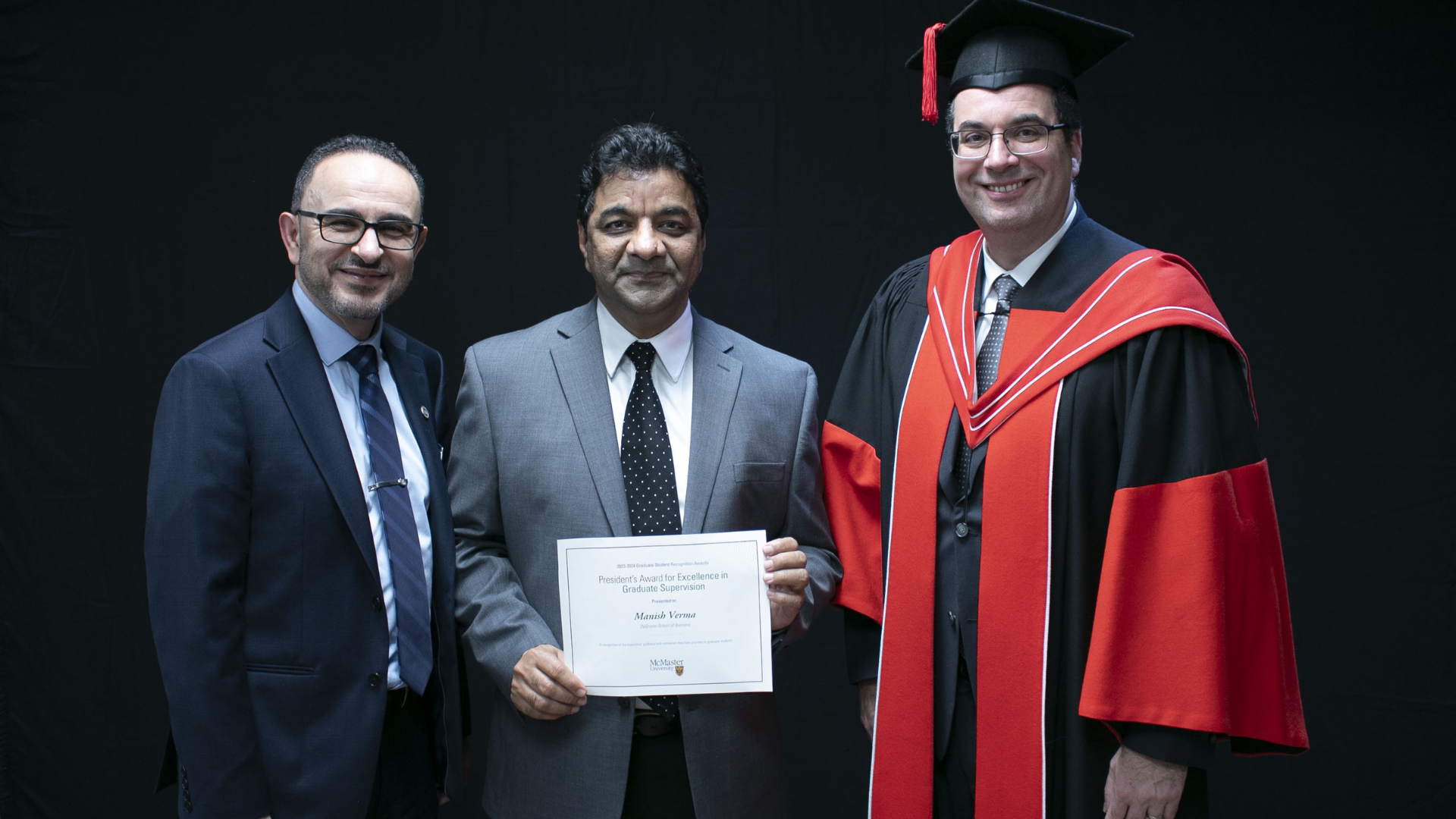
Manish Verma is Professor of Operations Management and Associate Dean, Graduate Studies at the DeGroote School of Business, McMaster University. His academic journey began with an MBA and PhD in Business Administration with Operations Management/Management Science specialization from Desautels Faculty of Management at McGill University. Dr. Verma's research focuses on multimodal transportation of dangerous goods, risk assessment, network design and planning in transportation, humanitarian logistics, green supply chain management, and disruption/resilience in transportation systems. His current research engagements center on safety and security issues in freight transportation and humanitarian logistics, funded by NSERC and SSHRC grants. He has been frequently approached by media to comment on railroad accidents involving dangerous goods. An analysis of his recent publications reveals a strong emphasis on hazardous materials transportation risk management, with significant contributions to rail-truck intermodal systems, hazmat risk modeling using value-at-risk methodologies, and emergency response planning for transportation networks. His work bridges theoretical operations research with practical transportation safety applications. $245K research grant for rail safety research from Government of Canada As an educator, Dr. Verma has taught courses including Predictive Analytics for Managers, Network Design Issues in Freight Transportation, and Management Science Research Issues. His scholarly impact is evidenced by publications in leading journals such as Transportation Research Part E, European Journal of Operational Research, and Safety Science. He actively contributes to real-world transportation safety through media commentary and research that informs policy decisions regarding dangerous goods transportation.
Tim Huh is a Professor and Chair of the Operations and Logistics Division at the University of British Columbia's Faculty of Commerce and Business Administration. He specializes in inventory control, supply chain management, and operations research, with a focus on dynamic decision-making under uncertainty. B.A., B.Math, M.Math from University of Waterloo M.A. from Regent College M.S., Ph.D. from Cornell University His research spans theoretical and applied topics including renewable energy systems, healthcare operations, and digital learning analytics. Recent work explores wind power storage optimization, asynchronous video usage in education, and multi-echelon inventory solutions. Scientific recognition includes the Canada Research Chair in Operations Excellence and Business Analytics He teaches core business analytics and operations management courses at both undergraduate and graduate levels, emphasizing quantitative decision-making and process fundamentals.
Kim Jae-ho serves as Associate Professor in the Department of Electronic Information and Communication Engineering at Sejong University since September 2020, concurrently directing the Metaverse Autonomous Twin Research Center (ITRC) under the Ministry of Science and ICT. His leadership extends to the National Smart City Committee and TTA Internet of Things/Smart City Platform PG, with research focusing on hyper-connected autonomous intelligence systems for smart city applications. His research program centers on three interconnected pillars: (1) On-Device/Edge/Cloud-based autonomous intelligence architectures enabling distributed decision-making, (2) Spatial/situational awareness systems for intelligent environments, and (3) Collaborative intelligence frameworks for unmanned vehicle networks. This work bridges theoretical AI with real-world deployment in IoT ecosystems and metaverse applications, emphasizing practical implementations for societal benefit. Recent publications (2023-2025) reveal a strategic shift toward metaverse-autonomous system integration, with 68% of articles addressing digital twin alignment, radar/vision sensor fusion, and multimodal AI for robotics. Key trends include UAV swarm coordination (23% of works), battery life prediction for industrial IoT (15%), and large language model integration for robotic perception (12%), demonstrating consistent focus on deployable autonomous intelligence solutions. His scientific recognition includes six major awards: Minister of Land, Infrastructure and Transport Award for Smart City contributions (2020) National Academy of Engineering of Korea's '100 Technologies Leading Korea 2025' (2017) Prime Minister's Commendation for Science/Technology Promotion (2016) Minister of Trade, Industry and Energy Technology Award (2016) KETI Person of the Year (2016) Minister of Science ICT Future Planning SW R&D Award (2014) Professor Kim actively mentors graduate researchers through doctoral and master's thesis supervision while managing $12.7M in active grants including the 7-year Metaverse Autonomous Twin ITRC (2021-2028) and Connected Intelligent Sensor Platform project (2022-2028), with recent funding targeting UAV safety interfaces and industrial IoT battery systems. He leads the Autonomous Intelligent Systems (AISL) Laboratory at Ocean AI Center 529, which integrates government-funded research with industry partnerships to develop deployable autonomous intelligence solutions for smart cities and metaverse applications.
Stelios Timotheou is an Associate Professor at the Department of Electrical and Computer Engineering and faculty member at the KIOS Research and Innovation Center of Excellence, University of Cyprus. He holds a Dipl-Ing from National Technical University of Athens, and MSc/PhD from Imperial College London. His research focuses on developing real-time distributed methodologies using mathematical optimization, machine learning, and computational intelligence to enhance efficiency in critical infrastructure systems. Research interests center on data-driven decision making for urban mobility management, traffic control systems, and energy optimization. Key areas include: Intelligent UAV-based sensing for traffic monitoring Cooperative control algorithms for multi-agent systems Optimization of renewable energy integration Robust infrastructure protection strategies Recent publications demonstrate strong focus on traffic state estimation (76%), energy system optimization (16%), and UAV applications (8%). Awarded the Cyprus Research Award (2017) and ERC Consolidator Grant for URANUS project. Secured multiple research grants focusing on real-time control systems.
Xavier Brusset is a Professor in Supply Chain at SKEMA Business School since 2016, where he also serves as Director of the PRISM Research Center since 2017. Previously, he held professorial positions at Toulouse Business School (2015-2016) and ESSCA School of Management (2009-2015), where he was responsible for the Master 2 in Purchasing and Supply Chain Management program. His academic journey includes a PhD in Management Sciences from Université Catholique de Louvain (2010) and a Habilitation à Diriger des Recherches from Université Paris Ouest Nanterre La Défense (2016). His research spans multiple critical areas in supply chain management, with particular focus on supply chain resilience, blockchain applications, weather risk management, and pandemic impacts on supply chains. Brusset has developed innovative approaches to understanding how supply chain partners interact, how information affects their behavior, and how external disruptions like weather anomalies and pandemics impact operational efficiency. His work bridges theoretical models with practical applications, often developing decision-support tools for managers facing complex supply chain challenges. Brusset's publication record shows a clear evolution of research interests, beginning with foundational work on supply chain contracts and information sharing, then expanding to weather risk management, and most recently focusing on pandemic disruptions and blockchain applications. His 15 most recent publications (2018-2025) demonstrate increasing sophistication in modeling complex supply chain phenomena, with particular emphasis on network effects, ripple effects, and multi-echelon optimization under disruption scenarios. Editorial board member of Logistics Research Editor of International Journal of Retail and Distribution Management (2022-2023) Recognized EU expert for CINEA research projects evaluation Organizer of the Colloquium on European Research in Retailing (CERR) Reviewer for multiple top journals including International Journal of Production Economics As an advisor, Brusset has supervised doctoral students including R. Alkhudary (co-director, Université Paris 2 Panthéon-Assas) and V. Capocasale (rapporteur). His professional experience extends beyond academia to include industry roles in financial markets and logistics technology, having co-founded WebLogistix, a platform for sharing logistics information in Argentina. His research has practical applications across multiple sectors, particularly in retail, food supply chains, and manufacturing, where he develops tools to help managers mitigate risks and optimize operations under uncertainty.
Professor Jan Bebbington holds the Rubin Chair in Sustainability in Business at Lancaster University and serves as Director of the Pentland Centre for Sustainability in Business . Her research intersects sustainable development with organisational operations, focusing on accounting technologies for control and accountability, the Sustainable Development Goals (SDGs), and carbon accounting. Her recent work explores sustainability reporting norms , inter-corporate accountability mechanisms , and biodiversity scenario analysis . Publications highlight interdisciplinary approaches to climate accountability, organisational stability, and resilient business practices. Key projects include collaborations with Stockholm Resilience Centre , The Swedish Research Council , and Innovate UK , addressing topics like ocean stewardship (SeaBOS) and biodiversity decision-making frameworks. She employs virtual labs and cross-sector partnerships to advance sustainability governance.
Jonathan P. Wong is a Senior Policy Researcher at the RAND Corporation and Professor of Policy Analysis at the RAND School of Public Policy. His work bridges academic research and defense policy, focusing on military strategy, acquisition, force planning, and the integration of emerging technologies into military operations. Education: Ph.D. and M.Phil. in Policy Analysis (Pardee RAND Graduate School), M.A. in Security Studies (Georgetown University), B.A. in Political Science (UC San Diego) Professional Experience: U.S. Marine Corps infantry officer (2001–2011), Consultant at Boston Consulting Group, current RAND researcher and professor Wong’s research interests center on defense innovation, military logistics, artificial intelligence in warfare, space capabilities, and the human dimension of military operations. He has led studies on human-machine teaming, non-lethal weapons, defense acquisition reform, and U.S. military posture in the Indo-Pacific. His work emphasizes practical, policy-relevant insights grounded in operational experience. The trends in his recent publications reveal a deep engagement with modern defense challenges: integrating commercial technologies into military systems, improving acquisition agility, enhancing battlefield awareness, and ensuring that defense innovation serves warfighter needs. His research spans strategic, operational, and tactical levels, often focusing on the U.S. Army and Marine Corps. Wong has not received public recognition in the form of listed awards in the provided texts, but his leadership in congressionally mandated studies and high-impact policy research suggests significant influence in defense circles. Advising & Grants: Co-led major projects such as the Long Range Precision Fires study and research on integrating women into Marine Corps infantry. His work is frequently funded by the Department of Defense and other federal entities, though specific grant details are not listed. Wong is affiliated with RAND’s defense and national security research teams, contributing to strategic analysis and policy development. He is not associated with a formal lab but works within RAND’s collaborative research environment, often partnering with other veterans and defense experts to produce actionable insights for military leaders and policymakers.
Dr. Kevin Kochersberger is an Associate Professor in the Department of Mechanical Engineering at Virginia Tech , with a career spanning academic research, technical innovation, and educational leadership. His work focuses on autonomous aerial systems , robotic control , and applied aerodynamics , particularly through the Uncrewed Systems Laboratory . Kochersberger's research has pioneered UAV-based radiation detection , 3D terrain mapping , and low-resource drone applications , including establishing the African Drone and Data Academy in Malawi . Education: Ph.D., Mechanical Engineering, Virginia Tech (1994) M.S., Mechanical Engineering, Virginia Tech (1984) B.S., Mechanical Engineering, Virginia Tech (1983) A.S., Engineering Science, Jamestown Community College (1981) Kochersberger's publications demonstrate expertise in UAV path planning , smart material actuation , and radiation source localization , with over $9M in research funding. His scientific awards include AIAA Associate Fellow (2009) and Aviation Week Aerospace Laureate (2003). Notable projects involve helicopter-deployable robotic systems and urban canyon navigation without GPS. Recent articles highlight BVLOS drone simulators , 2.5D terrain mapping , and autonomous negative obstacle traversal , reflecting his focus on real-time adaptive control and heterogeneous robotic systems . He teaches Drone Technology and Flight Operations and Advanced Design Projects , emphasizing student-driven innovation and industry collaboration .
Ronnie Sircar is the Eugene Higgins Professor of Operations Research and Financial Engineering at Princeton University , where he contributes to the Department of Operations Research and Financial Engineering (ORFE). His work spans financial mathematics, stochastic modeling, and applied probability, with a focus on market volatility, optimal investment strategies, and dynamic game theory. Email: sircar@princeton.edu Office: Sherrerd Hall, Room 208, Princeton, NJ 08544 His research interests include: Stochastic Volatility: Asymptotic analysis, calibration, and impact on option pricing and portfolio optimization. Mean Field Games: Applications to cryptocurrency mining, energy markets, and interbank network formation. Portfolio Theory: Forward performance processes, drawdown constraints, and risk-averse strategies. Credit Risk: Multi-name credit derivatives, CDO valuation, and risk measures. Energy Systems: Renewable reliability, unit commitment, and electricity market design. Recent publications emphasize mean field games in energy and blockchain, stochastic volatility in portfolio optimization, and machine learning applications for financial engineering. He has advised graduate students such as Giulia Crippa, Nicolas Garcia, and Burak Aydin, often collaborating with researchers including M. Soner, P. Chan, and A.M. Reppen.
Michael Muehlebach leads the independent Learning and Dynamical Systems research group at the Max Planck Institute for Intelligent Systems in Tuebingen, Germany. His interdisciplinary work bridges machine learning, dynamical systems theory, and control engineering to develop algorithms for cyber-physical systems with theoretical guarantees and practical implementations. Dr. Muehlebach received his B.Sc. and M.Sc. in Mechanical Engineering from ETH Zurich in 2010 and 2013, specializing in robotics and control systems. He completed his Ph.D. at ETH's Institute for Dynamic Systems and Control under Prof. R. D'Andrea in 2018, followed by postdoctoral research with Prof. Michael I. Jordan at UC Berkeley. His research focuses on constrained optimization, reinforcement learning, and control theory with applications in robotics. He pioneered approaches that express constraints in terms of velocities rather than positions, enabling more efficient optimization algorithms. His work spans theoretical foundations to physical implementations, including the One-Wheel Cubli balancing robot and electromagnetic navigation systems. Recent publications reveal a strong trend toward physics-informed machine learning, particularly for robotics applications requiring real-time performance and safety guarantees. Dr. Muehlebach has received numerous prestigious awards: Outstanding D-MAVT Bachelor Award Willi-Studer prize for best Master's degree ETH Medal and HILTI prize for doctoral thesis Branco Weiss Fellowship (2018) Emmy Noether Fellowship (2020) Amazon Fellowship (2024) He actively mentors doctoral researchers including Hao Ma, Melis Ilayda Bal, and Onno Eberhard, with research supported by multiple grants. His group maintains strong collaborations with Bernhard Schölkopf's Empirical Inference group at the Max Planck Institute. The Learning and Dynamical Systems group develops innovative hardware and software platforms, including Floaty (a wind-harnessing flying robot), advanced electromagnetic navigation systems, and data-efficient learning methods for robotic table tennis. Their approach combines rigorous theoretical analysis with practical validation on physical systems, emphasizing the integration of known physical structure into machine learning algorithms to improve sample efficiency and ensure generalization.
Caroline K. Milne, M.D., is Professor (Clinical) of Internal Medicine at the University of Utah School of Medicine, where she also serves as Vice Chair for Education and Program Director of the Internal Medicine Training Program. In addition, she directs the fourth-year sub-internship and leads clinical-skills education for medical students. Education & Training M.D., University of Wisconsin School of Medicine Residency & Chief Residency, Internal Medicine, University of Utah School of Medicine Fellowship in General Medicine / Medical Education Research, University of Pennsylvania M.B.A., Business Administration, University of Utah Fellowship in Executive Leadership in Health Care, Drexel University Research Focus Dr. Milne’s scholarly work centers on medical education research, particularly the assessment and development of clinical skills, evaluation of residency training programs, and policy studies on resident wellness and parental leave. Her investigations employ mixed-methods and multi-institutional survey designs to inform best practices in graduate medical education. Clinically, she practices general internal medicine at the VA Medical Center, integrating bedside teaching with outpatient and inpatient care. This dual role informs her research on optimizing educational experiences within clinical environments and improving systems of care for veterans. Publication Themes Across more than two decades, her peer-reviewed articles reveal consistent themes: evaluating learner performance, refining feedback mechanisms, exploring health-system responses (e.g., during COVID-19), and analyzing policies affecting residents’ well-being. The work bridges education science, health-services research, and quality improvement. Scientific Awards No specific awards are listed in the provided material. Advising & Grant Activity While formal student advisees are not enumerated, Dr. Milne’s roles as Program Director and Director of Clinical Skills imply extensive mentorship of residents and medical students. Grant details are not provided. Laboratories & Teams She collaborates with the Internal Medicine residency leadership team and the School of Medicine’s clinical-skills educators, operating primarily within the University of Utah’s academic medical center and the affiliated VA Medical Center.
Richard Simon is an Associate Professor in the Department of Civil, Geological and Mining Engineering at Polytechnique Montréal. He holds leadership roles as Publications Director of his department and Administrative Director of the Institute for Research in Mining and Environment (IRME) UQAT-Polytechnique. His educational background includes a B.Eng. and M.Sc.A. from Polytechnique Montréal and a Ph.D. from McGill University. Dr. Simon teaches courses including Introduction to Mine Operations, Underground Mining, and Rock Mechanics I. His research focuses on rock mechanics, numerical modeling, mining engineering, and geotechnical applications in mining environments. His extensive publication record demonstrates consistent focus on numerical modeling of rock behavior, mine stability analysis, and backfill mechanics. Recent work emphasizes computational geomechanics applications in mining operations, including stress analysis in backfilled stopes, slope stability in open pits, and optimization of mining layouts. Environmental aspects of mining, particularly contaminant transport in fractured rock, also feature prominently. Dr. Simon has supervised 6 doctoral and 8 master's students working on topics ranging from numerical seismic assessment in mines to rock fracture mechanics. He secured significant research funding including $900,000 (2017) for a metals circular economy project and led three new IRME research initiatives (2015). He directs research activities at IRME UQAT-Polytechnique and collaborates extensively within the mining geomechanics research community. His expertise is regularly featured in media outlets including La Presse+ and Les Affaires.