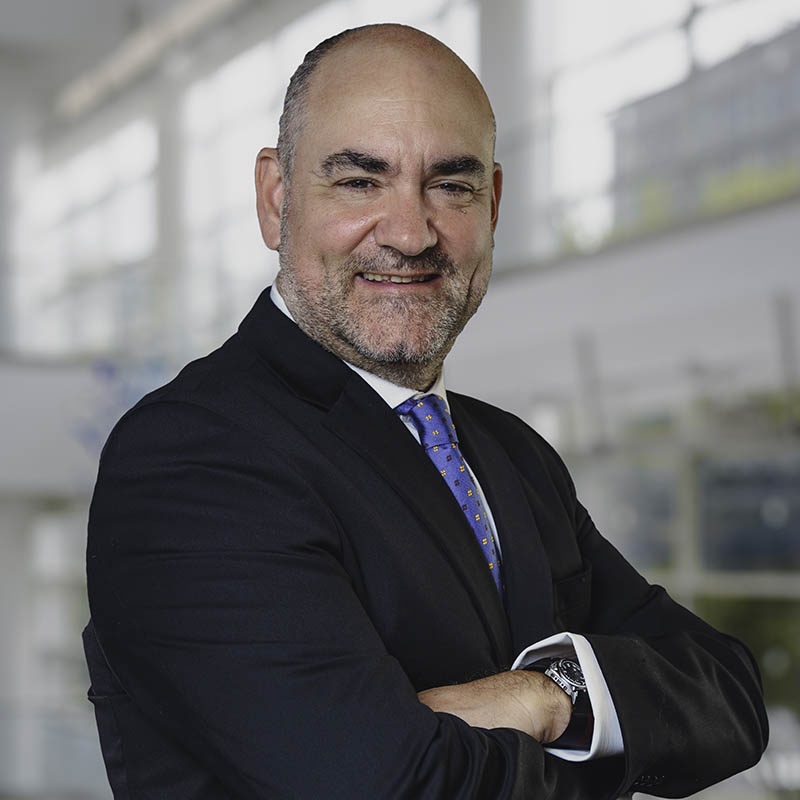
Prof. Dr. Marcus Vetter is the founder and director of the Institute for Applied Artificial Intelligence and Robotics (A²IR) at Mannheim University of Technology's Faculty of Information Technology. His work bridges Deep learning Medical imaging and navigation Embedded systems Real-time computing Software engineering for medical devices He has taught courses including Deep Learning Methods, Image-Guided Medicine, and Embedded Systems. Education Computer Science, Technical University of Mannheim, 1999 Doctorate ('summa cum laude superato') in 'Image-based navigation systems', University of Heidelberg, 2003 Research focuses on AI-driven medical imaging tools, real-time deformation models, and open-source frameworks like MITK. His 15 most recent publications span 6D pose estimation for medical robotics Spectroscopy-based diagnostics Formal software verification Gesture and gaze recognition interfaces UAV drive train optimization Scientific achievements Doctorate with distinction (2003) Co-founder of MITK open-source project Director of A²IR institute since 2007 He has received BMBF grants for real-time deformation models and tracking systems, and has led development of navigation systems for laparoscopic surgery and cardiac ablation procedures.
Marco Ceccagnoli is a Professor and Brady Family Professor in Management at the Scheller College of Business, Georgia Institute of Technology. He serves as the PhD Coordinator for the Strategy & Innovation area and teaches strategic management and technology strategy across undergraduate, MBA (full-time, evening, and executive), and PhD programs. His research focuses on the economics and management of innovation, particularly how firms appropriate value from innovation through intellectual property, knowledge spillovers, and strategic governance. His research interests include: Innovation Management and Appropriability Technology Strategy and Markets Intellectual Property and Open Source Software Knowledge Spillovers and Absorptive Capacity Corporate Venture Capital and Digital Platforms Complementary Assets and Organizational Governance The recent articles show a strong focus on empirical investigations of innovation value capture, digital platform ecosystems, and the role of firm capabilities in technology integration. His work spans disciplines including strategic management, information systems, industrial organization, and innovation economics, often bridging theory and practice with data-driven insights from enterprise software, R&D labs, and technology markets. His scientific awards include: William W. Cooper Doctoral Dissertation Award in Management or Management Science European Association for Research in Industrial Economics Award Best Doctoral Dissertation Award (runner-up), Academy of Management (TIM Division) Best Paper Award, Cooperative Strategy Interest Group, Strategic Management Society (SMS) ICIS Best Paper Award (runner-up) Marco Ceccagnoli advises PhD students in the Strategy & Innovation area and contributes to research grants and collaborative projects with institutions globally. He has served as a reviewer for top journals such as Management Science, Strategic Management Journal, and Research Policy. His work is frequently cited and has influenced both academic and practitioner understanding of innovation strategy. He is actively involved in research initiatives such as the Roundtable for Engineering Entrepreneurship Research (REER), which brings together scholars in technology and innovation management.
Magnus Nord is an Associate Professor in the Department of Physics, Faculty of Natural Sciences at Norwegian University of Science and Technology (NTNU). His research focuses on advanced electron microscopy techniques and computational tools for materials characterization. Research Interests : Scanning Transmission Electron Microscopy (4D-STEM), Open Source Scientific Software Development (Python), Big Data Processing, Magnetic/Electric Field Imaging, Structural Characterization using Higher Order Laue Zones. Publications span cutting-edge applications in functional materials, nanomagnets, and perovskite thin films, with emphasis on machine learning and precession-enhanced imaging. Key keywords include Materials Science , Electron Microscopy , and Computational Imaging . Software Development : Lead developer of Atomap and pyxem , contributing to HyperSpy and merlin_interface for electron microscopy data analysis. Current Research Funding : InCoMa (Research Council of Norway) IMPRESS (Horizon EU Program)
Ramón Luis Rizo Aldeguer is a University Professor in the Department of Computer Science and Artificial Intelligence at the Higher Polytechnic School of the University of Alicante. He has held this position since 1996 and continues to be actively involved in teaching and research as recently as 2025. He previously served in various leadership roles including Director of the Department of Computer Science and Artificial Intelligence (1997-2004) and Deputy Director of the Institutional Projects Area at the University of Alicante (2012-2020). His educational background includes a PhD in Computer Science from the Polytechnic University of Valencia (1992) and a degree in Mathematics from the University of Valencia (1977). He has been a member of the Spanish Association for Artificial Intelligence since 1990 and has held leadership positions within the organization. Rizo Aldeguer's research focuses on artificial intelligence with particular emphasis on swarm robotics, UAV deployment, and deep reinforcement learning. His work bridges theoretical foundations with practical applications in robotics and autonomous systems. He has made significant contributions to educational methodologies, particularly in integrating computational tools into engineering education. His publication record shows a consistent trajectory in swarm intelligence and robotics, with recent publications (2018-2023) demonstrating increasing sophistication in applying deep reinforcement learning to complex multi-agent systems. His research spans both theoretical advancements and practical implementations in robotics and autonomous systems. Fifteen five-year research periods (trienios) Six teaching merit periods Five six-year research periods (sexenios) President of Organizing Committee of VI Conference of Spanish Association for Artificial Intelligence (1995) President of Scientific Committee of CAEPIA (1999) Rizo Aldeguer has supervised 14 doctoral theses, with many receiving the highest honors (SOBRESALIENTE CUM-LAUDE). He has participated as a researcher in over 30 competitive public research projects, serving as principal investigator in 12 of them. His educational projects include innovative teaching methods and the development of computational tools for engineering education. He has been instrumental in the design and implementation of computer science programs at both the University of Alicante and the Polytechnic University of Valencia. He is a founding member of the University Institute for Computer Research and directed the Industrial Computing and Artificial Intelligence research group from 1992 to 2004. His current research continues to focus on swarm robotics and intelligent systems, with active participation in the Valencian Graduate School and Research Network of Artificial Intelligence since 2021.
Dr. Christoph Müller is a leading scientist at the Potsdam Institute for Climate Impact Research (PIK), Germany, where he has served as working-group leader of the Land Biosphere Dynamics group since 2012. He also co-leads the Global Biosphere and Water Modeling team and acts as the scientist-in-charge for the internationally renowned LPJmL global vegetation and crop model. Additionally, he is Co-lead of the Ag-GRID initiative within the Agricultural Model Intercomparison and Improvement Project (AgMIP) and serves as Topical Editor for Geoscientific Model Development . Education Diploma in Geoecology, University of Potsdam (2002) PhD in Geoecology, University of Potsdam & International Max Planck Research School (IMPRS) (2007) Research Interests Dr. Müller’s research centres on understanding and modelling the interactions between climate, land use, and the biosphere to support sustainable food-system transformations. His work integrates global-scale vegetation and crop models with climate projections, socio-economic scenarios, and observational data to assess: Impacts of climate change and extreme events on crop yields and food security Carbon, nitrogen, and water cycles in managed and natural ecosystems Land-based climate-mitigation strategies and their co-benefits or trade-offs Adaptation options for agriculture under global change He promotes open science and reproducible modelling workflows, exemplified by the LPJmL open-source ecosystem model and associated toolkits. Publication Profile & Trends Since 2014 he has authored or co-authored more than 200 peer-reviewed articles. Recent work (2024-2025) highlights three dominant themes: (1) quantifying underestimated negative impacts of climate extremes on crop yields, (2) assessing the sustainability of large-scale land-based mitigation measures, and (3) advancing model intercomparison frameworks (e.g., AgMIP, ISIMIP) to reduce uncertainty in global yield projections. His studies increasingly integrate economic and health perspectives, examining how dietary shifts and food-system transformations can achieve climate, environmental, and social co-benefits. Scientific Awards & Recognition While no formal awards are explicitly listed, several publications have received notable recognition: “Soil quality both increases crop production and improves resilience to climate change” (Nature Climate Change, 2022) – listed among China’s top ten major advances in agricultural science in 2023. “Large potential for crop production adaptation depends on available future varieties” (Global Change Biology, 2021) – top-downloaded article. “Climate change impacts on global agriculture emerge earlier in new generation of climate and crop models” (Nature Food, 2021) – widely cited in IPCC AR6. Leadership, Grants & Collaboration Dr. Müller leads or co-leads multiple international projects and working groups: Working Group Leader – Land Biosphere Dynamics, PIK Research Department 2 Co-Lead – Ag-GRID, Agricultural Model Intercomparison and Improvement Project (AgMIP) Scientist-in-Charge – LPJmL model development and application Topical Editor – Geoscientific Model Development journal These roles involve coordinating multi-institutional consortia, securing competitive grants, and mentoring early-career researchers. Laboratory & Data Resources Dr. Müller’s “team” is essentially the LPJmL modelling group at PIK, comprising post-docs, doctoral researchers, and software engineers who maintain and extend the LPJmL code-base, develop satellite-data fusion products, and provide model-driven policy support to governments and international organisations such as the IPCC, FAO, and World Bank.
Sriramkrishnan Muralikrishnan is a Research Staff member at the Department of Mathematics and Education within the Jülich Supercomputing Center (JSC) at Forschungszentrum Jülich, Germany. His work focuses on developing advanced computational methods for high-performance scientific computing, particularly in plasma physics and related multi-physics applications. Dr. Muralikrishnan's research spans several key computational domains: Numerical Analysis and High-Order Methods High Performance Scientific Computing for Exascale Architectures Plasma Physics Simulations Fast Solvers and Preconditioners Parallel-in-Time Integration Techniques Performance Portable Programming His recent publications demonstrate a strong focus on particle-based computational methods, particularly Particle-in-Cell and Particle-in-Fourier techniques. His work consistently addresses challenges in energy conservation, scalability across architectures, and noise reduction in plasma simulations. A significant portion of his research involves developing performance-portable frameworks that can efficiently leverage modern supercomputing hardware from different vendors without code rewrites. Dr. Muralikrishnan is actively involved in open-source scientific software development: Lead developer of IPPL (a performance portable library for grids and particles) Developer of OPAL (an open-source particle accelerator library) His research has direct applications in plasma physics, fusion energy research, and advanced accelerator design, with a strong emphasis on making computational methods accessible through open-source development and advocating for diversity in scientific computing.
Ludwig Schmidt is an Assistant Professor in the Computer Science Department at Stanford University and a member of Stanford Data Science. He also serves as a member of the technical staff at Anthropic and LAION, contributing to both academic and industrial research in machine learning. Dr. Schmidt completed his PhD at MIT, where he received the prestigious George M. Sprowls Award for best PhD theses in computer science, followed by a postdoctoral position at UC Berkeley. His educational background provides a strong foundation for his research at the intersection of theoretical and applied machine learning. Dr. Schmidt's research focuses on the empirical foundations of machine learning, with particular emphasis on datasets, reliable generalization, multimodality, and language models. His work addresses critical challenges in ensuring machine learning models perform consistently across different domains and data distributions. His research group has made significant contributions to open source machine learning through projects like OpenCLIP, DCLM, and the LAION-5B dataset, which have become important resources for the machine learning community. An analysis of Dr. Schmidt's recent publications reveals a strong focus on dataset quality, multimodal learning, and language model training. His work spans from fundamental research on generalization and robustness to practical applications in vision-language systems and tabular data. A recurring theme is the importance of high-quality, diverse datasets for training robust machine learning models, with several papers addressing dataset curation, evaluation methodologies, and the impact of data quality on model performance. New Horizons Award at EAAMO Best paper awards at ICML & NeurIPS Best paper finalist at CVPR Sprowls dissertation award from MIT (George M. Sprowls Award) Dr. Schmidt actively mentors doctoral students and postdoctoral researchers. His current advisees include doctoral candidates Liangyu Chen, Shiye Su, Elaine Sui, Audrey Xie, John Yang, Yuhui Zhang, and Wanjia Zhao. He serves as Doctoral Dissertation Reader for Kyle Hsu and Aishwarya Mandyam, and as Postdoctoral Faculty Sponsor for Benjamin Feuer and Mike Merrill. His research has attracted significant funding that supports these students and enables his group to contribute to open source projects like OpenCLIP and LAION-5B. Dr. Schmidt leads a research group focused on empirical machine learning foundations. The group actively contributes to open source machine learning through code repositories and datasets, including OpenCLIP, OpenFlamingo, LAION-5B, and the DataComp datasets. Their work bridges theoretical insights with practical applications, developing tools and resources that advance the entire machine learning community.
Samuel McDermott is an Associate Teaching Professor at the Department of Chemical Engineering and Biotechnology , University of Cambridge. He serves as the Sensor CDT Programme Manager , focusing on interdisciplinary research in healthcare, biotechnology, and open-source hardware. His research spans machine learning applications in medical imaging , laboratory automation , and web-of-things (WoT) integration for scientific equipment. Recent work emphasizes federated learning in healthcare, blood cell morphology classification, and low-cost diagnostic tools. Key article trends include: deep diffusion models for malaria detection , open-source microscopy platforms like OpenFlexure, and AI-driven clinical data generalization . His projects often combine 3D-printed hardware and IoT-enabled laboratory systems .
Juho Leinonen is an Academy Research Fellow at Aalto University's Department of Computer Science, Finland, specializing in AI-enhanced computing education. His work focuses on leveraging large language models (LLMs) to transform programming instruction through personalized learning analytics and educational technology. Education Background: PhD in Computer Science, University of Helsinki (2019) Docent (Adjunct Professor) in Computer Science, University of Helsinki Postdoctoral research at The University of Auckland, Aalto University, and University of Helsinki Research Focus: Leinonen's work centers on three interconnected pillars: (1) developing fine-grained learning analytics to decode student programming behavior; (2) applying LLMs to create adaptive educational tools for diverse learners; and (3) implementing learnersourcing strategies for scalable resource generation. His research particularly addresses challenges in multilingual programming education and responsible AI integration, with emphasis on non-native English speakers and novice programmers. Publication Trends: Recent publications (2024-2025) reveal a concentrated exploration of generative AI in computing education, with 85% focused on LLM applications. Key themes include synthetic data generation for educational research, multilingual prompting systems, and ethical frameworks for AI feedback. His work demonstrates both practical implementations (e.g., autocompletion quizzes) and critical analyses of AI limitations in educational contexts. Awards & Recognition: ACE2024 Best Paper Award for LLM-generated worked examples study UKICER 2023 Best Paper Award for achievement goals research ACE 2023 Best Practitioner Paper ICER 2022 Best Paper Award for programming exercise generation SIGCSE TS 2022 Best Paper in Computing Education Research ACE 2021 Best Paper Award for contextualized problem descriptions Research Leadership: As principal investigator of the Academy of Finland-funded project 'Advanced Student Modeling and Tailored LLMs for Personalized Learning', Leinonen supervises PhD students and postdocs while leading international collaborations with institutions including The University of Auckland and University of Helsinki. His grant portfolio focuses on ethical AI deployment in education and cross-cultural computing pedagogy. Collaborative Networks: He maintains active partnerships with leading computing education researchers like Paul Denny (Auckland), Arto Hellas (Aalto), and Andrew Luxton-Reilly (Auckland), evidenced by 90% co-authored publications. His work appears consistently in top venues including ACM SIGCSE, ICER, and ACE conferences.
Maurizio Zamboni is a Full Professor at the Department of Electronics and Telecommunications (DET) at the Polytechnic University of Turin, where he also serves as Student Ombudsman. His academic career spans over three decades with continuous teaching and research contributions in electronics and computing fields. Professor Zamboni's research interests focus on cutting-edge areas including CMOS integrated circuits, computer architecture, quantum computing, semiconductor devices, and VLSI design. His work particularly emphasizes emerging nanotechnologies for digital microelectronic architectures and the design of high-performance or low-consumption processing systems. He has developed expertise in circuit architectures for probabilistic computing, logic-in-memory computing, magnetic devices, and quantum architectures. His recent publications (2021-2025) reveal a strong trend toward quantum computing applications, in-memory processing architectures, and novel approaches to overcoming the memory wall problem. These works span both theoretical algorithm development and practical hardware implementations, with significant focus on quantum annealing, FPGA-based quantum emulation, and memory-mapped processing architectures. Professor Zamboni has been actively supervising PhD students working on quantum computing algorithms, hardware AI accelerators for automotive applications, and quantum-related optimization approaches. He leads research within the VLSILAB Group at DET, focusing on the intersection of nanoelectronics, quantum computing, and advanced computer architectures. His work bridges theoretical computer science with practical electronic design, creating novel solutions for next-generation computing challenges.
Ahmad Lotfi is a Professor of Computational Intelligence and Head of Department of Computer Science at Nottingham Trent University , with a Visiting Professor role at Tokyo Metropolitan University . He leads the Computational Intelligence and Applications (CIA) research group and has supervised over 30 PhD students to completion. PhD in Learning Fuzzy Systems (University of Queensland, 1995) MTech in Control Systems (Indian Institute of Technology, India) BSc in Control Systems (Isfahan University of Technology, Iran) His research spans computational intelligence , ambient intelligence , robotics , and machine learning , with applications in dementia monitoring , smart environments , and healthcare technology . Recent work focuses on using thermal sensor arrays for privacy-preserving human activity analysis. He has secured funding from Innovate UK , EPSRC , The Royal Society , and Horizon 2020 , with projects like iCarer (assistive living), SmartBerry (agricultural AI), and BigSpark (financial data augmentation). His 15 most recent articles demonstrate expertise in Wi-Fi-based activity recognition , EEG fall detection , and thermal sensor fusion . Senior Member IEEE Member of British Computer Society (MBCS) Editorial roles in Soft Computing and Journal of Ambient Intelligence and Smart Environments He has served as Program Chair for conferences like PETRA and ICCRT , and as Keynote Speaker at PETRA 2023 . His 28+ years of academic leadership include organizing UKCI and UKRAS conferences.
Peter Kazanzides is a Research Professor in the Department of Computer Science at the Whiting School of Engineering, Johns Hopkins University, where he joined the faculty in 2002. His research focuses on robotics, medical robotics, augmented reality, and computer-assisted interventions with primary applications in computer-integrated surgery. His educational background includes multiple degrees from Brown University: ScB (1983) in Electrical Engineering AB (1983) in Computer Science ScM (1985) in Electrical Engineering ScM (1987) in Applied Mathematics PhD (1988) in Electrical Engineering Kazanzides is a member of the Robotics, Vision, and Graphics research group and directs the Sensing, Manipulation, and Real-Time Systems (SMARTS) laboratory. His work spans surgical robotics, mixed reality, and systems engineering, with emphasis on computer-assisted surgery in extreme environments including minimally invasive surgery, microsurgery, and space teleoperation. The SMARTS lab develops real-time sensing systems, augmented/mixed reality interfaces using head-mounted displays, high-performance motor control, and sensor fusion technologies, with strong focus on system integration and open-source platforms like the da Vinci Research Kit (dVRK). Analysis of his recent publications (2024-2025) reveals dominant trends in surgical robotics autonomy, augmented reality navigation, force estimation, and digital twin technologies. Key themes include AI-driven task automation, haptic feedback enhancement, real-time instrument segmentation, and simulation environments for surgical training, primarily leveraging the da Vinci Research Kit framework. As director of the SMARTS lab within the Laboratory for Computational Sensing and Robotics (LCSR), Kazanzides leads a collaborative ecosystem including the Computer Integrated Interventional Systems (CIIS) Lab, Advanced Medical Instrumentation and Robotics (AMIRO) Lab, Dynamical Systems and Controls Lab (DSCL), Computer Aided Medical Procedures (CAMP) Lab, Medical UltraSound Imaging & Intervention Collaboration (MUSiiC) Lab, and Photoacoustic & ULtrasonic Systems Engineering (PULSE) Lab. His lab maintains responsibility for the development and support of the open-source da Vinci Research Kit, a critical resource for surgical robotics research worldwide.
Bradley Reaves serves as an Associate Professor in the Department of Computer Science at North Carolina State University and is a core member of the Wolfpack Security and Privacy Research (WSPR) Lab and the Secure Computing Institute. His work focuses on real-world security and privacy challenges across cellular networks, mobile platforms, and software systems. Education: Ph.D. in Computer Engineering, University of Florida (2017) M.S. in Computer Science, Georgia Institute of Technology (2015) Research Interests: Dr. Reaves pioneers interdisciplinary security solutions combining signal processing, machine learning, and cryptography to combat robocalls, mobile fraud, and software vulnerabilities. His work spans telephone network security (e.g., call authentication systems), mobile money security in developing economies, and software secret leakage in repositories. He emphasizes practical impact through industry collaboration and deployable tools. Publication Trends: Recent work (2023-2024) shows concentrated focus on telecom security (call traceback, SMS phishing), software vulnerability management (LLM-assisted patching, secret leakage), and network policy systems . His research consistently bridges theoretical innovation with real-world data collection, including analysis of 1.5 million robocalls and mobile money transaction fraud. Awards: Best Paper at ACM WiSec (2013) Advising and Collaborations: Dr. Reaves mentors Ph.D., Master's, and undergraduate researchers through structured pathways: Ph.D. applicants must demonstrate specific interest in his publications; Master's students typically engage via courses like CSC 574; undergraduates require CSC 230 completion and 10+ weekly hours. Industry partnerships include data sharing under confidential agreements, student hiring pipelines, and commissioned research for telecom fraud analysis. Labs and Teams: He leads the Wolfpack Security and Privacy Research (WSPR) Lab, which operates within NC State's Secure Computing Institute. The lab specializes in large-scale security measurement studies and develops tools like SNORCall for robocall analysis and SecretBench for secret leakage detection.
Prof. Dr. Andreas Herkersdorf is a Full Professor and Chair of Integrated Systems at the Technical University of Munich (TUM) School of Computation, Information and Technology. His research focuses on application-specific multicore processors (MPSoC), FPGA-based prototyping, fault-tolerant systems, and energy-efficient architectures, with applications in IP packet processing, automotive systems, and visual computing. He has received multiple IBM innovation awards and serves on editorial boards including the DFG Review Board for computer architecture. Education: Dipl.-Ing. Electrical Engineering (TUM, 1987), Dr. techn. Electrical Engineering (ETH Zurich, 1991) Research: MPSoC architectures, autonomic computing, NoC resilience, FPGA acceleration, and self-optimizing systems. Awards: IBM Master Inventor (1998), IBM Outstanding Technical Achievement Award (2001), multiple IBM Innovation Achievement Awards (1996-2003) His recent publications emphasize hardware/software co-design, machine learning integration for runtime optimization, and network-on-chip innovations. He collaborates on projects involving 6G systems, smartNICs, and automotive communication protocols.
Dr. Ahmed Elkady is an Associate Professor in Structural Engineering at the University of Southampton's Faculty of Engineering and Physical Sciences, Department of Civil, Maritime and Environmental Engineering. His research focuses on structural performance under seismic hazards with specialization in steel and composite structures. He leads the Infrastructure Research Group and actively supervises PhD students while developing innovative computational tools for structural analysis. Elkady's research interests center on Performance-Based Earthquake Engineering, Collapse Risk and Loss Assessment of Steel and Composite Buildings, and Resilience-based design of Existing Structures. His work combines advanced numerical modeling with large-scale experimental testing to develop robust predictive models for structural behavior under extreme loading conditions. He has made significant contributions to the understanding of structural connections, particularly steel endplate and bolted connections. His recent publications demonstrate a strong trend toward integrating machine learning with traditional structural engineering methods, particularly in modeling steel connections and predicting structural behavior. The research spans both fundamental mechanics and practical applications for seismic risk assessment, with several of his 2023-2025 publications focusing on data-driven approaches to structural analysis. Raymond C Reese Research Prize (2022) Multiple Outstanding Reviewer awards from ASCE Journal of Structural Engineering (2019-2020) First Place Award in NIST-ATC Blind Prediction Contest (2018) Alexander Graham Bell graduate scholarship from NSERC Canada (2014) Multiple best presentation awards at engineering conferences (2012-2015) Elkady currently supervises three PhD students (Weiran Li, Zizhou Ding, and Aran Naserpour) and leads the EPSRC-funded project 'Seismic Resilience of Egypt's Built Environment: A GIS-Based Framework for Assessment and Mitigation.' He has also secured funding from Research England for the 'EGYGIS: GIS Mapping in Support of Egypt's Disaster Risk Management' project. His research has resulted in several open-source software tools including EaRL (Earthquake Risk, Loss & Lifecycle Assessment), FM-2D (Frame Modeler 2D), and SCRonED (Semi-Rigid Connections Experimental Database), which are widely used in the structural engineering community for performance-based earthquake engineering.