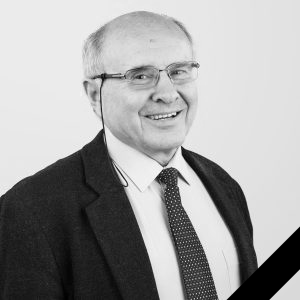
Professor Liudas Mažeika (deceased) was Director of the Prof. K. Baršauskas Ultrasound Research Institute and Professor in the Faculty of Electrical and Electronics Engineering at Kaunas University of Technology. He was elected as a full member of the Lithuanian Academy of Sciences in 2016. His research focused on developing ultrasonic measurement, monitoring, and diagnostic technologies for extreme conditions, with expertise spanning digital signal processing, non-destructive testing, and numerical modeling. He collaborated extensively on international research projects developing new measurement methodologies. Awards: Lithuanian Science Award in Technology Sciences (2016)
Audrius Aleknavičius is a Researcher at Vytautas Magnus University's Bioeconomy Research Institute, specializing in land management and consolidation. Previously serving as Professor (2010-2020) and Head of the Department of Land Management (2008-2012), he has been affiliated with the Agriculture Academy since 1997, when it was known as the Lithuanian University of Agriculture until 2011, and later as Aleksandras Stulginskis University (2011-2018). Dr. Aleknavičius earned his Doctor of Technological Sciences degree in 2002 after graduating from the Lithuanian Academy of Agriculture in 1995. He furthered his education at the Royal Institute of Technology in Stockholm, completing studies there in 2007. His international experience includes internships in Sweden (1999, 2000, 2001) and Taiwan (2003), which have informed his comparative approach to land management systems. His research focuses on critical aspects of land administration, with particular expertise in land consolidation, agricultural land use development, and real estate valuation. Dr. Aleknavičius has pioneered methods for optimizing large farm holdings, analyzing land market dynamics across Lithuanian municipalities, and adapting European land consolidation models to different national contexts including Ukraine. His work bridges theoretical land management principles with practical applications for improving agricultural efficiency and rural development. Recent publications reveal a strong trend toward practical solutions for land fragmentation issues, with significant attention to municipal-level land planning schemes and pre-emption rights for farm owners. His research increasingly incorporates comparative analysis of Baltic states' land administration systems while addressing contemporary challenges in land markets following Lithuania's land reform completion. Dr. Aleknavičius has supervised numerous master's theses covering diverse aspects of land management, from agricultural land use in specific municipalities to land lease processes and special land use conditions. His academic mentorship has produced research addressing practical land administration challenges across Lithuania's regions. Working within the Department of Land Use Planning and Geomatics, he contributes to the Agriculture Academy's mission of advancing sustainable land management practices. His current research activities focus on optimizing land holdings for large agricultural enterprises, analyzing land market intensity across Lithuanian municipalities, and developing more efficient land administration models through comparative analysis of European systems.
Dr. Ilya Inishev is a Professor at the Academic Department of Social Sciences, European Humanities University. His work focuses on hermeneutics, phenomenology, film theory, and media studies. He is also a prolific scholar with publications spanning philosophy, cultural theory, and interdisciplinary studies. Research interests include the interplay of materiality and interpretation in Gadamer’s hermeneutics, Heidegger’s influence on Russian philosophy, and the role of visual perception in contemporary culture. His recent work explores distributed imagery, speculative media, and cultural practices. Publications highlight themes like the material dimension of interpretive experience, existential analysis, and comparative philosophy. His interdisciplinary approach bridges aesthetics, technology, and historical studies, as seen in works on AI origins and church-state dynamics under Catherine the Great.
Jolita Greblikaitė is an Associate Professor at Vytautas Magnus University, affiliated with the Faculty of Bioeconomy Development and the Department of Business and Rural Development Management. Her work spans academic supervision and research in logistics and bioeconomy sectors. Primary Affiliation: Department of Business and Rural Development Management, Vytautas Magnus University Secondary Affiliation: Bioeconomy Research Institute Her research focuses on entrepreneurship, logistics management, and sustainable bioeconomy practices. She has supervised numerous Master's theses analyzing supply chain challenges in Nigeria, India, and Lithuania, emphasizing smart technologies and Lean methodologies. Key research domains include: Cross-border e-commerce logistics Smart transportation systems in developing economies Agri-food supply chain optimization Consumer behavior in rural and urban markets Lean warehouse management Sustainable bioeconomy policies
Romas Baronas serves as a Professor at the Faculty of Mathematics and Informatics, Vilnius University, actively teaching Database Management Systems and supervising Master's thesis research as evidenced by his current teaching schedule extending through the 2025/2026 academic year. His academic profile demonstrates sustained engagement in both educational and research activities within the university's mathematics and informatics framework. Professor Baronas' research centers on advanced mathematical modeling of biological systems, with primary focus areas including biosensor optimization, bacterial self-organization phenomena, enzyme kinetics, and bioreactor design. His work employs computational analysis to investigate diffusion limitations, pattern formation in microbial populations, and reaction-diffusion dynamics, bridging theoretical mathematics with practical biotechnological applications. The interdisciplinary nature of his research integrates microbiology, electrochemistry, and nanotechnology to develop predictive models for complex biological processes. Analysis of his 15 most recent publications (2020-2025) reveals consistent thematic progression in mathematical biosensor modeling, with increasing emphasis on bacterial pattern formation, oxygen consumption dynamics, and multi-layer system optimization. His scholarly output demonstrates methodological evolution from foundational biosensor modeling toward sophisticated investigations of bacterial self-organization across scales, incorporating fractal analysis and gravity effects. The research consistently applies nonlinear dynamics and computational simulation to address challenges in bioreactor efficiency and biosensor sensitivity. Professor Baronas has supervised Master's students through thesis preparation activities, though specific student names and grant details are not documented in the provided materials. His academic service includes editorial contributions as a referee for INFORMATICA journal, reflecting his standing in the scholarly community. While laboratory affiliations are not explicitly stated, his research methodology suggests involvement with computational modeling facilities supporting his extensive publication record in mathematical biosciences.
Prof. Dr. Adomas Butrimas is a distinguished art historian and archaeologist affiliated with the Vilnius Academy of Arts (VAA), serving as a Professor in the Department of Art History and Theory since 2002. He has held significant administrative roles including Rector (2004–2011) and Vice-Rector for Education (2011–2014), and initiated the Institute of Art Research (1994) and VAA Publishing House. 1978: BA in Archaeology, Faculty of History, Vilnius University 1985: PhD in Art History, Vilnius University His research focuses on art history, archaeology, prehistoric art, and Lithuanian history , with particular expertise in Baltic amber traditions, Mesolithic-Neolithic transitions, and Western Lithuanian cultural landscapes. He has led major projects like Prehistoric Art: Chronology, Context, Ritual and Symbols (2015–2018) and Crafted Bone and Horn Artefacts from Western Lithuania (2021–2024). Current research trends emphasize hunter-gatherer technology (e.g., T-shaped antler axes, socketed harpoon heads), bioarchaeological identity formation , and Baltic cultural landscape evolution over 5,000 years. His work bridges archaeological methodology with artistic symbolism, particularly in Mesolithic-Neolithic contexts. Scientific Awards Knight of the Order of Orange-Nassau, Netherlands (2008) Cross of Recognition, Latvia (2011) Order for Merits to Lithuania (Knight's Cross, 2014) Man of the Year in Design (2009) As editor-in-chief of Acta Academiae Artium Vilnensis , he has supervised numerous doctoral theses and organized international conferences. His lab affiliations include VAA's Art and Research Department, Art and Design Lab, and the Institute of Art Research, which he founded in 1994.
Habil. dr. Gediminas Gaigalas serves as Chief Researcher at the Institute of Theoretical Physics and Astronomy (ITPA) within Vilnius University's Faculty of Physics. His work bridges theoretical atomic physics with astrophysical applications, particularly in understanding heavy element spectroscopy for neutron star merger events. Gaigalas maintains active international collaborations, including the Lithuanian-Japanese project on gravitational wave sources, and contributes to major computational atomic physics initiatives. His research focuses on multi-electron atomic theory , relativistic atomic structure calculations , and computational methods for atomic spectroscopy. Specializing in spin-angular integration techniques and configuration interaction methods, Gaigalas has developed advanced computational approaches for modeling heavy elements. His work with the GRASP (General Relativistic Atomic Structure Package) computational framework has been particularly influential in the field, enabling precise calculations of atomic properties for elements critical to understanding kilonova phenomena. Analysis of Gaigalas's recent publications reveals a strong emphasis on astrophysical applications of atomic data , particularly for neutron star merger events (kilonovae). His work spans both theoretical development of computational methods and practical applications to spectroscopic problems, with particular focus on lanthanides and other heavy elements. The research demonstrates increasing sophistication in handling relativistic effects and electron correlations in complex atomic systems. Adolfas Jucys Award of the Lithuanian Academy of Sciences (2022) for series of works 'Second quantization and additional symmetries in atomic physics: theory and applications' Vilnius University Rector's science award (2018) Research Award of the Lithuanian Academy of Sciences (2014) Guest Professor of Lanzhou Northwest Normal University (2007) Letter of Appreciation from the President of Lithuania (2005) Gaigalas has supervised numerous doctoral students including L. Radžiūtė, J. Grumer, P. Rynkun, O. Sharf, and T. Žalandauskas, with postdoctoral supervision of L. Radžiūtė and P. Rynkun. He leads the Lithuanian-Japanese project 'Theoretical Studies of Structure and Properties of Heavy Elements Toward Identification of Gravitational Wave Sources' funded by the Research Council of Lithuania. His teaching spans all academic levels, from BSc courses in atomic and nuclear physics to PhD-level courses on symbolic programming and atomic theory. As an active member of the international atomic physics community, Gaigalas participates in the 'International Collaboration on Computational Atomic Structure' and serves on the editorial board of the journal Atoms. His research group focuses on developing computational methods for atomic structure calculations with applications to astrophysics, particularly in providing accurate atomic data for modeling kilonova emissions from neutron star mergers.
Prof. Kęstutis Kubilius serves as an Adjunct Professor within the Interdisciplinary Statistical Research Group at Vilnius University's Institute of Data Science and Digital Technologies. His research office is located at Akademijos Street 4, room 208 in Vilnius, with contact numbers +370 5 210 9731 and +370 618 06064. His research program centers on advanced stochastic processes, specializing in fractional Brownian motion and fractional stochastic differential equations (FSDEs). Key contributions include developing existence-uniqueness frameworks for FSDEs with stochastic forcing, creating numerical approximation schemes like the implicit Euler method, and advancing parameter estimation techniques for Hurst and Orey indices. His work bridges theoretical probability with applications in financial mathematics and statistical modeling of long-range dependent phenomena. Analysis of his 15 most recent publications reveals consistent focus on fractional calculus applications, with increasing emphasis on numerical methods since 2020. The research demonstrates methodological evolution from theoretical foundations toward practical implementation, particularly in volatility modeling and boundary-conditioned SDEs. Recent collaborative works (notably with Medžiūnas and Mishura) highlight interdisciplinary approaches combining statistical inference with computational mathematics. Prof. Kubilius actively supervises doctoral candidates, having guided Aidas Medžiūnas through completion of the 2018-2022 dissertation 'Parameter evaluation for mixed SDLs'. His research group maintains strong connections with international probability theory communities, evidenced by co-authorships with leading scholars in fractional calculus. As a core member of the Interdisciplinary Statistical Research Group, he contributes to Vilnius University's strategic focus on advanced statistical methodologies for complex data systems, with particular relevance to financial engineering and time-series analysis applications.
Delibalt Varvara Vasilievna is a Senior Lecturer at the Department of Legal Psychology and Law, Faculty of Legal Psychology, Moscow State Pedagogical University (MGPPU), a position she has held since 2006. She also serves as an Educational Psychologist at the Social Rehabilitation Center for Children and Adolescents 'Zyuzino' in Moscow's South-West Administrative District since 2003. She is a member of the editorial board of the journal 'Psychology and Law' and maintains an active research and teaching profile in legal and developmental psychology. Her research interests focus on the development of deviant behavior in children and adolescents, parent-child relationships, and psychological support for minors in difficult life and legally significant situations. Key areas include early prevention of deviant behavior, psychological aspects of preventing neglect and juvenile delinquency, comprehensive rehabilitation of minors in crisis, psychological preparation of guardians, and methodological support for specialists in prevention systems. She also investigates giftedness within the context of deviant development. Her recent publications, spanning from 2003 to 2023, demonstrate a consistent focus on legal psychology, juvenile development, and social intervention. The articles reflect a trajectory from foundational studies on neglected youth to contemporary work on professional models for legal psychologists and the definition of legally significant situations. The research is highly applied, contributing directly to educational standards, prevention programs, and rehabilitation practices. She has supervised numerous student research projects and has extensive experience organizing and supervising student practical training at MGPPU and partner institutions like the 'Zyuzino' center. Her work bridges academic theory and practical application in child protection and legal psychology. She teaches a wide array of courses including 'Development and Correction of Deviant Behavior in Children and Adolescents', 'Social and Psychological Technologies of Juvenile Justice', 'Professional Communication Training', and various age psychology seminars. She has also led a research laboratory and has been instrumental in developing problem-oriented and author-specific curricula.
Prof. Vida Škudiene is a Professor at ISM University of Management and Economics (Lithuania) and Nagoya University of Commerce and Business (Japan), specializing in Innovation Management, Organizational Behavior, and Relationship Marketing. She leads the graduate program in Innovation and co-organizes an international study course in Japan with Nagoya University. Her career spans roles as Dean of Studies, Director of Innovation Programs, and Executive Manager in publishing and economics sectors. Education: Doctoral research conducted at the University of South Carolina, USA. Research Interests: Focuses on innovation management frameworks, digital transformation, CSR-driven motivation, and cross-cultural marketing strategies. Her work bridges theoretical innovation models with practical business applications, emphasizing sustainable practices and stakeholder relationships. Publications: Over 40 articles, co-authored books on innovation and knowledge management, and contributions to journals like Management Decision and Baltic Journal of Management . Recent work explores Generation Z behavior, cybersecurity marketing, and employer branding through CSR. 2025: Explores digital subscription retention strategies for Gen Z 2024: Analyzes CSR communication impacts on employer brand sustainability 2021: Examines E-CRM's role in e-commerce service innovation Awards: Multiple best paper awards from international conferences, ISM Distinguished Scholar (2012), and recognition for strategic marketing expertise from the American Management Association (2014). Advising & Grants: Supervised numerous students in innovation management and marketing projects. Pioneered the Innovation and Technology Management Seminar in Japan since 2015, integrating industry visits with academic research. Active on editorial boards of Baltic Journal of Management and Business and Economics Journal . Labs/Teams: Leads the Innovation Management Research Group at ISM, collaborating with global institutions like Aarhus University and Salento University. Her work emphasizes cross-border academic partnerships.
Associate Professor Vaidas Bivainis of Vytautas Magnus University's Faculty of Engineering, Department of Agricultural Engineering and Safety, specializes in agricultural technology and materials engineering. Holding a Doctor of Technology degree since 2010, he contributes to sustainable agriculture through granular fertilizer research. Doctor of Technology (2010) Associate Professor at Vytautas Magnus University His research focuses on organic fertilizer mechanics , employing discrete element modeling (DEM) to optimize spreading efficiency. Recent studies examine bone meal granules, spherical manure fertilizers, and biochar integration, using Altair EDEM software for digital simulations. Research trends show emphasis on centrifugal spreader optimization and environmental impact reduction through improved fertilizer application techniques. Collaborative work with Eglė Jotautienė and Ramūnas Mieldažys dominates his publications.
Abdul Mounem Mouazen is a Professor at Vytautas Magnus University (VDU) in Lithuania, where he serves as the leader of the Precision Soil and Crop Engineering (PreSco) Group. He is affiliated with the Agricultural Academy and the Department of Agricultural Engineering and Safety at the university. Professor Mouazen holds a PhD degree in numerical modelling of soil-tillage tools interaction. With approximately 20 years of experience in proximal soil sensing, he has established himself as a leading researcher in precision agriculture and soil science. His academic background combines engineering principles with agricultural applications, creating innovative solutions for modern farming challenges. Professor Mouazen's research primarily focuses on proximal soil sensing , precision agriculture , and plant sensing . His work spans soil dynamics, tillage, traction, compaction, mechanical weeding, soil remediation and management. He has implemented various spectroscopy techniques for analyzing soil, manure, honey, milk, cheese, mandarin, and other food and natural materials. A significant achievement includes developing one of three internationally patented on-line measurement systems of soil properties. His research demonstrates strong interdisciplinary connections between engineering, environmental science, and agricultural technology. Professor Mouazen has coordinated two major European projects: FarmingTruth (funded by the European Space Agency) and FarmFUSE (funded by EU-FP7 under IRA-NET, ICT-AGRI). He currently coordinates the 3.5 M EUR Site Specific Soil & Crop Management (SiTeMan) project, funded by FWO, Belgium. His research group's work shows a clear trend toward sustainable agricultural practices with applications in carbon sequestration, food security, and climate change adaptation. Professor Mouazen serves as an Associate Editor for several prestigious journals including Soil & Tillage Research , Soil Research , Biosystems Engineering , and Soils . He is also a member of the Global Proximal Soil Sensing Group, contributing to international collaboration in this specialized field. As the leader of the Precision Scoring research group, Professor Mouazen oversees a multidisciplinary team working on advanced soil and crop monitoring technologies. His laboratory focuses on developing and implementing innovative sensing systems for precision agriculture applications, with strong connections to both academic research and practical farming solutions.
Jūratė Aleinikovienė is an Associate Professor at Vytautas Magnus University's Department of Agroecosystems and Soil Sciences. She specializes in soil microbiology, sustainable agriculture, and ecosystem management. Doctor of Biomedical Sciences (2009) Active in EU-funded initiatives like HoliSoils Focuses on soil health, microbial dynamics, and bioremediation Coordinates national projects on agricultural sustainability Her research explores soil microbiota dynamics, bio-based solutions for soil restoration, and climate-resilient agricultural practices. Recent projects analyze nano-fertilizers, organic residue mineralization, and soil carbon stabilization. Scientific activities intersect with economic modeling, environmental policy, and stakeholder engagement. She collaborates with institutions like the Bioeconomy Research Institute and European climate-focused consortia.
Professor Tadas Malinauskas is a Senior Research Fellow at Vilnius University's Institute of Photonics and Nanotechnology within the Faculty of Physics. His research focuses on semiconductor physics, particularly III-nitrides and epitaxy techniques. His research interests span III-nitrides, MOCVD, Remote Epitaxy, Optical and Structural Characterization of Semiconductors, Ultrafast Carrier Dynamics, and Numerical Modeling. His work bridges fundamental semiconductor physics with practical applications in optoelectronics and materials science. Professor Malinauskas's publication history reveals a consistent focus on gallium nitride semiconductor research, with particular emphasis on graphene-mediated epitaxial growth techniques. His most recent work (2021-2022) centers on remote epitaxy of GaN via graphene layers, representing cutting-edge approaches to semiconductor manufacturing. Earlier publications (2003-2014) demonstrate his longstanding expertise in carrier dynamics, photoluminescence, and characterization of GaN materials. Scientific awards: The award from Vilnius university Rector for young scientist (2010) The scholarship for young scientist from Lithuanian Academy of Sciences (2010) The award from Vilnius university Rector for young scientist (2006) The award from Lithuanian Academy of Sciences for student work (2005) Professor Malinauskas has successfully supervised doctoral students including K. Badokas who researched "Van der Waals epitaxy of III-nitrides via graphene" and D. Augulis who worked on "Development of innovative MOCVD epitaxy of III-nitrides". He has led multiple significant research projects funded by the Research Council of Lithuania, including "Development of Low-Gain Avalanche Detector Technology Based on GaN Membranes" (2024-2027) and "MOCVD growth of III-nitride semiconductors by van der Waals epitaxy on graphene" (2018-2022).
Dr. Kastytis Zubovas is a Senior Lecturer at the Institute of Theoretical Physics and Astronomy (ITPA) of Vilnius University. His research focuses on galaxy astrophysics, active galaxies, and numerical modeling of AGN-driven outflows, with a particular interest in their role in star formation regulation and galaxy evolution. Scientific awards include the Research Council Lithuania, Young Researcher Stipend (2013) . He has led multiple national research projects on AGN feedback (2012–2022) and contributed to over 10 peer-reviewed publications in Monthly Notices of the Royal Astronomical Society and The Astrophysical Journal Letters . His work highlights the interplay between supermassive black holes and host galaxy dynamics. As an educator, he teaches Numerical Modeling in Astrophysics I, II , Fundamentals of Astronomy , and Modern Problems in Astrophysics . He has supervised nine Bachelor’s and four Master’s theses and serves on the Physics Faculty Council (2021–2026). An active science communicator, he authored the popular science book 42 Stories About the Universe (2020), delivers annual public lectures on topics like black holes and exoplanets, and co-hosts the bi-weekly podcast Visiškas Kosmosas (Spaced Out) since 2019.