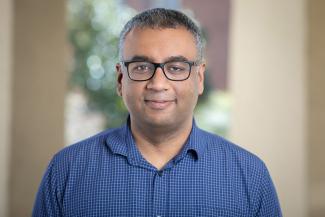
Hitesh Changlani is an Associate Professor in the Department of Physics at Florida State University, where he joined the faculty in 2018 after serving as an Assistant Professor from August 2018 to 2024. His academic journey includes postdoctoral fellowships at the Institute for Quantum Matter at Johns Hopkins University (2016-2018) and the Institute for Condensed Matter Theory at the University of Illinois at Urbana-Champaign (2013-2016). He received his Ph.D. in Physics from Cornell University in 2013 and earned his B.Tech. in Engineering Physics from the Indian Institute of Technology Bombay in 2007. Changlani's research focuses on theoretical and computational condensed matter physics, specializing in quantum many-body systems. His work spans several key areas including the study of quantum systems with strongly interacting particles, development of novel numerical algorithms for quantum many-body problems, multi-scale modeling of quantum matter, and investigation of frustrated magnets and Mott insulators. He has made significant contributions to understanding quantum spin liquids, particularly in pyrochlore systems like Ce2Zr2O7, and has developed advanced techniques such as density matrix downfolding for constructing effective Hamiltonians from first principles. Analysis of his recent publications (2023-2025) reveals a strong focus on quantum thermalization phenomena, quantum scars, and Hilbert space fragmentation in non-equilibrium quantum systems. His work bridges theoretical concepts with experimentally relevant materials, particularly in frustrated quantum magnetism. Changlani employs advanced numerical methods including tensor networks and quantum Monte Carlo to tackle challenging problems in strongly correlated electron systems, with recent emphasis on kinetic frustration in triangular lattice models and dipole-octupole physics in rare-earth pyrochlores. Changlani maintains active research collaborations and has developed computational approaches that connect ab initio calculations with low-energy model Hamiltonians. His research program addresses fundamental questions about quantum phases of matter, quantum dynamics, and the emergence of exotic quantum phenomena in correlated electron systems.