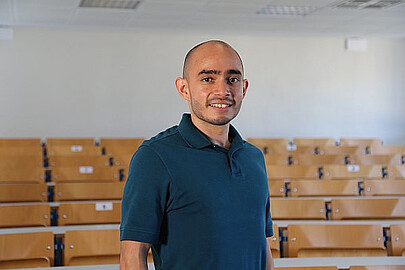
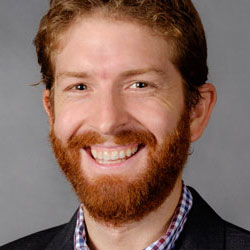
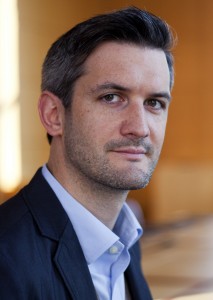
Dr. Victor Gabriel Lopez Mejia is a postdoctoral researcher at the Institute of Automatic Control Engineering, Faculty of Electrical Engineering and Computer Science, Leibniz University Hannover. His work focuses on data-driven control systems, reinforcement learning, and multi-agent system synchronization. PhD in Electrical Engineering (2019), University of Texas at Arlington M.Sc. in Electrical Engineering (2013), CINVESTAV, Mexico B.Sc. in Telecommunications and Electronics (2010), Universidad Autonoma de Campeche Research interests include: Neural network applications in control systems Reinforcement learning for cooperative control Game-theoretic analysis of multi-agent systems Data-based modeling of nonlinear dynamics Publications highlight advancements in data-driven predictive control, Gaussian process-based estimation, and nonlinear system analysis, with recent work in IEEE Transactions on Automatic Control and conferences like CDC and ECC. He has held academic roles including Adjunct Professor at the University of Texas at Arlington and Research Assistant at UTARI (2016-2019).
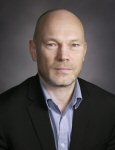
Vahé Nerguizian is a full Professor in the Department of Electrical Engineering at École de technologie supérieure (ÉTS) in Montreal, Canada, where he has established himself as a leading researcher in microelectronics, MEMS, and biomedical applications. Affiliated with the LACIME (Communications and Microelectronic Integration Laboratory), his work bridges engineering disciplines with healthcare innovations, particularly in cancer research and point-of-care diagnostics. His educational background includes a B.Ing. from Polytechnique Montréal, an M.Eng. from McGill University, and a Ph.D. from Concordia University. This strong foundation in electrical engineering has enabled his interdisciplinary research across multiple domains. Nerguizian's research focuses on the intersection of microfluidics, MEMS, and biomedical applications, with particular emphasis on cancer cell detection, liposome production for drug delivery, and microelectronic integration for healthcare solutions. His laboratory develops microfluidic devices for synthesizing nanoparticles and liposomes, with applications in cancer therapeutics and diagnostics. The work combines microwave engineering, bio-MEMS, and microelectronics to create innovative diagnostic tools and therapeutic delivery systems. His recent publications (2021-2025) demonstrate a clear trajectory toward increasingly sophisticated biomedical applications of microfluidic and MEMS technologies, with growing emphasis on cancer research, extracellular vesicle analysis, and therapeutic delivery systems. The research has evolved from fundamental MEMS and microwave engineering toward highly translational biomedical applications. 2015: Excellence in Teaching Award from the Board of Directors Nerguizian has supervised over 25 graduate students across doctoral and master's programs, with current projects focusing on microfluidic systems for nanoparticle synthesis and sensor systems for biomolecule detection. His research has received significant funding through collaborations with medical researchers, particularly with Julia Burnier's team at McGill University. The LACIME laboratory, where he conducts his research, provides state-of-the-art facilities for micro- and nanofabrication, integrated circuit design, and photonic microsystems. As part of the LACIME research group, Nerguizian contributes to a dynamic environment focused on both fundamental and applied research with strong industry connections. The laboratory's work spans from materials science to communication protocols, with particular strength in developing innovative solutions for healthcare applications.
Ilia Polushin is an Associate Professor at the Department of Electrical and Computer Engineering , Western University . His research focuses on Robotics, Teleoperation, Control Systems, and Biomedical Applications . Education : Ph.D. in Electrical Engineering (Carleton University), Cand. Sci. in Automatic Control (Saint-Petersburg Electrotechnical University) His work primarily addresses stability and control of teleoperation systems with communication delays, using scattering transformation techniques and projection-based force reflection algorithms . He has contributed to haptic systems, surgical robotics , and networked control applications , including drilling systems and cooperative teleoperation. Recent publications emphasize stabilization of conic systems , multi-agent synchronization , and nonlinear networked control . His research spans Robotics, Control Theory, Biomedical Engineering, and Industrial Automation . Scientific Awards : Best Conference Paper Award, IEEE International Conference on Mechatronics and Automation (2006) He has advised students and collaborated with researchers in Robotics , Control Systems , and Biomedical Applications . His laboratory focuses on teleoperation systems and haptic interfaces .
Matthew A. Franchek is a Professor in the Department of Mechanical and Aerospace Engineering at the University of Houston, where he has served since 2002. His career spans over three decades, including prior roles as Professor and Chair at the University of Houston (2002–2009), Director of the Biomedical Engineering Program (2002–2009), and faculty positions at Purdue University from 1992 to 2002. He earned his Ph.D. (1991), M.S. (1988), and B.S. (1987) in Mechanical Engineering from Texas A&M University and the University of Texas at Arlington, respectively. Dr. Franchek’s research focuses on Dynamic Systems, Measurement and Control , with expertise in linear/nonlinear system identification, multivariable control theory, diagnostics/prognostics, and adaptive control. His engineering applications span internal combustion engines , exhaust after-treatment , noise/vibration control , and health prognostics for cardiovascular/respiratory systems . His recent publications highlight applications in superconductor manufacturing, aeroelastic stability, magnetic actuators, and subsea engineering. 2002 Best Paper Award, ASME Journal of Dynamic Systems, Measurement and Control 2001 ASME Dynamic Systems and Control Division Young Investigator Award 1997 CASA/SME University Lead Award 1997 Feddersen Faculty Fellow, Purdue University Multiple teaching awards at Purdue University (1994–2001) and Texas A&M University (1991) He has served as an Associate Editor for the ASME Journal of Dynamic Systems, Measurement and Control, held leadership roles in ASME and IEEE, and organized symposia on nonlinear control and robust control at international conferences. His professional activities include advisory roles at Cummins Incorporated and reviewing for NSF and numerous journals.
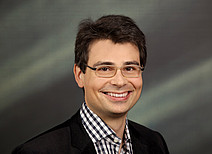
Klemens Fellner is a Professor of Mathematics/Computational Sciences and Group Leader of the Applied Analysis Group at the Institute of Mathematics and Scientific Computing, University of Graz. His research focuses on the analysis of partial differential equations and mathematical modeling across physics, chemistry, and biology. Research Interests: Prof. Fellner's work spans theoretical analysis of nonlinear PDEs (reaction-diffusion, kinetic, and non-local equations) using entropy/duality methods, with applications to: Biological systems (lipolysis, protein localization, stem-cell division) Physical processes (organic photovoltaics, semiconductor modeling) Collective behavior (swarming micro-organisms, aggregation dynamics) Interdisciplinary Mathematics-Arts collaborations Publication Trends: His recent articles (2018-2021) demonstrate strong focus on: Global existence and regularity for reaction-diffusion systems Convergence to equilibrium via entropy methods Drift-diffusion models in semiconductor physics Mathematical biology applications (prion dynamics, lipolysis) Novel approaches for non-local aggregation and hysteresis phenomena Research Leadership: Currently leads the Applied Analysis Group with members including postdocs and PhD students. Key projects: Doctoral School IGDK (International Graduate School) SFB Lipid Hydrolysis (Special Research Program) Mathematics and Arts collaborations Colibri research platform Supervises PhD candidate Reymart Lagunero studying generalized reaction-diffusion systems.
Yu Gu is an Adjunct Professor at the Lane Department of Computer Science and Electrical Engineering and a key contributor to the robotics program at West Virginia University (WVU). He directs the Interactive Robotics Laboratory (IRL), focusing on autonomous systems for planetary exploration, aviation safety, and swarm robotics. His work has earned recognition through awards such as the NASA Centennial Challenge and NASA NIAC Fellowship. Gu's research spans UAV navigation, sensor fusion, and multi-agent collaboration. His team's achievements include autonomous close-formation flight experiments and development of the SMART shared mobile robot platform for teaching. Projects sponsored by NASA, Air Force Research Laboratory, and the WV Space Grant Consortium highlight his expertise in GPS-denied navigation, flight safety monitoring, and underground mine mapping. His publications address theoretical and applied challenges in nonlinear stochastic estimation, fault-tolerant sensor fusion, and real-time stability indicators. Media coverage of his work includes features in Discovery Channel, Wired, and Aviation Week, underscoring its impact. NASA Centennial Challenge Winner NASA NIAC Fellow Gu leads projects like Stonemine (autonomous mine inspection) and SMART (open-source robotics teaching platform), with grants from agencies like NASA, AFRL, and MathWorks. The IRL lab's empirical studies demonstrate the utility of economic theories in swarm robotics task allocation and adaptability.
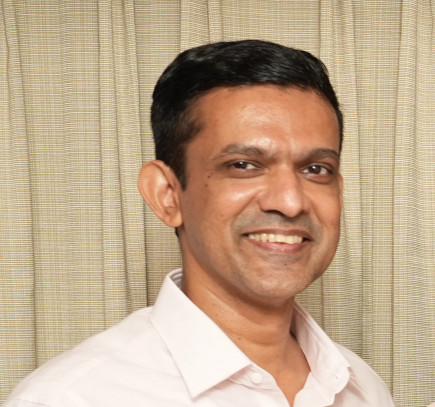
Joel George is an Associate Professor in the Department of Aerospace Engineering at the Indian Institute of Technology Madras (IIT Madras), where he conducts advanced research in aerospace vehicle dynamics, navigation, and control systems. His work spans theoretical studies, experimental validation, and practical applications in both atmospheric flight and space exploration domains. Dr. George's research focuses on several critical areas of aerospace engineering: Hybrid rocket propulsion systems and thrust control mechanisms Spacecraft landing technologies, including soft landing applications Orbital mechanics, particularly periodic orbits around asteroids Unmanned aerial vehicle (UAV) applications for microgravity experiments Propeller modeling for small UAV systems Geophysical flows research as part of IIT Madras's Centre of Excellence His recent publications demonstrate a strong trend toward innovative propulsion systems with practical space applications. Dr. George's work on hybrid rocket motors shows particular promise for safer vertical takeoff and landing systems both in space exploration and terrestrial aviation. His research on UAV-based microgravity platforms offers cost-effective alternatives to traditional space-based microgravity research methods. As a dedicated mentor, Dr. George supervises several PhD students including Anandu Bhadran (hybrid rocket motors), Rishi (asteroid orbital dynamics), and Siddhardha (UAV microgravity platforms). His collaborative work extends to partnerships with Prof. Ramakrishna and other researchers at IIT Madras. Within the Geophysical Flows Lab, a Centre of Excellence at IIT Madras, Dr. George contributes his expertise in UAV design, automation, and environmental monitoring. The lab employs a unified approach combining field measurements, climate modeling, and laboratory studies to advance understanding of air-sea interactions in the northern Indian Ocean, with applications to weather prediction and climate science.
Dr. Grey Ballard is an Associate Professor in the Department of Computer Science at Wake Forest University . He earned a B.S. in Math and Computer Science (2006), M.A. in Math (2008) from Wake Forest, and PhD in Computer Science (2013) from the University of California, Berkeley. He was a Truman Fellow at Sandia National Laboratories before joining Wake Forest. Research Focus: Ballard develops communication-optimal algorithms for high-performance computing , particularly in tensor decompositions , symmetric matrix computations , and nonnegative matrix factorization . His work combines numerical linear algebra with parallel algorithm design to reduce data movement costs in distributed systems. Publications demonstrate expertise in communication lower bounds , randomized tensor rounding , and visualization tools for parallel algorithms. He has contributed software packages such as TuckerMPI , GentenMPI , and PLANC for large-scale data compression and clustering. Scientific Awards: Wake Forest Excellence in Research Award NSF CAREER Award SIAM Linear Algebra Prize Three Conference Best Paper Awards (SPAA, IPDPS, ICDM) C.V. Ramamoorthy Distinguished Research Award (UC Berkeley) ACM Doctoral Dissertation Award – Honorable Mention Teaching: Courses include Introduction to Computer Science , Numerical Linear Algebra , and Parallel Algorithms . He has developed educational tools using the Thread-Safe Graphics Library to visualize parallel dynamic programming and collective communication.
Sam G. Krupa is a Research Fellow at École normale supérieure in Paris, France, holding a Marie Skłodowska-Curie European Postdoctoral Fellowship for his project on "Quantitative Stability and Regularity of Large Data for Conservation Laws," funded by the European Union with a grant of €195,914.88. His mentor is Cyril Imbert. Research interests include: Nonlinear Partial Differential Equations Fluid Dynamics Hyperbolic Systems of Conservation Laws Compressible Euler System Shocks Well-posedness Theory Ill-posedness Theory Convex Integration Scientific awards: Marie Skłodowska-Curie European Postdoctoral Fellowship Contact: sam.krupa@ens.fr . GitHub repositories include code for hyperbolic problems, p-system blowup analysis, and non-uniqueness in 2D isentropic Euler equations.
Gheorghe Craciun is a Professor in the Department of Mathematics and Department of Biomolecular Chemistry at the University of Wisconsin-Madison. His research focuses on mathematical and computational methods in biology and medicine, particularly chemical reaction networks, dynamical systems, and their applications to biochemical processes. He has organized and participated in workshops such as the Madison Workshop on Mathematics of Reaction Networks and the AIM-style Workshop on Mathematics of Reaction Networks, fostering collaborations and advancing the field. His work bridges theoretical mathematics with practical biological modeling, including studies on neurofilament transport, gene regulatory networks, and acoustic wave turbulence. Craciun's research spans diverse areas such as mass-action kinetics, graph-theoretic stability analysis, and algebraic approaches to reaction networks. He has published extensively in journals like SIAM Journal on Applied Mathematics, Bulletin of Mathematical Biology, and Journal of Mathematical Biology, often collaborating with interdisciplinary researchers. His teaching includes courses like Math 703 and involvement in the Madison Math Circle and Putnam Club.
Dr. Barak Ratzker is a researcher at the Max Planck Institute for Sustainable Materials , affiliated with the Microstructure Physics and Alloy Design department. His work focuses on the sustainable synthesis of materials, particularly through hydrogen-based reduction pathways and advanced sintering techniques like spark plasma sintering (SPS) and hot isostatic pressing (HIP). His research spans transparent ceramics, MAX/MXene phases, and alloy design. Key research areas include: Hydrogen reduction of oxides for sustainable metallurgy Pressure-assisted sintering (SPS/HIP) of transparent ceramics Microstructure engineering in refractory materials Development of MXene-based composites for electronics Thermodynamic and kinetic analysis of solid-state reactions His recent publications highlight trends in: Environmentally conscious processing of ferromanganese oxides High-pressure synthesis of MAX phases and MXenes Optimization of optical and mechanical properties in ceramics Dynamic deformation behavior under extreme conditions Biological material interactions (e.g., crusticul-chitin systems)
Dr. Alexander Thomas is a Professor in Nuclear Engineering and Radiological Sciences at the University of Michigan’s College of Engineering, and a cross-appointed Professor in Applied Physics at the College of Literature, Science and the Arts. His research at the Center for Ultrafast Optical Science (CUOS) focuses on computational and experimental laser-plasma interaction physics, particularly laser wakefield acceleration of electrons for compact particle accelerators. His work investigates high-intensity laser-plasma interactions (up to 10 22 W/cm²) to study relativistic electron dynamics, radiation generation, and quantum effects. He develops advanced computational models like the FARSIGHT Vlasov-Poisson code for non-equilibrium plasma physics, relevant to inertial confinement fusion and fast ignition scenarios. Current projects include optimizing laser-driven proton beams, characterizing photon-photon scattering, and advancing the ZEUS laser facility. Key trends in his recent publications include high-intensity laser wakefield acceleration, plasma-based photon acceleration to extreme ultraviolet, magnetic field generation in laser-solid interactions, and quantum electrodynamics (QED) studies. His research leverages facilities like the Hercules 300 TW laser and ZEUS, with applications in radiography, astrophysics, and radiation reaction studies.
Hugo Georges Victor Lavenant serves as Assistant Professor in the Department of Decision Sciences at Bocconi University, Milan, where he has held a faculty position since 2020. Previously, he completed a postdoctoral fellowship at the University of British Columbia (2019-2020) under the Pacific Institute of Mathematical Sciences and earned his PhD in Mathematics from Université Paris-Sud (2016-2019) under Filippo Santambrogio's supervision. His academic foundation includes: PhD in Mathematics, Université Paris-Sud (2016-2019) Studies at École Normale Supérieure (2012-2016) covering mathematics, physics, history, and philosophy of science Classes préparatoires in mathematics and physics (2010-2012) Lavenant's research centers on optimal transport theory and its applications across mathematical disciplines. He investigates geometric structures in Wasserstein spaces, develops numerical methods for dynamical optimal transport, and bridges theoretical advances with Bayesian statistics. His work demonstrates particular innovation in trajectory inference for biological data and dependence measures for random measures, connecting pure mathematics with computational statistics. Recent publications reveal accelerating interdisciplinary impact, with 2024-2025 works extending optimal transport to machine learning (kernel methods, variational inference) and data science (opinion dynamics, single-cell analysis). This trajectory shows increasing methodological sophistication in handling measure-valued mappings and non-smooth geometries while maintaining computational tractability. Award recognition includes: Pacific Institute of Mathematical Sciences Postdoctoral Fellowship Lavenant actively mentors early-career researchers through formal advising relationships and collaborative projects. He currently supervises two PhD candidates (George Kanchaveli and Francesco Mascari, co-advised with Marta Catalano) and has guided Master's students including Mathis Hardion and Niccolò Bargellini. His teaching portfolio spans advanced analysis, optimization, and real analysis courses at Bocconi, reflecting his commitment to mathematical rigor in education. He operates within Bocconi's Decision Sciences ecosystem while maintaining international collaborations with researchers at UBC, Université Paris-Sud, and statistical groups worldwide. Current projects focus on entropy-based transport methods and geometric approaches to nonparametric statistics, positioning his work at the intersection of theoretical mathematics and data-driven applications.
Nader Sadegh is a Professor in the Woodruff School of Mechanical Engineering at the Georgia Institute of Technology's College of Engineering, where he also serves as Associate Director and Education Director of the Robotics Ph.D. Program. His research spans robotics, control theory, and artificial intelligence with applications in industrial automation and public health. Dr. Sadegh's educational background includes: B.S. from University of California, Santa Barbara (1982) M.S. from University of California, Berkeley (1984) Ph.D. from University of California, Berkeley (1987) His research evolved from pioneering work on adaptive learning controllers for robotic manipulators—which enable robots to learn repetitive tasks without precise models—to neural network applications and nonlinear system identification. Current work focuses on barrier state theory for safety-critical control systems, safe trajectory optimization in robotics, and epidemiological modeling for disease transmission control. His methodologies consistently bridge theoretical control frameworks with industrial implementations to enhance system accuracy and autonomy while reducing hardware complexity. Analysis of his recent publications reveals a dominant trend toward safety-critical control architectures using barrier states and functions, with expanding applications in quadrotor navigation, agricultural robotics, and pandemic response systems. The interdisciplinary nature of his work connects control theory with machine learning, epidemiology, and industrial automation. Scientific distinctions include: Associate Editor, Journal of Dynamic Systems, Measurement, and Control (1993-1997) Registered Professional Engineer in Georgia U.S. Patent 5,946,449 for precision apparatus with non-rigid structures Dr. Sadegh has secured significant industry-sponsored research including Xerox Corporation projects on photoreceptor speed regulation, Ford Motor Company collaborations on assembly operations and continuously variable transmissions, and Visteon-funded work on high-precision manufacturing systems. His grants consistently target practical implementations where theoretical control methods solve real-world problems in automotive systems, electro-hydraulic valves, and glass forming processes. Based at the Georgia Tech Manufacturing Institute (GTMI), his lab develops integrated control solutions for complex mechanical systems, with recent emphasis on safety-guaranteed autonomous operations in unstructured environments and data-driven modeling for biological processes.
Peiyuan Chen is an Associate Professor at the Department of Electric Power Engineering, Chalmers University of Technology. He holds a B.Eng. from Zhejiang University (2004), an M.Sc. from Chalmers (2006), and a Ph.D. from Aalborg University (2010). His research focuses on power system operation and planning with wind power integration, emphasizing time series modeling, statistical analysis, and optimization. He contributes to projects on grid-forming converters, inertia estimation, frequency control, and renewable energy system stability. Research Interests: • Power Systems and Renewable Integration • Grid-Forming Converters and Stability Analysis • Time Series Modeling and Statistical Methods • Machine Learning for Energy Applications • Frequency Control and Synthetic Inertia Recent Publication Trends include studies on deep learning for heating load classification, wind turbine type optimization, fault ride-through capabilities, and inertia estimation in converter-dominated grids. His work bridges theoretical power system analysis with practical implementations in Nordic and European energy networks. Projects (2017-2024) include grants from the Swedish Energy Agency, Swedish Research Council (VR), and collaborations with institutions in Sweden, China, and Italy. Key areas: grid strength metrics, multiport converter applications, and citizen energy communities.