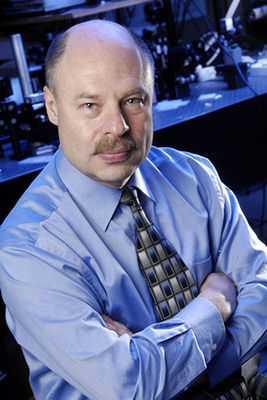
Dr. Sergey Mirov is a University Professor of Physics and Director of the UAB Center for Optical Sensors and Spectroscopies. An internationally recognized leader in mid-IR laser technologies, he has pioneered advancements in solid-state laser materials and quantum electronics. Education: Ph.D. Solid State and Laser Physics, P. N. Lebedev Physics Institute, USSR Academy of Sciences Research expertise spans: Development of transition-metal-doped laser materials Ultrafast mid-IR laser systems Laser spectroscopy and sensing applications Nonlinear optical phenomena Optical ceramic materials With over 30 years of continuous research leadership, Dr. Mirov maintains extensive collaborations with industry and national laboratories, directing UAB's quantum electronics research initiatives since 1993.
Leon Shterengas is an Associate Professor and Interim Department Chair in the Department of Electrical and Computer Engineering at Stony Brook University. His research focuses on high-power and high-speed light emitters, carrier dynamics in nanostructures, and molecular beam epitaxy. He leads the Optoelectronics Group, advancing innovations in mid-infrared lasers and quantum well structures. Teaching Responsibilities include courses such as ESE-211 Electronic Laboratory A, ESE-231 Introduction to Semiconductor Devices, and ESE-514 MOS Transistor Modeling. His work spans semiconductor laser design, photonic crystal engineering, and quantum photonics applications. Key research directions include developing photonic crystal surface-emitting lasers, cascade diode lasers, and single-photon-counting detectors for quantum biosensing. His publications emphasize breakthroughs in wavelength-tunable lasers and high-power mid-IR emission systems. Labs and Teams: Optoelectronics Group (focusing on advanced laser systems and semiconductor materials).
Mary Shultz is a Professor of Chemistry at Tufts University's School of Arts and Sciences. She leads the Shultz Research Group, focusing on surface science, physical chemistry, and clean water technologies. Her work combines experimental and instrumental innovations to study hydrogen bonding in environmental, biological, and atmospheric contexts. Key areas include icy surface dynamics, photocatalytic materials, and clathrate formation. Shultz has held faculty positions at Tufts since 1979, advancing from Assistant to Full Professor. She earned her BS from the University of Wisconsin-Madison (1970) and PhD from MIT (1975). Research Interests: Hydrogen bonding mechanisms at interfaces Photocatalytic nanoparticles for water purification Instrumentation development (e.g., nonlinear interferometers) Single-crystal ice surfaces and environmental applications Grants & Funding: Lead on a $7.5M Air Force Grant (2020-2025) studying ice nucleation $1M DOE grant for ultra-nano particle energy applications (2019-2022) Multiple NSF grants for surface chemistry and educational initiatives Teaching: Graduate courses in spectroscopy, quantum mechanics, and advanced chemistry Undergraduate research supervision in chemical physics and environmental chemistry Professional Contributions: Organized Gordon Research Conferences and international symposia Served on ACS Women Chemists Committee and Tufts Faculty Senate Hosted visiting researchers from institutions like Argonne National Laboratory
Simon Angstenberger is a Researcher at the 4th Physics Institute of the University of Stuttgart. His work focuses on rapidly tunable mid-infrared (mid-IR) laser sources and advanced laser spectroscopic techniques. He specializes in developing innovative laser systems for applications like trace gas detection and nonlinear optics. His research combines experimental photonics with cutting-edge technologies such as 3D-printed optical components and frequency comb systems. Education: Holds an M.Sc. (degree details not specified). Location: Based at Pfaffenwaldring 57, Stuttgart, in room 4-555. His publications emphasize rapid, high-sensitivity gas analysis and hybrid laser systems. Recent work includes COCO-QEPAS for ppm-level trace gas detection and femtosecond laser pulse compression techniques. Angstenberger’s contributions span laser technology, environmental sensing, and semiconductor material studies. Research Highlights: His 2025 publications showcase breakthroughs in photoacoustic spectroscopy for real-time gas monitoring, while earlier work (2020-2023) explores carbon nanotube networks and laser system design. His interdisciplinary approach bridges optics, materials science, and environmental applications.
Sebastian Loth is Professor and Managing Director of the Institute for Functional Matter and Quantum Technologies (FMQ) at the University of Stuttgart, leading cutting-edge research in atomic-scale quantum phenomena. His work integrates advanced scanning tunneling microscopy with quantum engineering to probe and manipulate matter at fundamental limits. His research spans: Quantum Physics and Computing (qubit design, error correction) Atomic-Scale Engineering (single-atom manipulation, quantum platforms) Spintronics and Nanomagnetism (single-molecule magnets, spin chains) Terahertz Spectroscopy (ultrafast dynamics, plasmon control) Condensed Matter Physics (charge density waves, quantum phase transitions) Analysis of his 2019-2025 publications reveals a trajectory toward atomically-precise quantum systems. Key advancements include stochastic resonance spectroscopy for slow-measurement dynamics characterization, terahertz near-field waveform control in STM, and atomic-scale vector network analyzers. His work consistently bridges quantum theory with experimental nanofabrication, particularly in quantum magnetism and electron dynamics at sub-nanometer scales. As head of the FMQ Institute, Professor Loth directs a multidisciplinary team focused on quantum materials characterization. The institute houses specialized facilities for ultrafast STM, terahertz spectroscopy, and atomic manipulation, enabling breakthroughs in quantum sensing and nanoscale device engineering. No information on academic advising, research grants, or scientific awards was provided in the source material.
Tilman Pfau is a Professor and Head of the 5th Institute of Physics at the University of Stuttgart. His research focuses on ultracold quantum gases, quantum computing with Rydberg atoms, and novel light-matter interactions. Key areas include supersolid systems, Rydberg molecule dynamics, and quantum device development. He leads projects such as QRydDemo, a neutral atom quantum processor demonstrator. Research Interests: Quantum droplets, dipolar supersolids, Rydberg physics, quantum optics, and scalable quantum computing architectures. His work bridges atomic physics with condensed matter and photonics, emphasizing precision spectroscopy and topological quantum phenomena. Key Projects: Development of optical tweezers arrays for quantum computing, pulsed ion microscopes for quantum gas imaging, and single-photon sources using four-wave mixing. Collaborations involve integrating nanophotonics with atomic vapors to enhance quantum control. Lab/Teams: Directs the 5th Institute of Physics labs focused on cold atoms, ion trapping, and quantum device fabrication. Hosts interdisciplinary projects combining experimental and theoretical approaches to quantum technologies.
Pavel Ruchka is a Researcher at the 4th Physics Institute of the University of Stuttgart, focusing on advanced optical technologies leveraging 3D printing. His work emphasizes micro-optics development for quantum systems, including applications in optical trapping, fiber integration, and biomedical imaging. With degrees in engineering and materials science, he explores intersections between additive manufacturing and photonics. His research spans quantum components, nonlinear optics, and sensor technologies, with a strong emphasis on practical implementations in fields like environmental monitoring and medical diagnostics. Key research areas include 3D-printed micro-optics for atomic trapping, hybrid laser systems, and gas sensing via photoacoustic spectroscopy. Ruchka's innovations often target miniaturization and functional integration, such as compact platforms for quantum experiments or high-resolution medical imaging devices. His contributions bridge fundamental optics research with applied technologies, addressing challenges in materials durability, beam control, and real-time data analysis. Publications highlight breakthroughs in exciton transport in 2D materials, ultra-compact photon sources, and fiber-coupled detectors. While no formal awards are listed, his work demonstrates significant impact in photonics and quantum engineering communities. He collaborates closely with the 4th Physics Institute’s teams, contributing to projects like microscopic optical tweezers and plasmonic photodetectors. Future directions likely involve further optimizing 3D-printed optical systems for quantum applications and biomedical settings.
Tomoyasu Mani is an Associate Professor in the Department of Chemistry at the University of Connecticut (Storrs Campus), part of the College of Liberal Arts and Sciences. He holds a Ph.D. from the University of Pennsylvania (2013) and a B.S. from the University of Texas at Dallas (2009), with postdoctoral training as a Goldhaber Fellow at Brookhaven National Laboratory (2014-2016). His research focuses on photo- and radiation-induced chemical reactions in condensed phases, emphasizing control of electronic excited states, charge/exciton transfer, and spin dynamics. Applications include biomedical imaging and energy technologies, using techniques like time-resolved optical spectroscopy and pulse radiolysis. His group collaborates on projects such as the QuanXR initiative, featured in UConn Today, and develops novel photoredox catalysts and molecular qubits for quantum sensing. Education: Goldhaber Fellow, Brookhaven National Laboratory, 2014-2016 Ph.D., University of Pennsylvania, 2013 B.S., University of Texas at Dallas, 2009 Awards: 2025 Faculty Mentoring of Undergraduate Students Award (CLAS) Labs/Infrastructure: Office: CHEM A-407 Wet Lab: R-213 Laser Lab: R-211 Recent Advancements: Design of spin-correlated radical pairs for magnetic field-controlled emissive qubits Development of red-emitting imaging dyes with sub-cellular specificity Study of perovskite interfaces and photocatalytic efficiency
Alex Rozhin is a Reader in Electronics & Computer Engineering at Aston University, where he leads the Nanomaterials Photonic Research Theme and heads the Nanoscience Research Group. His research spans nanotechnology, photonics, and nanomaterials synthesis, with applications in ultrafast lasers, optical sensors, and environmental monitoring. Key innovations include carbon nanotube-based saturable absorbers for GHz fiber lasers, functionalized nanomaterials for photonic gas sensors, and fluorescence mapping techniques for microplastic detection. His group develops nanocomposites for photonic devices, advanced manufacturing methods, and micro-spectrometers. Rozhin has received prestigious awards including the Royal Academy of Engineering/Leverhulme Trust Senior Research Fellowship and JSPS Postdoctoral Fellowship. His current projects focus on hybrid photonic sensors, nanomaterial-based water treatment membranes, and microplastic detection technologies as part of European initiatives.
Edik Rafailov is a Professor at Aston University, affiliated with the Aston Institute of Photonic Technologies (AiPT) under the College of Engineering and Physical Sciences. His research focuses on photonics, nanoscience, optoelectronics, and biomedical photonics. Notable contributions include work on quantum dots, ultrafast lasers, and nonlinear optical materials. He has published over 397 research outputs, including seminal reviews and articles in high-impact journals. His recent work explores biomedical applications of photonics for cancer detection and advanced laser technologies. Active in collaborative research, he leads projects involving international partnerships. Advises 4 current and past students. No explicit awards listed, though his extensive publication record reflects significant academic impact. Research Interests: Development of advanced photonic devices and materials Biomedical applications of photonics in diagnostics and therapy Ultrafast laser systems and nonlinear optics Quantum dot-based technologies for terahertz and THz radiation Recent Articles Highlight: Recent publications emphasize cutting-edge photonics techniques in medical diagnostics (e.g., label-free cancer detection systems) and ultra-compact femtosecond lasers. His work bridges fundamental optics research with applied biomedical and engineering solutions. Advising & Grants: Supervised 4 students (specific details not provided). Active in securing research grants through Aston University’s engineering and physical sciences funding streams. Labs/Teams: Leads the Aston Institute of Photonic Technologies (AiPT), a multidisciplinary research hub focusing on photonics innovation.
Sergei Sokolovski is a Senior Research Fellow at the Aston Institute of Photonic Technologies (AiPT), part of the College of Engineering and Physical Sciences at Aston University. His research focuses on biophysics, biophotonics, and photobiology, with an emphasis on laser technologies for medical diagnostics and therapy. Sokolovski holds a PhD in biophysics/photobiology and an MSc with honors in biology/biochemistry. Education: PhD in Biophysics/Photobiology, MSc with Honors in Biology/Biochemistry Key Roles: Senior Research Fellow (Aston University, 2014–present), Marie Curie Research Fellow (University of Dundee, 2013–2010), and Postdoctoral Research Fellow (University of York, 2000). Collaborations: Partnerships with institutions like the University of Dundee, LAZMA Ltd., and M-Squared Lasers Ltd., focusing on projects such as the EU-funded MEDI-LASE and ABLADE initiatives. His research interests include nonlinear optics of bacterial phytochromes, wearable laser Doppler flowmetry sensors for cardiovascular monitoring, and photodynamic therapies for brain tumors. Sokolovski’s work integrates advanced photonics with biomedical applications, such as 3D tissue modeling and non-invasive optogenetics. His publications span topics like laser-induced cellular effects, metabolic monitoring of artificial skin equivalents, and deep learning-enhanced retinal imaging. Recent studies highlight innovations in dual-mode OCT/fluorescence systems for tissue viability assessment and the development of compact laser sources for non-invasive diagnostics. Sokolovski also explores singlet oxygen’s role in neuroprotection and mitochondrial metabolism, advancing therapies for conditions like glioblastoma and diabetes-related complications. Labs/Teams: Core member of AiPT, collaborating with teams in photonics, biophysics, and medical engineering.
Dmitrii Stoliarov serves as a Research Associate at the Aston Institute of Photonic Technologies (AiPT) within Aston University's College of Engineering and Physical Sciences, Birmingham, UK. His research focuses on advanced photonics systems with applications spanning biomedical diagnostics and optical communications, and he is currently accepting PhD students for supervision. His core research areas include Fiber Lasers, Mode-locking, Ultrashort Pulses, and Nonlinear Optics, with significant contributions to Solitary Wave dynamics and Harmonics generation in optical systems. This work bridges fundamental laser physics with practical implementations in healthcare imaging and telecommunications infrastructure. Recent 2025 publications reveal strong interdisciplinary trends: compact femtosecond lasers for precision applications, dual-comb systems for optical ranging, and neuromorphic computing architectures. These demonstrate a clear trajectory toward photonics-driven solutions for cancer detection and next-generation information processing systems. Stoliarov actively supervises PhD candidates as indicated by his 'Accepting PhD Students' status. His research is conducted within the Aston Institute of Photonic Technologies (AiPT), a specialized research center focusing on laser development, optical communications, and biomedical photonics applications, leveraging state-of-the-art facilities for photonic device innovation.
Amit Yadav is a Researcher at the Aston Institute of Photonic Technologies (AiPT), part of the College of Engineering and Physical Sciences at Aston University, UK. He holds a PhD in Semiconductor LDs and LEDs from AiPT, an MSc in Electronics and Electrical Engineering from the University of Glasgow, and a B.Tech in Computer Science from Delhi. His research focuses on semiconductor lasers, ultrafast lasers, terahertz sources, and quantum dot-based technologies. Prior roles include Lecturer positions at CBP Government Engineering College in India and Teaching Assistant at Aston University. Research Interests: Terahertz generation, quantum dot lasers, fiber amplifiers, and optoelectronic material characterization. Key Achievements: Developed novel THz sources using quantum dot photoconductive antennas, optimized GaSb-based diode lasers in fluoride fiber amplifiers, and contributed to high-brightness LED efficiency studies. His work bridges fundamental photonics with biomedical and optical communication applications. Collaborations include projects on pulsed laser amplification and THz spectroscopy systems. He is affiliated with SPIE and OSA (2015-17).
Kaiming Zhou is a Senior Research Fellow at Aston University's Aston Institute of Photonic Technologies (AiPT), part of the College of Engineering and Physical Sciences. His research focuses on photonics technologies, including optical fiber devices, sensors, lasers, and microfabrication. He has led numerous high-impact projects, securing over £3 million in funding from Innovate UK, ERDF, and international collaborations with Airbus, Branscan Ltd, and others. Research interests span optical fiber Bragg gratings, femtosecond laser micromachining, biosensors, and mid-infrared spectroscopy. His work emphasizes industrial applications, yielding 200+ publications and a Google H-index of 29. Key innovations include tilted fiber grating technologies and label-free biosensors for rapid detection. Projects include ERDF-funded fiber laser developments (£2.3M), Innovate UK's food quality monitoring (£184K), and EU Horizon 2020 biochemical sensing grants (€180K). International collaborations with the Royal Academy of Engineering and US Air Force Research Laboratory. Supervised 5 student projects and holds patents in fiber optic sensor systems. His lab develops advanced optical components for aerospace, healthcare, and environmental monitoring applications.
Prof. Ilaria Cristiani is a Full Professor of Physics of Matter at the University of Pavia's Department of Industrial and Information Engineering. She coordinates the PhD Program in Electronic, Informatics, and Electrical Engineering since 2021. Her research focuses on nonlinear photonics, optofluidic devices for biomedical applications, and integrated optical components. She leads projects funded by EU FP7 (e.g., FABULOUS, NISTAS), Cariplo Foundation, and industrial collaborations (e.g., Huawei). She co-authored over 95 publications, holds 3 international patents, and edited books on photonics. She is a Senior Member of Optica and serves on the editorial board of the Journal of the Optical Society of America B. Education: PhD in Physics (1997, University of Pavia/Pirelli Labs), Laurea in Electronic Engineering (1994, University of Pavia with highest honors). Prior roles include Researcher at Pirelli Labs (1994–1998) and City Councillor for Education/Environment/Technology in Pavia (2014–2019). Research interests span optofluidic cell mechanics, integrated photonics for telecom/bio-applications, and nonlinear optical materials. Recent work includes optically stabilized lasers, sub-THz signal generation, and tumor cell mechanics analysis via microchips. Her lab designs low-loss grating couplers and semiconductor nanowire-based polarization controllers. Grants and Projects: European FP7 projects on optical networks and vascular screening; Italian Cariplo Foundation-funded optofluidic cancer cell studies; industry partnerships for optical component development. She coordinates international networks like COST actions on optofluidics and nonlinear micromanipulation. Labs/Teams: Active in the university's photonics lab, collaborating with institutions worldwide. Develops microfluidic chips for single-cell analysis and silicon nitride-based photonic devices.