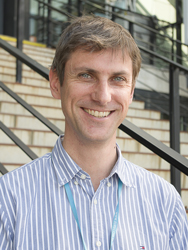
Florian Kaltenberger is a Professor in the Communication Systems department at EURECOM, a leading research institute in digital technology based in France. He actively contributes to research and teaching in wireless communications, with a focus on 5G/6G technologies, massive MIMO, and OpenAirInterface-based prototyping. Research Affiliation: EURECOM - Communication Systems Key Projects: SOLDER FP7, Newcom++, COST 2100 Professional Memberships: IEEE, reviewer for major journals and conferences His research centers on signal processing for wireless communications, MIMO systems, channel modeling, and hardware implementation. He specializes in exploiting channel reciprocity in TDD systems and developing practical testbeds for next-generation networks. Recent publications highlight a strong trend toward AI-integrated RAN, open-source 5G/6G testbeds (e.g., OpenAirInterface, X5G), UAV-aided localization, and real-time control using decentralized applications. His work bridges theoretical innovation with field deployment in programmable living labs. Award Highlights: Neal Shepherd Best Propagation Award (2013) He leads research grants under EU frameworks like FP7 and collaborates internationally on open RAN and 6G innovation. Though no formal student list is provided, his role as project lead and frequent co-authorship suggests active mentorship. He also manages EURECOM’s contributions to large-scale collaborative projects. Kaltenberger is deeply involved in lab development, particularly around OpenAirInterface, where he leads efforts in creating end-to-end, multi-vendor, private 5G O-RAN testbeds with real-time AI control and green networking capabilities.
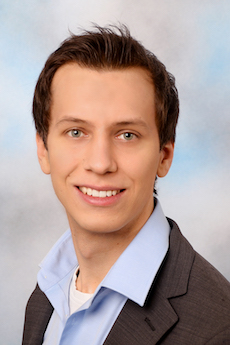
Prof. J. Rod Franklin, PhD is a Full Professor of Logistics and Academic Director of Executive Education at Kühne Logistics University (KLU) in Hamburg, Germany. With an extensive background spanning both academia and industry, Professor Franklin brings deep practical experience to his academic role. He has held significant leadership positions at KLU, including Dean of Programs, and was instrumental in the university's planning stages as he states: "KLU is near and dear to my heart, because I was one of the individuals that helped plan the university." His unique blend of academic rigor and industry expertise makes him a central figure in KLU's mission of providing world-class logistics education and research. Professor Franklin's academic foundation is impressive: Doctorate of Management, Case Western Reserve University, USA (2000) Master of Business Administration, Harvard Graduate School of Business, USA (1979) Master of Science in Mechanical Engineering, Stanford University, USA (1975) Bachelor of Science in Mechanical Engineering, Purdue University, USA (1974) His research focuses on applying modern management techniques to supply chain operations, with pioneering work in sustainable business models, green logistics, corporate social responsibility, and cloud-based supply chain management. Professor Franklin is a leading authority on the Physical Internet concept, which seeks to revolutionize logistics through interconnected systems inspired by the digital internet. His research consistently bridges theoretical frameworks with practical industry applications, addressing critical challenges in modern logistics networks while promoting sustainability and efficiency. Professor Franklin's publication record over the past two decades reveals a clear evolution from traditional logistics service innovation toward cutting-edge research on the Physical Internet, predictive analytics, and big data applications in supply chains. His recent work demonstrates increasing emphasis on urban logistics solutions, sustainability challenges, and the integration of digital technologies with physical logistics networks. His seminal 2020 paper "From the Digital Internet to the Physical Internet" has significantly advanced the conceptual framework for this emerging field, while his 2024 protocol design work continues to push the boundaries of practical implementation. Professor Franklin leads significant research initiatives including "Accelerating the Path Towards Physical Internet - SENSE," "Internet of Food and Farm 2020," and "URBANE - Upscaling innovative green urban logistics solutions." His work has been published in top-tier journals including Journal of Business Logistics, IEEE Transactions on Systems, Man and Cybernetics, and International Commerce Review, demonstrating substantial scholarly recognition. While specific individual awards aren't detailed in available information, his leadership in major funded research projects indicates significant institutional support for his work. As Academic Director of Executive Education at KLU, Professor Franklin oversees programs that effectively bridge academic theory with industry practice. His teaching portfolio includes MBA courses on Critical Thinking, Design Thinking, Managing Multiple Complex Expectations, and Systems Thinking - all emphasizing practical application of theoretical concepts. His extensive industry background, including executive roles at Kühne + Nagel and other major logistics firms, directly informs his approach to academic supervision and executive education. Professor Franklin has successfully secured research funding for multiple projects focused on sustainable logistics innovation, demonstrating his ability to translate theoretical concepts into impactful research initiatives. Professor Franklin leads collaborative research teams focused on the Physical Internet concept and its applications in modern logistics. Through projects like SENSE and URBANE, he works with international researchers, industry partners, and policymakers to develop innovative solutions for sustainable urban logistics. His research integrates expertise from computer science, operations research, and business management to address complex supply chain challenges. The BizSLAM App, developed as part of his work on multi-level SLA management, exemplifies his team's ability to create practical tools with direct industry applications, demonstrating the real-world impact of his research vision.
Ashwinkumar Venkatanaga Machanavajjhala is an Adjunct Associate Professor of Computer Science at Duke University's Trinity College of Arts & Sciences since 2024, with prior roles as Associate Professor (2018-2024) and Assistant Professor (2012-2018). His research focuses on differential privacy, secure multi-party computation, and privacy-preserving data analysis frameworks. Education: Ph.D. from Cornell University (2008) His work spans privacy-preserving algorithm design, synthetic data generation, and privacy-utility trade-offs. Recent research themes include differential privacy for aggregate queries, foreign key constraints in database systems, and policy-aware privacy frameworks . Grant projects like RAISE: C-Accel Pilot and RAPID: Poirot highlight his leadership in privacy and data security initiatives. Scientific contributions include groundbreaking work on ϵktelo for differentially private algorithms, DP-Sync for update pattern privacy, and Blowfish Privacy for customizable privacy definitions. Awards include the NSF CAREER Award (2013) for early-career impact. In outreach, he led the Bass Connections Faculty Team (2018-2019) addressing vaccine misinformation in Durham. Teaching includes COMPSCI 891: Special Readings in Computer Science (Summer 2022).
Mara Nikolaidou is a Professor in the Department of Informatics and Telematics at Harokopio University of Athens since 2007 and has served as the university's Rector since 2016. She represents Greek universities in the European University Association (EUA) for 2023-2024. Her research focuses on distributed systems, system modeling, and responsible computing, with a strong emphasis on IoT, cloud/edge computing, and cyber-physical systems. She leads projects funded by national, EU, and international agencies, exploring topics like autonomous systems, ethical requirements in design, and human-in-the-loop systems. Her educational background includes roles as a computer engineer and IT consultant before academia. She is a member of IEEE (SMC Society and Systems Council) and participates in the Object Management Group (OMG) working groups for SysML and responsible computing. She organizes international conferences in software and systems engineering. Research interests span distributed systems, IoT, and ethical computing. Recent work investigates cost analysis in cloud markets, human-AI collaboration, and smart city technologies. Over 200 publications highlight her contributions to model-based systems engineering, including SysML extensions for cost/QoS analysis and frameworks for autonomous fog nodes. Grants and projects include EU-funded initiatives on smart farming, cloud brokerage, and organizational interoperability. Her lab focuses on autonomous systems and context-aware middleware. She advises on e-Government compliance frameworks and collaborates with industry partners on IoT management platforms.
Eric Leclercq is a researcher at the University of Burgundy, affiliated with the LE2I Lab in Dijon, France. His work spans database systems, social network analysis, and biomedical data integration. He has contributed extensively to polystore systems, tensor decompositions, and category theory applications in data modeling. Fields of Interest : Database Systems, Data Mining, Social Network Analysis, Big Data Analytics, Semantic Web Leclercq's recent research focuses on formal frameworks for data lakes using category theory, multi-level tensor decomposition for social network stratification, and schema migration in multi-model systems. He has published in venues like CAiSE, IDEAS, and RCIS. His collaborations include Annabelle Gillet, Marinette Savonnet, and Nadine Cullot. Notable works include Lambda+ architecture for data processing, polarization analysis in social networks, and tools for tweet collection and biomedical data integration.
Ravi Reddy Manumachu is an Assistant Professor in the School of Computer Science at University College Dublin (UCD), Ireland. He holds a B.Tech from IIT Madras (1997) and a PhD in Computer Science from UCD (2005), specializing in high-performance heterogeneous computing and energy-efficient systems. His research focuses on optimizing performance and energy efficiency in modern heterogeneous platforms like clouds, grids, and supercomputers through novel models and algorithms. Key contributions include functional performance/energy models, energy-prediction frameworks, and extensions like Heterogeneous MPI and ScaLAPACK for heterogeneous clusters. He has published over 69 articles in top journals/conferences, with recent works addressing data transfer energy measurement, scalable allreduce algorithms (SUARA), and portable programming models (OpenH). Professional roles include Assistant Professor at UCD (2023–present), SEAI Research Fellow (2022–2023), and prior industrial experience at Ansys, Siemens, and IONA Technologies. He has certifications in university teaching, GDPR, and research integrity. Languages include English (fluent), Telugu, and Hindi. Research trends emphasize bi-objective optimization (performance-energy), hardware heterogeneity challenges, and scalable communication algorithms for deep learning. His work addresses energy non-proportionality in CPUs and GPU-CPU interactions, with practical solutions for real-world applications like matrix operations and gene sequencing.
Johannes Geier is a Researcher at the Chair of Design Automation at the Technical University of Munich (TUM). His work focuses on electronic design automation, fault injection simulations, and security countermeasures for RISC-V processors. University: Technical University of Munich Department: Chair of Design Automation Email: johannes.geier@tum.de Research Interests Electronic Design Automation (EDA) for analog and digital circuits Fault tolerance and reliability in RISC-V architectures Security analysis of post-quantum cryptographic systems Timing analysis and microfabrication techniques Optical Networks-on-Chip (NoC) and emerging technologies Compiler-assisted hardware security implementations Recent Research Trends Specializes in fault injection methodologies for hardware security validation Develops open-source tools like vRTLmod for RTL simulation acceleration Explores RISC-V vector extensions for post-quantum cryptography Investigates differential fault effect equivalence checks for efficiency Designs compiler-based security countermeasures against instruction skip attacks Works on concurrent multi-node XCP proxy server architectures
Dr. Laleh Tafakori is a Senior Lecturer in the Department of Statistics and Analytics at RMIT University's School of Science. Her research focuses on the intersection of statistical modeling, machine learning, and their applications in healthcare, finance, and environmental science. She is affiliated with the university's City Campus and can be contacted at laleh.tafakori@rmit.edu.au . Her teaching interests include Applied Analytics , Statistical Inference , Time Series Analysis , Mathematical Statistics , Stochastic Processes , and Probability Theory . She actively supervises research projects in areas such as: Healthcare modeling (e.g., diabetes onset prediction, maternal risk assessment) Environmental data analysis (e.g., extreme precipitation estimation via satellite data) Financial risk analysis (e.g., Value-at-Risk forecasting, credit portfolio management) Machine learning applications in complex networks and smart grids Her recent research trends emphasize predictive modeling for public health challenges, leveraging advanced statistical techniques (copula models, functional volatility) and machine learning (CNNs, random forests). She collaborates with institutions worldwide, addressing issues like Saudi Arabia's healthcare indicators and European financial systemic risk. While no formal awards are listed, her work demonstrates impactful contributions to interdisciplinary data science. Dr. Tafakori has advised over 16 students on topics ranging from diabetes epidemiology to edge computing optimization. Her research outputs include 28+ peer-reviewed articles, with a focus on methodological innovation and real-world problem-solving. She maintains active engagement in collaborative projects without explicitly listed grants.
Anne-Marie Kermarrec is a Senior Researcher at INRIA (France), with prior roles at Microsoft Research (UK) and the University of Rennes 1 (France). Her work focuses on decentralized systems, including gossip protocols, peer-to-peer networks, social networks, and collaborative filtering. PhD in Computer Science (Rennes, 1996) Her research spans epidemic algorithms, content-based search in large-scale networks, and scalable group communication. She pioneered gossip-based peer sampling and multicast infrastructures like Scribe and SplitStream. Her publications highlight applications in decentralized news recommendation (AllYours), network coding, and privacy-preserving social platforms (Gossple). Key article trends include gossip protocols , P2P systems , social network analysis , decentralized storage , and collaborative filtering . She received the Michel Monpetit Award (2011), ERC Starting Grant (GOSSPLE, 2008-2013), and an ICDCS Best Paper Award (2010). Michel Monpetit Award (2011) ERC PoC AllYours (2013) ERC Starting Grant GOSSPLE (2008-2013) ICDCS Best Paper Award (2010) Kermarrec led program committees for major conferences (e.g., EuroSys, Middleware) and chaired the ACM Software System Award. Her software contributions include AllYours (news recommender), GossipLib (gossip library), and GossipPeer (P2P platform maintenance).
Professor Jianming Tang is a leading academic at Bangor University's School of Computer Science and Engineering, holding the position of Professor in Optical Communications since 2011. He received his PhD in Optoelectronics from Bangor University in 1999 and has since developed an internationally recognized research program in optical networking technologies. His research focuses on: High-speed optical transmission systems Optical access networks and fiber-wireless convergence Digital signal processing for telecommunications Ultrafast dynamics of optical devices Secure communication systems Analysis of his recent publications (2024-2025) reveals strong emphasis on next-generation access networks, including fiber-wireless convergence, physical layer security using chaotic encryption, flexible transceivers for PON systems, neural network applications in optical communications, and advanced modulation techniques. His work consistently bridges theoretical innovation with experimental validation. Scientific Awards: The Royal Society Brian Mercer Feasibility Award (2008) Fellow of The ERA Foundation (2008) Visiting Professor, University of Electronic Science and Technology of China (2006) Professor Tang leads a highly productive research team that has secured £3.8M in research funding across 13 grants. His group focuses on optical transmission, dynamic networking, and ultrafast optical switching for future networks. He maintains active industry collaborations through projects like the EPSRC TRANSNET Programme and industrial partnerships with companies including Huawei and Oclaro.
Gerhard Wellein is a Professor for High Performance Computing at the Department of Computer Science of Friedrich-Alexander-Universität Erlangen-Nürnberg (FAU). He is the head of NHR@FAU (Erlangen National Center for High Performance Computing) and a member of the board of directors of the German NHR-Alliance. Since 2024, he has also served as a Visiting Professor for HPC at the Delft Institute of Applied Mathematics, Delft University of Technology. He holds a PhD in theoretical physics from the University of Bayreuth and has over two decades of experience in HPC education and research. Research Interests: His research focuses on performance modeling and engineering, architecture-specific code optimization, novel parallelization techniques, and the development of hardware-efficient building blocks for sparse linear algebra and stencil solvers. His work bridges computer science, applied mathematics, and computational physics, aiming to maximize efficiency on current and future HPC architectures, including exascale systems. Publication Trends: His recent publications emphasize analytical performance modeling (e.g., Roofline, oscillator models), energy efficiency, GPU optimization, and scalable linear algebra. They reflect a strong focus on both theoretical modeling and practical implementation, with applications in CFD, quantum physics, and molecular dynamics. Scientific Awards: 2011 Informatics Europe Curriculum Best Practices Award (shared with Jan Treibig and Georg Hager) for outstanding teaching contributions in HPC. Grants and Advising: He has led numerous third-party funded projects from the EU, BMBF, and DFG, including EoCoE-III, ESSEX, EXASTEEL, and ProPE. These projects focus on exascale software, performance engineering, fault tolerance, and multiscale simulation. He has mentored multiple researchers and students, contributing to the development of tools such as LIKWID, ClusterCockpit, and GEOPM. Labs and Teams: He leads the HPC research group at FAU and is deeply involved in national and international HPC initiatives. His team collaborates extensively on open-source HPC software and performance tools, fostering a strong community-driven approach to performance engineering.
Dominic Henze is a Professor at the Technical University of Munich (TUM), affiliated with the Faculty of Informatics and the Chair of Software Engineering . He leads research initiatives in Cyber-Physical Systems , Smart Environments , and Machine Learning Applications , with a particular focus on Fog Computing architectures. His research spans theoretical frameworks and real-world implementations, including collaborations with institutions like Carnegie Mellon University and industry partners such as Siemens AG and Zeiss IMT . His work addresses challenges in resource allocation , predictive maintenance , and blockchain integration within industrial contexts. Dr. Henze's publications reveal a consistent focus on Fog Computing architectures, IoT resource management, and educational software engineering. Key trends include self-organizing network systems , decentralized supply chain traceability , and smart environment coordination . He has advised numerous students on topics ranging from QoS negotiation to autonomous drone coordination . As an educator, he has taught multiple iPraktikum courses and seminars on iOS development and Agile Project Management since 2014, with publications exploring team composition strategies and distributed programming pedagogy.
Youhua Shi is a full Professor in the Faculty of Science and Engineering at Waseda University, Japan. He obtained his Doctor of Engineering from Waseda in 2005 and is an active member of IEICE, IPSJ, IEEE, and two Japanese academic societies. His research portfolio integrates trustworthy computing, hardware security of AI accelerators, energy-harvesting interface circuits for triboelectric nanogenerators, and low-power VLSI design-for-test methodologies. Education: Doctor of Engineering, Waseda University (2005) Graduate studies, Waseda University, Division of Engineering (completed 2005) Research Interests: Prof. Shi pursues trustworthy and secure silicon systems, spanning hardware Trojans in automated AI-accelerator flows, radiation-hardened latch design for soft-error resilience, and power-efficient CNN accelerators exploiting zero-gating and data-reuse techniques. Parallel work targets energy-autonomous IoT through advanced interface circuits for triboelectric nanogenerators, achieving record energy-per-cycle beyond the classical CMEO limit. Publication Trends: Recent articles (2024-2025) emphasize two thrusts: (i) security of AI/FPGA accelerators—proposing stealthy hardware-Trojan frameworks embedded within design-space-exploration flows that can misclassify up to 97% of inputs—and (ii) power electronics for triboelectric harvesters—introducing dual-output rectifiers and Bennet-doubler biasing that multiply output power >150× over conventional full-wave rectifiers, enabling battery-free IoT nodes. Scientific Awards: APCCAS Best Student Paper Award – 2020 IEEK Best Paper Award – 2012 Students & Collaboration: He has mentored numerous doctoral and master’s scholars, including Yirui Su, Chao Guo, Jinghao Ye, Lin Ye, Saki Tajima, and Masaru Oya, many of whom serve as first authors on his high-impact publications, indicating an active and productive advising role. Labs & Teams: While the text does not name a specific laboratory, his continued affiliation with Waseda University’s Faculty of Science and Engineering and his extensive project output imply he leads a research group focused on secure & energy-efficient VLSI systems, collaborating closely with colleagues such as Prof. Masao Yanagisawa and Prof. Nozomu Togawa.
Bing Qin is a Researcher specializing in computational linguistics, artificial intelligence, and multimodal learning. Their work focuses on enhancing large language models' capabilities in temporal knowledge graph forecasting, cross-lingual alignment, and safety mechanisms. Core Research Areas: Knowledge graphs, multimodal systems, reasoning frameworks Technical Innovations: Analogical replay, gain signal estimation, cross-modal attention intervention Recent Trends: 2025 publications emphasize training-free methods and preference alignment in LLMs
Damu Radhakrishnan is an Associate Professor in the Department of Computer Engineering at SUNY New Paltz. He holds a Ph.D. in Electrical Engineering from the University of Idaho, following B.Sc. and M.Tech. degrees from the University of Kerala and IIT Kanpur, India. His research focuses on low-power digital architectures, high-performance arithmetic circuits, reversible logic, and bio-medical instrumentation. He teaches courses including Introduction to Engineering Science, Digital Logic Lab, Digital Systems Design, and Senior Design Project 2. Dr. Radhakrishnan has contributed to over 20 publications since 1983, emphasizing low-power circuit design, residue arithmetic, and biomedical device development. His work spans analog-to-residue converters, fault-tolerant systems, and medical instrumentation. Key technical reports include contributions to NASA Langley Research Center and EG&G Corporation projects. His research trends reflect a sustained focus on energy-efficient digital systems, with early contributions to CMOS power optimization and later advancements in biomedical device testing. His publications demonstrate expertise in both theoretical foundations (e.g., switching theory textbooks) and applied engineering (e.g., defibrillator analyzers). Dr. Radhakrishnan maintains an active lab in Resnick Engineering Hall, where he oversees senior design projects and collaborates on interdisciplinary engineering solutions. His technical reports highlight contributions to medical simulation tools, VLSI implementation methods, and analog-digital interface design.