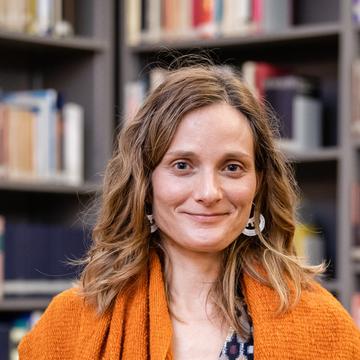
Dr. Ina Säumel is a scientific collaborator at the Institute of Agricultural and Horticultural Sciences at Humboldt University of Berlin. Her work bridges urban ecology, biodiversity conservation, and socio-cultural dimensions of sustainability through participatory approaches. Research Focus : Urban sustainability transitions, nature-based solutions, medicinal plants, and climate change adaptation. Key Projects : Edible City Solutions, biochar conversion from agro-residues, and biodiversity assessments in urban cemeteries. Geographic Scope : Uruguay, Andes, South Tyrol, and Berlin. Emphasis on post-industrial and water-sensitive cities. Her recent publications highlight interdisciplinary methods in co-creation, land-use impacts on metacommunity structures, and health-promoting urban green spaces. Contact: ina.saeumel@hu-berlin.de
Lilly Shanahan is an Associate Professor at the Department of Psychology , University of Zurich (UZH), and an Adjunct Professor of Psychology and Neuroscience at the University of North Carolina at Chapel Hill. She leads the Risk & Resilience Research Area and co-directs the z-Proso International Research Network . Her affiliations include the Jacobs Center for Productive Youth Development , the International Max Planck Research School on the Life Course , and Duke University's Center for Developmental Epidemiology . Her research focuses on: Social and biological risk factors for depression and anxiety Long-term developmental consequences of childhood mental/physical health issues Intersection of mental and physical health in adolescence Gender differences in developmental psychopathology Substance use and decision-making dynamics Recent publications analyze maternal mental health impacts, cannabis use trajectories, hormonal biomarkers, and digital mental health interventions. Scientific awards include a NICHD Postdoctoral Fellowship. She collaborates extensively with longitudinal cohort studies like the Zurich Project on Social Development and Great Smoky Mountains Study.
Professor Emil Lupu is a Professor of Computer Systems at the Department of Computing , Imperial College London. He leads the Resilient Information Systems Security Group and serves as Co-Director of the National Research Institute in Trustworthy Inter-Connected Cyber-Physical Systems (RITICS) . As a Security Science Fellow at Imperial’s Institute for Security Science and Technology, his work bridges academic research with real-world security challenges. Education: PhD in Computing, Imperial College London (1994–1998) His research focuses on security and resilience of cyber-physical systems (CPS) , with emphasis on defending against data spoofing attacks , adversarial machine learning , and IoT vulnerabilities . He pioneered the Ponder policy systems for access control and the Self-Managed Cell framework for autonomic computing, and developed Bayesian Attack Graphs for scalable risk assessment in CPS. Recent publications highlight trends in adversarial robustness (2025–2022), including LIDAR spoofing defense for autonomous vehicles, LLM security , and attack graph analysis for IoT. His work explores the intersection of safety and security , applying model-checking to identify adversarial threats in train control, microgrids, and aviation systems. Scientific Awards: Security Science Fellowship, Imperial College London (2011–present) As co-founder of the PETRAS National Centre of Excellence in IoT Cybersecurity (2016–2021), he advanced security methodologies for interconnected systems. His collaborations with institutions like the Cyber Security Body of Knowledge (CyBoK) demonstrate his leadership in shaping cybersecurity research standards. Current projects include the RITICS Institute , focusing on trustworthy cyber-physical systems, and exploring generative AI for security poisoning with practical defenses against adversarial ML.
Fabian Ferrari is an Assistant Professor in Cultural AI at Utrecht University, working in the Department of Media and Culture Studies within the Humanities faculty. He is affiliated with the Centre for Digital Humanities and is a member of the focus area Governing the Digital Society . Previously, he served as a Postdoctoral Researcher (2022-2024) in the same focus area and was a Visiting Scholar (2021-2022) at the Milieux Institute for Arts, Culture and Technology in Montréal. Dr. Ferrari's research focuses on the intersection of artificial intelligence, digital platforms, and society. His work examines AI governance, algorithmic power, digital labor, and the infrastructural geographies of AI systems. He investigates how public investments in AI infrastructure can reconcile competitiveness with public value creation, particularly through his upcoming NWO-funded Veni project Conditional Computing: Reimagining the Governance of Public AI Infrastructure , which begins in January 2026. His publication record demonstrates significant scholarly impact, with articles in top journals including Nature Machine Intelligence , Cultural Studies , New Media & Society , Big Data & Society , and Competition & Change . He has also co-edited the open-access book Digital Work in the Planetary Market published by MIT Press. Ferrari's work is frequently cited and has influenced policy discussions, as evidenced by multiple policy citations across his publications. NWO Veni grant for research on public AI infrastructure Dr. Ferrari's research collaborations span multiple institutions and international teams. He has frequently co-authored with scholars including Mark Graham, José van Dijck, and Anne Helmond. His work bridges technical, social, and policy dimensions of AI systems, with particular attention to labor implications and governance frameworks. He is actively engaged in both academic and public discourse on AI's societal implications, contributing to progressive policy visions for generative AI.
Brooke Foucault Welles is a Professor in the College of Arts, Media and Design at Northeastern University, where she also serves as Interim Dean and Director of the Network Science PhD program. Her research focuses on how social networks and communication technologies shape power dynamics, particularly in contexts of marginalization and social justice. PhD in Media, Technology and Society from Northwestern University MS and BS in Communication from Cornell University Her research spans multiple domains including: Network science of AI and social systems Digital activism and social movement dynamics Health information and (mis)information flows Open source community structures Race/ethnicity in digital contexts Computational social science methodologies Recent publications focus on attention dynamics in social networks, hate speech protection mechanisms, and open-source software sustainability. Her work has been supported by grants from the NSF, NULab, and Chan Zuckerberg Initiative. Awards include: McGannon Book Award (2021) for #HashtagActivism Best Paper Honorable Mention at CSCW 2019 She leads the Communication Media and Marginalization Lab (CoMM Lab) which includes PhD students and postdocs from diverse disciplines. Her advising approach emphasizes interdisciplinary collaboration and methodological training in both quantitative and qualitative approaches.
Robin Boyle-Laisure is a full-time Professor of Legal Writing at St. John's University School of Law , teaching first-year Legal Writing I/II and advanced courses in contract drafting. She has lectured internationally in Ukraine and China, designed legal education programs for college students through the Ron Brown Prep Program (17 years), and contributed to conditional admissions initiatives. Education: J.D., Fordham University School of Law (1989) B.A., Vassar College (1980) Her research spans legal writing pedagogy , contract drafting , human trafficking , and undue influence in cults . She has authored over 40 publications, including books like Taken No More (forthcoming 2025), and pioneered modular online learning platforms for legal education. Recent articles focus on learning-style theory, legal protections against trafficking, and interdisciplinary collaborations. She has presented at conferences globally and co-founded the Empire Legal Writing Biennial Conferences (since 2010). Scientific Awards & Service: Vincentian Senior Fellow (2021-present) and Research Fellow (2019-present) Co-Founder, Empire Legal Writing Biennial Conferences Editorial Board, Perspectives: Teaching Legal Research and Writing (2017-present) Faculty Advisor, EDNY Federal Bar Association student chapter Board Member, International Cultic Studies Association (2023-present) Chair, AALS Section on Academic Support (2010-2012)
Bernard S. Black serves as Professor of Finance at Kellogg School of Management and the Nicholas D. Chabraja Professor at Northwestern University School of Law, holding a joint appointment since 2010. He concurrently serves as managing director of the Social Science Research Network and founding chairman of the annual Conference on Empirical Legal Studies. His academic foundation includes: B.A. from Princeton University M.A. in physics from University of California at Berkeley J.D. from Stanford Law School Prior academic roles encompass Professor of Law at Stanford Law School (1998-2004) and Columbia Law School (1988-1998). His research centers on empirical analysis of law-finance interactions, with emphasis on corporate governance frameworks in emerging economies, securities regulation, and medical malpractice systems. Methodologically, he integrates legal scholarship with quantitative finance approaches. Recent publications (2016-2022) demonstrate sustained focus on corporate governance validity testing, causal inference methodologies, and cross-country comparative studies—particularly examining Brazil and BRIK nations. Key themes include board structure efficacy, shareholder rights enforcement, and institutional determinants of market value in developing economies. No scientific awards were documented in source materials. While specific student advisees remain unlisted, Professor Black's extensive co-authorship record (including books like The Law and Finance of Corporate Acquisitions ) indicates active research mentorship. His leadership of the Social Science Research Network and Conference on Empirical Legal Studies constitutes significant community-building beyond traditional advising. He directs the Social Science Research Network as managing director and founded the Conference on Empirical Legal Studies, creating platforms for interdisciplinary law-finance scholarship dissemination.
Prof. Dr. Johannes Kinder is a Professor and Chair of Programming Languages and Artificial Intelligence at the Institute of Informatics , Ludwig Maximilian University of Munich. His research focuses on software security through program analysis and machine learning, particularly targeting malware detection , vulnerability analysis , and reverse engineering . He has held faculty positions at Royal Holloway, University of London, and Bundeswehr University Munich. Research Interests include: Securing software systems via program and machine learning techniques Detection of software vulnerabilities and malware Preventing exploitation through binary analysis Applications of formal methods in systems security Recent Publications highlight advancements in binary function embedding , malware detection in npm , and speculative execution attack modeling . His work appears in top venues like USENIX Security and IEEE S&P . Education : Diplom from TU Munich (2005), Doctorate from TU Darmstadt (2010). Professional Roles : General Chair, ACM CCS 2019 Doctoral Symposium Chair, ESSoS 2016 Program Committee member for NDSS 2026, IEEE S&P 2022-2025
Professor Isabella Dobrescu is Head of the School of Economics at the University of New South Wales (UNSW) Business School and co-chair of the STEP UP initiative in Education. She serves as an editor for the Journal of Pension Economics & Finance and maintains an active research program spanning labor economics, public finance, health economics, and applied econometrics. Her educational background includes a Ph.D. in Economics with Honors from the University of Padua (2009), an M.Sc. in Economic Mathematical Modeling Summa cum Laude from West University of Timisoara (2005), and dual bachelor's degrees in Economics from Nottingham Trent University and Finance Summa cum Laude from West University of Timisoara (2003). Dobrescu's research has evolved from structural work on consumption and saving dynamics to pioneering applications combining theory, empirical analysis, and randomized controlled trials to improve educational outcomes through technology. Her recent work focuses on financial literacy interventions for high school students through the STEP UP program, while maintaining her longstanding research on aging populations, retirement decision-making, and risk behavior. Her publication portfolio demonstrates consistent output across labor economics, health economics, and applied econometrics, with recent emphasis on educational technology interventions and financial decision-making in retirement contexts. The research shows methodological diversity spanning structural modeling, nonparametric partial identification techniques, and experimental approaches. UNSW Business School Research Impact Award (2021) UNSW President's Award for Building Collaborations (2019) UNSW Scientia Education Fellowship (2017) Australian Government Office of Learning & Teaching Citation (2016) ARC Early Career Research Fellowship (2012) Dobrescu has secured over AU$2.5 million in competitive research funding since 2010, including major ARC Linkage grants and substantial UNSW strategic investments. She leads the STEP UP initiative which has received over AU$650,000 in funding for financial literacy outreach programs. Her collaborative approach is evident in numerous multi-investigator projects with colleagues including Bateman, Thorp, Motta, and Newell across economics, finance, and education domains. As Head of the School of Economics and co-chair of STEP UP, Dobrescu leads research teams focused on educational interventions using technology, retirement decision-making, and the economics of aging. Her Playconomics platform represents a significant innovation in experiential economics education, receiving media coverage from major outlets including The Sydney Morning Herald and The Australian.
Manolis Chatzis is an Associate Professor in the Department of Engineering Science at the University of Oxford and a Tutorial Fellow at Hertford College. His research focuses on dynamic systems and earthquake engineering, particularly modeling risks for unanchored structural and non-structural components subjected to ground motions. University of Oxford - Department of Engineering Science Hertford College - Tutorial Fellow His work on system identification and observability of nonlinear systems aims to optimize sensor setups for infrastructure reliability. Recent publications address discontinuous Kalman filters for non-smooth dynamics, energy loss in rocking bodies, and experimental validation of seismic response models. Applications span seismically isolated buildings, museum artifacts, hospital equipment, and supercomputers. Key research trends include: Nonlinear dynamics of rocking/sliding systems Bayesian identification methods Energy dissipation mechanisms 3D motion tracking algorithms Sensor fusion and data-driven modeling His publications since 2010 demonstrate interdisciplinary collaboration across civil, mechanical, and computational engineering domains.
John Gledhill is an Associate Professor of Global Governance in the Department of International Development at the University of Oxford, where he teaches courses on Global Governance and Diplomacy, Peacebuilding & Statebuilding, and Power, Conflict, & the Arts. He is a Fellow of St. Cross College and actively collaborates with international institutions such as the Asia-Pacific Centre for the Responsibility to Protect (University of Queensland), the Conflict Research Society, and OxPeace, a multidisciplinary peace research network at Oxford. PhD in Government from Georgetown University BA in History and Political Science from Trinity College, Dublin His research spans peace and conflict studies, focusing on the political dimensions of development, nonviolent resistance, and the role of music and the arts in conflict and peacebuilding. Recent work examines UN peacekeeping withdrawal legacies, the economic impacts of peace operation exits, and the integration of arts into peace processes. The 15 most recent publications reflect his expertise in UN peacekeeping dynamics, state formation, and the intersection of arts and conflict. These include studies in the European Journal of International Relations , Journal of Global Security Studies , and International Peacekeeping , alongside book chapters and encyclopedia entries addressing transitional justice, regime transitions, and globalization's effects on emerging economies. Scientific Awards: Teaching Excellence Award, University of Oxford (2013) Teaching Excellence Award, London School of Economics (prior to 2013) John has supervised research students Sabrina Brandt and Rachel Nguyen-Morrow. His projects include ESRC-funded studies on post-peacekeeping withdrawal outcomes and investigations into music's role in UN peacebuilding. He contributes to academic governance through roles on the Conflict Research Society's Governing Council and the OxPeace Steering Committee.
Leanna Hernandez, Ph.D., is Assistant Professor-in-Residence in the Department of Psychiatry and Biobehavioral Sciences at the David Geffen School of Medicine, University of California, Los Angeles. She directs the Hernandez Lab and can be reached at leannahernandez@ucla.edu . Her research integrates multimodal neuroimaging with large-scale genetics to uncover mechanisms underlying autism spectrum disorders, sex differences in brain development, and the role of immune–neurodevelopment pathways such as the complement system. Core themes include: Mapping how common genetic variation shapes brain structure and function across development. Identifying neural signatures that explain the female protective effect in ASD. Elucidating interactions between sleep physiology and brain maturation in youth. Across more than 40 peer-reviewed publications (2012-2023) she has leveraged data from the Adolescent Brain Cognitive Development (ABCD) Study, the GENDAAR Consortium, and multiple international biobanks, generating insights into white-matter microstructure, functional connectivity, and transcriptomic correlates of psychiatric traits. Scientific collaborations span UCLA, UC San Diego, University of Queensland, and the Busselton Health Study, reflecting an interdisciplinary approach that combines neuroimaging, genomics, lipidomics, and behavioral phenotyping. Dr. Hernandez’s laboratory website ( hernandezlabucla.org ) provides further resources, although specific trainees, grants, and awards are not detailed in the supplied text.
Rossella Ciccia is an Associate Professor of Social Policy at the University of Oxford, affiliated with the Department of Social Policy and Intervention and Green Templeton College. Her research focuses on comparative social policy, gender regimes, care work, social inequalities, and intersectionality across Europe and Latin America. Co-chair of ECPR Standing Group on Gender and Politics Convenor of European Conference on Politics and Gender Former member of Gender Equality Policy in Practice (GEPP) network Her work examines tensions between care and paid work, social policy expansion through protests, and intersectional solidarity in coalitions. Recent publications analyze childcare policies, labor regimes, and welfare state reforms using configurational methods. Key awards include the 2022 European Journal of Politics and Gender Best Article Award, 2020 Emma Goldman Award, and 2015 Rosabeth Moss Kanter Award nomination. She supervises DPhil students in areas like care policies, gender equality, and social movements.
Pascal Scherrer is Associate Dean (Research) and Professor within the Faculty of Business, Law and Arts at Southern Cross University . Based in Lismore, Australia, he combines an administrative leadership role with active research in sustainability, regional development, tourism and visitor management. His work bridges academia, industry and government, having jointly secured over AUD $2 million in competitive funding and delivered high-impact projects for clients such as the NSW National Parks & Wildlife Service and the Australian Meat Processor Corporation. Education BSc – Griffith University BSc (Hons) – Griffith University Graduate Certificate TESOL – Bond University PhD – Griffith University Research Interests Dr Scherrer’s scholarship centres on sustainability science applied to tourism and regional development. His current flagship project is a circular-economy partnership with the Australian Meat Processor Corporation aiming to reduce plastic packaging waste across red-meat supply chains. Earlier work includes sustainable-visitor-capacity assessments on Rottnest Island , alternatives to summiting Wollumbin-Mt Warning that informed a AUD $7.4 million NSW government trail investment, and longitudinal monitoring of visitor experiences at Point Fraser artificial wetland in Perth. Cross-cutting themes include visitor risk perception in remote alpine and coastal settings, community engagement in protected-area governance, Indigenous tourism business models , and the intersection of digital culture (e.g., selfie-taking) with tourism safety. Scientific Awards 2023 – Southern Cross University Research Award 2014 – Southern Cross University Vice-Chancellor’s Award for Excellence in Community Engagement Grants & Advising Scherrer has jointly attracted over AUD $2 million in research and consultancy funding from state and federal agencies, industry bodies and NGOs. He currently supervises Honours and PhD candidates across topics in sustainable tourism, regional development and visitor management, and teaches undergraduate and postgraduate units covering sustainable tourism, visitor-economy management, and planning & policy. Professional Affiliations & Service Member, IUCN World Commission on Protected Areas Member, North Coast Regional Advisory Committee, NSW National Parks & Wildlife Service External facilitator for community and local-government projects
Edward J. Balistreri is the Duane Acklie Chair and Professor of Economics at the University of Nebraska-Lincoln, where he also serves as Department Chair. He became the Duane Acklie College of Business Yeutter Institute Chair in August 2020 and is a core faculty member of the Clayton Yeutter Institute of International Trade and Finance. Prior to joining UNL, he held academic positions at Iowa State University and the Colorado School of Mines, and has contributed to climate and trade-policy debates as both an academic and consultant. Ph.D. in Economics, University of Colorado-Boulder (1995) B.A. in Economics, Arizona State University (1989) Professor Balistreri specializes in international economics with a focus on trade policy analysis using computable general equilibrium (CGE) modeling. His research examines the impacts of trade agreements, trade disputes, and policy responses on economic outcomes, with particular expertise in agricultural and energy products trade. He has made significant contributions to the theoretical and empirical understanding of international trade structures, including Armington, Krugman, and Melitz models, and has applied these frameworks to analyze contemporary trade issues including the US-China trade war and the economic impacts of the COVID-19 pandemic. Balistreri's recent publications demonstrate a strong focus on contemporary trade policy challenges, particularly the analysis of disruptive trade policies and their economic impacts. His work spans theoretical advancements in trade modeling and applied policy analysis of recent trade conflicts. Notably, he has applied his expertise to analyze the economic impacts of the COVID-19 pandemic on global food security and regional economies, showcasing the versatility of his methodological approach across different economic contexts. Professor Balistreri has served as a research economist at the United States International Trade Commission and as a consultant, providing expertise on trade policy matters. His research has been supported by various funding sources, including a cooperative agreement between the U.S. Department of Agriculture, Economic Research Service, and the University of Nebraska-Lincoln for his work on global food security during the pandemic. Balistreri is a core faculty member of the Clayton Yeutter Institute of International Trade and Finance at the University of Nebraska-Lincoln, which serves as a hub for research and policy analysis on international trade issues. His collaborative work with researchers like David G. Tarr, Christoph Böhringer, and Thomas F. Rutherford demonstrates his engagement with international research networks focused on advancing trade modeling methodologies and policy analysis.