Graham Johnson is a Researcher at the National Renewable Energy Laboratory (NREL), affiliated with the Computational Science Center and the Data, Analysis, and Visualization Group . His work focuses on designing high-performance visualization tools for energy systems and decision-making processes. Primary research areas include interactive web visualization, immersive environments, and real-time visual analytics. Formerly at The Aerospace Corporation (2017–2020), he transitioned to NREL to develop advanced visualization pipelines and collaborative tools. His recent publications highlight innovations in energy scenario modeling, contour visualization alternatives, and situational awareness applications. Articles emphasize Computer Science , Energy Systems , and Human-Computer Interaction themes. Education includes dual Masters in Applied Mathematics and Aeronautical & Astronautical Engineering from Purdue University, along with a Bachelor's in the latter field.
Jos Roerdink is a Professor at the Bernoulli Institute within the Faculty of Science and Engineering at the University of Groningen , Netherlands. His research spans multiple disciplines including computer science, mathematical morphology, data visualization, and neuroscience, with a focus on algorithm development and applications in medical imaging and astronomical data analysis.
Manuel Curado is a researcher with a focus on graph theory, network analysis, and machine learning applications. His work spans spatio-temporal forecasting, traffic accident prediction, medical imaging, and urban mobility studies. He collaborates extensively with researchers like José-Francisco Vicent, Francisco Escolano, and Leandro Tortosa. 2025 : Self-explainable graph convolutional recurrent networks for traffic forecasting 2024 : GeoCC-ConvLSTM for air quality and CTextureFusion for lung CT super-resolution 2023 : Return Random Walk Gravity Centrality for node influence metrics 2022 : Human mobility analysis using Twitter data and directed graph centrality models His research emphasizes graph-based algorithms, deep learning, and data science for real-world problems in transportation and healthcare. He has contributed to journals like Information Sciences , Applied Soft Computing , and Neural Computing & Applications .
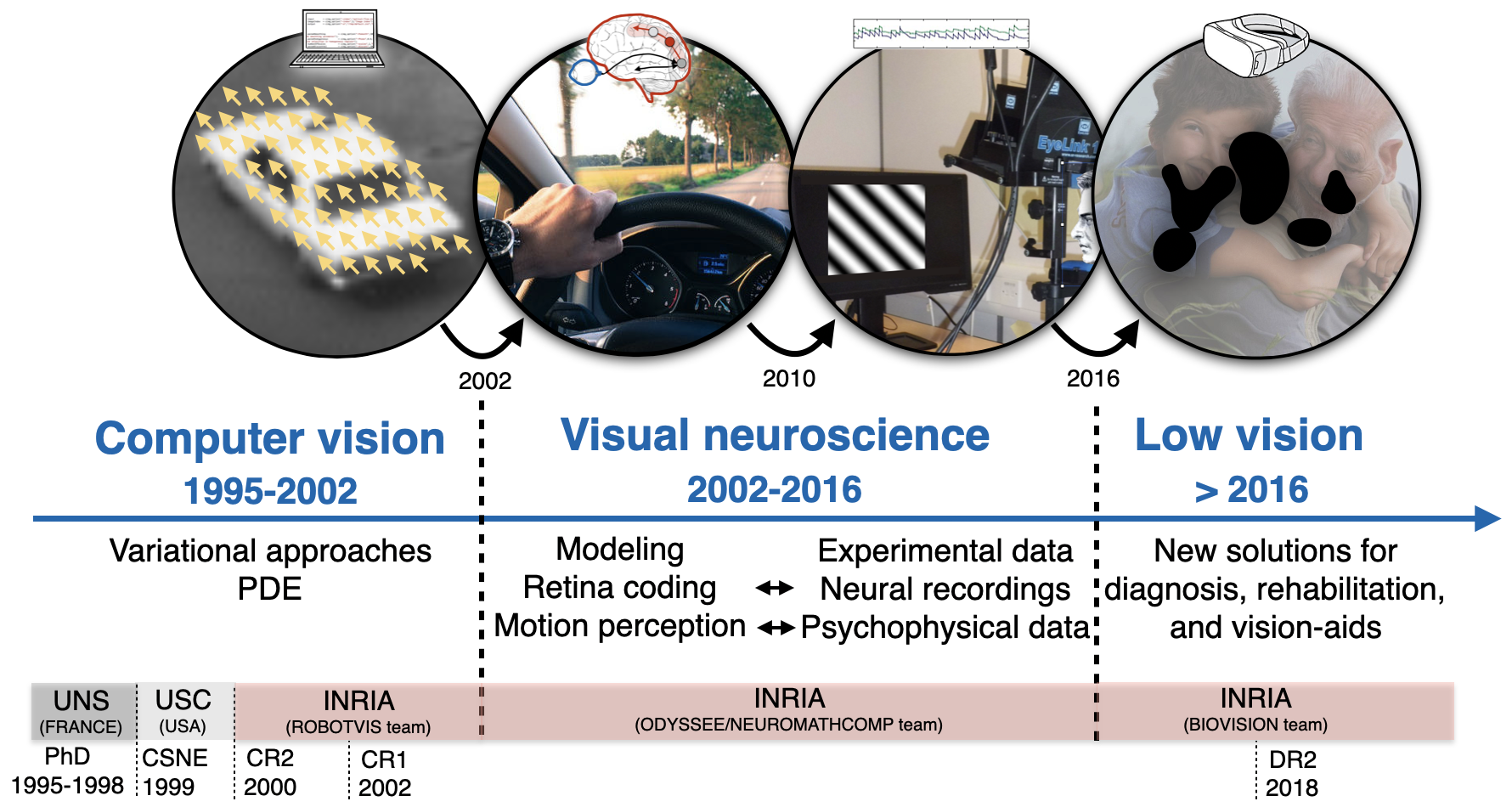
Pierre Kornprobst is a Senior Research Scientist ( Directeur de Recherche ) at Inria Sophia Antipolis – Méditerranée, France. Specializing in vision science and computational neuroscience, he focuses on understanding visual perception mechanisms in visually impaired individuals and developing innovative solutions using virtual reality (VR) and augmented reality (AR). His work bridges biological vision systems with artificial computer vision, emphasizing bio-inspired models. Ph.D. in Mathematics (1998), Nice-Sophia Antipolis University Co-author of a textbook with over 2,000 citations Advisor to 8 Ph.D. and 20+ M.S. students Research interests span bio-inspired computer vision , VR/AR for accessibility , computational neuroscience , and visual perception modeling . Recent publications highlight VR-based assistive technologies, constrained text generation for vision screening, and Python toolboxes for reproducible experiments. His work has been recognized with inclusion in the 21st Annual Best of Computing . He has contributed to five European projects (FACETS, SEARISE, BRAINSCALES, MATHEMACS, RENVISION) and leads work packages in ANR DEVISE (2021–2024).
Prof. Dr. Michael Kleine is a Professor of Mathematics Education at the Faculty of Mathematics, Bielefeld University since 2012. He specializes in mathematics didactics, focusing on developing diagnostic tools for identifying at-risk students, integrating origami into mathematical teaching, and exploring linguistic factors in mathematical task design. Research interests include enactive learning, blended learning environments, and mathematical modeling Actively involved in international collaborations (KMTUT Bangkok, Peking University) and ERASMUS+ projects Previously served as Professor at Weingarten University of Education (2008-2012) Recent publications emphasize experimental mathematics, geometric reasoning through origami, and linguistic complexity in mathematical tasks. He developed the DITOM diagnostic framework for early identification of mathematical learning challenges. Prof. Kleine combines theoretical research with practical teacher training, particularly for secondary education. His work bridges cognitive psychology, educational technology, and curriculum innovation.
Rick O. Gilmore is Professor of Psychology at Pennsylvania State University's College of the Liberal Arts and a Huck Institute of the Life Sciences Faculty Co-fund. He directs the Brain Development Laboratory with research foci in Cognitive and Developmental psychology. His educational background includes a Ph.D. and M.S. from Carnegie Mellon University (1997 and 1994) and an A.B. magna cum laude from Brown University (1985). Gilmore's research centers on visual perception, specifically how brain networks process optic flow to extract environmental layout, object shape, and self-movement information. He is a leading advocate for open science practices and co-founded Databrary.org data library and Datavyu.org video coding tool. His work has been supported by NIH and NSF grants. His recent scholarly output demonstrates strong focus on research transparency, data sharing infrastructure, and visual development. The publications reveal consistent themes in open science methodology and cognitive development research. College of the Liberal Arts tenure-line faculty teaching award Gilmore has served as founding Director of Human Imaging at Penn State's Social, Life, and Engineering Sciences Imaging Center (2008-2014) and leads the Human Developmental Neuroscience Initiative for the Child Study Center. He advises numerous research initiatives and has mentored students in his senior seminar on the reproducibility crisis in science. He maintains active laboratory operations through the Brain Development Laboratory and contributes to multiple open science infrastructure projects including databraryr package development and the Legacy Project: Visual Acuity initiative.
Prof. Dr. Vytautas Michelkevičius is a curator, art critic, and academic leader at the Vilnius Academy of Arts (VAA) , where he has served as Professor (since 2022), Associate Professor (2013–2022), and Lecturer (2005–2013). He has led the Photography, Animation and Media Art Department since 2019 and the Doctoral Programme in Fine Art since 2019. His career spans curatorial projects, academic research, and international collaborations. Education: PhD in Communication and Information Studies (Vilnius University, 2010), MA in Communication Studies (2005), BA in Information Studies (2003). Post-doctoral research at VAA (2013–2015). Research Interests: Focused on artistic research as an epistemological framework, media art , diagrammatic imagination , and remote artist residencies . His work bridges art, philosophy, and technology, emphasizing interdisciplinary methodologies. Scientific Awards: Best PhD Thesis in Humanities (2010) Herder Stipendium (2004–2005) DAAD Fellowship (2008–2009) Advising & Grants: Supervised 9 doctoral students in Lithuania and Finland. Led projects like the New European Bauhaus Research Centre (2023–2027) and Critical Tourism Studies (2012–2013). Grants from Lithuanian Research Council and Pro Helvetia Foundation. Labs & Teams: Coordinated the Nida Art Colony (2010–2019) and Design Innovation Centre at VAA. Active in international networks like the Society for Artistic Research (SAR) and editorial boards of Acoustic Space journal.
Neslihan Bulur is a Researcher at Uskudar University's Department of New Media and Communication. Currently completing her PhD in Communication Sciences at Marmara University (2025), she holds a Master's in Strategic Communication Management (Galatasaray University, 2020) and a double major in Communication Design & Management and Sociology (Anadolu University, 2017/2018). PhD Candidate: Communication Sciences, Marmara University (2025) MSc: Strategic Communication Management, Galatasaray University (2020) BSc: Communication Design & Management + Sociology, Anadolu University (2017/2018) Her research combines techno-political analysis with cultural studies, examining AI perception, climate change discourse, and digital inequality. Recent work investigates: AI representation in Global South vs. North Algorithmic framing of environmental issues Crisis communication during pandemics and disasters Digital media's role in identity formation Key article trends show growing focus on: Technopolitical dimensions of social media Critical AI studies in communication Data colonialism in digital spaces Visual culture in conflict representation Administrative roles include: Co-editor for national academic journals (2022–present) Member of accreditation working groups (2024–present) Web development commissions (2018–present)
Prof. Dr. Marco Oetken is Full Professor (Chair) of Chemistry and its Didactics at the University of Education Freiburg (Pädagogische Hochschule Freiburg), Germany, and serves as Head of the Chemistry Department. Since 2007 he has held a permanent W3-Professorship, having previously declined calls to Justus-Liebig-Universität Gießen, University of Oldenburg and University of Münster. He is deputy chair of the GDCh Chemistry Education Division and editor-in-chief or editorial-board member of several leading German journals for chemical education. Education 1989 – 1994: Undergraduate studies in Chemistry & Biology for secondary-school teaching, Carl von Ossietzky University Oldenburg 1994: First State Examination (1. Staatsexamen) 1997: PhD (Dr. rer. nat.), Carl von Ossietzky University Oldenburg – Chemistry Education under Prof. Dr. Walter Jansen 2000: Second State Examination (2. Staatsexamen) 2001: Habilitation in Chemistry, Carl von Ossietzky University Oldenburg Research Interests Marco Oetken’s research integrates cutting-edge electrochemistry with innovative didactic approaches. His group develops school-oriented experiments on next-generation energy-storage systems (lithium-ion, sodium-ion, redox-flow, metal-air, supercapacitors), electrochromic “smart windows”, and forensically relevant reactions. A second focus lies on conceptual change research: empirical studies on students’ particle concepts, the role of misconceptions, and the design of conflict-oriented teaching sequences. He also pioneers early-science education through the NAWIlino and NAWI-Haus projects that bring inquiry-based chemistry to kindergarten and primary school pupils. Scientific Awards Buchpreis des Fonds der Chemischen Industrie (1987) Manfred und Wolfgang Flad-Preis der GDCh (1999) Umweltfreundlicher Chemieunterricht Prize, Baden-Württemberg (2000) Lehrpreis (1st place), University of Education Freiburg – NAWIlino project (2005) 1st prize, Landesstiftung Baden-Württemberg „Exponate aus Naturwissenschaft und Technik“ (2007) Poster Prize (1st place), 2. Batterieforum Deutschland (2014) Heinz-Schmidkunz-Preis der GDCh (2017) Literature Prize 2018 – Austrian Society for Chemistry & School Grants & Collaborative Networks Oetken is spokesperson of the structured doctoral college „Experimentieren im mathematisch-naturwissenschaftlichen Unterricht“ , a joint graduate school of the Universities of Education Freiburg, Heidelberg, Ludwigsburg and Weingarten. His projects are funded by the German Federal Environmental Foundation (DBU), the Baden-Württemberg Foundation, the European Social Fund, and industry partners. Long-standing collaborations exist with Karlsruhe, Münster and Oldenburg universities on electrochemical model systems and teacher professional development. Laboratory & Outreach He directs a fully equipped research laboratory for electrochemical energy storage and chemical education at Freiburg, housing the NAWIlino-Box development workshop and the NAWI-Haus outreach centre. Annual teacher-training courses and summer schools attract hundreds of educators from across Germany.
Michael Crang is Professor in the Department of Geography at Durham University, where he previously served as Head of Department (2014-2017) and Director of Research. His research spans cultural geography, tourism studies, waste economies, and urban governance, with projects including ESRC-funded 'The Waste of the World' and Vetenskapsrådet-supported 'Re:heritage'. He co-edits major reference works like the International Encyclopaedia of Human Geography (CHOICE Outstanding Academic Title 2010) and journals including Tourist Studies . Research interests focus on: Cultural geographies of memory, heritage, and identity Global recycling networks and waste transformations Ethical consumption and agri-food systems Urban technologies and sentient cities Visual methodologies and digital geohumanities His publications demonstrate consistent focus on material cultures, spatial justice, and transnational flows, with recent work examining Chinese urbanization, ethical consumption, and logistical systems. Key theoretical contributions include reconceptualizing commodity cycles and analyzing the temporal-spatial politics of waste. Awards include the CHOICE Outstanding Academic Title for co-editing the International Encyclopaedia of Human Geography . He serves on scientific committees including Societa Italianá di Scienze del Turismo. Currently supervises 10 PhD students researching topics from Chinese tourism to rural governance. Leads AHRC/ESRC projects on counterfeit economies and sustainable consumption. Associated with Durham's Centre for Visual Arts and Cultures and Leverhulme Doctoral Programme.
Gail Murphy is a Professor in the Department of Computer Science and Vice-President Research & Innovation at the University of British Columbia (UBC). A co-founder of Tasktop Technologies Incorporated, she leads the Software Practices Lab and is affiliated with CAIDA (Centre for Artificial Intelligence Decision-making and Action) and ICICS (UBC Institute for Computing, Information and Cognitive Systems). B.Sc. (Honours), University of Alberta (1987) M.Sc., University of Washington (1994) Ph.D., University of Washington (1996) Her research focuses on software engineering , particularly improving knowledge worker productivity and tools for evolving large-scale systems. She combines lightweight design approaches with industrial evaluations, addressing structural degradation in software systems through: Techniques for understanding/imposing structure in existing systems Design approaches for component reuse and flexible architectures Her recent work includes developer discussion analysis for design recovery (2022), semantic-based task relevance detection (2022), and automated resource-task association (2023). Awards include SIGSOFT Outstanding Research Award (2023), ACM Fellow (2023), and Royal Society of Canada Fellow (2023). She has taught courses like Introduction to Software Engineering (CPSC 310) and Software Construction (CPSC 210).
Joachim Mathiesen is a Professor at the NJORD Center for the Study of Earth Physics within the Department of Physics, University of Oslo. His research spans geophysics, porous media dynamics, and nonlinear fluid systems. Key collaborations include Gaute Linga, Francois Renard, and Tanguy Le Borgne. His work focuses on fracture network analysis , turbulent flow in rough channels , and electrohydrodynamic phenomena . He investigates fluid-rock interactions, solute dispersion in multiphase systems, and stress-driven phase transformations. 2024-2023 : Deep-learning analysis of rock fractures, 4D neutron imaging of sandstone transport, chaotic signatures in porous media flows 2018-2020 : Wetting control with electrolytes, electrohydrodynamic channeling effects, dynamic fluid connectivity in porous media Mathiesen applies computational modeling to geological systems, including Martian araneiform formation, rock compaction, and communication networks. His numerical schemes address energy-stable simulations of complex fluid properties.
Jian Zhong is a Research Fellow at the University of Birmingham’s Geography, Earth and Environmental Sciences department, focusing on air quality and climate interaction modelling. His work bridges environmental science with public health, contributing to major projects in the UK and international collaborations. Education: PhD in Geography & Environmental Sciences (University of Birmingham, 2011-2015), B.Sc. in Safety Engineering (Central South University, China). Research Interests: Modelling emissions interactions, environmental nanoparticle evolution, climate-weather systems, geographical data analytics for health, and translating environmental research into policy impacts. His work supports UN Sustainable Development Goals through climate mitigation and air quality improvements. Recent Articles: Focus on air quality mapping in European cities, climate risk scaling in West Midlands, black carbon sensitivity tests, and WRF-LES urban particle dispersion models. Scientific Awards: 3rd Place UKFN Video Competition #12 (2022) Best Technical Solution Prize (2022) Grants & Collaborations: £5m WM-Air Programme (Named Researcher), £2m Wellcome Trust health-climate project, EPSRC £6.2m CLEETS Clean Energy initiative, and multiple Royal Society/NERC-funded projects on urban ozone pollution and climate adaptation.
Jonathon Shlens is a principal scientist and research director at Google DeepMind, focusing on vision, language, and learning. He has led teams in deploying production systems, invented TensorFlow, and collaborated with Waymo. His work spans machine learning, computer vision, basic science, and autonomous driving. Research interests include: Machine learning with applications in multimodal and transformer models Computer vision, particularly robustness and 3D object detection Neuroscience, analyzing neural computations in the primate retina Autonomous driving systems and motion forecasting Recent articles highlight trends in: Vision-language models and semantic guidance Transformer architectures for scene flow and calibration Adversarial robustness across human and machine perception Scalable datasets and model architectures Scientific awards include: Best Paper Award at CVPR 2013 Former advisees include notable researchers now at institutions like Stanford, MIT, and OpenAI.
Vincent Danjean is an associate professor at Grenoble Alpes University , specializing in parallel computing, high-performance computing, and bioinformatics. He earned his PhD in 2004 from École Normale Supérieure de Lyon under the supervision of Raymond Namyst. Research Interests: Vincent's work spans several critical areas in computational science: Parallel and Distributed Systems: Focus on task-based parallelism and hybrid cluster architectures. Performance Analysis: Development of visual frameworks for analyzing parallel applications. Bioinformatics: Application of computational methods to genetic and genomic data analysis. GPU Computing: Efficient scheduling and work stealing strategies for multi-GPU systems. Reproducible Research: Workflows using Git and Org-mode for scientific transparency. Publication Trends: His publications demonstrate a consistent focus on advancing parallel computing techniques, with significant contributions to GPU scheduling, cache-efficient algorithms, and visualization tools. Recent work includes interdisciplinary applications in genomics and cybersecurity protocols. Contact: vincent.danjean@imag.fr