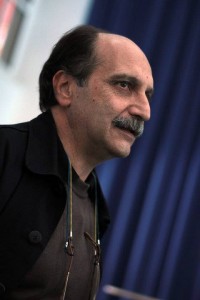
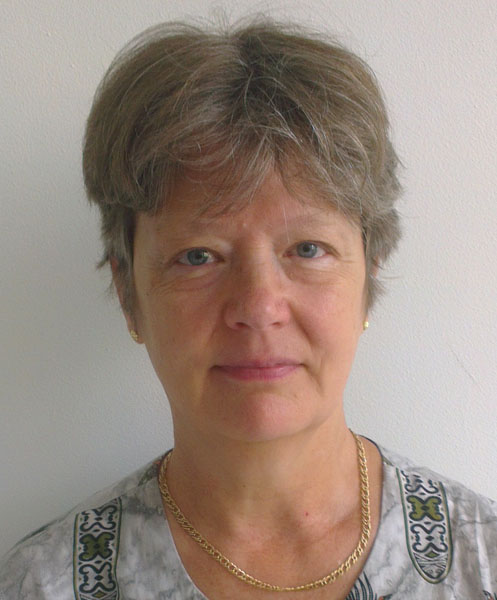
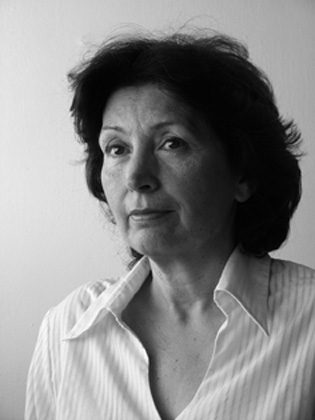
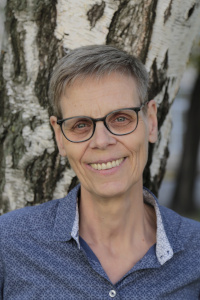
Denis Delfitto is a Full Professor in General Linguistics at the University of Verona's Faculty of Humanities since November 2001. He previously served as Associate Professor of Italian Linguistics (1990-2001) and coordinated the syntax/semantics research group at Utrecht Institute of Linguistics OTS (1996-2001). His academic career includes visiting professorships at ZAS Berlin, University of Geneva, and LaBRI Bordeaux. PhD in General Linguistics, Scuola Normale Superiore (1990) Graduate in Philosophy, University of Pisa (1985) Diploma in Humanities (Logic and Formal Linguistics), Scuola Normale Superiore (1985) His research focuses on the syntax-semantics interface, morphology-semantics interactions, temporal and aspectual semantics, and the philosophy of language. He explores how linguistic structures encode reference mechanisms and self-representation in syntax. Professor Delfitto served as Vice-rector for International Relations at the University of Verona (2005-2011). His work spans formal linguistics, cognitive science, and semiotics. 2014 NWO Visiting Fellow 2008 LaBRI Fellow 1997 NIAS Fellow 1988 Fulbright Fellow
Shalom Lappin is a Professor of Computational Linguistics at the University of Gothenburg and King’s College London. He has held multiple academic roles, including Director of the Centre for Linguistic Theory and Studies in Probability at Gothenburg since 2015. Ph.D. in Philosophy, Brandeis University (1975) M.A. in Philosophy, Brandeis University (1973) B.A. in Philosophy, York University (1970) Lappin’s research focuses on the intersection of syntax, semantics, and computational modeling of linguistic knowledge. He explores probabilistic approaches to grammar induction, the philosophy of language, and the application of machine learning in understanding linguistic structures. His publications highlight trends in syntactic theory, anaphora resolution, and computational linguistics. Notable works include critiques of the Minimalist Program and foundational contributions to natural language processing algorithms. ESRC Professorial Fellowship (2012-2015) Elected Chair of the British Academy’s Linguistics and Philology Section (2011-2014) Fellow of the British Academy (2010) Lappin has led research teams and centers, notably the Centre for Linguistic Theory and Studies in Probability at Gothenburg. His career spans institutions like Tel Aviv University, University of London, and IBM Watson Research Center, with grants supporting interdisciplinary research in linguistics and cognition.
Christian Winkler is a Senior Lecturer at the Institute for Romance Studies and the Institute for Applied Informatics at the University of Klagenfurt (Alpen-Adria-Universität Klagenfurt). He has been actively involved in interdisciplinary research and teaching since 1994, bridging the fields of linguistics and computer science. His academic affiliations include the Faculty of Cultural Sciences (KUWI) and the Faculty of Technical Sciences (TEWI), where he contributes to programs in Romance studies, Anglistics, and computer linguistics. Education: Studied Romanistics, Anglistics, and Linguistics at the University of Klagenfurt. Languages: Fluent in English, Italian, French, Spanish, and Portuguese. Winkler's research is centered on the intersection of natural language and information systems. His primary interests include computational linguistics, natural language processing (NLP), requirements engineering, syntactic theory (especially infinitive constructions in European languages), and the application of linguistic principles to software engineering. He has made significant contributions to the development of linguistic tools for conceptual modeling and text analysis, particularly through the long-running NIBA (Natürlichsprachliche Informationsbedarfsanalyse) project. The 15 most recent publications reflect a strong trend in applying linguistic analysis to software and information systems. Key themes include natural language-based requirements engineering, text summarization, semantic tagging, ontology integration, and enterprise search optimization. These works are predominantly published in the ICSSEA and NLDB conference series, indicating a sustained focus on the practical application of linguistics in computing contexts. Subfields span AI-driven text evaluation, verb phrase similarity, collaborative knowledge repositories, and mobile instructional applications. Scientific Awards: No awards or fellowships are mentioned in the provided text. Christian Winkler has played a significant role in academic advising and research collaboration, particularly through his long-term involvement in major research projects. The NIBA project, ongoing since 1995 and funded by the Klaus Tschira Stiftung and the Austrian National Bank, represents a major collaborative effort in linguistically based requirements engineering. He has also contributed to numerous grants and initiatives in natural language processing and software engineering. While no formal advisees are listed, his co-authorship with students and researchers suggests mentoring and collaborative supervision. Labs and Research Teams: NIBA Project Team: Core member since 1995, focusing on natural language analysis for information systems. ICSSEA Conference Series: Regular participant and contributor, indicating integration into a broader European research network in software and systems engineering. Natural Language and Information Systems (NLIS) Community: Active in program committees, showing leadership in the academic community.
Iván Igartua is a Full Professor at the University of the Basque Country (UPV/EHU), where he has held a tenured position since 2009 and was accredited as Full Professor in 2016. He currently serves as Vice-rector of the Alava Campus (2017–present) and previously directed linguistic research for the Basque Government (2010–2013). His academic trajectory includes roles as Associate Professor (2008–2009), Assistant Lecturer (2001–2008), and Researcher (1996–2000) at UPV/EHU. Education: B.A. in Russian and Slavic Philology, Lomonosov State University (1991–1995) B.A. in Spanish Philology, UNED Madrid (1992–1997) Ph.D. in Classical Philology, University of the Basque Country (1997–2003) Research Focus: Igartua specializes in morphological and diachronic typology, Slavic historical linguistics (particularly nominal inflection), Indo-European reconstruction, and Basque language evolution. His work integrates comparative analysis of phonology, morphology, and lexicography across Basque, Slavic, and Indo-European languages. Awards & Honors: Corresponding member of Jakiunde (Basque Academy of Sciences, Arts & Humanities) since 2019 Member of the Basque Government's Advisory Committee for Basque Language (2016–present) Best Dissertation Award in Linguistics/Humanities, UPV/EHU (2005) Academic Leadership: He has supervised 5 PhD theses and 14 Master's theses, served on editorial boards ( Current Issues in Linguistic Theory , ASJU ), and held memberships in Societas Linguistica Europaea and Slavic Linguistics Society. His international engagements include research stays in Moscow, Paris, St. Petersburg, Tbilisi, and Leipzig.
Prof. Dr. Attila Németh holds the Professorship for German Linguistics and Language Didactics at the University of Education Upper Austria (PH Oberösterreich), Faculty of Languages, Literatures, and Cultures. His research focuses on language variation, grammar didactics, language contact, dialectology, and sociolinguistic aspects of German minority languages in Hungary. Education : PhD in German Linguistics (Sociolinguistics/Dialectology) from the University of Szeged (2009). Prior Roles : Senior Research Assistant at the University of Veszprém (2009-2016), Editorial Assistant for intercultural Germanistics journals, and Project Assistant for DAAD initiatives. His scholarly output examines morphosyntactic complexity in language contact, code-switching dynamics, and dialect preservation challenges in Central Europe. Notably, he co-authored studies on Hungarian-German linguistic interplay and dialect attrition in Transdanubia. Prof. Németh actively contributes to academic publishing as co-editor of the Zeitschrift für Mitteleuropäische Germanistik and through editorial roles in journals like Beiträge zur Interkulturellen Germanistik . His work bridges theoretical linguistics with practical language teaching frameworks.
Josef Pichler serves as a Professor at the Research Center Hagenberg within the University of Applied Sciences Hagenberg, specializing in the Information & Communications Technology focal area. His academic profile demonstrates continuous research activity with publications spanning from 1998 through 2024, showing particularly productive periods in 2008-2010, 2013-2014, and consistently from 2017 onward. Dr. Pichler's research focuses on practical software engineering solutions with strong industrial applications. His primary interests include software systems , reverse engineering , documentation generation , and domain-specific languages . His work bridges theoretical computer science with practical industry needs, developing tools that address real-world software maintenance and comprehension challenges. Analysis of his recent publications reveals a clear research trajectory toward integrating artificial intelligence with traditional software engineering practices. His 2023-2024 work particularly emphasizes AI-assisted programming, semantic differencing techniques, and low-code development platforms for industrial applications like welding robot control. This demonstrates his ability to adapt to emerging technologies while maintaining focus on practical software engineering problems. Dr. Pichler has delivered numerous presentations on topics ranging from ChatGPT applications in computer science education to advanced semantic differencing approaches. His activities indicate active engagement with both academic and industry communities, particularly in the German-speaking region. While specific grant information isn't detailed in the provided text, his research output suggests involvement in projects related to software documentation, reverse engineering tools, and AI-assisted development environments. His supervision of student work (indicated by 'Supervised Work (3)') demonstrates his commitment to academic mentorship alongside his research activities. The Research Center Hagenberg, where Dr. Pichler is based, appears to be a significant hub for ICT research with strong industry connections, as evidenced by his publications on industry collaboration and practical software solutions.
Denis Delfitto is a Professor in General Linguistics at the Faculty of Humanities , University of Verona, Italy, since 2001. He previously held academic positions as Associate Professor at Utrecht University (1990-2001) and has been invited as a guest professor at institutions including ZAS Berlin, University of Geneva, and University of Bordeaux 1. Education : Graduated in Philosophy (1985), University of Pisa Diploma in Humanities (Logic and Formal Linguistics, 1985), Scuola Normale Superiore, Pisa PhD in General Linguistics (1990), Scuola Normale Superiore, Pisa (Dissertation: "Generics and Variables in Syntax") Research Interests : His work spans the syntax-semantics interface , morphology-semantics interplay , and the semantics of tense, aspect, and noun phrases . He explores philosophical dimensions of language, including mind-body connections , cognitive sciences , and reference mechanisms in natural language. His research also investigates how first-personal thoughts manifest across syntactic structures. Scientific Awards : NWO Visiting Fellow (2014), Utrecht Institute of Linguistics OTS LaBRI Fellow (2008), CNRS, University of Bordeaux Fellow (1997), Netherlands Institute for Advanced Studies Fulbright Fellow (1988), Massachusetts Institute of Technology Administrative Role : Served as Vice-rector for International Relations at the University of Verona (2005-2011).
Gábor Recski is a computational linguist and postdoctoral researcher at TU Wien's Faculty of Informatics, affiliated with the Data Science Research Unit. He holds a PhD and previously served as an assistant professor at the Budapest University of Technology. His research focuses on natural language processing (NLP), particularly computational semantics and transparent information extraction. He teaches courses such as Natural Language Processing and Information Extraction, and supervises students at BSc, MSc, and PhD levels. His work includes over 50 peer-reviewed publications and projects like BRISE-Vienna (2019–2025) and Honeypot LLM: Creation of a Scam Conversation Dataset. Roles: PostDoc Researcher, Substitute Member of Faculty Council, Substitute Member of Curriculum Commission for Business Informatics Education: PhD (previous role at Budapest University of Technology) Research Interests: Transparent information extraction, semantic modeling, legal text analysis, and explainable AI His research projects span legal corpus construction (e.g., BRISE-plandok), offensive text detection, and AI applications in legal research. He actively contributes to conferences like ACL, EMNLP, and SIGIR. Supervised students have explored topics ranging from explainable prediction models to graph-based relation extraction.
Bas Aarts is a Professor of English Linguistics at the Department of English , University College London (UCL), where he has worked since 1989. He served as Vice-Dean for Innovation and Enterprise in UCL's Faculty of Arts and Humanities (2016–2022) and as Director of the Survey of English Usage (1997–present). Professor of English Linguistics (2003–present) Director of Survey of English Usage (1997–present) International Society for Linguistics of English - Vice-President (2007–2012) Research Interests: His work spans corpus linguistics , syntax , language change , and grammar pedagogy . Recent publications focus on grammatical constructions, verbal structures, and educational interventions. Scientific Awards: Founding Editor of English Language and Linguistics (Cambridge University Press) (1997) UK Government Advisor for grammar teaching in schools (2014–2018) Member of the Council of the Philological Society (2015–2018) International Society for Linguistics of English - Vice-President (2007–2012) Publications: His 15 most recent works highlight expertise in grammatical theory, corpus-based language change, and pedagogical frameworks. Key topics include syntactic gradience, verb phrase evolution, and oblique constructions in English.
Elia Annibale is a Full Professor of Computational Linguistics at the University of Salerno, Italy, holding positions since 1987. He leads the Department of Political, Social and Communication Sciences and previously directed the Department of Communication Sciences. His academic journey includes a PhD in Computational Linguistics from Paris 7 University (1979) and earlier roles at the University of Paris and the University of Southern California. Research focuses on computational linguistics, machine translation, and semantic web technologies. Notable projects include the ESPRIT MULTILEX and GENELEX EU initiatives, developing multilingual linguistic resources. Awards include Academia Europaea membership (1989) and leadership in PRIN research units. Education: PhD in Computational Linguistics, University of Paris VII (1979) Laurea in Modern Literature, University of Naples (1972) Publications span theoretical linguistics, applied computational linguistics, and semantic analysis. Current projects include a semantic web search engine and lexical resource development for e-government.
Mary Dalrymple is a Professor Emerita of Syntax at the University of Oxford's Faculty of Linguistics, Philology & Phonetics. She previously held the position of Professor of Syntax (2006–2021) and University Lecturer in General Linguistics (2004–2006). Her research focuses on Lexical Functional Grammar (LFG), glue semantics, descriptive and theoretical syntax, and the documentation of Austronesian and Papuan languages. Her major grants and projects include: 2022–2024: Arts and Humanities Research Council-funded project on lexical resources for Enggano 2019–2024: AHRC project analyzing Enggano's linguistic history 2017–2018: SynSem project on integrating linguistics and computing at the Norwegian Academy of Sciences Notable awards include Fellowship of the British Academy (2013) and Erskine Fellowship (2004). Her work bridges formal syntax with computational linguistics and typological documentation, particularly in endangered languages. Her research consistently explores the interplay between formal linguistic theory and empirical data from understudied languages, with a focus on number systems, anaphora, and morphosyntactic variation.
Katalin E. Kiss is a Professor at the Research Institute for Linguistics, Hungarian Academy of Sciences. She has held academic roles including Senior Researcher (1989-2007), Associate Professor (1982-1986), and Lecturer (1979-1981) at Eötvös Loránd University, Researcher at Université de Montréal, and Lecturer at Kossuth Lajos University. Education: MA in Hungarian and English (1972), PhD in Linguistics (1979), Habilitation in Linguistics (1991), Corresponding Member of Hungarian Academy of Sciences (2007). Her research focuses on Hungarian syntax and generative syntax, leading to significant contributions in diachronic syntax and event structure funded by OTKA grants (2002-2013). She has guest lectured at Universität Stuttgart (1988) and Universität Potsdam (2006). Katalin E. Kiss has been honored with prestigious awards including the Palladium Prize, Charles Simonyi Fellowship, and Mellon Fellowship. She has served on editorial boards for journals like Natural Language and Linguistic Theory and Acta Linguistica Hungarica .
Mark Steedman is a Professor of Cognitive Science at the School of Informatics , University of Edinburgh, and an Adjunct Professor in the Department of Computer and Information Science at the University of Pennsylvania. His research bridges Artificial Intelligence , Cognitive Science , and Computational Linguistics , with a focus on Combinatory Categorial Grammar (CCG) , Prosody and Intonation , and Temporal Semantics . He has led the Institute for Language, Cognition, and Computation and contributed to interdisciplinary research at the Human Communications Research Center and Centre for Speech Technology Research . Research Interests : Steedman's work explores the intersection of formal grammar, computational models, and cognitive processes. He investigates how CCG parsing can enhance semantic inference, how prosodic features improve speech processing, and the role of temporal semantics in language understanding. His projects often integrate language models with entailment graphs for question answering and dialogue systems. Scientific Awards : Fellow of the American Association of Artificial Intelligence (1993) Fellow of the Royal Society of Edinburgh (2002) Fellow of the British Academy (2002) Member of Academia Europaea (2006) Best Paper Awards at ACL 2023 and AACL/IJCNLP 2023 Influential Paper Award (IFAAMAS 2017) Recent Trends in Publications : His recent work emphasizes language models for semantic inference , entailment graphs in multilingual settings, and incremental parsing for brain-language interfaces. Papers address challenges in hallucination , cross-lingual transfer , and prosody-text alignment .
Mathilde Eveline Keizer is a Professor of English Linguistics: Variation and Cognition at the Department of English and American Studies, Faculty of Philological and Cultural Studies, University of Vienna. She serves as both Vice-Director of Studies for English and American Studies and Deputy Head of the Department of English and American Studies, demonstrating significant leadership within the institution. Professor Keizer's educational background includes: MA in English language and literature, Vrije Universiteit Amsterdam (1987) PhD in English Linguistics, Vrije Universiteit Amsterdam (1992) Her primary research focuses on the theoretical framework of Functional Discourse Grammar, with particular emphasis on the Noun Phrase in English and Dutch, possessive constructions, reference and predication, definiteness, English pronouns, apposition, information structure, linguistic categorization, and semi-fixed constructions. Professor Keizer leads the FunCog research group, which investigates the intersection of functional and cognitive approaches to language structure. Her work demonstrates how linguistic structures emerge from the interaction of cognitive processes and communicative needs, providing insights into the dynamic nature of language organization. Analysis of Professor Keizer's recent publications reveals a consistent focus on English syntax within the framework of Functional Discourse Grammar. Her work spans noun phrase structure, partitive constructions, prepositional phrases, and adverbial modification, demonstrating the versatility of FDG in addressing diverse syntactic phenomena. A notable trend is her increasing attention to cross-linguistic comparisons, particularly between English and Dutch, which enriches our understanding of language universals and specifics. Professor Keizer has made significant contributions to the field through her extensive publication record, including authored and edited books that have shaped contemporary understanding of functional-cognitive approaches to grammar. Her work has appeared in leading linguistics journals and handbooks, establishing her as a prominent voice in theoretical linguistics. As an educator, Professor Keizer teaches courses on Functional Discourse Grammar, Cognitive Grammar, Linguistic Categorization, Fuzzy grammar, Linguistic models and approaches, The English Noun Phrase, English adjectives, English idioms, and English syntax. She has supervised numerous graduate students through thesis seminars and advanced courses in linguistics, contributing significantly to the development of the next generation of linguists. Professor Keizer leads the FunCog research group, which brings together scholars interested in the intersection of functional and cognitive approaches to language. The group focuses on empirical investigations of linguistic structures through the lens of Functional Discourse Grammar, fostering interdisciplinary collaboration and innovative research methodologies that bridge theoretical linguistics with practical applications in language teaching and computational linguistics.