Jennifer Coates, PhD is an Associate Professor of Food Policy and Applied Nutrition at Tufts University’s Friedman School of Nutrition Science and Policy, and a Senior Researcher at the Feinstein International Center. Her work focuses on improving the design and evaluation of international nutrition and food security programs, particularly in development and humanitarian contexts. She develops methods for scaling dietary data collection (e.g., INDDEX24 platform), assesses food affordability metrics in Africa, and evaluates micronutrient programs globally. Dr. Coates holds leadership roles in UN inter-agency groups on food security measurement and agricultural statistics. Education: PhD and MS in Food Policy & Applied Nutrition from Tufts (2006, 2000), BA in International Relations from Tufts (1994). She teaches courses on nutrition program monitoring, food security, and development at the Friedman School. Research Interests: Food policy design, program evaluation, nutrition equity, and sustainable development. Her work emphasizes low-resource settings and integrates technology for scalable data collection methods. Key Contributions: INDDEX project to standardize dietary assessments, IANDA initiative on diet affordability metrics, and ACFA/GAIN partnerships for nutritional impact evaluation. Her research bridges academia and policy, impacting global health programs.
Professor Mark Strong is the Dean of the School of Medicine and Population Health at the University of Sheffield, where he also holds the title of Professor of Public Health. He maintains an honorary clinical consultant role with the Office for Health Improvement and Disparities at the Department of Health and Social Care. His research focuses on Uncertainty Quantification in health economic models, particularly methods for computing Expected Value of Sample Information (EVSI) and Partial Expected Value of Perfect Information (EVPI) . Key Contributions : Developed the SAVI web calculator for efficient value-of-information calculations Co-investigator on NIH-funded SIPHER Consortium projects Expertise : Bayesian statistical methods Model discrepancy analysis Health policy decision modeling Systems science applications in public health Research Trends Analysis of his 20+ recent publications reveals concentrated activity in: Health Economic Evaluation (8 articles) Uncertainty Quantification (6 articles) Public Health Policy (7 articles) Systems Science Applications (4 articles) Alcohol Consumption Modeling (3 articles) Clinical Decision Support (5 articles)
Professor Iram Siraj is an Emeritus Fellow at Jesus College, University of Oxford, and holds an adjunct professorship at Stavanger University. She specializes in Early Childhood and Primary Education, with a focus on longitudinal studies, mixed methods research, and policy development. Her academic journey includes roles at the Universities of Warwick, University College London, and Wollongong, alongside visiting professorships globally. Her research has shaped influential studies like the EPPSE (Effective Provision of Pre-school, Primary and Secondary Education) and E4Kids projects, emphasizing quality pedagogy and its impact on child outcomes. She has authored award-winning books, including Social Class and Educational Inequality , and developed rating scales such as the ECERS-E and SSTEW to assess educational quality. Professor Siraj has advised governments and international bodies like UNESCO, UNICEF, and the World Bank, and has received an OBE for services to early childhood education. She currently supervises doctoral students in areas like early childhood policy, pedagogy, and curriculum design. Her work bridges research, practice, and policy to address global educational inequities.
Matthew Hayek is an Assistant Professor in the Department of Environmental Studies at New York University's College of Arts & Science. He holds a PhD in Environmental Science and Engineering from Harvard University and a bachelor's in Physics from Wesleyan University. His research focuses on quantifying environmental impacts of food systems, particularly greenhouse gas emissions, methane mitigation, and land-use tradeoffs. Key projects include analyzing grass-fed vs conventional beef production impacts and assessing carbon sequestration potential through land-use shifts. Hayek previously worked as a postdoctoral researcher at Harvard Law School's Animal Law and Policy Program, and teaches courses on earth system fluid mechanics and global change biology. Research interests span climate change mitigation strategies in agriculture, food systems emissions accounting, and interdisciplinary approaches to sustainability. Recent studies emphasize livestock emissions reduction pathways and policy frameworks for aligning food systems with climate goals. His work integrates spatial analysis, life-cycle assessments, and policy evaluation to address global environmental challenges. Advising and grant activities include NYU advising roles and research funding focused on food systems sustainability. Current projects explore regional carbon sequestration opportunities through land-use optimization, with emphasis on reforestation and agricultural intensification. Hayek's lab focuses on bridging environmental science with actionable policy solutions for equitable climate action.
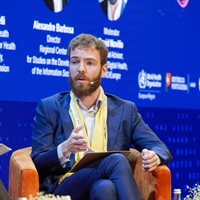
Dr Robin van Kessel is the Hoffmann Fellow on Health System Financing and Payment Models at LSE Health and the World Economic Forum. He holds a PhD in Comparative Health Policy from Maastricht University and co-founded LSE Health Digital, a research unit focusing on digital health and AI technologies. His work examines regulatory frameworks, financing mechanisms, and socio-ethical challenges in digital health, alongside value-based healthcare transformations. He has collaborated with the WHO, OECD, and European Commission, among others. Education: PhD in Comparative Health Policy (Maastricht University). Research interests include digital health policy, AI in healthcare, health system financing, and autism education policies across Europe. His interdisciplinary work bridges technology, policy, and clinical practice to address inequities and improve health outcomes globally. Key research trends include analyzing AI regulatory landscapes in the EU, mapping socioeconomic drivers of health challenges (e.g., antimicrobial resistance), and promoting patient engagement through digital platforms. His articles highlight the interplay between technology, policy, and ethical considerations in healthcare systems. Collaborations with global institutions have informed policy initiatives like the World Economic Forum’s Global Coalition for Value in Healthcare. His work emphasizes actionable solutions for digital health paradoxes, such as balancing innovation with accessibility and equity.
Ronald Wolthoff is a Professor in the Department of Economics at the University of Toronto, holding positions at both the St. George campus and the Mississauga (UTM) campus. He serves as Chair of the UTM Economics Department. His research focuses on macroeconomics and labour economics, particularly labour market frictions, search theory, and competitive market mechanisms. Wolthoff holds a Ph.D. (2008), M.Sc. (2004), and B.Sc. (2003) from VU University Amsterdam. He has held academic positions in Europe before joining the University of Toronto. His research interests include: Labour market dynamics and search models Evaluation of market mechanisms and policies Competitive equilibrium analysis in economic systems Key contributions include studies on firm recruiting strategies, adverse selection in labour markets, and spatial labour market inefficiencies. His work has been published in top journals like the Review of Economic Studies and Journal of Economic Theory . He has received the FEEM (Young Economist) Award (2011) and teaches graduate courses in macroeconomic theory and labour markets. Wolthoff collaborates with institutions such as the Institute for the Study of Labor (IZA) and maintains an active Google Scholar profile with over 100 publications.
Sharon Friel is an ARC Laureate Fellow and Professor of Health Equity at the Australian National University (ANU), directing the Planetary Health Equity Hothouse and Menzies Centre for Health Governance within the School of Regulation and Global Governance (RegNet). Her research focuses on the political economy of health, governance of planetary and social determinants of health inequities, and the intersection of climate change with human health. She authored the 2019 book *Climate Change and the People’s Health*, emphasizing systemic reforms to address global consumptogenic systems. Research interests span health governance regulation, social determinants of equity, global health systems, food systems transformation, and urbanization impacts on health. She leads initiatives addressing commercial determinants of health and advocates for policy coherence in climate, energy, and disaster solutions. Her work frequently engages with NGOs and global governance frameworks to advance equity-focused policies. Key scientific recognition includes the ARC Laureate Fellowship. Her recent articles analyze policy influences on health inequities, corporate power in food systems, and climate litigation dynamics. She collaborates extensively on transnational health equity projects, including the Lancet Commission on Gender and Global Health. Sharon Friel’s work integrates interdisciplinary methods, combining political economy analysis with health system governance to drive actionable policies. She has advised international bodies on climate health strategies and led research on multisectoral governance in Pacific Small Island Developing States.
Camila Picchio (PhD, MPH) is a multidisciplinary Post-Doctoral Researcher at ISGlobal, focusing on public health, implementation science, migrant health, and health systems. She coordinates the EU-funded VH-COMSAVAC project in Spain, Italy, and Greece, building on her HBV-COMSAVA pilot project among West African migrants in Catalonia. Former post-doctoral training at Dornsife School of Public Health, Drexel University Consultant for WHO Regional Office for Europe and PAHO on viral hepatitis, HIV, TB, STI elimination, and community engagement Her research emphasizes simplified diagnostic tools for HBV/HCV, multisectoral interventions, and vaccine hesitancy. She has worked in Kampala (Makerere University), Buenos Aires (Fundación Huésped), New York (CUNY SPH), and Catalonia's public health agencies. Key publication trends include migrant health equity, viral hepatitis elimination, community-based interventions, and pandemic response frameworks. Currently Vice President of the European Public Health Association (EUPHA) section on Health Promotion, she bridges policy and practice across Europe and low- and middle-income countries.
Dr. Andreas Mayer is an Associate Professor at the Institute for Social Ecology within the Department of Economic and Social Sciences at the University of Natural Resources and Life Sciences Vienna (BOKU). With a Mag. in Social and Human Ecology from Alpen-Adria University (2009) and a BA in Sociology from the University of Vienna (2002-2006), he has established himself as a leading researcher in social-ecological systems. His career includes serving as a Research Fellow at ICTA, UAB in Barcelona (2014) and transitioning with the Institute of Social Ecology to BOKU in 2018 after previously working there as a Research Associate from 2009-2018. Dr. Mayer's research focuses on the complex interactions between society and nature, with particular expertise in social metabolism, agent-based modeling, socio-economic biomass metabolism, circular economy approaches, and integrated land use scenarios. His work bridges theoretical frameworks from ecological economics and political ecology with empirical analyses of sustainability transitions. He investigates how socio-ecological systems respond to climate change, resource constraints, and policy interventions, with special attention to agricultural systems, bioeconomy pathways, and urban-rural linkages. His extensive publication record demonstrates a strong trajectory in analyzing sustainability transformations across multiple scales, from local farming decisions to EU-level policy frameworks. Recent work shows increasing integration of biophysical modeling with social theory, particularly Polanyian concepts of re-embedding economic systems within ecological constraints. His research often employs mixed methods, combining quantitative material flow analysis with qualitative insights into decision-making processes. Stadt Wien-BOKU Research Funding Programm (BOKU Jubiläumsfonds): PACE - Pathways towards a circular bioeconomy in Vienna (2023) Best Paper Award for the year 2020 of the Journal 'Resources, Conservation & Recycling' (2021) 2019 Graedel Prize: Journal of Industrial Ecology (JIE) Senior Author Best Paper Prize (2020) Dr. Mayer actively supervises graduate students, with his most recent advisee completing research on global aquaculture feed requirements. He leads multiple significant research projects including 'Potentiale für eine klimaneutrale und zirkuläre Bioökonomie in der Wiener Metropolregion' (2023-2025) and previously led 'Multisectoral Analysis of climate and landuse change impacts on Pollinators, Plant diversity and crop Yields' (2019-2023). His work frequently involves international collaborations across European research networks focused on sustainability transitions. Based at BOKU's Institute for Social Ecology in Vienna, Dr. Mayer contributes to one of Europe's leading research centers examining the social dimensions of environmental change, participating in interdisciplinary teams that integrate natural science, social science, and policy analysis approaches to address pressing sustainability challenges.
Professor Dirk U. Pfeiffer is the Chair Professor of One Health at City University of Hong Kong's Jockey Club College of Veterinary Medicine and Life Sciences. He holds a part-time position at the Royal Veterinary College (RVC) in the UK and is an Adjunct Professor at China's Animal Health & Epidemiology Centre. His academic roles include Director of the Centre for Applied One Health Research and Policy Advice (OHRP) and former Chief Epidemiologist at the UK's Animal and Plant Health Agency (2015–2017). Education includes a veterinary degree from Justus Liebig University (1984), a Doctorate in Veterinary Medicine (1986), and a PhD in Veterinary Epidemiology from Massey University (1992). He has extensive advisory roles, including chairing OIE/FAO's Avian Influenza Network and the UK's Animal Health Surveillance Board. Research focuses on One Health, epidemiology, and disease control, with a focus on avian influenza, African swine fever, and spatial analysis. He has over 440 publications (h-index 63) and leads projects like the £19M UK-funded One Health Poultry Hub. Awards include the Calvin W. Schwabe Award and recurring recognition as a top 2% cited scientist globally. Teaching includes advanced epidemiology courses and international training programs in over 20 countries. Current grants exceed HK$47M, addressing poultry health in Bangladesh and Hong Kong's livestock systems. Collaborations span global institutions, emphasizing interdisciplinary solutions to zoonotic threats.
Dr. Melissa S. Bukovsky is an Associate Professor at the Haub School of Environment and Natural Resources at the University of Wyoming and serves as Director of the Collaborative for Intersectoral Modeling of the Earth System (CLIMES). She holds an adjunct appointment and previously worked at the National Center for Atmospheric Research (NCAR) as a research scientist from 2009 to 2023. Her academic journey includes a PhD in Meteorology from the University of Oklahoma (2009), a Master's (2004), and a Bachelor's (2002), along with an Associate's degree (2000). Her research focuses on regional Earth systems modeling, particularly addressing nonstationarity in Earth systems and their impacts on human and natural systems. CLIMES, her newly established lab, develops quantitative scenarios for socio-environmental futures using computational models. Key areas include climate change impacts, decision-making under uncertainty, and interdisciplinary collaboration in modeling. Her work emphasizes advancing regional climate modeling through initiatives like NA-CORDEX and CORDEX-CORE, contributing to global climate assessments. She advocates for open-source science, ensuring modeling tools are accessible for diverse applications. Recent publications highlight urbanization effects on climate, wildfire risks, and extreme weather projections in North America. Dr. Bukovsky collaborates internationally to enhance climate science applicability and engages stakeholders through projects like WyACT, which integrates socio-environmental observations in Wyoming. Her research bridges climate science with practical decision-making, addressing challenges in agriculture, water resources, and disaster resilience.
Nathan Urban serves as Group Leader and Computational Scientist for the Applied Mathematics group at Brookhaven National Laboratory's Computational Science Initiative (CDS), a position held since 2020. Concurrently, he holds adjunct and guest appointments at Stony Brook University's Institute for Advanced Computational Science and Los Alamos National Laboratory's Statistical Sciences group. His interdisciplinary career bridges computational mathematics, statistics, and environmental science with emphasis on decision support under uncertainty. His educational foundation includes multiple degrees from Virginia Tech (1997): B.S. in Physics, Computer Science, and Mathematics, followed by advanced degrees from Penn State University (2006): Ph.D. and M.Ed. in Physics. Ph.D. in Physics, Penn State University (2006) M.Ed. in Physics, Penn State University (2006) B.S. in Physics, Virginia Tech (1997) B.S. in Computer Science, Virginia Tech (1997) B.S. in Mathematics, Virginia Tech (1997) Urban's research centers on uncertainty quantification and Bayesian inference methodologies applied to complex scientific systems. His work develops frameworks for probabilistic prediction, multi-model uncertainty analysis, reduced order modeling, and scientific machine learning. Key application domains include climate science, ice sheet dynamics, and molecular design, where he addresses challenges in decision making under uncertainty and optimal experimental design. His expertise spans computational statistics, hybrid physical-data driven modeling, and in-situ data analysis for large-scale simulations. Recent publications (2021-2024) reveal a pronounced shift toward integrating machine learning with physical modeling, particularly in climate and environmental systems. His work demonstrates innovative applications of active subspaces, Gaussian processes, and deep generative models to quantify epistemic uncertainties in ice sheet projections, molecular design, and extreme weather analysis. A consistent theme is developing scalable methods for uncertainty quantification in high-dimensional systems. Urban received significant recognition through the DOE Office of Science Early Career Research award (2013) in Biological and Environmental Research, supporting his foundational work in climate model uncertainty. Early Career Research award, DOE Office of Science (Biological and Environmental Research), 2013 As Applied Mathematics group leader at Brookhaven, Urban directs research in computational statistics and mathematical modeling for scientific applications. His team develops advanced methods for uncertainty quantification and decision support across multiple DOE mission areas, with strong collaborations in climate science and materials research.
Lara Vesentini is a Doctor-assistant in the Health Sciences Mental Health and Wellbeing Research Group at the Faculty of Medicine and Pharmacy, Vrije Universiteit Brussel (VUB) in Brussels, Belgium. With over two decades of academic contribution, she has produced 69 research outputs including articles, commissioned reports, chapters, and theses, demonstrating sustained scholarly activity from 1999 through 2025. Dr. Vesentini's research expertise focuses primarily on intimacy and sexuality within the psychotherapeutic relationship, encompassing sexual harassment, boundary issues, taboos, and ethics. Additional interests include epidemiological studies and mixed methods research in public mental health. Her work forms a distinctive fingerprint across disciplines including Psychotherapy (80%), Emotions (75%), Mental Health (46%), and Taboo topics (41%). Her recent scholarly output demonstrates growing impact, with publication rates increasing from 1-10 papers annually (2002-2015) to 6-9 papers per year (2021-2023), indicating heightened research productivity in recent years. These works span diverse methodologies including quantitative studies, qualitative analyses, and mixed-methods approaches, with particular emphasis on boundary violations in mental healthcare, sexual health discussions among patients with chronic conditions, and policy development for academic work environments. Among her professional recognitions: Best Presentation Award (2018) Dr. Vesentini actively supervises academic work, having guided multiple theses including doctoral research on "Intimacy and sexuality in the psychotherapeutic relationship" (2021) and master's theses on topics ranging from sexual boundary violations in Flemish mental health care to the experiences of single parents. She participates extensively in academic service through committee work, conference presentations (62 recorded activities), and public engagement initiatives focused on mental health policy. Her collaborative work extends across multiple research domains, particularly evident in projects like DIAMENT (addressing psychosocial needs of diabetes patients) and studies examining transgressive behavior in academic contexts. These initiatives reflect her commitment to translating research into practical healthcare improvements and policy development.
Peter Leško is an Assistant Professor in the Department of Economics at the Faculty of Economics and Finance, Bratislava University of Economics and Business. His roles include Website Administrator and AIS Coordinator for SP Law and Economics. He specializes in Macroeconomics, with teaching responsibilities in Principles of Economics, Macroeconomics, and Advanced Macroeconomics. His research focuses on Sustainable Economic Development, Regional Convergence, and Economic Growth in Open Economies. He has conducted research stays at institutions such as the OECD in Paris, Universidade de Coimbra (Erasmus+), and the University of London’s Cass Business School. Leško has participated in notable research projects including APVV-20-0338 (led by Prof. Ochotnický) on economic growth and firm survival, KEGA 035EU-4/2020 (led by Prof. Muchová) on e-learning applications in economics education, and VEGA 1/0356/19 (led by Dr. Novák) on indebtedness in the EU. His work spans academic publications in journals like Politická ekonomie and Eastern European Economics . No scientific awards are explicitly mentioned in the provided text. Leško collaborates with international institutions and contributes to the Bee4R LAB and SecureDataLab initiatives. His academic stays and projects underscore his engagement in both theoretical and applied economic research.
Jonathan Lamontagne is an Associate Professor in the Department of Civil and Environmental Engineering at Tufts University’s School of Engineering. He holds a Ph.D. and M.S. in environmental water resources systems analysis from Cornell University (2015 and 2014) and a B.S. from the University of New Hampshire (2009). Prior to joining Tufts in 2017, he was a postdoctoral researcher at Cornell, focusing on integrated human-climate system modeling. Affiliations: Tufts University, Lamontagne Lab, and collaborations with institutions like U.S. Department of Energy and National Science Foundation. Grants: Lead on NSF-funded projects on data-driven decision making, integrated food-energy-water nexus modeling, and Massachusetts hydrologic risk studies. Research Interests: His work centers on decision-making under uncertainty, hydrologic statistics, and integrated global change assessment. Key areas include flood frequency analysis, climate mitigation impacts on water resources, and multisector systems modeling. He emphasizes robust infrastructure planning and explores compounding risks from economic/population growth uncertainties. Publications: Recent work highlights include analyzing unintended consequences of climate policies on African river basins, quantifying economic impacts of water scarcity, and developing robust statistical frameworks for hydrologic data. His research bridges hydrology, energy systems, and socioeconomic factors to address climate adaptation challenges. Awards: 2017 ASCE Outstanding Reviewer Award for contributions to peer review. Teaching: Courses include Statistical Inferences & Prediction , Integrated Planning & Management , and Water Resource Systems . He mentors students in stochastic modeling and decision analysis. Labs/Teams: Leads the Lamontagne Lab, focusing on improving decision-making for complex multisector systems. Collaborates with global teams on energy-water nexus studies and climate resilience projects.