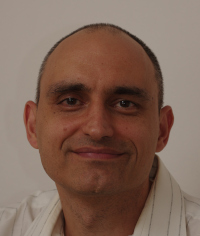
Radu-Lucian LUPŞA serves as a Lecturer at Babeş-Bolyai University's Faculty of Mathematics and Computer Science in Romania. His academic career spans over two decades with a consistent focus on computer science, particularly in image processing and graph algorithms. His teaching responsibilities include courses on Graph Algorithms and Parallel and Distributed Programming, demonstrating his expertise across theoretical and applied computer science domains. LUPŞA's research interests center around image processing, with significant contributions to compression methods, dithering algorithms, and multiresolution analysis. His work bridges theoretical computer science with practical applications in graphics and healthcare optimization. The evolution of his research shows a progression from fundamental image compression techniques in the late 1990s to more specialized applications in medical imaging and transportation logistics by the late 2000s. Analysis of his publications reveals strong expertise in computational geometry, algorithm design, and optimization problems. His research demonstrates consistent application of mathematical rigor to practical computing challenges, particularly in the areas of image representation and processing. The interdisciplinary nature of his work is evident in publications spanning computer graphics, healthcare logistics, and mathematical optimization. LUPŞA completed his PhD in 2006 with the dissertation titled Contributions to the analysis, processing and representation of images , which serves as a foundation for his subsequent research trajectory. His academic output shows a period of high productivity between 1996-2008 with publications in respected venues including IEEE conferences and academic journals. As an educator, LUPŞA has developed comprehensive teaching materials for graph algorithms, including lecture notes, practical assignments, and evaluation methods. His teaching approach emphasizes both theoretical foundations and practical implementation, as evidenced by the detailed laboratory assignments and programming tasks he has designed for students.