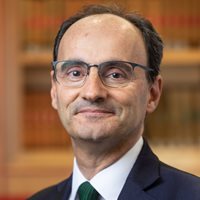
Peter Williamson is an Honorary Professor of International Management at Cambridge Judge Business School and Co-Director of the Cambridge Centre for Chinese Management. He is also a Fellow and Director of Studies in Management at Jesus College. Education: BA (Macquarie University), MA (University of Cambridge), PhD (Harvard University) Professor Williamson’s research focuses on globalization and corporate strategy, business ecosystems, merger and acquisition dynamics, China-specific strategic advantages, and sustainable strategies for carbon-constrained economies. He has extensive professional experience across academia, consulting, and executive education, with a career spanning Australia, France, Hong Kong, Singapore, Switzerland, and the United States. His recent publications emphasize digital innovation, disruptive competition from Chinese firms, AI-driven internationalization, and ecosystem-based strategies for accelerated innovation. He has also contributed to debates on deglobalization myths and cross-border collaboration models, particularly in crisis scenarios like the VentilatorChallengeUK. Williamson actively serves on the editorial boards of European Management Journal and Academy of Management Learning and Education , and his insights on China-West innovation dynamics have been featured in The New York Times , Forbes , and Kompas .
Huda Khan is a Senior Lecturer in Marketing at the Business School of the University of Aberdeen, where she also serves as Director of the MSc Marketing Management Program and Associate Director of the Africa-Asia Centre for Sustainability Research. She holds a PhD in Marketing from the University of South Australia and has previously worked as a marketing academic there, engaging in high-value research projects with global brands through the Ehrenberg-Bass Institute. University: University of Aberdeen School: Business School Academic Rank: Senior Lecturer Email: huda.khan@abdn.ac.uk Office: 719, MacRobert Building, UK Education: PhD in Marketing, University of South Australia, 2016 Graduate Certificate in Digital Learning, University of South Australia, 2020 Huda Khan’s research centers on international marketing, sustainability, digital transformation, and SME internationalization. Her work explores strategic agility, responsible innovation, and the impact of digitalization on business models and consumer behavior. She is particularly interested in emerging markets and the challenges faced by firms in volatile environments. Her recent publications (2023–2025) span top journals such as Journal of Business Research , Industrial Marketing Management , International Business Review , and European Journal of Marketing . The articles reflect a strong interdisciplinary focus on sustainability, digitalization, and international business, with recurring themes of strategic agility, value co-creation, and responsible innovation. She has also contributed to book chapters and edited special issues on sustainability and marketing disruption. Scientific Awards and Recognitions: Fellow of the Royal Society of Arts Endorser of Responsible Research in Business & Management (RRBM) Certified Practising Marketer (CPM), Australian Marketing Institute Affiliate Professional, Chartered Institute of Marketing (CIM) Member, BAM Peer Review College (2023–2026) Huda Khan has secured research funding from the Society for Advancement of Management Studies and the Royal Society of Edinburgh for projects on supply-chain resilience and women-led startups in Pakistan. She is actively supervising PhD students in Business Management, with a focus on international marketing, digital marketing, and sustainability. She serves on the editorial boards of several journals, including Industrial Marketing Management and Journal of Business Research , and is an Associate Editor for Rutgers Business Review . She is also an External Examiner at the University of Sussex and the University of Kent. Huda is actively involved in research centers and networks, particularly the Africa-Asia Centre for Sustainability Research, where she contributes to cross-regional sustainability initiatives. She has also led special issues on climate change, de-globalization, and sustainable partnerships, reflecting her leadership in shaping scholarly discourse on global business challenges.
David L. Tschirley is a fixed-term Professor in the Department of Agricultural, Food, and Resource Economics at Michigan State University (MSU), co-Director of the Food Security Group (FSG), and Director of the USAID-funded Innovation Lab for Food Security Policy, Research, Policy and Influence (PRCI). He holds a Ph.D., M.S., and B.S. from MSU and Colorado State University, respectively. His work focuses on agrifood system transformation, food security policy, dietary change in Africa and Asia, and the intersection of food aid with market dynamics. Fluent in Spanish and Portuguese, he has extensive field experience in Ecuador and Mozambique. Dr. Tschirley has advised major international organizations including the World Bank, IFAD, and FAO, and received the 2022 Ralph Smuckler Award for advancing international programs at MSU. His research emphasizes policy-relevant topics such as modern vs. traditional marketing channels, emergency food response strategies, and linking smallholder farmers to cash crop markets. Over 30 years of applied research have yielded >40 journal articles, book chapters, and policy reports, with recent focus on processed food systems and the double burden of malnutrition. Education: Ph.D., Michigan State University M.S., Michigan State University B.S., Colorado State University Key Roles: Director, PRCI Innovation Lab Co-Director, FSG at MSU Lead Author, IFAD 2019 Rural Development Report Awards: Ralph Smuckler Award (2022) Labs/Teams: Feed the Future Innovation Lab for Food Security Policy Cross-country Agrifood System Transformation Initiative His recent work highlights global food system challenges, including policy responses to crises like the Russia-Ukraine war and pandemic impacts on food systems. He collaborates with institutions worldwide to strengthen policy influence and evidence-based decision-making in food security.
Britta Glennon is an Assistant Professor of Management at the Wharton School of the University of Pennsylvania and a Faculty Research Fellow at the National Bureau of Economic Research (NBER). Her work bridges economics, management, and public policy, focusing on how immigration and cross-border innovation shape economic outcomes. Dr. Glennon received her educational training from prestigious institutions: Ph.D. in Public Policy and Management from Carnegie Mellon University M.P.P. in Public Policy from the University of Chicago B.A. in Economics and East Asian Studies from Cornell University Her research program explores the intersection of immigration policy, innovation, and multinational business strategy. Dr. Glennon has significantly advanced understanding of how skilled immigration affects firm performance, how immigration restrictions lead to offshoring of R&D activities, and how geopolitical tensions impact international scientific collaboration. Her methodology combines rigorous econometric analysis with rich datasets spanning immigration records, corporate activities, and scientific publications. She demonstrates how immigration policies shape the global geography of innovation and how multinational firms strategically respond to constraints on skilled labor mobility. Analysis of Dr. Glennon's publications reveals consistent examination of immigration policy's economic implications through multiple lenses - from macro-level effects on innovation geography to micro-level impacts on individual scientists and firms. A recurring theme is the interconnectedness of global talent flows and innovation ecosystems, demonstrating how policy changes in one country trigger complex adjustments across international borders. Her most recent work increasingly focuses on geopolitical dimensions of scientific collaboration, particularly U.S.-China research relationships. Dr. Glennon's scholarly contributions have been recognized with: Finalist, INFORMS/Org Science Dissertation Proposal Competition (2018) Her research has attracted significant external attention. She has testified as an expert witness before the U.S. Senate Committee on the Budget regarding 'Unlocking America's Potential: How Immigration Fuels Economic Growth and Our Competitive Advantage.' Her work has been cited in Congressional Testimony and has influenced policy debates on immigration and innovation. She maintains active collaborations with researchers at NBER and has contributed to influential policy briefs for organizations like the Peterson Institute. As a Faculty Research Fellow at NBER, Dr. Glennon participates in a vibrant research community focused on economic policy analysis. Her work connects with broader initiatives examining globalization, innovation, and labor markets. She regularly presents her research to academic audiences and policy makers, translating complex economic findings into actionable insights for business leaders and government officials.
Kwaku Ohene-Asare is a Lecturer in Business Analytics at De Montfort University, UK, within the School of Leadership, Management and Marketing. He holds a PhD in Operational Research and Management Science from the University of Warwick, an MSc in Economics and Finance (with distinction) from Loughborough University, and a BSc in Economics (first-class honors) from the University of Ghana-Legon. He also completed a certificate in Decision Science and Machine Learning at MIT, USA. He has held visiting professorships at Warwick University and Stellenbosch University and plays a senior lecturer role at the University of Ghana. His educational background includes: PhD in Operational Research and Management Science, University of Warwick, UK (2012) MA in Decision Science and Machine Learning, MIT, USA MSc in Economics and Finance, Loughborough University, UK (Distinction) BSc in Economics, University of Ghana-Legon (First Class) PGCAP (Part 1), University of Warwick, UK (2009) Certificate in Nonparametric & Bootstrap Methods, Sapienza University of Rome, Italy (2012) Kwaku's research interests span business analytics, management science, artificial intelligence, data science, machine learning, economic efficiency, productivity analysis, data envelopment analysis (DEA), stochastic frontier econometrics, and their applications in energy, finance, insurance, and credit unions. He has developed a research-based DEA course at the University of Ghana and pioneered the advanced quantitative research methods course for PhD students since 2015. His work integrates cutting-edge computational techniques and econometric modeling to address real-world economic and business challenges. The recent trend in his publications shows a strong focus on efficiency and productivity analysis across sectors—particularly in energy, banking, and insurance—using advanced non-parametric and parametric methods. He frequently applies DEA, Malmquist indices, and stochastic frontier models to assess performance in African and ECOWAS economies, with a growing emphasis on sustainability, undesirable outputs, and dynamic efficiency. His work bridges theoretical rigor with practical policy implications. His scientific awards include: Global Leadership Award (2021) DFID Shared Scholarship Scheme Award (2004) Doctoral Research Scholarship, Warwick Business School (2007) He has received multiple research grants, primarily from the University of Ghana Business School (UGBS), as Principal Investigator, including projects on data science and machine learning, energy productivity, banking efficiency, and multinational operations. He has supervised PhD students through course development and research mentorship. His consultancy work includes efficiency analysis for the National Petroleum Authority, Ghana, and market entry feasibility studies for international firms. He is affiliated with the Centre for Enterprise and Innovation (CEI), the Institute for Sustainable Economics, and the Institute of Energy and Sustainable Development (IESD) at DMU, where he contributes to interdisciplinary research on sustainable economic development. He is an active member of professional societies including the Operational Research Society (UK), INFORMS, Association of European Operational Research Societies, British Academy of Management, Productivity Analysis Research Network (USA), and the Economic Society of Ghana.
José Paulo Afonso Esperança is a Full Professor of Finance at ISCTE Business School, ISCTE - University Institute of Lisbon. He previously served as Pro-Rector for International Relations and Entrepreneurship (2010-2013), Dean of ISCTE Business School, and Vice-President of FCT (Foundation for Science and Technology). He co-founded Building Global Innovators (BGI), a MIT Portugal technology transfer accelerator, and chaired AUDAX-ISCTE, an entrepreneurship center focused on family business. His educational background includes: Agregação (2003) from ISCTE-Instituto Universitário de Lisboa PhD in Economics (1993) from the European University Institute, Florence Licenciatura in Organization and Business Management (1980) from ISCTE-IUL Professor Esperança's research centers on entrepreneurship and small business financing , corporate governance , and language commonality in international business . His work bridges theoretical frameworks with empirical analyses of emerging economies, examining financial inclusion mechanisms, SME credit constraints, and linguistic influences on foreign direct investment. He has published extensively in top-tier journals including Annals of Operations Research and Journal of Business Finance and Accounting. His publication trends reveal increasing focus on financial technology applications, behavioral aspects of lending, and Lusophone economic integration. Recent work analyzes prosocial crowdlending dynamics and socio-technical credit evaluation frameworks, reflecting interdisciplinary approaches to financial inclusion challenges. Key recognitions include: Best IBS Case for the FAE-MOVVO Competition: Location-Based Big Data Marketing (2015) Best IBS Case for the FAE-Science 4You Competition (2014) He secured significant research funding as Principal Investigator for the project 'Corporate Governance in Medium Income Countries: The Case of Portugal' (2007-2011). His leadership extends to entrepreneurship initiatives through AUDAX-ISCTE and BGI, where he developed technology transfer frameworks. Since 2014, he has served as National Delegate for the H2020 SME Instrument at FCT, advising on European innovation funding. Professor Esperança maintains active involvement in Lusophone economic networks through the New Atlas of the Portuguese Language project and CPADA (Portuguese Federation of Environmental Associations), where he serves on the board.
Eshani Beddewela is an Associate Professor in Corporate Social Responsibility (CSR) at the Huddersfield Business School, University of Huddersfield. She also serves as Deputy Director of Graduate Education and Subject Group Leader in Research at the Department of Management. Previously, she worked at the University of Gloucestershire, University of Bradford, and University of Colombo (Sri Lanka). Her academic career began after a role as Assistant Manager in Human Resources in a Sri Lankan public sector organization. She holds a PhD from the University of Bradford as a Commonwealth Scholar. Affiliations: Centre for Sustainability, Responsibility, Governance and Ethics Education: PhD in Business (University of Bradford, UK) Her research focuses on CSR governance in multinational contexts, corporate social reporting, and responsible management education, particularly in developing and least-developed countries. Key themes include institutional influences on CSR, cross-national studies, and the role of multi-actor networks in enabling responsible corporate behavior. She has published in journals like Journal of Business Ethics , Long Range Planning , and Business Strategy and Environment . Her recent articles explore topics such as CSR disclosure in emerging economies, environmental governance in GCC countries, and sustainability performance in the hospitality sector. She guest edits special issues on CSR governance and sustainability accounting. Professional Memberships: Academy of Management, International Association for Business and Society, British Academy of Management Reviewing Roles: Academy of Management Review , Journal of Business Ethics , and others Eshani has supervised numerous PhD students and examined doctoral theses in the UK, Australia, and India. She actively contributes to responsible management education initiatives and collaborates internationally on CSR-related research.
Brian Kovak is an Associate Professor of Economics and Public Policy at Carnegie Mellon University's Heinz College of Information Systems and Public Policy. He holds the Dean's Career Development Professorship at Heinz College and maintains significant affiliations as a Faculty Research Fellow at the National Bureau of Economic Research (NBER) and a Research Fellow of the Institute for the Study of Labor (IZA). His scholarly contributions reach across multiple institutions and academic journals, reflecting his prominence in the field of labor economics and international trade. Ph.D., Economics, University of Michigan Master of Public Affairs, Indiana University B.S., Computer Engineering, Penn State University Brian Kovak's research examines the economic effects of international migration and trade with a focus on local labor markets. His work investigates how worker mobility responds to local labor market conditions, particularly the role of immigrants' geographic mobility in equalizing wage differences for native-born workers across U.S. local labor markets. He also studies the local labor market effects of trade liberalization, developing theoretically motivated empirical approaches based on specific-factors models of local economies. His research spans multiple countries, including extensive work using household survey and matched employer-employee data from Brazil to study the effects of liberalization on wages, employment, informality, and the skill premium. Analysis of Kovak's recent publications reveals a consistent focus on how migration and trade policies affect local labor market dynamics. His work demonstrates sophisticated methodological approaches that bridge theoretical economic models with empirical evidence from diverse contexts. The research shows particular attention to how economic shocks transmit across regions through migration networks and how trade liberalization affects different segments of the workforce. His publications in top economics journals demonstrate the significance of his contributions to understanding the intersection of international economics and labor market outcomes. IZA Young Labor Economist Award (2014) for best peer-reviewed journal publication in labor economics by authors under age 40 Beyond his research, Kovak serves as an Associate Editor of the Journal of Development Economics, contributing to scholarly discourse in his field. His work has attracted significant funding, including NSF grants (award #1851679) for research on wage insurance for displaced workers and another NSF grant (award #1854051) on emerging technologies, labor outcomes, and policy responses. His research has garnered substantial attention from both academic and policy communities, with coverage in major media outlets including the New York Times, Financial Times, Wall Street Journal, and Washington Post. Kovak's scholarly impact extends through his collaborations with numerous researchers across institutions, creating a substantial body of work that informs both academic understanding and policy development in international economics and labor markets.
Danchi Tan is a Professor at the Department of International Business within the College of Commerce at National Chengchi University (NCCU). He has held administrative positions including Director of the Center for Business Sustainability (2023, 2025) and Department Chair (2020-2023). With a Ph.D. in Business Administration from the University of Illinois at Urbana-Champaign and degrees from National Taiwan University, he has been on NCCU's faculty since 2001, progressing from Assistant to Associate to full Professor. His research focuses on International Business Management, Strategic Management, Foreign Direct Investment, and the growth patterns of Multinational Enterprises and Business Groups. Specific interests include Penrose's growth theory, emerging market expansion strategies, and the institutional drivers of corporate internationalization. Research publications demonstrate strong focus on multinational firm growth, emerging market strategies, and organizational learning in international contexts. Recent work explores sustainability impacts, neuroscientific aspects of decision-making, and corporate social responsibility dimensions in global business. Major Awards & Honors: Distinguished Professor (multiple years) NSC Outstanding Research Award Research Excellence Award Senior Excellent Teacher Award (10 & 20 years) NSC Award for Special Outstanding Talent Research Leadership: Principal Investigator for numerous National Science Council projects including studies on multinational enterprises' environmental impacts (2024-2027), foreign direct investment effects on innovation (2021-2025), and business group control mechanisms (2018-2022). Served as Convener for Management Division I at NSC (2017-2019).
Audra Mockaitis is a Professor of International Business at Maynooth University's School of Business (Faculty of Social Sciences). She previously held tenured positions at Monash University and Victoria University of Wellington . Her research focuses on: Global (virtual) teams Cross-cultural leadership Cultural values and identity Migration in international business Language impact on multinational operations Key research projects include VALUEHOST (Lithuanian emigrant values) and studies on narcissistic leadership in SMEs. Her recent publications examine: Dark triad personality traits in CEOs Temporal schemata in virtual teams Cultural evolution in Lithuania Psychic distance in firm internationalization Award-winning scholar with 10+ Best Paper/Reviewer awards from AOM, EURAM, and ANZAM. Serves on editorial boards of Journal of World Business and Thunderbird International Business Review . Currently chairs university committees on research, promotions, and international education strategy.
Balazs Szent-Ivanyi is a Reader in Politics at Aston University, affiliated with the School of Law and Social Sciences. He serves as Associate Dean for Research and Enterprise (2023–present), Deputy Co-Director of the Aston Centre for Europe (2015–present), and previously led the Politics and International Relations Department (2018–2021). His research focuses on foreign aid policies, multinational companies, and political economy in Central and Eastern Europe. He holds a PhD from Corvinus University Budapest (2010) and has held fellowships at the University of Leeds (2012–2013) and visiting roles at the University of Bologna (2013–2015). Education: PhD (Corvinus University Budapest), Combined BA/MA in Economics and International Relations (Budapest University of Economic Sciences). Research Interests: Emerging donor foreign aid policies; civil society influence on aid; multinational corporations and state interactions; Central and Eastern European political economy. Awards include the AHRC-ESRC FCDO Knowledge Exchange Fellowship (2021–2023), EU FP7 Marie Curie Fellowship (2012–2013), and National Excellence Fellowship (Hungary, 2014). His work bridges aid effectiveness, NGO advocacy, and EU development policy. Administrative roles and grants highlight his leadership in research strategy and policy analysis, with recent focus on Brexit impacts and pandemic responses in the EU.
Dr. Nahid Rozalin is a Senior Lecturer and Course Director for the MBA Global Business program at Coventry University London. She has over fifteen years of academic experience, previously serving as Lecturer and Course Director for BA Global Management at Regent’s University London for eight years and as a Visiting Lecturer and Research Assistant at the University of Bedfordshire. Her academic leadership spans curriculum design and delivery in leadership, organizational behaviour, and international HRM. Her educational background includes a PhD in International Human Resource Management from the University of Bedfordshire (2015), an MA in International Human Resource Management from London Metropolitan University (2009), an MBA in Strategic and International Management from the University of Dhaka (2005), and a Postgraduate Certificate in Higher Education from Regent’s University London (2020). She also completed the Oxford Executive Leadership Programme at Saïd Business School in 2023 with a grade of 93.3%. Dr. Rozalin's research focuses on international and comparative HRM, institutional and cultural theories, transfer of HR practices in MNCs, leadership, and education research . She has conducted extensive fieldwork with senior executives in European and South Asian multinational corporations, ministries, and industry experts. Her work explores how Western HRM practices are adapted in emerging economies, particularly Bangladesh, and the role of cultural and institutional contexts. The analysis of her publications reveals a consistent focus on HRM in multinational subsidiaries in Bangladesh, especially those of Northern European companies. Her work spans themes such as HRM transfer, control mechanisms, subsidiary HR roles, and expatriate selection, reflecting a deep engagement with both theoretical and practical aspects of global HRM. The keywords across her articles highlight her expertise in cross-cultural management, organizational behaviour, and international business. Fellow of Advance HE (formerly HEA), UK (since 2020) Member, British Academy of Management (BAM), UK (since 2010) Editor and Reviewer, Journal of Law and Social Studies (since 2019) £80,000 PhD Grant from University of Bedfordshire (2010) £12,000 MA Grant from London Metropolitan University (2008) Bangladesh Government Grants for Academic Excellence (1998–2004) Dr. Rozalin has supervised PhD and postgraduate students and is actively involved in commercial research projects at Coventry University London. She has designed and led multiple modules in leadership and organizational behaviour. Her grants and research activities demonstrate strong external recognition and funding success. She has also contributed to academic scholarship through book chapters and peer-reviewed journal articles. She is affiliated with professional networks including the British Academy of Management and contributes to academic discourse as a reviewer and editor. Her work bridges academia and industry, particularly through her engagement with MNCs and commercial projects.
Dr. Laura Marie Phipps is a Clinical Assistant Professor in the Department of Kinesiology at The University of Texas at Arlington (UTA). Her academic roles include teaching and research in public health, disaster management, and environmental health. She holds a PhD in Public Health from the University of North Texas Health Science Center and dual BS degrees in German and Microbiology from UTA and Texas A&M University. She is certified in Public Health (CPH) and licensed as a Registered Sanitarian (RS). Education: PhD in Public Health, University of North Texas Health Science Center (2018) MA in Public Health, University of North Texas Health Science Center (2012) BS in German, The University of Texas at Arlington (1996) BS in Microbiology, Texas A&M University (1993) Dr. Phipps' research focuses on disaster resilience, international emergency management, and environmental health. She has led grants such as the "Mobilizing Communities to Strengthen Resilience" project (2024–2025) and co-authored a book on international disaster management trends. Her teaching includes courses on emergency preparedness, global health, and public health ethics. Her service activities span academic leadership roles, including committee memberships at UTA and professional organizations. She actively contributes to community initiatives addressing public health inequities and disaster preparedness.
Dr. April Knill is the BPF Moore Fellow and Professor of International Finance at the University of South Carolina's Darla Moore School of Business. With a PhD from the University of Maryland, she previously held the Truist Professorship at Florida State University and consulted for the World Bank's Development Research Group. Her research bridges international corporate finance, political economy, and law, examining sovereign wealth funds, venture capital, political connections, and corporate malfeasance. Recent publications analyze how political ties (e.g., campaign contributions, scandals) impact firm outcomes, media's role in corporate decisions, and globalization's risks during crises like COVID-19. Editorial leadership includes roles at Corporate Governance: An International Review (Editor), Journal of International Business Studies (Consulting Editor), and Journal of Financial Research (Associate Editor). Honors include the CIBER/FMA Best Dissertation Award and Dean’s Emerging Scholar recognition. She currently serves on the Southern Finance Association Board and mentors doctoral students in international finance and governance.
Eduardo Baistrocchi is an Associate Professor of Law at the LSE Law School, part of the London School of Economics and Political Science. He specializes in international and corporate taxation, with a focus on tax treaty disputes, global tax governance, and transfer pricing. His research has been published in leading journals and has authored a seminal treatise on tax treaty disputes in the G20. Prior to academia, he served as a Law Clerk to Argentina’s Supreme Court Chief Justice Petracchi and practiced tax law in Buenos Aires and São Paulo. He is a Chevening Scholar and Fulbright Scholar, and held Distinguished Visiting Professorships at FGV Direito São Paulo, Northwestern University, and the University of Toronto. Education: Law degrees from Universidad de Buenos Aires Harvard Law School London School of Economics Research interests include analyzing tax treaty mechanisms, global tax hubs, and the evolution of international tax regimes. His recent work explores structural reforms to global tax governance, the role of the G7 in international taxation, and theoretical frameworks for corporate income taxation. He has contributed to understanding tax dispute resolution patterns across jurisdictions, particularly in emerging economies. His articles highlight themes such as the impact of tax hubs on global competitiveness, the need for modernized tax treaties, and the interplay between economic power shifts and tax policies. Awards include prestigious fellowships that underscore his academic contributions. His work bridges legal frameworks with economic realities, influencing both policy and practice in international taxation.