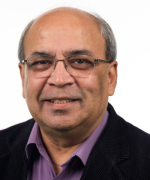
Kavita Bala is the 17th Provost of Cornell University and a Professor of Computer Science. She previously served as the inaugural Dean of the Cornell Ann S. Bowers College of Computing and Information Science, leading its transition to a degree-granting college by 2025, and as Chair of Cornell’s Department of Computer Science. Her academic leadership includes expanding faculty, establishing research programs like the Bowers CIS Undergraduate Research Experience (BURE), and securing a new research facility for computing and information science. Education: B.Tech (IIT Bombay), M.S. and Ph.D. (MIT, Computer Science) Bala’s research focuses on computer vision, artificial intelligence, and computer graphics , with groundbreaking work in material and style recognition using deep learning. Her innovations in crowdsourced training data and differentiable rendering have advanced visual search technologies and translucent material modeling, powering her startup GrokStyle. She pioneered AI techniques applied to environmental monitoring through projects like MONITRS and AllClear , addressing Earth observation challenges. Her scientific awards include: American Academy of Arts and Sciences (2025) SIGGRAPH Computer Graphics Achievement Award (2020) IIT Bombay Distinguished Alumnus Award (2021) ACM Fellow (2019) SIGGRAPH Academy Fellow (2020) As Provost, Bala drives strategic initiatives like the Cornell AI Initiative , creating interdisciplinary minors in AI and AI in Society, and establishing the Schmidt AI in Science postdoctoral program. She co-chaired a task force for generative AI guidelines in education.
Kevin Chetty is a Professor of Wireless Sensing at University College London (UCL), leading the Urban Wireless Sensing Lab within the Department of Security and Crime Science. His work bridges radar technology, machine learning, and healthcare applications, with a focus on passive sensing systems. Education: PhD in Medical Ultrasound Physics (Imperial College London, 2004-2007), MRes in Image and X-Ray Physics (King's College London, 2003), BSc in Physics (King's College London, 1999) Research spans radar micro-Doppler signature analysis for human behavior classification, software-defined radar development, and integrated communication-sensing systems, with applications in security, healthcare, and smart environments. Recent work emphasizes privacy-preserving technologies and edge processing for real-time operations. Scientific awards include the 2022 IET Radar Systems Best Paper Runner-Up, 2022 IEEE Radar Conference 2nd Place, and 2015 National Instruments Engineering Impact Award. He has received funding from government and industry sectors in telecommunications, IoT, security, and healthcare. Teaching roles: Programme Convener for MSc Crime Science and IEP Minor in Crime and Security Engineering; Module Convener for Security Technologies and Crime Mapping & Spatial Analysis Consultancy: Huawei Technologies (2020-2022), Metropolitan Police Service (2019)
Shuhao Fu is a Program Postdoctoral Fellow at the Santa Fe Institute (SFI) researching the intersection of machine learning and cognitive science. He completed his Ph.D. in Psychology at UCLA under advisors Hongjing Lu and Ying Nian Wu, following a B.S. in Computer Science and Mathematics from Hong Kong University of Science and Technology. His research examines human-like relational reasoning in AI systems through cognitive modeling and computational approaches. Research focuses on: Bridging human-machine reasoning gaps via analogical mapping Developing explicit relational representations in vision models Structural cognitive modeling for compositional understanding Multimodal reasoning and scene interpretation Relational knowledge representation in biological and artificial systems Publication trends show concentrated work in computational cognitive science (2021-2025), with evolving focus from visual analogy fundamentals to applications in 3D recognition, social interaction modeling, and mental health diagnostics. Recent work demonstrates increased emphasis on transformer architectures, multimodal integration, and human-AI comparative studies. Professional experience includes research internships at Google X and Mineral.ai, with prior affiliation at Johns Hopkins University's CCVL lab under Alan Yuille. Currently serves as reviewer for ICML, ICCV, and Cognitive Science Society conferences.
Ashok Goel is a Professor of Computer Science and Human-Centered Computing at Georgia Institute of Technology and Chief Scientist at Georgia Tech’s Center for 21st Century Universities (C21U). He also serves as Executive Director of the NSF-funded National AI Institute for Adult Learning and Online Education (AI-ALOE). His research spans cognitive systems, artificial intelligence, and education, with a focus on computational design, creativity, and AI-driven educational technologies. Professor, School of Interactive Computing, Georgia Tech Chief Scientist, Center for 21st Century Universities Executive Director, NSF’s National AI Institute for Adult Learning and Online Education Goel’s research explores the intersection of AI and cognitive science, particularly in computational design, creativity, and biologically inspired design. His recent work emphasizes AI in education, including virtual teaching assistants like Jill Watson (powered by ChatGPT) and frameworks for scalable, human-centric AI-augmented learning. He investigates explainable AI, multimodal educational systems, and bidirectional feedback mechanisms to enhance personalized learning experiences. Award highlights include: AAAI’s Outstanding AI Educator Award Fellow of AAAI and Cognitive Science Society University System of Georgia Regent’s Award for Scholarship of Teaching and Learning Goel leads the Design Intelligence Laboratory at Georgia Tech, mentoring a team of graduate and undergraduate researchers. His contributions to AI education include pioneering Georgia Tech’s Online Master of Science in Computer Science (OMSCS) program and developing blended learning frameworks. He also co-founded the AI-based educational startup Beyond Question (LLC) in 2020.
Dr. Yang Zhang is a tenured Professor at the CISPA Helmholtz Center for Information Security . His research focuses on Trustworthy Machine Learning , emphasizing privacy, safety, and security , with additional work on measuring misinformation and unsafe online content like hateful memes. He has published extensively at top conferences (CCS, NDSS, Oakland, USENIX Security) and received multiple awards including the Busy Beaver Award (2022) and NDSS Distinguished Paper Award (2019) . Research Interests : Trustworthy Machine Learning LLM Security, Privacy, and Safety Misinformation and Hate Speech Detection Social Network Analysis Recent Publications examine synthetic data auditing, hate speech detection in LLM-generated content, and privacy risks in curriculum learning, spanning conferences like USENIX Security , IEEE S&P , and ACM CCS . His work often intersects AI security with ethical considerations . Scientific Awards : Busy Beaver Award for “Privacy of Machine Learning” (2022) NDSS Distinguished Paper Award (2019) CCS Best Paper Runner-Up (2022) Best Machine Learning and Security Paper in Cybersecurity Award (2025) Best Paper Finalist at CSAW Europe (2023, 2024) Students in his group include Yixin Wu , Xinyue Shen , and Yiting Qu , the latter recently completing their Ph.D. defense. He actively recruits MSc and PhD students and has contributed to iDRAMA Lab for meme-related research.
Yingdan Lu is an Assistant Professor in the Department of Communication Studies at Northwestern University's School of Communication. She serves as Director of the Computational Media and Politics Lab, co-director of the Computational Multimodal Communication Lab, and is core faculty in Northwestern's Media, Technology, and Society (MTS) and Technology and Social Behavior (TSB) PhD programs. She is also affiliated with the Center for Communication & Public Policy and the Center for Human-Computer Interaction + Design. Her educational background includes a Ph.D. in Communication from Stanford University (2023), where she also earned a Ph.D. minor in Political Science and an M.A. in East Asian Studies. She received her B.A. in Journalism and Communication from Tsinghua University. Dr. Lu's research centers on digital technology, political communication, and authoritarian politics, with two primary focus areas: the role of digital technologies in authoritarian politics, and multimodal communication across different contexts. Her work employs computational and qualitative methods to examine how authoritarian governments use digital media and AI to maintain rule, and how individuals experience technology in different media environments. As a computational social scientist, she advances methods for analyzing multimodal data (images, videos), cross-lingual digital communication, and mixed-method research. Her publications reveal a consistent focus on digital authoritarianism, particularly Chinese state propaganda on social media platforms, multimodal communication analysis, and information manipulation. Her work spans interdisciplinary outlets including Political Communication, New Media & Society, International Journal of Press/Politics, and Proceedings of the National Academy of Sciences. Dr. Lu's research has received funding from the National Science Foundation, Brown Institute for Media Innovation, and the Stanford Institute for Human-Centered Artificial Intelligence. She is the founder of COMputation Island ("计传岛"), a WeChat-based platform serving over 10,000 Mandarin-speaking scholars in computational communication research. She leads the Computational Media and Politics Lab and co-directs the Computational Multimodal Communication Lab, where she develops innovative frameworks for analyzing multimodal data and promotes mixed-method approaches to computational social science research.
Stuart E. Middleton is a Professor in the Electronics and Computer Science (ECS) department at the University of Southampton, where he has been employed since 2003. His research bridges artificial intelligence with practical applications in social science, mental health, and security domains. He leads multiple research projects funded by DTP and CISDnS CDT, focusing on multimodal natural language processing and large language models for social good applications. Professor Middleton's research interests center on Natural Language Processing, Large Language Models, and Human-in-the-loop AI systems. His work spans mental health applications (particularly suicide risk detection and mood change analysis), social media analysis for crisis mapping, geoparsing for location extraction, and argument mining in political discourse. He has developed numerous open-source NLP projects and datasets including CPIQA for climate science, ConversationMoC for mental health monitoring, and M-Arg for multimodal argument mining. His research demonstrates how AI can effectively support human decision-making in critical domains like mental healthcare, defense applications, and crisis management. His recent publications reveal a strong trend toward applying LLMs to high-impact societal challenges, particularly in mental health monitoring and climate science verification. He has pioneered methods for detecting suicidal ideation in social media, identifying moments of mood change, and developing context-aware question answering for climate papers. His work consistently emphasizes the importance of human oversight in AI systems, with numerous publications on responsible AI, regulation, and human-in-the-loop approaches. Ranked 1st in ECAL-2024 shared task on suicidal ideation detection Ranked 1st in NAACL-2022 shared task on suicide risk and mood change classification Winner of 'best paper' award at WWW2002 Semantic Web Workshop Professor Middleton actively supervises PhD students through multiple funded projects including 'Multimodal Natural Language Processing for Computational Social Science', 'Large Language Models for Military Veteran Mental Health', and 'Large Language Models for Human/AI Information Foraging to Combat Digital Human Trafficking into Terrorism'. He has secured significant funding from UKRI, DSTL, and other sources to support his research in responsible AI applications. He organizes major workshops including the RAI UK Workshops on Responsible AI for Mental Health and AIUK workshops on AI for Data Rescue and Defense applications. His research group maintains numerous GitHub repositories with open-source NLP tools and datasets that have been widely adopted by the research community.
Peter Burke is a Professor of Electrical Engineering and Computer Science (joint appointments in Biomedical Engineering and Materials Science and Engineering ) at the Samueli School of Engineering, University of California, Irvine . His research bridges nanoelectronics with biotechnology , focusing on carbon nanotubes , graphene devices , and mitochondrial bioenergetics . He has received prestigious Young Investigator Awards from the Office of Naval Research and Army Research Office. Education: B.A. in Physics, University of Chicago (1992) Ph.D. in Physics, Yale University (1998) His work spans quantum electronics , high-speed semiconductor devices , and bio-nano interfaces . Recent publications highlight drone technology , mitochondrial electrical activity , and AI-driven nanoscale sensing . Research trends include terahertz spectroscopy , super-resolution imaging , and open-source medical devices like the NanoStat potentiostat . Scientific Awards Young Investigator Award, Office of Naval Research Young Investigator Program Award, Army Research Office As director of the BurkeLab , he develops nano-electronic interfaces for biological systems, including mitochondrial membrane potential assays and graphene-based biosensors . His lab's innovations in carbon nanotube arrays and scanning microwave microscopy have advanced bio-nano applications.
Jungeun (Jenny) Won is an Assistant Professor of Research in the Department of Biomedical Engineering at the School of Engineering and Applied Sciences, University at Buffalo. Her research focuses on optical imaging , biomedical device development , medical image analysis , and artificial intelligence in OCT . She leads the Translational Biophotonics Laboratory , where she develops advanced OCT techniques for medical applications such as diabetic retinopathy , otitis media , and biofilm analysis . Contact: 215J Bonner Hall, Buffalo NY 14260, jungeunw@buffalo.edu Related Links: CV PDF , Google Scholar , Lab Website Her recent work involves high-resolution OCT for longitudinal studies on retinal degeneration, VISTA OCTA for blood flow analysis, and 3D motion correction algorithms to enhance image quality. She also explores multimodal imaging combining OCT with Raman spectroscopy for bacterial differentiation and microplasma-based therapies for ear infections.
Dr. Armin Mustafa is an Associate Professor in Computer Vision and AI at the University of Surrey, where he holds a prestigious Royal Academy of Engineering Research Fellow position. He is affiliated with the Centre for Vision, Speech and Signal Processing (CVSSP), the School of Computer Science and Electronic Engineering, and the Surrey Institute for People-Centred Artificial Intelligence (PAI). His research focuses on developing AI systems for visual understanding of complex dynamic scenes, with applications in entertainment, autonomous systems, and augmented/virtual reality. Dr. Mustafa completed his PhD in general dynamic scene reconstruction from multi-view videos in 2016 from the University of Surrey under the supervision of Prof. Adrian Hilton. Prior to his doctoral studies, he worked for three years (2010-2013) at Samsung Research Institute in Bangalore, India, in the field of Computer Vision. His research expertise spans Computer Vision, Scene Understanding, 3D/4D Vision, Virtual Reality, Light Fields, Machine Learning, Video Captioning, Augmented Reality, Artificial Intelligence, and Audio-visual Video Understanding. Dr. Mustafa has pioneered advances in 4D vision, NLP, and Scene Understanding over the past decade, with a particular focus on enabling machines to model and interpret real-world environments for socially beneficial applications. His work bridges theoretical advances in computer vision with practical applications in media production, virtual reality, and autonomous systems. Analysis of Dr. Mustafa's recent publications reveals a strong focus on multimodal learning, particularly the integration of audio and visual information for scene understanding. His work spans diverse areas including shadow detection and removal, audio event classification, video captioning, person image generation, and dynamic scene reconstruction. A notable trend is his exploration of transformer architectures for both vision and audio tasks, as well as the application of self-supervised learning techniques to reduce dependency on labeled data. Dr. Mustafa has received numerous prestigious awards: 2018 - Research Fellowship, The Royal Academy of Engineering, UK 2017 - Young Researcher award, CVPR 2016 - Doctoral Consortium grant, CVPR 2015 - BMVA travel grant for ICCV 2014 - Set-Squared Research to Innovator grant 2013 - Overseas Research Scholarship, FEPS, The University of Surrey 2010 - Cadence Silver Medal, Indian Institute of Technology, Kanpur As a dedicated mentor, Dr. Mustafa supervises several PhD students working on cutting-edge topics including multi-person reconstruction, audio-visual scene understanding, and automatic storyboard generation. His research is supported by significant grants including a £15 million UKRI Prosperity Partnership with the BBC (AI4ME), a 5-year Royal Academy of Engineering fellowship (4D Vision for Perceptive Machines), and multiple projects with industry partners such as Figment Productions and Foundry. Dr. Mustafa is an active member of the Centre for Vision, Speech and Signal Processing (CVSSP), one of the world's leading research centers in vision, speech, and signal processing. He also contributes to the Surrey Institute for People-Centred Artificial Intelligence (PAI), where he serves as a Surrey AI Fellow. His work often involves collaboration with industry partners and other academic institutions across Europe.
Narges Mahyar is an Associate Professor at the University of Massachusetts Amherst in the Manning College of Information and Computer Sciences (CICS) . She is currently on sabbatical with the Aviz team at the Inria Center, University of Paris-Saclay . Her research focuses on Human-Computer Interaction (HCI) , Information Visualization , and Digital Civics , aiming to empower communities through technology. Education: She holds a PhD in Computer Science from the University of Victoria, an MS in Information Technology from the University of Malaya, and a BS in Electrical Engineering from Tehran Azad University. She completed postdoctoral fellowships at the University of British Columbia (2014–2016) and the University of California San Diego (2016–2018). Research Interests: Her work addresses complex societal challenges like climate change, urban planning, and healthcare by designing inclusive technologies. Key areas include civic engagement, data visualization for equity, and integrating AR/VR for public participation. Notable projects include CommunityClick and RisingEMOTIONS , which enhance public input in decision-making. Publications & Awards: With over 50 publications, her work has received prestigious awards including Best Paper Awards at CHI 2023 , Eurovis 2022 , and CSCW 2020 . Her research emphasizes ethical design and inclusivity, particularly involving marginalized communities. Grants & Advising: She has secured grants totaling over $1.4 million, including NSF funding for projects like "Mapping Instability" . Advises PhD student Mahmood Jasim and collaborates with Ali Sarvghad and Pari Riahi on interdisciplinary research. Labs & Teams: Leads the HCI-VIS Lab at UMass, focusing on social computing and visualization. Collaborates internationally with teams like Aviz and Inria on civic tech initiatives.
Zahraa Abdallah is a Senior Lecturer at the School of Engineering Mathematics and Technology, University of Bristol. She holds a PhD and BSc in relevant fields. Her research focuses on Machine Learning, Data Science, Time Series Analysis, and their applications in Health Informatics, Neuroscience, and Bioinformatics. She leads projects on wearable technology integration for diabetes management and EEG-based disease classification. Her work emphasizes explainable AI and multimodal approaches. Zahraa is affiliated with the Bristol Doctoral College Initiative (BDFI) as an Academic Co-Director and collaborates with experts like Prof. Raul Santos-Rodriguez. Contact: zahraa.abdallah@bristol.ac.uk | Website: zahraa-abdallah.com Research Interests: Time Series Clustering & Forecasting EEG-based Disease Detection (Parkinson’s, Alzheimer’s) Smartwatch-Driven Healthcare Systems Explainable AI in Biomedical Applications Key Projects: Development of the CSTS benchmark for time series clustering Investigating insulin needs using automated delivery data Gene essentiality classification via graph neural networks Collaborations: Professor Raul Santos-Rodriguez (BDFI) Lucia Marucci (Systems & Engineering Biology)
Dr. Yizi Chen is a Researcher affiliated with the Professorship for Cartography at ETH Zurich's Department of Civil, Environmental and Geomatic Engineering. Their work focuses on advancing cartographic techniques through AI-driven methods, historical map analysis, and geospatial technologies. Key contributions include automated map vectorization, semantic segmentation of historical maps, and integrating multimodal data for robotic systems. They have published extensively in top-tier journals and conferences, addressing challenges in deep learning applications for geomatic engineering. Education details are not explicitly provided in the text. Research interests include semantic segmentation, generative AI for cartography, and steganography in image translation. Notable publications span topics from eye-tracking segmentation to urban land use mapping, reflecting a strong interdisciplinary approach. Dr. Chen collaborates on projects involving historical map digitization and benchmarking datasets for computer vision tasks. No awards or grants are mentioned. Their work contributes to advancing geomatic engineering through innovative solutions in digital mapping and spatial data analysis.
Shunyuan Zhang is an Assistant Professor at Harvard Business School with research focusing on AI algorithms, economic inequality, and computer vision applications in business contexts. His work examines how algorithmic systems impact economic outcomes, particularly in sharing economy platforms like Airbnb. His research interests include AI algorithms, economic inequality, pricing algorithms, machine learning, computer vision, and the sharing economy. Zhang's work often combines technical computer vision approaches with economic analysis to understand platform dynamics. Zhang's recent publications demonstrate a strong focus on the intersection of AI, fairness, and economic outcomes. His work analyzes how algorithmic pricing affects racial disparities on platforms like Airbnb, and how visual content impacts demand in the sharing economy. His research employs sophisticated methodologies including deep learning, structural modeling, and causal inference. He has published in top journals and working paper series, with notable work including 'Can an AI Algorithm Mitigate Racial Economic Inequality? An Analysis in the Context of Airbnb' and 'What Makes a Good Image? Airbnb Demand Analytics Leveraging Interpretable Image Features.' Zhang collaborates extensively with leading researchers at Carnegie Mellon University and University of Toronto, particularly on topics related to algorithmic fairness and platform economics. His work has significant implications for both academic understanding and practical policy recommendations regarding algorithmic systems in marketplace contexts.
Dr. Rafeef Garbi is a Professor at the Department of Electrical and Computer Engineering, University of British Columbia, and the Founder/Director of the Biomedical Signal and Image Computing Laboratory (BiSICL). Her multidisciplinary research integrates artificial intelligence, computer vision, and medical imaging for clinical applications in pediatric orthopedics, oncology, and neurology. PhD (Chalmers University, Sweden), MSc (with distinction), Technical Licentiate Research Focus: Specializing in Medical Image Computing and Visual Computing , her lab develops AI-driven solutions for: Automated segmentation and analysis of multi-dimensional biomedical data Clinically-translatable biomarkers for disease assessment Computer-aided intervention systems in surgical contexts Scientific Leadership: UBC Killam Faculty Research Fellow Peter Wall Institute for Advanced Studies Early Career Scholar Senior IEEE Member & Founding IEEE EMBS Vancouver Section Member Key Collaborations: Active in the Medical Image Computing and Computer Assisted Intervention (MICCAI) Society and CAIDA: UBC ICICS Centre for Artificial Intelligence Decision-making and Action. Her team bridges engineering, medicine, and computational biology through translational research.