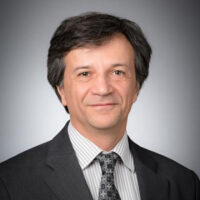
Prof. Liam Murphy is a Full Professor of Computer Science & Informatics at University College Dublin (UCD) and Director of the Performance Engineering Laboratory. He holds a B.E. from UCD, M.Sc. and Ph.D. from UC Berkeley. His research focuses on performance engineering of networks, software systems, and multimedia transmissions. He has published over 150 peer-reviewed papers and is an IEEE member and Fellow of the Irish Computer Society. Education: B.E. in Electrical Engineering, UCD (1985) M.Sc. & Ph.D. in Electrical Engineering & Computer Sciences, UC Berkeley (1988, 1992) Research Interests: Dynamic resource allocation in networks Cloud computing efficiency Software performance engineering Wireless multimedia systems Quality of Service (QoS) optimization Recent work emphasizes energy-efficient cloud workflows, multi-objective data center optimization, and decentralized traffic simulation. Grants & Awards: Fellow of the Irish Computer Society (2007) Conference Paper Awards (2004, 2002, 2001) Principal Investigator in multiple funded projects (e.g., EU-funded traffic simulation, cloud resource allocation) Advising & Labs: Directed 24 Ph.D. and 8 M.Sc. students. Leads the Performance Engineering Laboratory (PEL), focusing on distributed systems, cloud efficiency, and network performance. Collaborates on industry-relevant projects like crovan (UCD/DCU campus company). Teaching: Coordinates courses on computer science fundamentals, distributed systems performance, and software engineering at UCD.
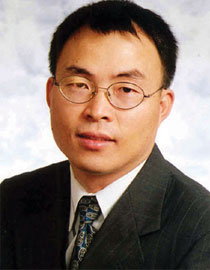
Dr. Honggang Wang is a Professor in the Department of Electrical & Computer Engineering at the University of Massachusetts Dartmouth. He holds a PhD from the University of Nebraska-Lincoln and MS/BE degrees from Southwest Jiaotong University, China. His research focuses on Internet of Things (IoT), Wireless Body Area Networks (BAN), Multimedia Communications, and Connected Vehicle Systems. Notable projects include developing lightweight authentication systems for healthcare IoT and mmWave communication for vehicle safety. Editor-in-Chief of IEEE Internet of Things Journal since 2020 Former Chair of IEEE Multimedia Communications Technical Committee (2018-2020) Current Chair of IEEE eHealth Technical Committee (2020-2021) His work emphasizes secure, low-power communication protocols for medical devices and vehicular networks. Over 200 publications in top-tier venues have earned him six best paper awards and IEEE Fellow recognition.
Esa Ollila serves as Associate Professor in the Department of Signal Processing and Acoustics at Aalto University, Finland, and holds an adjunct professorship in Statistics at the University of Oulu. His academic appointments include Academy of Finland Research Fellow (2010-2015) and prior senior research/lecturing roles at both institutions. His educational background features: M.Sc. in Mathematics, University of Oulu (1998) Ph.D. in Statistics (with honors), University of Jyväskylä (2002) D.Sc.(Tech) in Signal Processing (with honors), Aalto University (2010) Professor Ollila's research centers on statistical signal processing and robust statistical methodologies , with significant contributions to array processing, high-dimensional data analysis, and covariance matrix estimation. His work bridges theoretical statistics with practical applications in radar systems, wireless communications, and big data analytics, emphasizing robustness against outliers and computational efficiency in modern data-intensive environments. Current focus areas include compressed sensing, sparse approximation, and blind source separation techniques. Analysis of his 15 most recent publications (2024-2025) reveals three dominant trends: (1) robust covariance learning for massive random access systems, (2) integrated sensing and communications (ISAC) for 6G networks using advanced beamforming, and (3) geometric approaches to elliptical distributions in statistical inference. His work increasingly incorporates deep learning (GANs, graph neural networks) while maintaining strong foundations in classical signal processing theory. Key recognitions include: Academy of Finland Postdoctoral Fellowship (2004-2007) Academy of Finland Research Fellowship (2010-2015) His research has been supported through prestigious Academy of Finland grants totaling over a decade of continuous funding. Professor Ollila currently leads an active research group at Aalto University, supervising doctoral candidates and collaborating internationally with institutions including Princeton University (where he served as Visiting Post-doctoral Research Associate during 2010-2011). He maintains strong ties with the University of Oulu through his adjunct professorship and has contributed to EURASIP's Special Area Team on Theoretical and Methodological Trends in Signal Processing. The Esa Ollila Research Group focuses on cutting-edge challenges in statistical signal processing, with current projects spanning robust DOA estimation under non-Gaussian noise, covariance matrix learning for massive MIMO systems, and machine learning-enhanced radar-communication integration. The group actively develops open-source tools like the fitHeavyTail R package for heavy-tailed distribution modeling and maintains collaborations with industry partners in wireless communications.
Professor David Taubman is a distinguished academic serving as Professor and Deputy Head of School (Research) at the School of Electrical Engineering and Telecommunications (EE&T) at the University of New South Wales (UNSW) in Sydney, Australia. He is also co-director of Kakadu Software Pty. Ltd. and its affiliates Kakadu R&D and Kakadu GPU. With a career spanning over three decades, Professor Taubman has made significant contributions to the field of image and video compression, most notably as the author of the EBCOT coding algorithm adopted in the JPEG2000 international standard. Professor Taubman earned his B.Sc. in Mathematics and Computer Science (1986) and B.E. (Medal) in Electrical Engineering (1988) from the University of Sydney, followed by an M.Sc. (1992) and Ph.D. (1994) in Electrical Engineering from the University of California at Berkeley. His professional journey includes engineering work at the Electricity Commission of N.S.W. (1988-1990), research positions at Hewlett-Packard Laboratories in Palo Alto (1994-1998), and an academic career at UNSW where he progressed from Senior Lecturer (1998-2003) to Associate Professor (2004-2009) and finally to Professor (2009-present). He has held various leadership roles including Head of the EE&T Telecommunications Research Group (2003-2014), Head of the EE&T Signal Processing Research Group (2014-present), Director of Research for the School of EE&T (2011-2016), and Deputy Head of School (Research) since 2017. Professor Taubman's research interests center on image and video compression, with particular expertise in JPEG2000 standards and implementations. His work spans signal processing, wavelet transforms, scalable video coding, motion modeling, and multimedia systems. He has pioneered numerous compression algorithms and frameworks, including the EBCOT coding algorithm that became central to the JPEG2000 standard. His recent research focuses on efficient motion modeling with cuboidal partitioning, learned lifting-based transform structures, and high-throughput implementations of JPEG2000 for video applications. His work bridges theoretical foundations with practical implementations, as evidenced by the commercially successful Kakadu Software tools that have garnered around 500 commercial licensees. Analysis of Professor Taubman's recent publications reveals a consistent focus on advancing compression technologies with particular emphasis on scalability, efficiency, and adaptability. His work spans traditional image compression (JPEG2000 extensions), video coding (cuboid-based partitioning for UHD/360-degree video), and emerging applications (nanopore sequencing data compression). A notable trend is the integration of machine learning techniques with traditional compression frameworks, as seen in his work on learned lifting-based transform structures. His research maintains strong connections to real-world applications across diverse domains including medical imaging, astronomical data processing, and genomic sequencing. IEEE Fellow Engineers Australia Fellow (by invitation) Professor Taubman has served as Associate Editor for the IEEE Transactions on Image Processing for two four-year appointments (2003-2005 and 2010-2013). He has been actively involved in numerous research grants focused on image and video compression technologies, particularly those related to the JPEG2000 standard and its extensions. His work has received significant industry support, reflected in his consultancy with various U.S., Japanese, and Australian corporations. He has also contributed to international standards development as a member of Standards Australia Technical Committee MS-065 (mirroring ISO TC42 on Digital Photography) and as a constitutional member of Standards Australia Technical Committee IT-029 (Coded Representation of Picture, Audio and Multimedia/Hypermedia Information). Professor Taubman co-directs Kakadu Software Pty. Ltd. and its research affiliates Kakadu R&D and Kakadu GPU, which have developed the commercially successful Kakadu Software tools for JPEG2000. His research group at UNSW focuses on advanced image and video compression techniques, with particular expertise in wavelet-based methods, scalable coding, and motion modeling. The group maintains strong industry connections and has contributed significantly to the development and standardization of image compression technologies worldwide.
Prof. Dr. Gordana Gardašević is a full professor at the Department of Telecommunications, Faculty of Electrical Engineering, University of Banja Luka, Bosnia and Herzegovina. She has been actively contributing to telecommunications research and education since the early 2000s and was appointed to full professor in September 2020. Her research interests focus on advanced networking technologies, particularly in these areas: Industrial Internet of Things (IIoT) and 6TiSCH networks Visible Light Communication and audio/speech quality assessment Quality of Service (QoS) in heterogeneous wireless networks Smart healthcare applications using IoT technologies Network protocols for time-sensitive industrial applications Professor Gardašević's publication record shows consistent research activity over two decades with a strong recent focus on 6TiSCH networks and Visible Light Communication. Her work combines theoretical analysis with experimental validation using platforms like OpenMote-B. She has published in reputable journals including IEEE Sensors, Entropy, and Wireless Personal Communications, with increasing emphasis on healthcare applications of IoT technologies in recent years. She has served as principal investigator for numerous research projects including: Algoritmi za lokalizaciju u IoT mrezama (2025, active) Eksperimentalno testiranje performansi industrijskih 6TiSCH mreza (2022-2023) Razvoj Internet of Things (IoT) aplikacija primjenom opticko-bezicnih tehnologija (2021-2022) Projectovanje industrijskih Internet of Things aplikacija (2021) Razvoj algoritama za vremenski osjetljive aplikacije u industrijskim IoT mrezama (2019-2021) Professor Gardašević collaborates extensively with researchers across Europe through COST Actions and Horizon Europe initiatives. Her laboratory work focuses on experimental testbeds for IoT and industrial communication systems, particularly using OpenMote platforms for 6TiSCH network evaluation. She has also contributed to standardization efforts through white papers and collaborative projects.
Dr. Reza Montasari is a Senior Lecturer in Cyber Threats at Swansea University's Hillary Rodham Clinton School of Law. He holds a BSc in Multimedia Computing and MSc in Computer Forensics from the University of South Wales, and a PhD in Digital Forensics from the University of Derby. His professional memberships include Fellow of the Higher Education Academy (FHEA) and Chartered Engineer (CEng). Montasari’s research focuses on Digital Forensics, Cyber Security, and Cyber Terrorism, with over 50 publications. He has authored/co-authored books like Cyberspace, Cyberterrorism and International Security (2024) and Countering Cyberterrorism (2023). His work bridges technical and legal aspects of cyber threats, addressing AI’s role in counterterrorism and national security. He has held roles such as External Examiner at the University of South Wales and leadership positions in cybersecurity initiatives. His expertise includes IoT forensics, dark web challenges, and digital policing strategies. Montasari also collaborates with law enforcement agencies like Cheshire Police and advises media on cybersecurity issues. Key contributions include editorial board memberships, conference presentations (e.g., ICGS3), and contributions to cybersecurity policy development. His research emphasizes ethical AI applications, privacy rights, and mitigating cyber threats in modern societies.
Andres Kwasinski is a Professor in the Department of Computer Engineering at Rochester Institute of Technology (RIT), part of the Kate Gleason College of Engineering. He serves as Graduate Program Director for the Ph.D. in Electrical and Computer Engineering and M.Sc. in Computer Engineering. He co-directs the Networking and Information Processing (NetIP) Lab and holds editorial roles with IEEE publications, including Chief Editor of the IEEE Signal Processing Repository and Associate Editor of IEEE Signal Processing Magazine. Education: Ph.D. and M.Sc. in Electrical and Computer Engineering from the University of Maryland, College Park (2004 and 2000), and B.Sc. in Electrical Engineering from the Buenos Aires Institute of Technology (1992). Prior to RIT, he worked at Texas Instruments, Lucent Technologies, and the University of Maryland. Research Interests: Cognitive radios, machine learning for dynamic spectrum access, 5G/6G networks, VR communications, cross-layer resource allocation, smart infrastructures, and signal processing. His work emphasizes sustainable and resilient communication systems, integrating renewable energy and AI-driven solutions. Notable Contributions: Authored/co-authored books on cooperative communications and 3D visual communications. Over 70 peer-reviewed publications, including works on energy-efficient wireless networks, microgrid integration for base stations, and deep reinforcement learning in cognitive radio. His research is funded by the NSF, Harris Corporation, and the Air Force Research Laboratory. Grants & Awards: Supported by grants from NSF and industry partners. Recognized for contributions to IEEE standards and technical leadership in signal processing and communications. Labs & Teams: Co-director of the NetIP Lab, focusing on networking, signal processing, and smart infrastructure. Collaborates on interdisciplinary projects in robotics, warehouse automation, and 5G/B5G systems.
Zixiang Xiong is a Professor and Associate Department Head in the Department of Electrical and Computer Engineering at Texas A&M University, holding the Robert M. Kennedy '26 Endowed Professorship II. He earned his Ph.D. in Electrical Engineering from the University of Illinois at Urbana-Champaign in 1996. His career includes roles at Princeton University, University of Hawaii, and Texas A&M since 1999. Education: Ph.D., Electrical Engineering, University of Illinois at Urbana-Champaign, 1996 Visiting Research Associate, Princeton University, 1995–1997 University of Hawaii, 1997–1999 Research Interests: Focuses on machine learning, image/video processing, federated learning, network information theory, biomedical engineering, and communications. His work spans distributed source coding, genomic signal processing, and energy-efficient systems. Publications & Awards: Over 200 publications, including seminal works on distributed video coding and network information theory. Notable awards include the NSF Career Award (1999), ONR Young Investigator Award (2001), IEEE Fellow (2006), and the ECE Outstanding Faculty Award (2024). His research has led to patents in video compression and multimedia systems. Grants & Advising: Active in NSF-funded projects on coding theory and energy-delay tradeoffs. Advises numerous PhD and MS students, with over 50 alumni in academia and industry. Collaborates on biomedical imaging, remote sensing, and federated learning initiatives. Labs & Teams: Leads a dynamic research group at Texas A&M, focusing on cutting-edge projects in signal processing and machine learning applications. Collaborates with industry and governmental agencies on applied research.
Dr. Shahram Shirani is a Professor and holds the L.R. Wilson/Bell Canada Chair in Data Communications in the Department of Electrical & Computer Engineering at McMaster University. He also serves as Acting Chair of the department. His research focuses on multimedia communications, image/video processing, medical imaging, and hardware architectures. He teaches courses like Image Processing (COMPENG 4TN4) and 3D Image Processing and Computer Vision (ECE 736). Shirani earned his B.Sc. from Isfahan University of Technology (1989), M.Sc. from Amirkabir University of Technology (1994), and Ph.D. from the University of British Columbia (2000). His achievements include the Faculty of Engineering Leadership Fellowship (2014–15) and leadership roles in editorial boards for IEEE Transactions on Multimedia and Circuits and Systems for Video Technology. Research interests include video quality assessment, biomedical signal processing, and edge computing for traffic monitoring. His lab develops algorithms for multimedia representation, compression, and hardware implementation. Recent work includes AI-driven medical sound datasets, real-time noise removal in MRI, and efficient CNN pruning techniques. He advises over 15 graduate students and collaborates on projects like the HLS-CMDS dataset and cardiac segmentation reviews. His lab’s contributions span biomedical engineering, autonomous systems, and smart sensor technologies.
Saverio Mascolo is a Full Professor at the Polytechnic University of Bari , Department of Electrical and Information Engineering. He leads the Control of Computing and Communication Systems Lab (C3Lab) and contributes to IEEE/ACM Transactions on Networking as an Associate Editor. His research focuses on Future Internet, network congestion control, and real-time communication systems. Laurea in Electronic Engineering, Politecnico di Bari (1991) PhD in Electronic and Automatic Control, Politecnico di Bari (1995) Visiting researcher roles at UCLA (1995, 1999), INRIA (2004), and FTW (2004) Research spans network congestion control , adaptive video streaming , and real-time communication . His lab develops protocols like TCP Westwood+ and contributes to WebRTC standards. Current projects include low-delay protocols for immersive video streaming and autonomous systems control. Recent publications emphasize adaptive threshold mechanisms in congestion control, millimeter-wave radar datasets , and immersive teleoperation systems . Projects integrate nonlinear control , time-delay analysis , and cloud-based multimedia delivery . Scientific recognition includes: Elevated to IEEE Fellow (2018) for congestion control contributions Google Faculty Award (2014) for WebRTC research Cisco Research Award (2013) for video streaming control Best paper awards at MMSYS (2025, 2024, 2016) Grants fund research in cloud-based video platforms (MISE, 2017-2020), WebRTC optimization (MIUR, 2012-2015), and network control algorithms. His lab collaborates with institutions like Uppsala University (since 2001) and industry partners.
Thaier Hayajneh , Ph.D., is a University Professor at Fordham University's Department of Computer and Information Sciences. He serves as Founder Director of the Fordham Center for Cybersecurity and Program Director for the MS in Cybersecurity program. Previously, he held academic roles at New York Institute of Technology and Hashemite University in Jordan. Specializes in cybersecurity, networking, and applied cryptography Focus areas include blockchain, IoT security, and wireless network vulnerabilities Active in NSF cybersecurity review panels and as a CAE reviewer for NSA Recipient of peer-review awards from Publons His research spans secure protocols for medical IoT systems, lightweight cryptographic algorithms, and smart contract implementations in healthcare. Publications in IEEE IoT Journal, IEEE Systems Journal, and Journals like Future Generation Computer Systems demonstrate his expertise in securing emerging technologies. Dr. Hayajneh has received research funding from federal agencies including NSA, Department of Defense, and NSF. He has published over 80 papers and maintains active editorial roles in prestigious journals. Scientific Awards: Peer-review awards from Publons
Professor Jinho Choi is a Chair and Professor in Radio Frequency at the School of Electrical and Mechanical Engineering, University of Adelaide, Australia. He holds a B.E. (magna cum laude) from Sogang University, and M.S.E. and Ph.D. degrees from KAIST. His research focuses on advancing wireless communication and sensing technologies, particularly in IoT, 5G/6G, non-terrestrial networks, and cognitive satellite systems. He authored three books and has been recognized with the 1999 EURASIP Best Paper Award, IEEE Fellowship, and inclusion in Stanford's Top 2% Scientists list since 2020. He currently serves as a Senior Editor of IEEE Wireless Communications Letters and editorial roles in multiple journals. Education: B.E. (Electronics Engineering) - Sogang University, Seoul (1989) M.S.E. (Electrical Engineering) - KAIST (1991) Ph.D. (Electrical Engineering) - KAIST (1994) Research Interests: Professor Choi's work addresses connectivity challenges in non-terrestrial networks, leveraging statistical signal processing and machine learning. Current projects include UAV-assisted LEO satellite technologies, cognitive satellite radios, and semantic communication protocols. His research aims to enhance global connectivity and efficiency in terrestrial and satellite networks. Publications: His recent work spans semantic communication, satellite quantum key distribution, federated learning optimization, and coverage diversity in mega constellations. These studies reflect trends in 6G-ready technologies, AI-driven communication systems, and hybrid satellite-terrestrial networks. Awards: 1999 Best Paper Award for Signal Processing (EURASIP) IEEE Fellow (Leadership in technical excellence) World’s Top 2% Scientists (Stanford University, 2020–present) Grants & Supervision: As a senior academic, he oversees grants in wireless innovation and has advised numerous students on advanced communication systems. His lab focuses on next-generation networks, integrating theoretical insights with practical implementations. Labs/Teams: Active in interdisciplinary teams at the University of Adelaide, collaborating on projects funded by industry and government to bridge gaps between academic research and real-world applications.
Montserrat Cachero Vinuesa is a Full Professor in the Department of Economics, Quantitative Methods and Economic History at Pablo de Olavide University in Spain. She specializes in Economic History and Institutions, with a particular focus on applying network analysis to historical research. Her work bridges the fields of economic history, early modern studies, and digital humanities. Her research interests center on the application of network theory to historical contexts, particularly examining merchant networks in the Atlantic world during the early modern period. She investigates how social and economic networks facilitated trade, colonization, and cultural exchange between Europe and the Americas. Her work spans multiple dimensions including gender dynamics in commerce, book trade networks, risk management in pre-industrial trade, and the institutional frameworks that enabled transatlantic economic integration. Her scholarly output demonstrates a consistent trajectory of applying network analysis to historical questions, with increasing methodological sophistication over time. Recent work has focused on gender dimensions of commercial networks, particularly women's roles in the book trade, alongside continued exploration of Basque merchant networks, Atlantic trade routes, and colonial economic structures. Her research combines traditional archival methods with innovative network visualization and analysis techniques. Dr. Cachero Vinuesa is the creator of RedLab, an academic space dedicated to the application of network analysis to historical research. This initiative reflects her commitment to methodological innovation and interdisciplinary collaboration. She is actively involved in doctoral education through the History and Humanistic Studies program at her institution, with emphasis on European, American, and geographical approaches to historical research.
Dr. Shervin Shirmohammadi is a Professor at the University of Ottawa's Faculty of Engineering, specifically within the School of Electrical Engineering and Computer Science. With an impressive h-index of 41 and over 6,800 citations across 473 publications, his research has made significant contributions to the fields of computer vision, biomedical instrumentation, and health monitoring systems. His academic journey spans over two decades, beginning with work on communication architectures for virtual environments in 2001 and evolving toward practical healthcare applications. Dr. Shirmohammadi's research interests center on Computer Vision , Image Processing , and Embedded Systems with a strong focus on healthcare applications including nutrition monitoring, mental health assessment, and driver safety systems. His most influential work examines computer vision applications for health monitoring, particularly food calorie measurement systems that use smartphone cameras to analyze nutritional content. His research has evolved to include EEG-based systems for ADHD detection and serious games for autism therapy, demonstrating a consistent trajectory toward practical healthcare solutions using advanced instrumentation techniques. Dr. Shirmohammadi maintains active collaborations with researchers including A. Yassine (118 joint publications), D. Ahmed, Ali Asghar Nazari Shirehjini, and B. Hariri. His publications appear primarily in IEEE Transactions on Instrumentation and Measurement, reflecting his strong connection to the instrumentation and measurement community.
Hatem Abou-Zeid is an Assistant Professor at the Department of Electrical and Software Engineering in the Schulich School of Engineering , University of Calgary. He holds Adjunct Professor appointments at Queen’s University, Carleton University, and Ontario Tech University, Canada. With a Ph.D. in Electrical and Computer Engineering from Queen’s University (2014), his academic journey includes 7 years of industry research at Ericsson and Cisco , where he led R&D projects resulting in 15+ patents. Queen's University (Ph.D., Electrical and Computer Engineering) Arab Academy for Science, Technology and Maritime Transport (B.Sc. and M.Sc., Electronics and Communications Engineering) His research focuses on 5G/6G wireless networking , immersive communications , and robust machine learning for networks. Recent projects explore trustworthy AI , joint sensing and communication , and pediatric brain-computer interfaces (BCI) . He has published extensively in top venues like IEEE JSAC , GLOBECOM , and IEEE Transactions on Networking , with over 60 publications and 19 patent filings. His scientific awards include the Research Excellence Award 2023 (UCalgary), Early Research Excellence Award 2023 (Schulich), and Best Paper Awards at EMBC 2024 (as advisor) and IEEE ICC 2022 . He leads the WAVES Research Group , mentoring 10+ graduate students and postdocs. Collaborations span institutions like the Hotchkiss Brain Institute and industry partners such as Ericsson and European Space Agency .

/prod01/production-cdn-pxl/media/umassdartmouth/profiles/engineering/220517-08.HONGGANG-WANG.jpg)