Mariann Andersen is a Senior Lecturer in Pedagogy at UiT The Arctic University of Norway, specializing in Teacher Training and Pedagogy. She is based at Campus Alta and focuses on innovative educational practices, particularly in early childhood education and digital learning environments. University: UiT The Arctic University of Norway Department: Teacher Training and Pedagogy Email: mariann.andersen@uit.no Her research explores fictional kindergarten models, digitalization in education, and the use of narrative techniques in teacher training. Recent projects include collaborative work on collective and practice-oriented educational methods, digital film presentations for pedagogical development, and continuing education initiatives in the Arctic context. She is a member of the BiA (Kindergarten Research in the Arctic) research group. Scientific Awards: None explicitly mentioned. Advising and Grants: No direct student advising list provided. Collaborates extensively with researchers like Kari Wallem Bøe, Merete Daniloff, and Carola Kleemann. Labs/Teams: Active in the BiA research group, focusing on Arctic early childhood education.
Jutta Cornelia Eschenbach is an Associate Professor at the Department of Languages, Literature and Culture at Østfold University College. Her research interests center on intercultural communication, film-based pedagogy, and the analysis of cultural stereotypes, particularly in educational and cross-cultural contexts. She has collaborated extensively with scholars like Eva Margareta Lambertsson on projects exploring identity negotiation, intercultural dialogue through film, and academic barriers faced by women in South Africa. Her work emphasizes practical applications of intercultural learning in education, such as using film fragments to foster dialogue and understanding. She has published widely on topics including cultural hybridity, narrative analysis in travelogues, and the role of film in language teaching. Her contributions span books, edited volumes, and peer-reviewed articles in journals like Journal of Intercultural Communication . Eschenbach’s research often bridges theory and practice, addressing how cultural stereotypes are constructed and contested in media and educational settings. She has also contributed to curriculum development for Nordic master’s programs integrating intercultural learning. While no formal awards are listed, her prolific publications reflect sustained scholarly engagement with intercultural studies.
Solena Diane Candice Pradayrol is an Assistant Professor at the National Centre for English and Other Foreign Languages in Education (Norway). Her work focuses on innovative teaching methods for French as a Second Language (FLE), including digital tools like Escape Rooms, flipped classrooms, and collaborative learning strategies. She emphasizes pedagogical approaches centered on student engagement and practical application. Her academic background includes teaching experience in lower secondary schools (French, English, Home Economics, and Physical Education). She has contributed to research groups like TOOL-Kit and served as a union representative for Utdanningsforbundet (Norway's largest teachers' union). Pradayrol has authored numerous publications on FLE methodology, digital pedagogy, and assessment techniques. Recent works include articles on digital tool utilization in education, oral proficiency evaluation, and thematic teaching materials (e.g., Olympic Games resources). Her research also explores cultural integration in language learning and teacher mentorship. Key areas: Digital innovation in education, FLE curriculum design, oral assessment strategies Highlighted projects: Development of digital escape rooms, Flipped Classroom methodologies, and FLE materials
Morgan Konnestad is an Associate Professor in the Department of Information and Communication Technology at the University of Agder's Faculty of Technology and Natural Sciences. He has been employed full-time at UiA since January 1, 1989, and holds a Master's degree in Marine Technology from NTNU with a focus on Computer-Aided Design and additional coursework from the ICT department. His career spans over three decades of dedicated service to the university, with significant contributions to multimedia education and technology. Education Background: Master of Science in Marine Technology from NTNU (Computer-Aided Design focus) Additional coursework from NTNU's Department of ICT University Pedagogics Program completed at UiA in 2006 Konnestad's research interests center on visual computing technologies and their educational applications. He has been responsible for Computer Graphics and CAD courses since joining UiA, later expanding into Video, DVD/Blu-ray Authoring, and e-learning material production. His work demonstrates a consistent focus on practical applications of digital media technologies in educational contexts, with particular emphasis on motion capture systems, 3D visualization, and emerging AR/VR technologies. He has developed numerous multimedia production techniques specifically tailored for academic use and student learning. Analysis of his recent publications (2014-2023) reveals a strong trajectory toward immersive technologies and collaborative learning environments. His work increasingly focuses on motion capture applications, AR/VR implementations in education, and interactive systems for specialized training. The publications show a clear evolution from technical demonstrations of multimedia capabilities toward research-oriented investigations of how these technologies enhance learning outcomes and professional training, particularly in emergency management contexts. Academic Supervision: Assistant supervisor for Maurice Isabwe's PhD completed in 2013 Konnestad actively contributes to the university's outreach efforts through numerous presentations at open house events, high schools, and educational institutions. He has been instrumental in demonstrating UiA's Motion Capture Laboratory capabilities, providing hands-on experiences that showcase the practical applications of multimedia technology. His work bridges academic research with real-world implementation, particularly through collaborations with regional businesses and emergency management stakeholders. Laboratory Focus: Konnestad has been a driving force behind UiA's Motion Capture Laboratory, developing demonstration protocols and practical applications that support both educational and research objectives. His work with this facility has enabled innovative approaches to multimedia production, 3D visualization, and interactive learning environments.
Thomas Erich Zinner is Professor at the Department of Information Security and Communication Technology, Norwegian University of Science and Technology (NTNU), a position held since August 2019. Previously, he served as visiting professor and head of the FG INET research group at TU Berlin, and led the 'Next Generation Networks' research group at the University of Würzburg's Communication Networks chair. His educational background includes a diploma (2006) and Ph.D. (2012), both from the University of Würzburg. His research spans network architecture performance evaluation with emphasis on SDN/NFV and QoE-centric management approaches for emerging networks. Zinner's recent publications reveal strong trends toward intelligent 6G architectures integrating AI in the user plane, QoE-aware 5G resource allocation, and autonomic management of softwarized networks. His work combines theoretical modeling, simulation frameworks like OMNeT++, and practical implementations focused on real-world applicability in beyond-5G systems. He leads the Networking Research Group at NTNU working on the TeraFlow project, developing secure cloud-native SDN controllers for autonomic traffic management at massive scale. This initiative addresses critical challenges in next-generation network infrastructure through innovative controller architectures and flow management techniques.
Roman Vitenberg is a Professor at the Department of Informatics, University of Oslo. His research focuses on distributed systems, blockchain, privacy, and middleware. He leads the Blockchain Lab, which runs Norway's production node in the EBSI network. Key contributions include work on fault-tolerant overlays, privacy-preserving frameworks for genomic data, and blockchain applications in healthcare. He teaches courses on distributed systems and blockchain technologies. Education: Ph.D. from Technion (Israel Institute of Technology), M.Sc. from Hebrew University of Jerusalem. Previous roles include postdoc at UC Santa Barbara and researcher at IBM. Research Interests: Distributed algorithms, blockchain systems, cloud/fog computing, dependability, and privacy-preserving techniques. Awards: Best Demo Award at ACM DEBS 2014, Best Paper Award at ACM DEBS 2016, Most Influential Paper Award (2007 paper recognized in 2017). Grants & Projects: PriTEM (privacy-preserving energy management), Conserns, Credence, and EBSI-NE (operating Norway's EBSI node). Advising: Supervised over 10 PhD and master students, including notable alumni at Spotify and Max-Planck Institute. Publications: Over 100 peer-reviewed articles in top venues like IEEE Transactions, ACM conferences, and blockchain-focused journals.
Evi Zouganeli is a Professor at the Department of Mechanical, Electrical and Chemical Engineering, Faculty of Technology, Art and Design, Oslo Metropolitan University (OsloMet). She leads the Automation, Robotics, and Intelligent Systems (ARIS) research group and serves as a board member of the Norwegian Artificial Intelligence Society (NAIS). Her work bridges academic research and industrial applications in intelligent systems. Research Focus: Zouganeli specializes in Machine Learning and Computer Vision applications for Cognitive Robotics, with emphasis on assistive technologies, smart cities, and smart industry. Her research explores neuromorphic computing, sensor network optimization, and multi-modal AI integration. Publications Trends: Recent works focus on AI-enabled robotics, sensor placement optimization in smart homes, and neuromorphic reservoir networks. Earlier contributions include European collaborative research in photonic technologies and broadband networks. Additional Contributions: She actively participates in public discourse about AI implementation challenges and Norway’s AI development potential, engaging with industry leaders and policymakers.
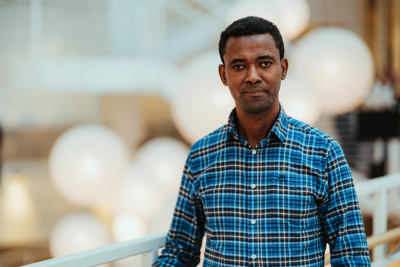
Gebremariam Assres is an Associate Professor at Kristiania University College's School of Economics, Innovation and Technology, specializing in software engineering, human-computer interaction, intelligent systems, and cybersecurity. His research spans IoT, machine learning, mulsemedia, and secure computing applications in healthcare and education. B.Sc. and M.Sc. in Computer Science from Addis Ababa University Ph.D. in Information Technology (Software Engineering) from Addis Ababa University 20+ years of teaching and research experience His work focuses on software development frameworks, telemedicine, and multisensory media. Recent publications address AI-enabled vulnerability detection, ML software engineering challenges, and telemedicine architecture reviews. Dr. Assres supervises bachelor's and master's students, teaches cybersecurity and software architecture courses, and contributes to open-source educational materials via public repositories. Labs/Teams: Mobile Technology Lab at Kristiania University College
Vegard Gjerde is a Research Fellow in the Department of Physics and Technology at the University of Bergen. His research focuses on physics education, specializing in cognitive learning strategies, peer instruction methodologies, and retrieval practice applications in STEM education. He investigates how structured learning interventions, including mandatory retrieval tests and short instructional videos, enhance conceptual understanding in physics. His work examines threshold concepts in atmospheric physics and digital learning adaptations during pandemic disruptions. Dr. Gjerde has presented on cognitive learning strategies at multiple international conferences, including the Teachers' Day 2024 in Bergen and IMPEL seminars. He leads the PAFYS project (Principle-based active teaching for stronger physics students), developing evidence-based physics pedagogy.
Elena Pérez is an Associate Professor in Drama and Theatre at NTNU's Department of Art and Media Studies, currently leading bachelor and master programs. She holds a PhD in Drama and Theatre from NTNU, a M.A. from Simon Fraser University, and a B.A. in English Literature from Complutense University Madrid. She conducted research at UC Berkeley (2009-2010) and worked as Artistic Director at Trondheim Kunstforening (2016-2020). Her research focuses on performance studies, digital media integration in theatre, sustainability, and ecotheatre. Notable projects include Turning it Sustainable (2023) and Interactivity and Togetherness in Digital Theatre (2022). She teaches courses like Environmental Humanities and Performance Theory, emphasizing sustainability and innovation. Education: PhD (NTNU), MA (Simon Fraser), BA (Complutense University Madrid) Research Projects: Collaborations with Bæredygtig Scenekunst NU and Ellen Foyn Brunn Teaching: Focus on Sustainability in Theatre, Digital Storytelling, and Entrepreneurship Her work bridges performance studies with ecological and technological challenges, advocating for the transformative potential of the arts. Recent articles address sustainability in theatre education and digital tools' role during the pandemic.
Svein Erik Bratsberg is a Professor at the Norwegian University of Science and Technology (NTNU) in the Department of Computer Science, Faculty of Information Technology and Electrical Engineering. His research focuses on databases, distributed systems, and high-velocity big data. Current Affiliation: NTNU/IDI Research Focus: Velocity in Big Data, Scalable Indexing, Structured Queries Previous Affiliation: Clustra (real-time databases) Research Centers: SFI iAD (2007-14), SFU Excited He has developed next-generation search engines and optimized distributed inverted indexes. His work includes entity linking, query processing, and dynamic optimization of pivot-based indexing systems. Scientific awards are not documented in the provided text. His recent publications focus on entity search, query processing techniques, and distributed retrieval architectures. Courses: TDT4145 Data Modeling, TDT4225 Distributed Data Volumes, TDT02 Distributed Systems Contact: sveinbra@ntnu.no
Professor Lars Kyte serves at the Department of Health and Caring Sciences , Western Norway University of Applied Sciences. He is actively involved in teaching Anatomy, Physiology, Biochemistry, Microbiology (subject responsible for SYKF130) and Pathology and Pharmacology (subject responsible for SYKF140) across multiple semesters. Academic Focus: Medical education pedagogy and digital learning tools Recent Research Themes: 2024 publications emphasize educational video development, vocational rehabilitation coordination, and hybrid learning methods.
Thomas Peter Plagemann is a Professor in the Department of Informatics at the University of Oslo , specializing in Data and Knowledge Systems . His research focuses on data stream processing , sensors and AI for health , Internet of Things , and mobile network applications . Current projects: Parrot (Privacy Engineering for IoT), Respire (Explainable ML for Sleep Disorders), and TRAMP (Real-Time Application Mobility) Editorial leadership: ACM Transactions on Multimedia Computing and past roles at Computer Communications and Multimedia Systems Recent publications analyze operator migration in stream processing , explainable AI for pediatric sleep apnea , and privacy-preserving healthcare systems . His work combines distributed computing , sensor networks , and machine learning applications in medical and mobile environments.
Dominique Heyler is an Assistant Professor in the Department of Language and Literature at NTNU. Her work focuses on digital learning tools and language education, particularly through projects like LearnNo and the LearnNow platform . She has collaborated extensively with colleagues across disciplines to develop educational technologies. Her outreach activities include organizing the FRANOR initiative (French for Norwegian Students) at ISL, NTNU, highlighting her commitment to multilingual education. While no formal student advisees are listed, her research emphasizes collaborative projects with institutions like ISL and academic networks. Though no formal awards are mentioned, her contributions to digital pedagogy reflect innovative approaches in educational technology. Her work spans academic publications, outreach events, and applied research in language learning environments.
Tor Jarle Wergeland is an Associate Professor in the Department of Visual Arts and Drama at the University of Agder, Norway. His academic work bridges visual arts, digital storytelling, and educational innovation, with a strong focus on creative processes in teaching and learning. Research Interests: Visual Arts Education Digital Storytelling Integration of Artificial Intelligence in Art Creative Workshops and Formative Assessment Educational Technology in Art and Craft His recent publications reflect a consistent engagement with digital tools in art education, particularly in exploring how AI can function as a co-creator. He investigates collaborative cultures, assessment practices, and the transformation of traditional artistic methods through digital media. His work often appears in educational anthologies and institutional publications. Scientific Contributions: Active contributor to the ProDig project on digital tools in art and craft education. Regular publications on digital storytelling, formative assessment, and creative digital practices. Emphasis on practical, workshop-based, and student-centered pedagogy. Wergeland has collaborated with colleagues such as Tor Jørund Føreland Pedersen and Cornelia Brodahl, and his work is disseminated through the University of Agder’s Cristin repository. He has no listed scientific awards, and no information is available about students he may have supervised. He maintains an active academic profile with recent outputs extending into 2025.