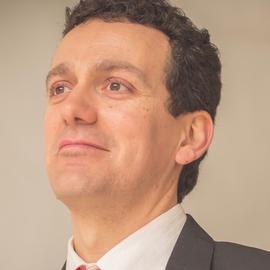
Fernando Romera Galan , born in 1967 in Ávila, Spain, is a university professor, poet, and literary researcher at the Catholic University of Ávila (UCAV), where he works in the Faculty of Humanities and Education. He holds a PhD in Philology from the UNED with the thesis Urban Space in Autobiographical Writing , and has delivered lectures in California, Missouri, and Oxford. Doctorate in Philology, UNED Bachelor's Degree in Hispanic Philology, University of Salamanca Romera's research focuses on autobiographical writing , urban space symbolism , and literary identity . His poetic work explores themes of postmodern existence , personal history , and cultural memory , influenced by French poets like Philippe Jaccottet. His publications bridge literary theory and creative practice, with notable monographs on Ávila's literary heritage and Hemingway. Scientific Awards : Joaquín Benito de Lucas National Poetry Prize National Narrative Award from Ávila Press Association Educational Innovation Award from Castile and León Government Knight of the Pontifical Order of the Holy Sepulchre of Jerusalem (2025) He has received international recognition through anthologies like 50 Contemporary Poets of Castile and León and Las palabras de paso . Romera operates the online literary journal Falsirena and collaborates with research institutions including the Gran Duque de Alba Research Institution and UNED's Literary and Theatrical Semiotics Research Center. His academic career spans multiple continents, with teaching engagements in Europe and the Americas.
Jose A. Ruiperez Valiente is an Associate Professor at the Information and Communications Engineering Department of the University of Murcia. His academic journey includes a B.Eng. and M.Eng. in Telecommunications, followed by an M.Sc. and Ph.D. in Telematics from UC3M, with research conducted at IMDEA Networks. He completed research stays at MIT and the University of Edinburgh, and a postdoc at MIT Teaching Systems Lab/Playful Journey Lab. He has held academic appointments at Complutense University of Madrid and industry roles at Multimedia Vocento, Accenture, and ExoClick. Current role: Associate Professor, University of Murcia Previous institutions: UC3M, IMDEA Networks, MIT, University of Edinburgh, Complutense University of Madrid Industry experience: Multimedia Vocento, Accenture, ExoClick His research focuses on computational social science, educational technology, cyberdefence, and data science. Key methodologies include learning analytics, game-based assessment, and serious games for skill evaluation. Recent publications analyze trends in educational technology, develop frameworks for game-based assessments, and explore disinformation detection. His work combines machine learning with educational innovation, particularly in stress detection and competency evaluation through biometric data. Scientific awards include: BBVA Award as Outstanding Young CS Researcher Humboldt Research Fellowship He has co-authored over 100 publications with 2100+ citations and participated in 20+ funded projects like DEFENDER, SEMANTIC, and EU-GUARDIAN, focusing on cybersecurity training and decentralized AI systems.
Abdulmotaleb El Saddik is a University Research Chair and Professor at the University of Ottawa's School of Electrical Engineering and Computer Science. He holds prestigious fellowships including Fellow of the Royal Society of Canada, Canadian Academy of Engineering, Engineering Institute of Canada, and IEEE Fellow. He directs two research laboratories: the Multimedia Communications Research Laboratory (MCRLab) and the Distributed & Collaborative Virtual Environments Research Laboratory (DISCOVER). Research Interests: His work focuses on multimedia computing, communications, and applications. This includes advanced multimedia systems design, network architectures, and innovative applications of multimedia technologies. His research bridges theoretical foundations with practical implementations in telecommunications and computer engineering. Awards & Recognition: Fellow of the Royal Society of Canada Fellow of the Canadian Academy of Engineering Fellow of the Engineering Institute of Canada IEEE Fellow Labs & Teams: Leads MCRLab and DISCOVER labs, which specialize in multimedia systems, virtual environments, and collaborative technologies. These labs drive interdisciplinary research with industry and academic partners globally.
José Ignacio Olmeda Martos is a Professor at the Computer Science Department of the University of Alcalá, Spain. His research focuses on artificial intelligence, neural networks, financial modeling, and applications in tourism and e-learning. He leads the CSRG-UAH Cognitive Science Research Group and the AUDITAI Group for AI Software Development. He earned his Ph.D. in 1996 with a thesis on nonlinear financial models under Dr. Sergio Barba-Romero. His work bridges computational methods with real-world challenges in finance, tourism, and education. Research interests include predictive analytics, algorithmic optimization (genetic algorithms, SOMs), and accessibility in digital systems. His contributions span hybrid models in credit scoring, volatility forecasting using neural networks, and e-commerce adoption analysis. Over 25 years, he has published extensively on topics like tourism demand prediction (PLAZA project), web accessibility metrics, and financial market predictability. Key projects include developing internet-based tourism reservation systems for Castilla-La Mancha and applying wavelet filtering in financial time series. His research emphasizes interdisciplinary applications, integrating AI with tourism management and financial engineering. Education: Ph.D., Universidad de Alcalá, 1996 Publications reflect his expertise in computational finance, tourism technology, and machine learning. Despite no listed awards, his work demonstrates sustained impact in both academic and applied domains. Advising and grant activities are not detailed in the provided texts.
Dr. Juan Manuel Sáez Martínez is a full professor in the Department of Computer Science and Artificial Intelligence at the University of Alicante's Higher Polytechnic School II. With a PhD in Computer Engineering and over two decades of academic experience since 2000, he specializes in Computer Vision and Mobile Device Applications for accessibility, particularly for the blind and visually impaired. His groundbreaking NaviLens project—a digital signage system patented internationally by the University of Alicante and licensed to Neosistec SL—represents a significant contribution to assistive technology. Teaching experience across 15+ years in programming fundamentals, computer systems, and internships for telecommunications and multimedia engineering Supervised one PhD thesis on structural similarity in object recognition Active in public research projects including airport navigation systems and airborne obstacle detection for the visually impaired His research interests focus on computer vision algorithms , stereo-based wearable devices , and ultra-efficient artificial vision systems for mobile platforms . Recent work includes biomedical informatics applications like 3D obstacle detection and accessibility-oriented UI design. He has participated in 10+ competitive public research projects (2016-2021) while contributing to technology transfer initiatives. Teaching contributions include 4 quinquennials (five-year terms) and 14+ years of instruction in Programming Fundamentals I for Telecommunication Sound and Image Engineering. Notable collaborations include co-authorship with Dr. F. Escolano on entropy-based SLAM algorithms and Gaussian mixture models for image processing. Current research emphasizes practical applications through the Mobile Vision Research Laboratory (MVRLab) .
Roberto Rodriguez-Echeverria is an Associate Professor at the Computer Languages and Systems Department of the Universidad de Extremadura (Spain). He leads the Applied Informatic Technology Institute and co-founded MetrikaMedia, a SaaS company for multimedia content measurement. His research focuses on software engineering, model-driven engineering, machine learning, and legacy system modernization. Education: Bachelor and Master in Computer Science (2000), Universidad de Extremadura Master on Education and IT (2012), Universitat Oberta de Catalunya PhD in Computer Science (2014), Universidad de Extremadura Research interests include data-driven software development, medical image segmentation using SAM models, and educational technology applications like chatbot performance analysis in exams. He explores reproducible data science workflows and hybrid recommendation systems for media. Recent work highlights include advancing loss function analysis for COVID-19 lung scans and developing cost-efficient medical image segmentation techniques leveraging SAM's zero-shot capabilities. He also studies the impact of AI tools like ChatGPT on academic assessment methods. His contributions span over 50 publications since 2004, with recent focus on smart city applications, cloud cost estimation, and cooperative social process modeling. Rodriguez-Echeverria's work bridges theoretical computer science with practical industry solutions through his lab's applied research initiatives. Labs/Teams: Applied Informatic Technology Institute (Director) i3 Lab (Affiliated)
Mari Carmen Suárez-Figueroa is an Associate Professor at the Artificial Intelligence Department, School of Computer Science, Universidad Politécnica de Madrid (UPM). She is also a senior researcher at the Ontology Engineering Group (OEG). Her research focuses on Ontology Engineering, Semantic Web, and Linked Data, with emphasis on ontology networks, evaluation, and design patterns. She holds a PhD in Artificial Intelligence from UPM (2010) and has been recognized with an Outstanding Award from UPM's Graduate Doctorate Commission. Her work includes contributions to methodologies like the NeOn Framework, tools such as OOPS! for ontology validation, and participation in projects like NeOn, SEEMP, and Ready4SmartCities. She has organized conferences and workshops, including TKE 2012 and WOP 2012. Over 88+ publications span journals like International Journal of Information Technology & Decision Making and Data & Knowledge Engineering . Key achievements include co-editing Ontology Engineering in a Networked World (Springer, 2012) and leading interdisciplinary initiatives on inclusive consumer testing and semantic metadata standards. Ongoing projects address social inclusion via machine learning and educational service-learning programs.
Roger Espasa Sans is a senior academic and researcher at the Universitat Politècnica de Catalunya (UPC), affiliated with the Faculty of Informatics of Barcelona (FIB) and the Department of Computer Architecture. He has made significant contributions to computer architecture, particularly in vector processing, GPU design, and performance optimization. Universitat Politècnica de Catalunya (UPC) Faculty of Informatics of Barcelona (FIB) Department of Computer Architecture His research focuses on advanced computer architecture, including vector and superscalar processors, memory systems, instruction-level and data-level parallelism, GPU microarchitecture, and performance modeling. His work bridges theoretical design and practical implementation, especially in high-performance and embedded systems. The recent articles highlight a strong trend in GPU and shader optimization, memory redundancy elimination, and performance modeling. His publications span prestigious venues such as IEEE Microarchitecture Symposium, IEEE HPCA, and The Visual Computer, indicating sustained impact in the field of computer systems and architecture. Premiada (Awarded activity) Roger Espasa Sans has advised several doctoral students, including Manel Fernandez Gomez and Francisca Quintana Domínguez, contributing to the next generation of computer architects. His collaborative network is extensive, involving key figures like Mateo Valero and international institutions. While specific grants are not listed, his prolific output suggests sustained funding. He has contributed to major research groups such as CAP (High Performance Computing Group). He is a core member of the CAP - Grup de Computació d'Altes Prestacions (High Performance Computing Group), and has also been associated with PM - Programming Models and ARCO - Microarchitecture and Compilers. His work often involves simulation frameworks like JINKS and Asim, indicating a strong focus on performance evaluation and modeling.
Antonio Garrido del Solo is a Professor in the Department of Computer Systems at the School of Computer Engineering, University of Castilla-La Mancha (UCLM). He has been affiliated with UCLM since 1986, becoming a Catedrático (Full Professor) in the area of Computer Architecture and Technology (ATC) in 2003. He served as Director of the School of Engineering at UCLM (2000-2008), Director of the Information Technology section at the Regional Development Institute (IDR) of UCLM (1996-2000), and Deputy Director of the Informatics Department at UCLM (1993). Professor Garrido earned his Licentiate in Physical Sciences from the University of Granada in 1986 and his Doctorate from the University of Valencia in 1991. Since 1993, he has been the co-founder of the High-Performance Networks and Architectures (RAAP) research group at UCLM, which currently includes 23 doctors. His academic leadership includes heading the Computer Architecture and Technology area from 2008 to 2021. His research interests span wireless networks, multimedia communications, video transcoding, software-defined networking, edge computing, and energy efficiency in networks. Professor Garrido has focused on digital image processing, broadband video transmission, video transcoding, and multimedia data transmission over wireless networks. His recent work demonstrates a strong emphasis on software-defined networking applications for wireless LANs, particularly in multicast transmission, load balancing, and energy efficiency. His publication record shows a clear evolution from video transcoding and wireless communications to software-defined networking and edge computing. The past decade reveals a significant shift toward SDN-based solutions for wireless networks, with particular attention to quality of service, resource allocation, and energy efficiency in enterprise WLAN environments. His work often combines theoretical networking principles with practical implementations for real-world applications. Professor Garrido has been deeply involved in university quality evaluation since 2000, serving as an external evaluator for Spain's National University Quality Evaluation Plan (PNECU), ANECA's Evaluation Plan (PEI), and multiple ANECA programs including VERIFICA, MONITOR, and ACREDITA. Since 2018, he has been a member of the EURO-INF seal commission, which he has chaired since 2022. He has also collaborated with regional quality agencies (ACCUEE, AQUIB, DEVA) in evaluating university programs and faculty. His research has been supported by numerous competitive research projects, including MECODIVI (2018-2021), excellence networks in computer architecture and advanced communications (2017-2019), and multiple projects focused on multimedia content delivery, wireless sensor networks, and energy management systems. He has led the RAAP research group for nearly three decades, securing funding from both regional and national sources. Professor Garrido co-founded the RAAP (High-Performance Networks and Architectures) research group at UCLM in 1993, which has grown to include 23 doctors. The group has maintained a consistent research focus on network architectures, wireless communications, and multimedia systems, while adapting to emerging technologies like software-defined networking and edge computing. Their collaborative approach has resulted in numerous publications in top-tier networking journals and conferences.
Francesc Alías Pujol is a Professor at the Department of Engineering, Ramon Llull University (La Salle Campus Barcelona), where he also serves as Director of Teaching and Research Staff Policies since September 2019 and coordinates the PhD Program in Information Technologies since February 2022. He is a researcher in the Human-Environment Research (HER) group, focusing on speech and acoustic signal processing for natural human-machine interaction. His educational background includes: BSc in Telecommunications Engineering (1997) MSc in Electronics Engineering (1999) PhD in ICT and their application in Management (2006) MBA in Business Administration (2013) University Expert Program in Digital Transformation (2023) Dr. Alías's research primarily focuses on signal processing, with special emphasis on speech and acoustic signal processing to achieve natural interaction between humans, machines, and their environment. His work spans from Text-to-Speech (TTS) synthesis to vocal biomarkers for digital health applications, numerical voice simulation, and environmental acoustics. He has developed expertise in expressive speech analysis and synthesis, sound source identification, and smart city applications through wireless acoustic sensor networks. His publication record shows a consistent trajectory in speech and acoustic processing, with recent work focusing on the impact of global events like the COVID-19 pandemic on urban soundscapes, advanced techniques for glottal source analysis, and the development of algorithms for anomalous noise event detection in smart city applications. His research bridges theoretical signal processing with practical applications in environmental monitoring and human-computer interaction. Dr. Alías has received numerous scientific awards including: 3rd six-year research merit (2018-2023) from AQU Catalunya Most cited paper in Noise Mapping (2021) for his work on COVID-19's impact on urban noise 2nd six-year research merit (2012-2017) from AQU Catalunya Best academic record award for his MBA (2013) Multiple best paper awards from the Spanish Thematic Network on Speech Technology He has led and participated in numerous research projects including DISTRESIA (stress biomarker identification), FEMVoQ (3D voice simulation), SUARAMAP (acoustic monitoring for dementia detection), GENIOVOX (expressive voice generation), and DYNAMAP (dynamic noise mapping). His work has been supported by various funding bodies including the European Commission, Spanish Ministry of Science, and Catalan Government. As coordinator of the PhD Program in Information Technologies and former Director of the Department of Engineering (2014-2021), Dr. Alías plays a significant role in academic leadership at La Salle-URL. His research group focuses on the intersection of speech processing, environmental acoustics, and smart city applications, contributing to both theoretical advancements and practical implementations in these fields.
Dr. Pedro Antonio Palmer Rodríguez serves as Senior Lecturer in the Department of Informatics Engineering at the University of the Balearic Islands' School of Mathematics and Computer Science. With continuous service since 1993, he teaches core theoretical and practical computer science subjects across multiple campuses including Majorca, Ibiza, and Minorca. His research focuses on multimedia technologies with specializations in: Image synthesis and deformable object representation Mobile and television application development Social media content analysis systems Algorithmic language implementations As an active member of both the Multimedia Information Technology (TIM) and Computational Biology and Bioinformatics (BIOCOM) research groups, he bridges theoretical computer science with practical multimedia applications. His current teaching portfolio emphasizes compilers, theory of computation, and final degree projects across various Informatics Engineering programs. Dr. Palmer Rodríguez maintains regular office hours in Anselm Turmeda building (Room 142) and supervises student research through the university's Informatics Engineering programs. His academic journey includes completing both undergraduate and doctoral studies at UIB, with his PhD awarded in 2014 after two decades of teaching experience.
Dr. Sergi Jordà is a Senior Researcher and Associate Professor at the Music Technology Group of Universitat Pompeu Fabra (UPF) in Barcelona. He obtained his B.S. in Fundamental Physics (1986) and PhD in Computer Science and Digital Communication (2005) from UPF. He leads the Music & Advanced Interaction (MAIn) team and teaches courses in Computer Music, Audio Signal Processing, Human-Computer Interaction (HCI), and Interactive Media. In 2011, he joined the tenure-track faculty at UPF. Research Interests Jordà's research focuses on the intersection of Human-Computer Interaction (HCI) and tangible musical interfaces , including applications in education, collaborative music creation, and brain-computer interfaces . His work explores how tabletop interfaces and visual feedback can enhance intuitive instrument design and real-time performance. He is best known for co-inventing the Reactable , a tangible tabletop musical instrument that gained global recognition after being used by Icelandic artist Björk in her 2007-08 world tour. Scientific Awards Prix Ars Electronica Golden Nica (2008) MIDEM Hottest Music Biz Start-Up Award (2008) Yellow Pencil, D&AD Design Awards (2008) Rolling Stone Magazine's Hot Instrument of the Year (2007) Premi Ciutat de Barcelona (1999, 2007) Möbius International Award (2001) Innova Business Ideas Contest (2008) Projects and Grants He has participated in over 30 international scientific committees, including chairing TEI'13 (Tangible, Embedded and Embodied Interaction Conference) . Jordà has secured funding from the European Commission and Spanish government for six research projects, two as Principal Investigator (IP). In 2009, he co-founded the spin-off company Reactable Systems , which launched Reactable Mobile for iOS devices in 2010.
Mònica Rius Piniés is a Senior Lecturer in the Section of Arabic Studies at the University of Barcelona, where she serves as director of the ADHUC Research Centre for Theory, Gender, and Sexuality and holder of the UNESCO Chair Women, Development and Cultures. She coordinates the consolidated research group Women's Creation and Thought (2021 SGR 01097) and contributes to the International Research Network World Gender. Education: Not explicitly detailed Affiliations: University of Barcelona, ADHUC, UNESCO Chair, World Gender Network Her research spans gender studies, cultural analysis, postcolonial literature, and historical science. Key areas include: Arab women's writing in diaspora contexts Qibla orientation and medieval Islamic astronomy Postcolonial translation dynamics Science-religion intersections in Western Islam Cultural memory in Andalusian science Technology-enhanced Arabic language pedagogy Recent publications examine: 2021: Translation politics in Mediterranean Maghrebi-Spanish literary exchange 2020: Scientific legacy of Muslim Iberia 2018: Utopian frameworks in exile literature 2014: Architectural astronomy in Morocco 2012: Arab identity in film and feminism 2009: Medieval Islamic knowledge circulation
Arturo Azcorra is a Full Professor at the University Carlos III of Madrid in the Telematics Engineering Department and serves as Director of the IMDEA Networks Institute . His career spans academic leadership and research in network architectures, communication protocols, and wireless technologies. Full Professor at Universidad Carlos III de Madrid (since 1998) Director of IMDEA Networks Institute (since 2006) Senior Member of IEEE Communications Society Research Interests: His work focuses on network architectures, communication protocols, wireless and mobile networks, peer-to-peer systems, and energy-efficient networking. Current projects include 5G network slicing, microsleep techniques for WiFi, and collaborative file distribution systems. Publications Trends: Recent articles address 5G network optimization, energy-efficient protocols, ad traffic filtering systems, and multicast video delivery mechanisms. His research combines theoretical modeling with practical implementations in real-world network environments. Scientific Awards: IEEE Communications Society Senior Member President of the Association for Telematics Academic Leadership: He has held significant administrative roles including Deputy Vice-Provost and Department Director at UC3M. Currently supervises the NETCOM Research Group and collaborates with IMDEA Networks .
Carlos José Villagrá Arnedo is a full-time Professor in the Department of Computer Science and Artificial Intelligence at the University of Alicante, where he has been employed since 1999. He holds a PhD in Computer Engineering (2016) and a Bachelor's in Computer Science from the Polytechnic University of Valencia (1994). He coordinates the Digital Creation and Entertainment program and previously served as Head of Studies for Multimedia Engineering. His research integrates Artificial Intelligence , Educational Technology , and Game-Based Learning , with specific focus areas including learning analytics, adaptive educational systems, programming pedagogy, and accessibility in gaming. Recent work explores mental model analysis using AI and low-level programming approaches to enhance learning outcomes. His publications demonstrate a consistent emphasis on predictive learning models, educational gamification, and inclusive technology design. Key trends include AI-driven analytics (2020-2024), programming error analysis (2018-2023), and accessible game development (2017-2019). Research Projects: Integrating Adaptive Flipped Learning in Physical Education Students (2024-2025) Smart Learning Research Group (2024) Semantic Web for Cultural Heritage (2019-2021) European Collaborative Learning for Robot Skill Acquisition (2016-2018) He has directed or co-directed 75+ undergraduate/master's theses in the last five years and leads the Smart Learning Research Group focused on intelligent educational technologies.