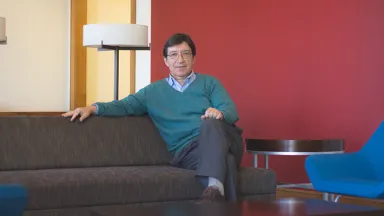
Subhadip Chakrabarti is a Lecturer in Economics at Queen's Business School, Queen's University Belfast. He holds a PhD from Virginia Polytechnic and State University (USA). His research focuses on microeconomic theory, game theory, operations research, and telecommunications policy. He teaches game theory and introductory macroeconomics, and serves as Examination Officer for Economics Programmes. Research Interests: Dr. Chakrabarti explores networks, industrial organisation, cooperative/non-cooperative game theory, and policy-related issues in telecommunications. His work integrates theoretical frameworks with practical applications in strategic decision-making and market structures. Teaching: He contributes to foundational courses in economics, emphasizing analytical rigor and real-world relevance. Professional Activities: As Examination Officer, he oversees academic standards and assessment processes in the Economics Department.
Federico Ciliberto is an Associate Professor in the Department of Economics at the University of Virginia, with additional affiliation as a DIW Fellow in the Department of Firms and Markets at Deutsches Institut für Wirtschaftsforschung (DIW Berlin). His research spans industrial organization, agricultural economics, and transportation economics, with a significant focus on the airline industry. His research interests include industrial organization with emphasis on airline market competition, econometric modeling of market structure, agricultural economics focusing on genetically engineered crops, and the application of game theory to market behavior. His work often combines sophisticated econometric techniques with detailed industry data to analyze complex market dynamics. Ciliberto's publication record shows a strong concentration in top economics journals, with a notable shift toward agricultural economics in recent years while maintaining his expertise in airline industry analysis. His research demonstrates consistent methodological rigor, often employing structural econometric models and large-scale datasets to address questions of market competition, innovation valuation, and policy impacts. His work has appeared in premier journals including Journal of Political Economy, Review of Economic Studies, Econometrica, RAND Journal of Economics, and Science Advances, reflecting both the theoretical and empirical strength of his research contributions across multiple subfields of economics. Ciliberto has maintained active research collaborations with scholars from various institutions, producing work that bridges theoretical economics with practical policy implications, particularly in regulated industries and agricultural technology adoption.
Ahmed Khwaja is a Professor of Marketing, Business & Public Enterprise at the Judge Business School, University of Cambridge . His work bridges theoretical rigor with practical applications in market dynamics, healthcare systems, and social enterprises in emerging economies. Academic Affiliation: Judge Business School, Cambridge Highest Degree: PhD from University of Minnesota Research Interests: His primary focus lies in marketing strategy and quantitative marketing , with emphasis on: Structural modeling of healthcare markets (moral hazard, adverse selection) Pharmaceutical R&D dynamics and alliance impacts Employee-customer satisfaction linkages Retail chain expansion and market dominance Double bottom-line challenges in social enterprises Econometric methods: matching estimators, dynamic games, reinforcement learning Publication Trends: His research spans healthcare economics, retail dynamics, and econometric methodologies. Recent work (2025) analyzes ACA policy impacts on willingness-to-pay, while earlier studies explore topics like medication adherence, retail expansion, and behavioral economics of smoking. The majority of his 2018 publications focus on market entry spillovers, employee engagement impacts, and pharmaceutical innovation patterns.
Matthew S. Lewis is a Professor in the John E. Walker Department of Economics at Clemson University’s Wilbur O. and Ann Powers College of Business. He specializes in industrial organization, focusing on energy and healthcare markets. His research examines gasoline market competition, price dynamics, consumer search behavior, and healthcare system consolidation effects. He holds a Ph.D. from the University of California, Berkeley (2004) and an A.B. from the University of Illinois, Urbana-Champaign (1998). Research interests include energy economics, healthcare economics, and industrial organization. He has published over 20 articles in top journals like the Journal of Political Economy, RAND Journal of Economics, and International Journal of Industrial Organization. Notable awards include the Paul Geroski Best Paper Award (2013) and Senior Scholar Research Awards (2024). He advises numerous Ph.D. students and serves as Associate Editor for the International Journal of Industrial Organization. His work has been featured in media outlets such as the New York Times, Wall Street Journal, and National Public Radio.
Prof. Dr. Catherine Roux is a Professor of Industrial Organization at the Faculty of Business and Economics, University of Basel. She leads the Professorship of Industrial Organization and conducts research at the intersection of theoretical and experimental economics, with applications in antitrust, competition policy, and energy markets. Her work is widely published in leading journals such as American Economic Journal: Microeconomics , International Economic Review , and Journal of Law and Economics . University of Lausanne Copenhagen Business School Paris 1 Panthéon-Sorbonne University University of California, Berkeley Her research interests include collusion (multimarket contact, information exchange, leniency programs), exclusionary practices, mergers, intellectual property, and energy markets. She has a special interest in laboratory and lab-in-the-field experiments to test theoretical models. Her work often explores how market design, transparency, and behavioral constraints affect firm behavior and consumer choices. Her recent publications reveal a strong trend toward integrating behavioral insights with industrial organization, particularly in energy markets and innovation. She frequently employs experimental methods to examine strategic interactions, cartel stability, and policy effectiveness. Her work bridges theoretical rigor with empirical validation, contributing significantly to both academic discourse and policy design in competition and sustainability domains. Multigame Contact: A Double-Edged Sword for Cooperation (2024, AEJ: Micro ) Communication and Market Sharing: An Experiment on the Exchange of Soft and Hard Information (2021, International Economic Review ) Hunting Unicorns? Experimental Evidence on Exclusionary Pricing Policies (2019, Journal of Law and Economics ) Shared Ownership of Intangible Property Rights: The Case of Patent Coassignments (2017, Journal of Legal Studies ) Leniency Programs for Multimarket Firms: The Effect of Amnesty Plus on Cartel Formation (2012, International Journal of Industrial Organization ) Prof. Roux advises on competition policy and sustainable market design. She leads the Research Group Industrial Organization and is involved in the Research Network Sustainable Future, indicating active grant-supported research. Her collaborations with scholars across Europe and the US suggest a strong international research network and potential for future interdisciplinary projects. She leads the Research Group Industrial Organization at the University of Basel, fostering collaborative research on competition, market regulation, and experimental economics. Her involvement in the Research Network Sustainable Future highlights her commitment to interdisciplinary work on energy and sustainability challenges.
Dr. Shiva Sikdar is a Senior Lecturer in Economics at Keele University's Keele Business School. He holds a PhD from Iowa State University and previously taught at Yonsei University (South Korea) and the National University of Singapore. His research focuses on applied microeconomics, particularly the economics of discrimination, international trade policies, and strategic environmental policy. He uses game-theoretic approaches to analyze individual and governmental behavior, with recent work examining identity-blind hiring policies and non-cooperative environmental strategies. Dr. Sikdar currently coordinates Keele's Race Equality Lecture series and supervises PhD students in discrimination economics and strategic environmental policy. Education: B.A. and M.A. from the University of Calcutta, India, and a PhD from Iowa State University, USA. His research emphasizes policy analysis in discrimination mitigation, trade-environment interactions, and market collusion dynamics. Notable contributions include studies on carbon leakage, permit trading systems, and peer effects in diversity enhancement. Recent publications (2023) explore trade policies' environmental impacts and multimarket collusion strategies. His work bridges theoretical models with real-world policy implications, particularly in global environmental governance and labor market equity.
Robert Feinberg is a Professor in the Department of Economics at American University, where he has served since 1989, including terms as Department Chair from 1996 to 2000 and 2012 to 2013. He holds a PhD in Economics from the University of Virginia and a BA from the University of Pennsylvania. His research focuses on industrial organization, antitrust enforcement, international trade policy, and applied microeconomics. Feinberg's research examines competition policy and trade regulation through empirical analysis of antitrust cases, antidumping measures, and market behaviors. His recent work investigates multi-market competition dynamics, trade policy retaliation mechanisms, determinants of self-employment among PhDs, and the economic impacts of guaranteed income programs. His publication record demonstrates consistent focus on competition policy evolution, with recent articles analyzing state-level antitrust enforcement patterns, Canadian anti-cartel policies, and credit union competitive effects. His research employs both theoretical and empirical methodologies to examine market behaviors and regulatory impacts. Honors include: Fulbright Scholarship at University of Limerick American University's Award for Outstanding Scholarship (2006) Fellow of the International Journal of Industrial Organization Feinberg has held visiting positions at the International Institute of Management in Berlin, University of New South Wales, and World Trade Organization. He served as Program Director for Economics at the National Science Foundation and president of the Industrial Organization Society.
Constantinos Syropoulos is a Trustee Professor of International Economics in the School of Economics at Drexel University's LeBow College of Business. He is also a Research Network Fellow at CESifo in Germany. Previously, he held academic positions at Florida International University and Pennsylvania State University, establishing a long and influential career in economic research. His research expertise lies in International Trade , Political Economy , and the Economics of Conflict , with a recent focus on Economic Sanctions . His work integrates game theory, microeconomic modeling, and empirical analysis to examine trade agreements, customs unions, multimarket collusion, and the political economy of war and peace. The 15 most recent articles highlight a dominant trend in analyzing the economic and geopolitical impacts of sanctions , including database development, quantification of trade effects, and theoretical modeling of sanction dynamics. Other key themes include trade and insecurity , self-enforcing peace agreements , innovation contests , and tariff policy in regional trade blocs. His publications appear in top-tier journals such as the Journal of International Economics , Review of Economic Studies , and American Economic Review . Associate Editor, Journal of International Economics Guest Editor, Special Issue on "Economics Sanctions", European Economic Review Associate Editor, Journal of Evolutionary Economics Associate Editor, EuroMed Journal of Business Syropoulos has been involved in significant research collaborations, particularly with Michelle Garfinkel, Yoto Yotov, Gabriel Felbermayr, and Stergios Skaperdas. His work has informed public discourse, with recent media mentions in The New York Times and The Conversation discussing the limitations and risks of economic sanctions. While no formal grants are listed, his sustained research output and editorial roles suggest continuous funding and academic leadership. He has contributed to major handbooks such as The Oxford Handbook of the Economics of Peace and Conflict . He is associated with research teams focused on global sanctions data and trade in the shadow of conflict , working within collaborative networks that bridge economics, political science, and policy. His recent publications emphasize interdisciplinary approaches and data-driven policy analysis.