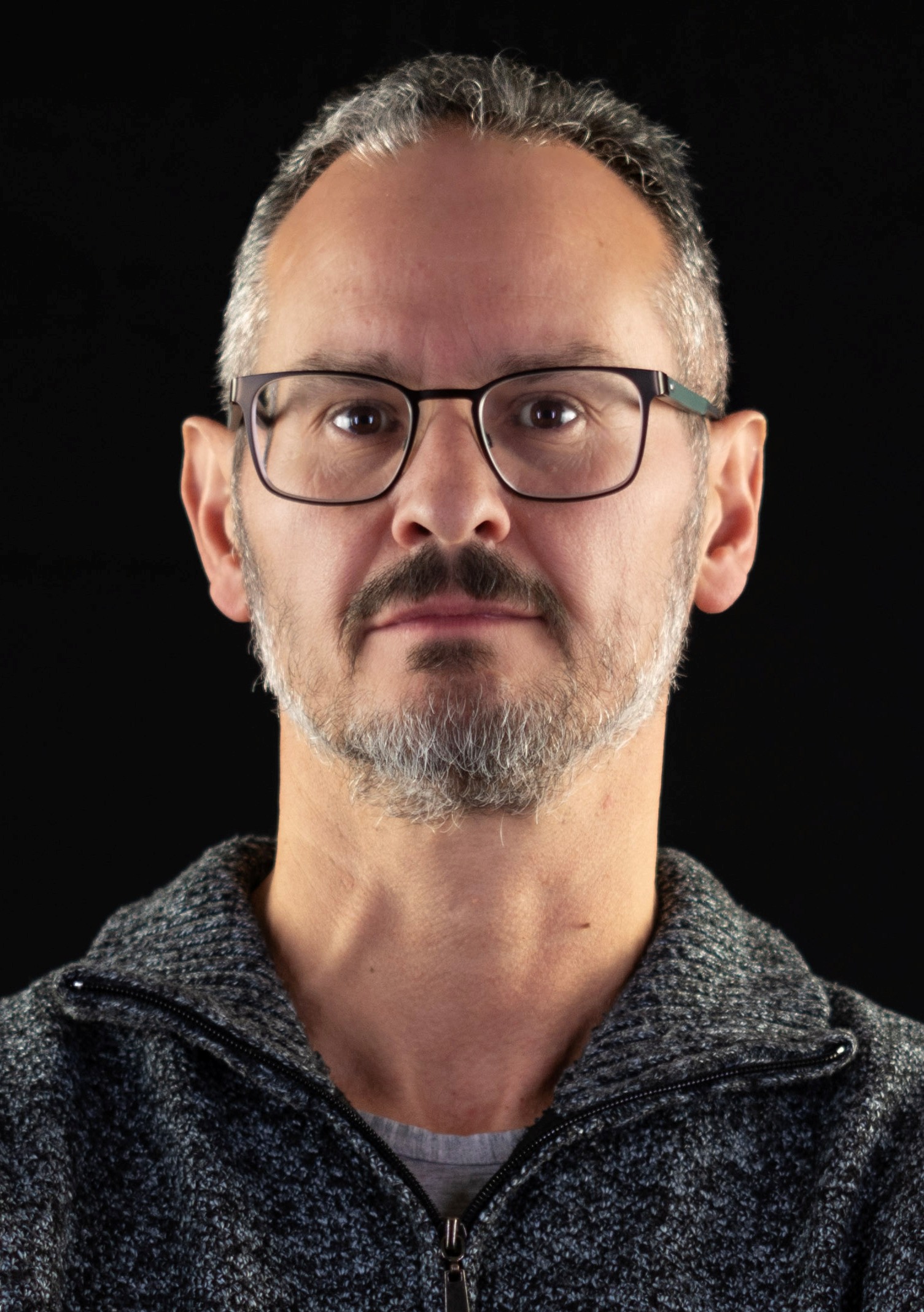
Giovanni Squillero is a Full Professor in the Department of Control and Computer Engineering (DAUIN) at Politecnico di Torino, Italy. He leads the CAD group (Electronic CAD & Reliability) and serves on Politecnico's Joint Committee for Teaching and Ph.D. Steering Committee (Pure and Applied Mathematics).
Dr. Vito Trianni is a researcher at the Institute of Cognitive Sciences and Technologies (ISTC-CNR) in Rome, Italy, with a focus on swarm robotics , collective intelligence , and bio-inspired algorithms . He collaborates with institutions like Sapienza University of Rome and Queen Mary University of London on projects involving decentralized decision-making, UAVs for precision agriculture, and self-organizing systems. His work bridges theoretical insights from natural systems (e.g., honeybee colonies) with practical robotic implementations. His research interests center on Designing collective decision-making systems for robot swarms Modeling psychophysical laws in superorganism behavior Autonomous construction using compliant materials Applications of swarm robotics to real-world challenges like agriculture Key trends in his publications include bio-inspired design, micro-macro dynamics, and decentralized cognition. Scientific awards include the Rosaria Conte Memorial Fellowship for interdisciplinary research. He has supervised PhD candidates like Luigi Feola and collaborated with researchers such as Andreagiovanni Reina and Marco Dorigo . Projects like DICE , SAGA , and BeesBook highlight his lab’s focus on experimental and theoretical robotics. Public outreach activities at events like Wired Next Fest 2015 and RomeCup demonstrate his commitment to science communication.
Eric Eaton is a prominent researcher in Computer Science, specializing in Artificial Intelligence, Reinforcement Learning, and Federated Learning. His work bridges theoretical advancements with practical applications in healthcare, robotics, and educational technology, as evidenced by his collaborations with institutions like the Vector Institute and co-authors such as Marcel Hussing and Amir-massoud Farahmand. Research Focus: Lifelong Learning, Object-Centric Representation, and Algorithmic Fairness Key Contributions: ELLA algorithm, Distributed Continual Learning frameworks, and AI integration in surgical video analysis His recent publications address critical challenges in high update ratio reinforcement learning, federated learning for surgical data, and ethical considerations in algorithmic fairness. These works highlight his interdisciplinary approach, combining AI with healthcare and education. Eaton's leadership in projects like FORLA and Slot-BERT demonstrates innovation in unsupervised learning and temporal coherence. His involvement in the CS2023 curriculum design underscores his commitment to advancing computer science education.
Edoardo Gaffeo is a Full Professor at the Department of Economics and Management, University of Trento. His expertise spans applied econometrics, corporate governance, financial economics, and macroeconomic policy, with a focus on financial networks, banking systems, and agent-based modeling. Email: edoardo.gaffeo@unitn.it Research Interests Gaffeo investigates financial stability, monetary policy transmission, and the role of interbank networks in economic fluctuations. His work bridges theoretical models (e.g., agent-based simulations) with empirical analyses of financial markets and institutions. Teaching He teaches Macroeconomia in both Economics and Mathematics departments, emphasizing macroeconomic theory, growth models, and European monetary union policies. Publication Trends Recent articles analyze interlocking directorates, financial accelerators, liquidity contagion, and auction mechanisms in NPL markets, reflecting his focus on systemic risk, banking behavior, and financial policy.
Fabio Carapellese is a Fixed-term Researcher at the Department of Mechanical and Aerospace Engineering (DIMEAS) at Politecnico di Torino. His research focuses on wave energy conversion systems, control engineering, and mechanical systems design. He is affiliated with multiple academic colleges at Politecnico di Torino: College of Chemical and Materials Engineering (as an Invited member) College of Management and Production Engineering (as an Invited member) College of Mechanical, Aerospace and Automotive Engineering (as a Member) Dr. Carapellese's research spans wave energy conversion, control systems, and mechanical engineering with applications in renewable energy. His work emphasizes: Design and optimization of wave energy converters including the SWINGO system Control systems for wave energy conversion with focus on anti-windup mechanisms and state constraints Multi-objective optimization of inertial wave energy converters Modeling of mechanical interactions in wave energy systems Integration of pendulum and gyroscopic effects for enhanced energy extraction His recent publications (2023-2025) demonstrate a consistent focus on advancing wave energy conversion technology through innovative mechanical designs and sophisticated control strategies. The research shows progression from theoretical modeling to experimental validation of wave energy systems, with particular attention to practical implementation challenges. Dr. Carapellese has contributed to several patents related to renewable energy technology, including: "Multifunctional gyropendulum and integrated WEC for wave energy production" (National and international patent) "Electricity generator" (National patent) As an educator, he serves as a Course Collaborator for multiple engineering courses at Politecnico di Torino, including Project Work in Manufacturing Technologies and Machine Mechanics in Materials Engineering, demonstrating his commitment to training the next generation of engineers in sustainable energy technologies.
Giampaolo Liuzzi is an Associate Professor at the Department of Computer, Automation, and Management Engineering 'Antonio Ruberti' (DIAG) at Sapienza University of Rome since July 2023. Previously, he was a fixed-term researcher at the same department (July 2020-June 2023) and a Senior Researcher at the Institute of Systems Analysis and Computer Science 'A. Ruberti' of the CNR until July 2020. He teaches Mathematical Programming, Complements of Mathematics, and Mathematical Analysis 2 for various engineering programs at Sapienza University. Dr. Liuzzi's research focuses on Nonlinear Optimization , particularly derivative-free methods for constrained and unconstrained optimization, global optimization, mixed integer nonlinear programming, and applications in operations research and machine learning. His work spans theoretical developments in optimization algorithms as well as practical applications in engineering design, simulation-based optimization, and biomedical systems. He has made significant contributions to derivative-free optimization techniques that don't require gradient information, which is particularly valuable for black-box optimization problems where derivatives are unavailable or expensive to compute. His recent publications (2022-2025) demonstrate a strong focus on advancing derivative-free optimization methods, with particular attention to complexity analysis, convergence properties, and practical implementations for challenging problem classes including nonsmooth, constrained, multi-objective, and mixed-integer optimization problems. His work bridges theoretical computer science with practical engineering applications, with publications appearing in top optimization journals like Optimization Methods & Software, Computational Optimization and Applications, and Journal of Optimization Theory and Applications. Dr. Liuzzi has received significant professional recognition through National Scientific Habilitations for both Associate Professor (2014) and Full Professor (2018) positions in Italy. He is actively involved in the academic community as an administrator of the Derivative-Free Library (DFL), a collection of algorithms and methods for derivative-free optimization developed through collaboration among several prestigious Italian research institutions. As an educator, Dr. Liuzzi has developed comprehensive teaching materials for courses in Mathematical Programming, Complements of Mathematics, and Mathematical Analysis. He is also engaged in academic entrepreneurship as a co-founder of DEIX s.r.l., a Sapienza startup focused on algorithms and industrial software for planning and control of complex systems. Additionally, he organized the 2nd Derivative-Free Optimization Symposium (DFOS'24) in June 2024 in Padua, highlighting his leadership role in this specialized optimization community.
Thomas Stützle is a Research Fellow at the Université Libre de Bruxelles (ULB) in Belgium, affiliated with the IRIDIA laboratory. His work spans Metaheuristics , Swarm Intelligence , and Stochastic Local Search , with a focus on algorithm design for Multi-objective Optimization and Automatic Algorithm Configuration . Education Diplom (M.S. equivalent) in Business Engineering from Universität Karlsruhe (TH), Germany (1994) PhD in Computer Science from Technische Universität Darmstadt, Germany (1998) Habilitation in Computer Science from Technische Universität Darmstadt, Germany (2004) He is co-author of foundational books on Stochastic Local Search: Foundations and Applications and Ant Colony Optimization , with over 200 highly cited publications. His editorial roles include Associate Editor for journals like Computational Intelligence and Swarm Intelligence , and positions on the editorial boards of seven additional journals. Scientific Awards IEEE Fellow Senior Research Associate at the Belgian Fund for Scientific Research (F.R.S.-FNRS) Stützle’s research is conducted within the IRIDIA laboratory at ULB, a hub for computational intelligence and metaheuristics. His contributions to algorithm engineering and optimization place him at the forefront of computational research communities.
Patrizia Scandurra is an Associate Professor at the Department of Management, Information and Production Engineering, University of Bergamo, Italy. Her academic appointment in Computer Science (01/B1) spans from 2022 to 2033. She previously held roles as a researcher at the University of Bergamo (2009-2017) and postdoctoral fellow at the University of Milan (2006-2008). She earned her PhD in Computer Science (2006) and Bachelor's degree (2002) from the University of Catania. Research Focus : Software architectures and formal methods for modeling, validation, and verification of software-intensive systems. Specializations : Runtime analysis of self-adaptive, autonomous, and uncertain systems including IoT-Edge-Cloud applications, embedded systems, and system-on-chip. Collaborations : STMicroelectronics, Atego, Bialetti, and ENEA. Conference Involvement : Program/organizing committees for ICSE, ASE, ISSRE, ICSA, ECSA, SEAMS@ICSE, ABZ, SA-TTA@SAC, FAACS@ECSA. Research Projects : Model-driven development for robotics, adaptive architectures for pervasive systems, big data in smart cities, and digital twins for medical systems. Notable Contributions : Development of the ASMETA formal method community tools and frameworks for rigorous system design. She has published over 100 peer-reviewed works in international journals and conferences.
Iacopo Colonnelli is an Assistant Professor (RTDA) at the University of Turin's Computer Science Department and a member of the Alpha Research Group (Parallel Computing) and CINI HPC Key Technologies and Tools lab. He has established himself as a leading researcher in scientific workflow systems, bridging cloud computing and high-performance computing environments. His research focuses on workflow modeling and management in heterogeneous distributed architectures, with significant contributions through open-source tools including StreamFlow (a container-native workflow management system), Jupyter Workflow, and CAPIO (middleware for I/O streaming). These tools enable hybrid workflows execution on cloud-HPC infrastructures and have gained recognition through multiple European projects and initiatives. Colonnelli's publication record shows consistent output in top venues related to parallel and distributed computing, with recent work focusing on federated learning, confidential computing, and workflow standardization. His most recent publications (2024-2026) demonstrate strong engagement with cutting-edge challenges in cross-facility federated learning, workflow representation languages, and performance evaluation of confidential computing for bioinformatics applications. Scientific Awards: ITADATA 2023 Best PhD Thesis Award for 'Workflow models for heterogeneous distributed systems' StreamFlow selected as one of the three exploitable results of the EUPEX European project (2023) StreamFlow selected as an exploring technology by the EC Innovation Radar initiative (2023) 'Distributed Workflows With Jupyter' selected as Fall 2022 Editor's Choice by Future Generation Computer Systems journal HPC-Europa3 grant recipient for Barcelona Supercomputing Center visit (2019) HiPEAC grant recipient for ACACES 2019 Summer School (2019) As an active contributor to research infrastructure, Colonnelli serves as a member of the CWL Technical Team and founder of the CWL4HPC Working Group. He has organized multiple international conferences including PDP 2025 as program chair and CWLCon 2024. His service extends to numerous program committees for major HPC conferences and journals, demonstrating his standing in the international research community. Colonnelli leads significant contributions to multiple European research projects including Space Center of Excellence, European Pilot, EUPEX, TEXTAROSSA, ACROSS, DeepHealth, and HPC4AI, focusing on advancing HPC and AI technologies for scientific applications.
Lucia Seminara serves as an Associate Professor in the Department of Naval, Electrical, Electronic, and Telecommunications Engineering (DITEN) at the University of Genoa's Polytechnic School. She teaches Electronic Devices, Sensors, and Sensing Systems for Master's programs in Electronic Engineering and Engineering for Natural Risk Management, while also contributing to Philosophy of Medicine for Philosophical Methodologies. As a member of the Joint Teacher-Student Commission, she bridges academic governance with pedagogical innovation in engineering education. Her research pioneers tactile sensing systems using piezoelectric polymers (PVDF) and electronic skin for robotics and prosthetics. She investigates indentation mechanics on soft electronic skin, grasping speed sensitivity, and hierarchical sensorimotor control frameworks for human-in-the-loop robotic hands. Key innovations include machine learning-based contact force estimation and electrotactile feedback systems that restore natural touch perception in prosthetic devices, addressing critical gaps in sensory substitution technology. Analysis of her 2021-2025 publications reveals escalating integration of machine learning with tactile sensing, particularly in symmetry detection for efficient haptic exploration and transdisciplinary human-in-the-loop applications. Recent work emphasizes real-world implementations like post-stroke rehabilitation systems and high-bandwidth human-machine interfaces, demonstrating a strategic shift from foundational sensor development toward clinically viable solutions with measurable user impact. Dr. Seminara's research lineage includes significant contributions to the Roboskin project (2013), which established large-area tactile sensor arrays for robotics. Her current work extends this foundation through investigations into viscoelastic properties, stress transmission modeling, and AI-driven tactile perception, positioning her at the forefront of intelligent electronic skin development with active collaborations across engineering, neuroscience, and clinical rehabilitation domains.
Raphael Zaccone serves as an Associate Professor in the Department of Naval, Electrical, Electronic and Telecommunications Engineering at the University of Genoa, where he is an active member of the department board. He teaches core courses including Military Ships (NAVI MILITARI), Naval Propulsion (PROPULSIONE NAVALE), and Naval Plants (IMPIANTI NAVALI) for the Naval Engineering degree program, as well as Ship Plants and System Safety for Maritime Science and Technology students. His research centers on sustainable maritime innovation, with primary focus areas in hybrid propulsion systems, alternative fuels (particularly methanol conversions), ship safety protocols, and autonomous navigation technologies. Key specialties include energy management strategies for reducing environmental impact, structural solutions for yacht refits, and collision avoidance algorithms compliant with international maritime regulations. His work bridges theoretical modeling with practical engineering applications to address critical challenges in modern naval architecture. Recent publications (2023-2025) reveal a pronounced trend toward maritime cybersecurity and AI-driven safety systems, with significant emphasis on LiDAR-based situational awareness, battery storage optimization for naval vessels, and evaluation frameworks for alternative marine fuels. Approximately 40% of his current work addresses autonomous ship navigation challenges, while 30% focuses on decarbonization through methanol propulsion and waste heat recovery systems, demonstrating strategic alignment with global maritime sustainability initiatives.
Michela Spagnuolo is a Research Director at the Italian National Research Council’s Institute of Applied Mathematics and Information Technology (CNR-IMATI-GE) since 2001. Her work bridges Computer Graphics , Geometry Processing , and Computational Topology , with applications in 3D Shape Analysis , Cultural Heritage , and Bioinformatics . Co-supervised 6 PhD theses (plus 2 ongoing) Associate Editor for journals like The Visual Computer and Computers&Graphics Chair of conferences including Shape Modeling International and EG Workshops on 3D Object Retrieval Research Interests : Focus on geometric and semantic modeling of 3D objects , computational topology for shape analysis , and structural/similarity evaluation . Her work enables advanced 3D search engines , semantic annotation , and medical imaging applications . Article Trends : Recent publications emphasize mesh quality indicators for Virtual Element Methods in engineering simulations and semantic-driven 3D model analysis for medical diagnostics and cultural heritage . Key subtopics include topological decomposition , data processing services , and multi-scale modeling . Scientific Awards : Fellow of the Eurographics Association (2014) Notable Contributions : Led projects like IQmulus (geospatial data analytics) and MultiScaleHuman (medical shape modeling). Pioneered CIDOC CRMdig for cultural heritage documentation and developed techniques for kernel computation in polyhedra .
Luigi Pomante is a tenured Assistant Professor at the University of L'Aquila, Italy, where he is affiliated with the Department of Engineering and Information Science and Mathematics (DISIM) and the DEWS Center of Excellence. His academic career focuses on research and teaching in embedded systems and hardware-software co-design methodologies. Dr. Pomante's primary research interest is Electronic System-Level Hardware-Software Co-Design of heterogeneous parallel dedicated systems. He is the principal developer of the HEPSYCODE framework, which provides comprehensive methodologies and tools for system-level design space exploration. His work addresses critical challenges in embedded systems development, including handling functional and non-functional requirements, heterogeneous architectures, and mixed-criticality constraints. He has published extensively in journals like IEEE Transactions on Computers and IET Computers & Digital Techniques, as well as at major international conferences. Analysis of Dr. Pomante's publication record reveals a consistent research trajectory focused on hardware-software co-design methodologies, with increasing attention to real-time constraints and mixed-criticality systems in more recent work. His publications demonstrate expertise in design space exploration techniques, system modeling using CSP-like approaches, and the development of metrics for evaluating hardware-software partitioning solutions. The HEPSYCODE framework represents his most significant contribution to the field. Dr. Pomante actively supervises student projects and theses related to electronic design automation and embedded systems. He has contributed to European research projects including EMC2 (Embedded Multi-Core systems for Mixed Criticality applications), where he was responsible for deliverables related to design methodologies, implementation approaches, and validation frameworks. His work has practical applications in aerospace and other safety-critical domains through collaborations with industry partners. He leads the HEPSYCODE research group at DEWS, which focuses on developing methodologies and tools for hardware-software co-design of heterogeneous parallel dedicated systems. The group's current work includes extensions for real-time and mixed-criticality systems, frameworks for embedded system monitoring, and techniques for handling approximate computing and energy/power constraints within the design space exploration process.
Giulia Michieletto serves as an Assistant Professor (RTD-A) at the Department of Management and Engineering, University of Padova, where she leads research in networked control systems and multi-agent robotics. She is a core member of the SPARCS research team and holds the position of publicity and dissemination lead for the IEEE Robotics and Automation Society's Technical Committee on Multi-Robot Systems. Her academic foundation includes a Laurea Degree in Automation Engineering (2014) and a Ph.D. in Information Engineering (2018), both from the University of Padova, supplemented by a Visiting Researcher appointment at LAAS-CNRS (2016-2017) funded by the Eiffel Scholarship Program. Michieletto's research centers on multi-agent system modeling with specialized focus on aerial vehicle formations and nanosatellite coordination . She pioneers thrust-vectoring aerial platform design for enhanced environmental interaction, while advancing theoretical frameworks in bearing rigidity theory. Her work spans wireless sensor networks for environmental monitoring, multi-camera systems for cooperative tracking, and ground robotics for autonomous manipulation, addressing critical challenges in robustness, security, and distributed control. Analysis of her publication trajectory reveals deep integration of bearing rigidity theory with practical aerial robotics applications, evolving toward cybersecurity-enhanced navigation and distributed estimation for sensor networks. Recent work demonstrates increasing sophistication in handling GNSS spoofing attacks, multi-robot formation control under disturbances, and real-time surveillance systems. Her scientific recognition includes: Eiffel Scholarship Program of Excellence (2016) Finalist for IEEE RAS Italian Chapter Fabrizio Flacco Young Author Best Paper Award (2019) As an active educator, Michieletto supervises master's theses on contact-aware aerial robotics and mobile manipulation while securing research leadership as Principal Investigator for the Contact-Aware Robotics (CAR) project and co-PI for formation control research. Her grant portfolio spans national initiatives including TSTARK and INTERACT, plus EU H2020's AEROARMS, frequently as fellowship recipient. She drives innovation within the SPARCS research ecosystem, focusing on networked control solutions for complex robotic systems operating in constrained environments.
Vincenzo Deufemia is a Full Professor at the Department of Computer Science of the University of Salerno . His work focuses on cybersecurity, IoT security, data analytics, machine learning, and end-user development in smart environments. He has been actively involved in interdisciplinary research spanning database systems, human-computer interaction, and ethical AI applications. Key research interests include: Automation rule security and coherence Unsupervised learning for IoT interference detection End-user customization of smart systems Functional dependency discovery in data streams Social media analysis for geopolitical perception studies Recent work has explored leveraging generative AI for ethical phishing defense mechanisms and developing tools like EFESTO-5W for non-expert security rule specification. His contributions also include visualization frameworks for dependency analysis and spatial integrity constraints verification. No formal awards are explicitly listed in the provided material, though his extensive publication record indicates significant contributions. His research has practical applications in both academic and industrial contexts, particularly in improving end-user security awareness and system usability in smart environments.