Nutapong Somjit holds dual academic roles as an Associate Professor in the School of Electronic and Electrical Engineering at the University of Leeds and an adjunct faculty member in the Micro and Nanosystems Department at KTH Royal Institute of Technology, Sweden. His career includes a research leadership position at TU Dresden and a Doctoral Research Award from IEEE in 2012. Specializing in high-frequency components and sustainable microsystems, his work emphasizes innovative fabrication techniques and MEMS integration. He has received over a dozen awards, including the 2009 EuMIC Best Paper Award and editorial roles in IET Electronics Letters. Education: MSc (Dresden University of Technology, 2005), PhD (KTH, 2012) Awards: 6 major honors including IEEE fellowships and chair positions at international conferences Research focuses on next-gen RF systems, with 15+ peer-reviewed articles since 2006. Key innovations include 3D-printed antennas, cost-effective MEMS phase shifters, and high-aspect-ratio TSV fabrication using magnetic assembly techniques. His work bridges microfabrication scalability with practical high-frequency applications. Grants: Not explicitly stated in provided text Labs: Leads research teams at both Leeds and KTH focusing on millimeter-wave and nanoscale systems
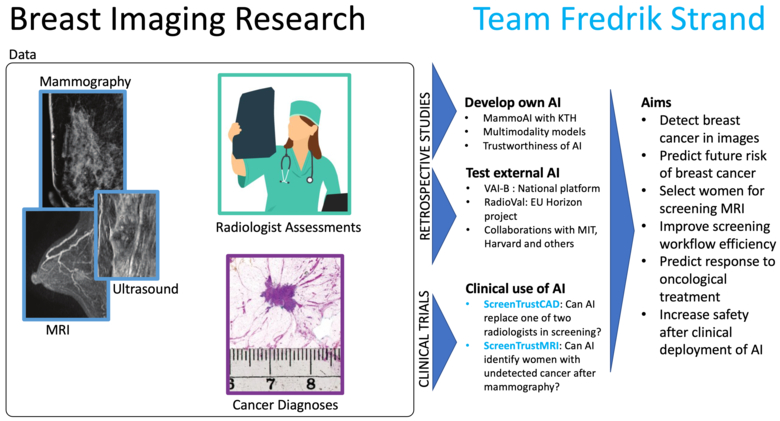
Fredrik Strand is a researcher at the Karolinska Institute , specifically within the Department of Oncology-Pathology under the Faculty of Medicine . He leads the Computational Breast Imaging Group , focusing on leveraging Artificial Intelligence (AI) for early breast cancer detection , precision diagnostics , and image-guided minimally invasive procedures . His work spans cross-disciplinary collaboration with institutions like the Royal Institute of Technology (KTH) and involves major clinical trials such as ScreenTrustCAD and ScreenTrustMRI . His research emphasizes AI in precision screening to address interval cancers and optimize radiologist workflows. Projects like VAI-B and RadioVal aim to validate AI algorithms and predict therapy response for neoadjuvant treatment . Recent publications highlight advancements in multi-modality imaging (mammography, MRI), GAN-based synthetic data generation , and trustworthy AI frameworks for clinical deployment. A consistent focus is on cost-effectiveness , equity in AI diagnostics , and human-AI interaction dynamics . Key trends in his work include deep learning for tumor detection , reinforcement learning for screening policies , and multi-institutional validation of AI tools. His research is funded by organizations such as Medtechlabs , Vinnova , EU Horizon Europe , and the Swedish Breast Cancer Association .
Linda Stihl is a postdoctoral researcher and lecturer at Lund University, affiliated with both the Department of Human Geography and Economic Geography (as a Lecturer ) and the Department of Economic History (as a Researcher ). Her research spans two core areas: (1) regional development in non-metropolitan and lagging regions, focusing on agency and growth pathways, and (2) sustainable transformation of global value chains through circular economy initiatives. She teaches spatial analysis using GIS and economic geography, with a focus on areas outside major cities. Research Focus : Regional development in Sweden's Borås, Kiruna, and Olofström (30–40-year longitudinal analysis). International projects: ACORE (Agents of Change in Old Industrial Regions in Europe), Regrow (Regional Growth Against All Odds), and Circular Economy: Multi-level Value Chain and Policy Dynamics . UN Sustainable Development Goals (SDGs) related to sustainable cities and responsible consumption. Teaching : Qualified Teacher (QTP) in Lund University's Pedagogical Academy for Social Sciences. Specializes in GIS-based spatial analysis, cartography, and qualitative research methods. Projects : Active in Circular Value & Supply Chains, Regional Development, and Multi-Level Policy Dynamics (2024–2027). Contributor to the Excellence Programme for Sustainable Development (2021–2027). Collaborations : Networks across Sweden, Finland, and Nordic countries. Active in workshops and seminars like the Lund University Research Conference on Sustainable Development and Nordic City Network .
Amos H. C. Ng is a Professor at the School of Engineering Science, University of Skövde, specializing in simulation-based optimization and Industry 4.0 technologies. His research bridges production engineering with human-robot collaboration, ergonomics evaluation, and cloud-based cyber-physical systems for manufacturing efficiency. Key Affiliations: University of Skövde (School of Engineering Science), Uppsala University (Industrial Engineering and Management) Research Themes: Multi-objective optimization, Digital Twin frameworks, Human-centric production systems, Reconfigurable manufacturing, Throughput bottleneck analysis Projects: ACCURATE 4.0 (Knowledge Foundation), VF-KDO (Virtual Factories with Knowledge-Driven Optimization), EWASS (Wire Harness Assembly Optimization) His recent publications demonstrate expertise in applying evolutionary algorithms, machine learning models, and digital human modeling tools to solve complex manufacturing problems ranging from crankshaft machining to wood supply chain robustness. Current work integrates motion capture technology with DHM tools for objective ergonomic assessments in assembly stations. Amos collaborates extensively with industrial partners like Volvo Penta and academic institutions, utilizing simulation-based approaches to enhance decision-making in production systems. His methodological focus includes non-dominated sorting genetic algorithms, surrogate modeling, and parallel computing architectures for optimization tasks.
Dmytro Orlov is a Professor in the Department of Industrial and Mechanical Sciences at Lund University's Faculty of Engineering (LTH), actively contributing to the Engineering Health and Circular Building Sector profile areas. His research bridges metallurgy, biomaterials engineering, and sustainable materials development. Research Focus: Prof. Orlov specializes in thermo-mechanical processing of metallic materials, with core expertise in deformation-based techniques for hierarchical material design. His group pioneers magnesium alloys for biomedical implants and lightweight mobility, multi-scale architected structures with controlled heterogeneity, and advanced characterization methods including in situ electron microscopy at large-scale facilities. Research directly supports UN Sustainable Development Goals through sustainable materials innovation. Publication Trends: Recent 2024-2025 publications reveal intense focus on magnesium surface science (oxidation mechanisms, core level shifts), deformation physics (geometric modeling, high-pressure torsion), and computational materials design. Cross-cutting themes include heterogeneity engineering, multi-scale structure-property relationships, and sustainable alloy development for biomedical applications. Awards: No specific scientific awards documented in provided materials. Supervision and Funding: Leads 13 projects including Biomaterials@LU (PI), SuRe-Mag (Vinnova-funded sustainable magnesium research), and Biomaterials 4.0 roadmap. Supervised 2 works including PhD projects on harmonic structure nickel. Manages significant infrastructure grants for TEM facility development and neutron polarization capabilities at ESS. Laboratory Leadership: Directs the Facility for TEM and site-specific sample preparation for hard materials, enabling atomic-to-macro scale characterization central to his group's research on metallic biomaterials and sustainable alloys.
Christine Grosse is a Researcher at Mid Sweden University, affiliated with the Department of Humanities and Social Sciences (HSV) . She contributes to the Risk and Crisis Research Centre (RCR) and serves as a member of the Forum for Digitalization (FODI) . PhD in Computer and Systems Science (Mid Sweden University, 2020) MSc in Information Security (Luleå University of Technology, Sweden) BSc in Business Informatics (FernUniversität in Hagen, Germany) Her research focuses on systems theory , critical infrastructure protection , information systems security , risk communication , and regional development . She explores intersections between governance, technology, and societal resilience through empirical studies and conceptual frameworks. Key publication trends address: Critical infrastructure resilience (power shortages, airports, systemic risks) Digital transformation in crisis management Regional development challenges in remote areas Information flow barriers in emergency planning Generative AI applications in risk research Her work combines interdisciplinary methodologies like Soft Systems Methodology and data simulations to improve collaborative planning and risk governance.
Gustav Lidén is an Associate Professor in Political Science at Mid Sweden University, affiliated with the Department of Humanities and Social Sciences. He earned his Ph.D. in Political Science in 2011 from the same institution and served as a postdoctoral fellow there during 2012-2013. He has held visiting scholar positions at Åbo Akademi University (2012), Universitat Pompeu Fabra (2021/2022), and University of Potsdam (2024). Lidén serves as director of studies for third-cycle education at the Faculty of Humanities. His research focuses on comparative examinations of governance and policy output in local political arenas, with specific emphasis on: Digitalization of political processes Local migration policy Democratic innovation Welfare policy design Mixed methods approaches Lidén's publications demonstrate consistent focus on Swedish local governance, migration policy implementation, and democratic processes. Recent works explore gender representation impacts, policy coordination mechanisms, digital governance variations, and integration policy outcomes, predominantly using comparative case studies and mixed methodologies. He leads or has contributed to numerous research projects including: Ongoing : The integration network in Västernorrland; Local labor market programs Completed : Housing integration and work; Democratic innovations; Enhanced urban environment; Gatekeeper for the unwanted; Sustainable Community Building (HåSa)
Peter Lundberg is an Adjunct Professor at Linköping University, affiliated with the Department of Health, Medicine and Care (HMV) and Department of Diagnostics and Specialist Medicine (DISP) . His research focuses on quantitative magnetic resonance imaging (MRI/MRS/NMR) for organ function analysis, particularly in liver disease (MASLD, HCC), neurological disorders (pediatric brain tumors, MS), and metabolic syndrome . He also works on text-based AI and federated learning applications in medical imaging. Developed non-invasive liver diagnostics replacing biopsies Co-founder of physiologically-based digital twin models for alcohol metabolism Active in MR safety standardization through ESMRMB Research Trends in recent articles include: Multi-organ interactions (liver-heart axis) Deep learning for brain tumor classification Population-level MASLD prevalence studies Advancements in MR spectroscopy for neurochemical analysis Collaborations with international societies like ISMRM and ESMRMB , and research centers including the Center for Medical Imaging and Visualization (CMIV) and Wallenberg Center for Molecular Medicine .
Gunhild Rosqvist is a Professor of Geography with a specialization in Physical Geography at Stockholm University, where she is affiliated with the Department of Physical Geography within the Faculty of Science. Her research focuses on climate change impacts in alpine and polar environments, with particular emphasis on snow, glaciers, and water systems. She has extensive experience in interdisciplinary research, working with climate modelers, environmental and indigenous law experts, and Sami reindeer herders to address the complex challenges facing Arctic communities. Dr. Rosqvist previously served as director of the Tarfala Research Station in Kebnekaise from 2005 to 2020, during which time she helped develop the station into a national and international research infrastructure supported by the Swedish Research Council and the EU through SITES and INTERACT programs. She currently leads several significant research initiatives, including Sweden's Antarctic research program iQ2300, which aims to quantify Antarctica's contribution to future sea level rise along the Swedish coast and globally. Her research interests span multiple interconnected domains within climate science and environmental geography. She investigates how rapid climate change and land use alterations affect mountain ecosystems and create new challenges for traditional livelihoods like reindeer herding. Her work integrates physical science with social dimensions, emphasizing the need for climate impact assessments that incorporate indigenous knowledge. She also studies glacial dynamics, snow properties, and lake ecosystems in Arctic environments, using both field measurements and advanced modeling approaches to understand past, present, and future environmental changes. Dr. Rosqvist's publication record demonstrates a consistent focus on Arctic and alpine environments, with particular attention to climate change impacts, glaciology, and human dimensions of environmental change. Her recent work shows increasing integration of indigenous knowledge with scientific methods, especially regarding reindeer herding in northern Sweden. She has made significant contributions to understanding snow dynamics through innovative remote sensing techniques and has pioneered research on microbial processes for remediating mine pollution in Arctic environments. Her interdisciplinary approach bridges physical geography with social sciences, creating pathways for more holistic environmental assessments. As a research leader, Dr. Rosqvist directs multiple ongoing projects funded by Formas, the National Heritage Board, Vinnova, and international collaborations. These include initiatives on sustainable land use planning in Arctic Sweden, climate impact assessments for reindeer herding areas, methods for cultural environment monitoring, and snow quality assessment tools that integrate Sámi knowledge. She previously led the Nordic Center of Excellence REXSAC (Resources Extraction and Sustainable Arctic Communities) through NordForsk and contributed to the Bolin Center for Climate Research at Stockholm University. Dr. Rosqvist works closely with the Tarfala Research Station in Kebnekaise, which serves as a critical field site for Arctic and alpine research. She collaborates extensively with researchers from Stockholm and Helsinki Universities through the Arctic Avenue initiative, focusing on lake ecosystems and glacial activity. Her research teams include climate scientists, geographers, environmental lawyers, and indigenous knowledge holders, creating truly interdisciplinary approaches to understanding and addressing climate challenges in the Arctic.
Mélanie Despeisse is an Associate Professor in Production Systems at Chalmers University of Technology. Her research focuses on the relationship between industry and environmental sustainability at varying levels, from operational resource efficiency in manufacturing processes to corporate social responsibility in strategic planning. Her primary research interests include sustainable manufacturing systems, circular economy implementation, and the integration of digital technologies with environmental sustainability goals. She develops practical tools and methodologies to help companies create sustainable social value through concepts like eco-efficiency and circularity. Her work spans multiple industries including automotive, aerospace, maritime shipping, and battery production systems, addressing challenges from resource efficiency to strategic sustainability planning. Analysis of her recent publications reveals a strong focus on the intersection of digital technologies (such as virtual reality, computer vision, and digital twins) with environmental sustainability in manufacturing. Her research increasingly addresses the twin transitions of digitalization and sustainability, exploring how Industry 4.0 technologies can support eco-efficient production systems while building organizational resilience. She has developed frameworks for eco-efficient and circular industrial systems, examining both technical and organizational aspects of sustainability transitions. Mélanie Despeisse is actively involved in numerous research projects across multiple domains, including XR for battery production, visibility of value networks for circularity, aircraft architecture integration, and sustainable manufacturing for maritime shipping. Her collaborative work demonstrates strong interdisciplinary partnerships across engineering, environmental science, and business management domains.
Dmytro Orlov is a Professor at Lund University within the Mechanics, Materials and Component Design division of the Faculty of Engineering (LTH). He is actively involved in two profile areas: Circular Building Sector and Engineering Health . Research focuses on multi-scale materials engineering, particularly magnesium (Mg) alloys for biomedical and lightweight mobility applications. Expertise in thermo-mechanical processing, deformation techniques, and advanced characterization (electron microscopy, in situ methods). His recent work explores magnesium oxidation mechanisms, pseudopotential modeling, and plastic deformation geometry, contributing to sustainable materials and biomedical applications. He manages the TEM and Sample Preparation Facility and participates in interdisciplinary projects like Biomaterials@LU and SuRe-Mag .
Hercules Dalianis is a Professor at the Department of Computer and Systems Sciences, Stockholm University. His research focuses on Natural Language Processing, particularly in clinical text mining for Swedish language data. He leads the Natural Language Processing Research Group and serves as director of the Health Bank - Swedish Health Record Research Bank infrastructure. MSc in Electrical Engineering (1984), KTH PhD in Technology (1996), KTH Professor of Computer and Systems Science (2011), Stockholm University His research addresses privacy-preserving NLP for clinical text analysis, including automated de-identification , domain adaptation of BERT models , and clinical entity recognition . Current projects like DataLEASH and Privacy-Preserving Techniques explore machine learning solutions that balance data utility with patient confidentiality. Key publication trends show emphasis on Swedish clinical text processing , ICD-10 coding automation , and privacy-aware language modeling . Collaborations span Karolinska University Hospital, Nordic healthcare institutions, and international AI research communities. He teaches courses in Internet Search Techniques and Business Intelligence (ISBI) , Natural Language Processing (NLP) , and Principles and Foundations of Artificial Intelligence (PFAI) . His work has produced the open-access textbook Clinical Text Mining: Secondary Use of Electronic Patient Records , establishing foundational frameworks for clinical NLP in low-resource languages.
Aleksandra Turkiewicz serves as an Associate Professor in Medical Statistics at Lund University's Faculty of Medicine, based at the Clinical Epidemiology Unit (IKVL). Her work focuses on statistical methodology development for orthopaedic and epidemiological research, with particular expertise in register-based studies and pre-clinical applications. She holds additional roles as a Researcher in Orthopaedics, participant in the Lund OsteoArthritis Division, and member of the LU Profile Area: Proactive Ageing. Her research interests center on register-based epidemiology with emphasis on bias quantification, multilevel models in omics applications, and methods for handling missing data. She is responsible for the mandatory statistics course for PhD students at the medical faculty with pre-clinical research focus, and serves as Associate Editor for Statistics at Osteoarthritis and Cartilage . Her work contributes to UN Sustainable Development Goals related to health and wellbeing. Analysis of her recent publications reveals a strong focus on osteoarthritis epidemiology, particularly knee and hip osteoarthritis, with increasing integration of genetic and metabolic factors in understanding disease mechanisms. Her work spans population-based cohort studies, clinical classification systems, and molecular-level investigations into joint tissue degeneration. Dr. Turkiewicz actively supervises doctoral students and participates in multiple research projects including EpiMusc2 (2025-2045), The Impact of Metabolic Health on Osteoarthritis (2023-2027), and several dissertation projects focused on thumb base osteoarthritis, meniscus repair outcomes, and socioeconomic inequalities in musculoskeletal care. Her collaborative network spans multiple institutions with significant international engagement as evidenced by her participation in multi-center studies.
Håkan Grahn is a Professor of Computer Engineering at the Department of Computer Science, School of Computing, Blekinge Institute of Technology (BTH) in Sweden. He has been a faculty member since 1996, becoming a full professor in 2007. His academic leadership includes serving as Head of Department (1999-2002) and Dean of Research (2011-2013) at BTH. He leads multiple significant research projects including GPAI (General Purpose AI Computing) and Green Clouds, with funding from ELLIIT, the Knowledge Foundation, and Vinnova. His educational background includes: M.Sc. in Computer Science and Engineering (1990) from Lund University Ph.D. in Computer Engineering (1995) from Lund University Håkan's research spans several interconnected domains in computer science and engineering, with a strong emphasis on practical applications. His work in computer architecture focuses on optimizing system performance through innovative cache coherence protocols and memory management techniques. In the realm of parallel computing , he investigates multicore systems, GPU computing, and thread-level speculation to enhance computational efficiency. His research in AI and machine learning addresses energy efficiency, data stream mining, and practical applications in areas like district heating systems and airborne networks. The integration of image processing with machine learning forms another significant strand of his work, particularly in historical document analysis and medical imaging applications. These research areas converge in his leadership of major initiatives like BigData@BTH and GPAI, where he bridges theoretical advances with real-world implementation challenges. Analysis of Håkan's recent publications reveals a clear trajectory toward increasingly applied research with strong industry connections. While maintaining foundational work in computer architecture, his output increasingly focuses on practical AI applications, energy efficiency in computing, and domain-specific implementations in sectors like telecommunications, energy systems, and defense. The interdisciplinary nature of his work is evident in collaborations spanning computer science, engineering, and domain-specific applications, with a growing emphasis on sustainability and resource optimization in computing systems. Håkan has successfully supervised numerous doctoral students, with ten graduates and six current Ph.D. candidates. His research has been supported by substantial funding from: The Knowledge Foundation (BigData@BTH, HINTS, Green Clouds) ELLIIT (GPAI project) Vinnova (FANET-MCA, Directed COM & EW) Industry partners including Ericsson, Saab, Telenor, and Fortnox He is actively involved in multiple research groups including DISL (Distributed and Intelligent Systems Lab), CCS-Lab (Communication and Computer Systems Research Lab), and previously PAARTS (Parallel Architectures and Applications for Real-Time Systems). His leadership extends to organizing academic events like the Nordic workshop on Multi-Core Computing and the Swedish Artificial Intelligence Society workshop.
Christine Grosse is an Associate Professor at Luleå University of Technology in the Department of Computer Science, Electrical and Space Engineering, specializing in Digital Services and Systems. Her research focuses on information systems and security, with particular expertise in critical infrastructure protection and societal resilience. She is associated with the Center for Security in Society and Critical Infrastructures (C SHARP) at LTU. Dr. Grosse specializes in organizational, societal, and governance issues related to risk and security, including policy analysis, process modeling, decision-making, and cybersecurity. Her work examines data and information challenges in policy processes, such as disinformation, information scarcity, uncertainty, conflicting stakeholder interests, lack of awareness, and the increasing interest in collective intelligence and multi-level governance. Central to her research is understanding how critical infrastructure protection, public security and crisis management can be approached from a systems perspective. Her recent publications (2025-2026) show a strong focus on the intersection of AI, digital resilience, and critical infrastructure protection. She explores how AI technologies can enhance collective intelligence in governance while addressing cybersecurity challenges in space systems and public administration. Her work demonstrates the limitations of purely technical approaches to cyberattacks and highlights the need to integrate crisis management and cybersecurity efforts for enhanced organizational cyber resilience. Dr. Grosse serves as Educational leader for the international master's program in information security and coordinates courses such as Risk management Trends in information systems and security. She supervises students at advanced and doctoral levels and leads research projects funded by organizations including MSB, Swedish Transport Administration, Vinnova, and municipal authorities. Her notable projects include Space systems as critical infrastructure, Digital resilience: Challenges and opportunities of AI technologies for civil preparedness, and Human, Measure and Resilience: New Ways to Study Risk Communication. She is associated with the Center for Security in Society and Critical Infrastructures (C SHARP) at LTU, which serves as a hub for her interdisciplinary research connecting information security with societal resilience and critical infrastructure protection.