José António Ferreira Machado is a Full Professor at the Nova School of Business and Economics, Universidade Nova de Lisboa. He currently serves as Vice-Rector of the university and previously held director roles at the Nova School of Business and Economics (2005-2015) and Angola Business School (2010-2015). His academic career includes consultancy at the Bank of Portugal (1992-2015) and teaching Econometrics, Statistics, and Macroeconomics. Research Interests: Machado's work focuses on Econometrics, Quantile Regression, Wage Distributions, Firm Size Analysis, and Macroeconomic Modeling. His most cited paper (2005) introduced counterfactual decomposition methods for wage distribution analysis. Recent publications examine quantile regression extensions, trade margins, and moment-based statistical inference. His research spans both theoretical and applied economics, with collaborations including J. M.C. Santos Silva and Roger Koenker.
Yuriy Gorodnichenko serves as the Quantedge Presidential Professor in the Department of Economics at the University of California, Berkeley since 2018. His extensive academic affiliations include being a Faculty Research Associate at the National Bureau of Economic Research (2014-present), Research Fellow at the Institute for the Study of Labor (2007-present), International Fellow at the Kiel Institute for the World Economy (2011-present), and Research Consultant for both the European Central Bank (2018-present) and European Investment Bank (2017-present). He also serves as Editor of the Journal of Monetary Economics (2018-present) and Member of the Executive Committee of the Association for Comparative Economic Studies (2019-present). Education: Ph.D., Economics, University of Michigan, 2007 M.A., Statistics, University of Michigan, 2004 M.A., Economics (high honors; valedictorian), Economics Education and Research Consortium at National University of Kyiv-Mohyla Academy, Kiev, Ukraine, 2001 B.A., Economics (honors; valedictorian), National University of Kyiv-Mohyla Academy, Kiev, Ukraine, 1999 Gorodnichenko's research spans multiple subfields of economics with particular emphasis on monetary economics, public finance, international economics, and macroeconomics . His scholarly approach typically combines both macroeconomic and microeconomic data with rigorous theoretical and statistical analyses. His work is organized into five major categories: monetary economics, aggregate implications of informational frictions, business cycles, development/productivity/income differences, and inequality. As an applied macroeconomist, he frequently bridges methodological approaches across different economic subdisciplines. His publication record demonstrates consistent high-impact research across top economics journals including American Economic Review, Journal of Political Economy, and Review of Economic Studies. The trajectory of his work shows increasing focus on the microfoundations of macroeconomic phenomena, particularly how information frictions affect economic behavior and policy transmission mechanisms. His recent publications have increasingly addressed the distributional consequences of monetary policy and the role of cultural factors in economic development. Scientific Awards and Honors: Fellow, Econometric Society (2021) Highly Cited Researcher, Clarivate (2021) Distinguished Teaching Award, Social Science Division, UC Berkeley (2020) World Junior Prize in Monetary Economics and Finance (2018) NSF CAREER award (2012) Sloan Research Fellowship (2013) Multiple #1 rankings among young economists by RePEc (2014-2021) Best paper award, American Economic Journal: Economic Policy (2015) Gorodnichenko has received consistent recognition for his teaching and advising from UC Berkeley's Economics Department, including multiple runner-up positions and a win for the Best Advisor Award (2014). His research has been supported by prestigious grants including the NSF CAREER award and Sloan Research Fellowship. His impact metrics are substantial with over 19,000 citations and an h-index of 54, reflecting significant influence in the economics profession. While the scraped text doesn't specify dedicated research laboratories, Gorodnichenko maintains active research collaborations through his affiliations with major economic research institutions including NBER, IZA, and Kiel Institute. His editorial roles at leading journals position him at the center of contemporary macroeconomic research discourse.
David Ardia is a Full Professor in the Department of Decision Sciences at HEC Montréal, promoted to this position on June 1, 2025. Previously, he served as an Associate Professor from June 2020 to May 2025. He holds the Research Professorship in Sentometry and is a member of the Study and Research Group on Decision Analysis (GERAD) and the International Statistical Institute. Ardia is also an elected member of the ISI Louis Bachelier Fellow and serves as Associate Editor for both the International Journal of Forecasting and the Journal of Statistical Software. His educational background includes a Ph.D. in Financial Econometrics from the University of Fribourg, a Master of Applied Sciences in Quantitative Finance from the Swiss Federal Institute of Technology Zurich and University of Zurich, and a Master of Science in Financial Engineering from the University of Neuchâtel. Ardia's research focuses on the intersection of quantitative finance, machine learning, and natural language processing, with particular emphasis on sentometrics (textual sentiment analysis in finance), risk management, and climate finance. His work spans financial econometrics, volatility modeling, and the application of advanced statistical methods to asset allocation and economic forecasting. He has pioneered methods for analyzing climate change concerns in financial markets and has made significant contributions to understanding green versus brown stock performance. His publication record shows a strong trajectory in high-impact finance and statistics journals, with recent work examining Robinhood trading patterns, cryptocurrency markets, climate finance, and innovative methodological approaches to financial time series analysis. His research demonstrates increasing focus on sustainability applications within quantitative finance. Prix de la qualité des données ouvertes 2024 (Canadian Open Data Community) Prix de recherche pour les professeures et professeurs agrégés (HEC Montréal, 2024) Prix pour l'excellence en pédagogie (HEC Montréal, 2022) Best Paper Award at the 38th International Conference of the French Finance Association Best Paper Award 2018-2019 from International Journal of Forecasting eRum 2020 COVID19 contest winner for the COVID-19 Data Hub Ardia actively supervises numerous graduate students, with over 70 mentorship activities documented in the past five years, spanning both thesis supervision and supervised projects. His research is supported by collaborations with institutions including IVADO, the R Consortium, and the University of Lugano. He co-created the influential COVID-19 Data Hub platform, which integrates epidemiological data with policy measures and spatial databases to analyze pandemic impacts. His research group focuses on developing computational tools for financial analysis, particularly through R packages like MSGARCH for Markov-switching GARCH models and sentometrics for textual sentiment analysis. This work bridges academic research with practical applications in financial institutions and policy analysis.
Anton Korinek serves as Professor at the University of Virginia , affiliated with both the Department of Economics and the Darden School of Business . He is Faculty Director of the Economics of Transformative AI (EconTAI) Initiative and holds positions as Visiting Fellow at The Brookings Institution , Research Associate at NBER and CEPR . His work bridges economics, AI governance, and financial systems. PhD in Economics (2007), Columbia University Former positions: Johns Hopkins University, University of Maryland Visiting roles: Harvard University, World Bank, IMF, BIS Research Focus : Transformative AI's economic impacts Labor market disruption from AGI Inequality and democratic stability Financial system transformation by AI Macroprudential regulation Capital flow management in emerging markets Key Contributions : Developed AI agent frameworks for economic research Proposed steering technology to complement labor Analyzed AI-induced market concentration Testified to Senate on AI workforce impacts Created Coursera course on Economics of AI Scientific Recognition : TIME100 AI (2025) David M. Rubenstein Fellow, Brookings Advising & Collaboration : Coauthored with Joseph Stiglitz, Megan Juelfs, and Donghyun Suh Contributor to G7 High-Level AI Policy Report Advises Anthropic's Economic Council
Peter Ireland is the Murray and Monti Professor of Economics at Boston College, specializing in Macroeconomics and Monetary Economics. He holds a B.A., M.A., and Ph.D. from the University of Chicago. His work focuses on monetary policy transmission mechanisms, inflation dynamics, and the historical evolution of central bank strategies. Ireland has contributed extensively to understanding the effects of interest on reserves, the Barnett critique, and the implications of New Keynesian models for policy analysis. His research spans topics such as money growth rules, nominal GDP targeting, and the role of monetary aggregates in policy frameworks. Ireland has published in leading journals like the Journal of Econometrics and Journal of Money, Credit, and Banking , and his recent work addresses modern challenges such as the zero lower bound and post-crisis monetary policy strategies. His teaching includes courses on Financial Economics and Mathematics for Economists. Notably, Ireland’s work often critiques traditional policy approaches, advocating for clearer nominal anchors and rule-based frameworks. He collaborates frequently with Michael T. Belongia and others on projects analyzing the Federal Reserve’s strategy, Greenbook forecasts, and historical policy decisions. His contributions highlight the importance of monetarist principles in contemporary economic debates.
Giuseppe Moscarini is the Philip Golden Bartlett Professor of Economics at Yale University and a Research Associate at the National Bureau of Economic Research (NBER). He co-chairs the Micro and Macroeconomic Perspectives on the Aggregate Labor Market working group at NBER and serves as Co-Director of the Research Program in Macroeconomics at the Cowles Foundation. Previously, he held the Henry Kohn Associate Professorship at Yale and was a Sloan Foundation Research Fellow. His research focuses on labor markets, unemployment, wage inequality, and business cycles, with recent work analyzing labor market flows and employer-to-employer transitions. He has developed methodologies to measure and predict wage inflation dynamics, including a novel Phillips curve framework. Education: Ph.D. in Economics from MIT (1996), Laurea in Economia e Commercio from Università di Roma La Sapienza (1991). Research emphasizes theoretical and empirical labor market dynamics, including pricing, monetary policy, and information economics. His work bridges macroeconomic and microeconomic perspectives, with contributions to understanding firm size impacts on job creation and cyclical job ladder dynamics. Articles highlight employer mobility, wage dispersion, and post-recession labor market challenges. Awards: None explicitly listed. Editorial roles include co-Editor of Theoretical Economics and Associate Editor of the Journal of Economic Theory. Grants and lab affiliations include the Cowles Foundation and Federal Reserve Bank collaborations. Advising includes PhD student Francesco Beraldi.
João Tovar Jalles serves as a Senior Associate Professor of Economics at the University of Lisbon's Lisbon School of Economics and Management (ISEG), with over 15 years of expertise spanning macroeconomics, public finance, and applied econometrics. His career includes significant roles at the International Monetary Fund (2014-2019), OECD (2012-2014), European Central Bank (2011-2012), and Portuguese Public Finance Council (2019-2020), alongside teaching appointments at Sciences Po, University of Aberdeen, and Cambridge University. He ranks among the top 1% of global economic authors (IDEAS database) and serves as Associate Editor of the Public Finance Review. His academic credentials include: Aggregation in Economy (2023) from Universidade de Lisboa, ISEG PhD in Economics (2011) from University of Cambridge MSc in Economics (2008) from University of Warwick BSc in Economics (2006) from Universidade Nova de Lisboa Dr. Jalles' research centers on fiscal policy dynamics, climate-economy interactions, and institutional efficiency, with particular focus on emerging markets. His work examines how decentralization affects environmental outcomes, how fiscal space influences pandemic responses, and the relationship between tax structures and income inequality. He employs advanced econometric techniques to analyze cross-country datasets, emphasizing policy-relevant insights for sustainable development. Recent publications (2024-2025) reveal a pronounced shift toward integrating climate risk into macroeconomic modeling, with 60% of his work now addressing environmental-fiscal linkages. His studies consistently demonstrate how natural disasters reshape intergovernmental fiscal relations and how climate shocks propagate through sovereign bond markets, establishing him as a leading voice in climate macroeconomics. Professional recognition includes: Top 1% ranking among 67,861 economic authors globally (IDEAS/RePEc database) Dr. Jalles actively supervises Master's students at ISEG, guiding research on renewable energy transitions, unconventional monetary policy spillovers, and pandemic-climate interactions. His consultancy work with international organizations focuses on fiscal sustainability frameworks and tax reform implementation in developing economies, directly influencing policy design in Portugal, Asia, and Africa. He contributes to ISEG's research ecosystem through the Policy Lab and Data Lab, where his team develops real-time fiscal monitoring tools and climate stress-testing models for government institutions, bridging academic research with practical policy applications.
James Mitchell is a Professor of Public Policy at the University of Edinburgh’s School of Social and Political Science . He holds a MA (Political Studies) from the University of Aberdeen and a D.Phil. (Oxford). His research focuses on British politics, devolution, public policy, territorial politics, and Scottish nationalism. He has supervised over 30 years of PhDs and Masters in public policy, devolution, and constitutional politics. Key research themes include fiscal accountability in Scotland, party membership surges post-referendum, and multi-level governance. Research Projects: ESRC-funded study on SNP and Scottish Greens’ post-referendum membership growth Investigation of fiscal devolution’s accountability gaps Analysis of Scotland’s constitutional questions and local governance Research Interests: Mitchell explores territorial politics, public service reform, and political behavior in sub-state governments. He has contributed to debates on Scottish independence, EU referendum impacts, and intergovernmental relations. Recent work includes studies on the SNP leadership contest (2023) and Holyrood’s fiscal structures. Grants & Awards: He has secured grants from the Economic and Social Research Council (ESRC) for projects on party membership and constitutional dynamics. No specific scientific awards are listed, but his work is widely cited in political science and public policy. Labs & Teams: He is part of the Territorial Politics Research Group and has collaborated on regional economic forecasting and governance studies. His work often bridges academia and policy, influencing debates on devolution and public finance.
Rüdiger Bachmann is the Stepan Family College Professor of Economics at the University of Notre Dame, with affiliations at the Centre for Economic Policy Research, CESifo, and ifo Institute. His research focuses on macroeconomic effects of uncertainty and expectation formation. Research examines: Impacts of economic uncertainty on business investment and hiring Survey-based measurement of firm expectations Labor market dynamics and productivity gaps Distributional consequences of energy policy shifts Behavioral responses to fiscal interventions Recent publications analyze German energy independence scenarios, pandemic consumption patterns, and firms' decision-making under ambiguity. He has advised German government institutions on economic policy matters and contributed to public debates through influential policy briefs. Professional experience includes positions at Goethe University, RWTH Aachen University, University of Michigan, and visiting appointments at leading institutions including Harvard and Yale. Teaches advanced macroeconomics courses at both undergraduate and graduate levels.
Dr. Yanjun Zhang is an Honorary Research Fellow at the School of Electrical Engineering and Computer Science, The University of Queensland. His research focuses on privacy-preserving technologies, federated learning, cybersecurity in IoT systems, and machine learning security. He holds a PhD in Privacy-Preserving Sharing for Genome-Wide Analysis from The University of Queensland (2021). Education: PhD in Information Technology, School of Information Technology and Electrical Engineering, The University of Queensland (2021) Research Interests: Designing secure collaborative machine learning frameworks Defending against adversarial attacks in cyber-physical systems Privacy preservation in distributed genomic and medical data analysis Compliance and ethics in virtual personal assistant applications Key Contributions: Developed privacy-preserving federated learning frameworks (AgrAmplifier, PrivColl) Conducted foundational studies on evasion attacks in IoT systems Created datasets for analyzing malicious browser extensions and Alexa skills Labs/Teams: Active contributor to UQ Cyber initiatives, including the 2021-2022 Seed Funding project on federated deep learning for medical imaging.
Professor Jagjit S. Chadha is a distinguished academic and policy adviser serving as Professor of Economics at the University of Cambridge's Faculty of Economics. He concurrently serves as Director of the National Institute of Economic and Social Research (NIESR) until December 2024, and holds advisory roles with the Bennett Institute of Public Policy and the Productivity Institute. His career spans academic appointments at the University of Kent and St Andrews, and professional roles including Chief Quantitative Economist at BNP Paribas and Specialist Adviser to the UK Treasury Committee. His research focuses on macroeconomics, monetary policy, fiscal frameworks, and historical business cycles. Notable contributions include analyses of quantitative easing impacts, debt management strategies, and long-term UK economic data. Chadha has authored A Century of High Frequency UK Macroeconomic Statistics and frequently publishes in journals like Journal of Economic Surveys and Economic History Review . He has received an OBE (2021) and Royal Economic Society Founding Fellowship (2025). His work bridges academia and policy, advising central banks, HM Treasury, and international institutions. Recent media engagements include commentary on UK fiscal rules, China-UK economic relations, and post-pandemic productivity challenges.
Stephen Terry is an Associate Professor of Economics at the University of Michigan's College of Literature, Science, and the Arts. He is also a Research Associate at the National Bureau of Economic Research (NBER) and serves as Co-Editor of the Review of Economics and Statistics. His research focuses on macroeconomics, particularly firm investment and the impact of micro-level frictions on long-term growth and business cycles. Dr. Terry received his PhD in Economics from Stanford University in 2015. Prior to joining the University of Michigan, he served as an Assistant Professor at Boston University. Professor Terry's research spans several key areas in macroeconomics, with a particular emphasis on understanding how micro-level frictions affect macroeconomic outcomes. His work investigates firm investment behavior, economic growth dynamics, and business cycle fluctuations. He employs both theoretical models and empirical analysis to examine how factors like uncertainty, immigration, innovation, and financial constraints shape economic performance at the aggregate level. His research often bridges micro and macroeconomic perspectives to provide deeper insights into economic mechanisms, with special attention to how short-term phenomena can have long-term consequences for economic growth. Analysis of Professor Terry's recent publications reveals a consistent focus on macroeconomic dynamics, particularly the relationship between micro-level frictions and macroeconomic outcomes. His work spans topics including economic uncertainty, firm dynamics, innovation, immigration effects, and business cycle analysis. A notable trend is his examination of how short-term phenomena can have long-term economic consequences, as seen in his research on short-termism and its macroeconomic impact. His collaborative work with leading economists across various institutions demonstrates the interdisciplinary nature of his research. Professor Terry has earned significant recognition in his field: Research Associate, National Bureau of Economic Research (NBER) Co-Editor, Review of Economics and Statistics As an academic advisor, Professor Terry has mentored numerous PhD and Master's students in economics. His research has been supported by various grants that have enabled extensive empirical analysis and theoretical modeling. His work on economic uncertainty, firm dynamics, and growth mechanisms has contributed significantly to our understanding of macroeconomic phenomena. Professor Terry actively collaborates with researchers across institutions, fostering interdisciplinary approaches to economic questions, and frequently participates in academic discussions at major conferences including the NBER Summer Institute. Professor Terry is affiliated with several research groups at the University of Michigan, including the Research Seminar in Quantitative Economics (RSQE). His work connects with various subfields within economics, particularly Macroeconomics, and contributes to ongoing research in economic growth, business cycles, and firm dynamics. His position as Co-Editor of the Review of Economics and Statistics places him at the forefront of scholarly communication in economics.
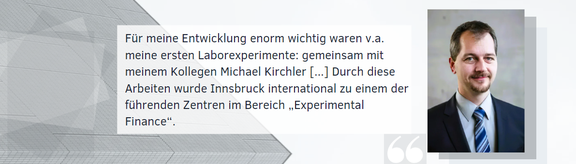
Jürgen Huber is a Full Professor in Finance and Head of the Department of Banking and Finance at the University of Innsbruck. He has been a central figure in experimental finance since 1998, founding the Society for Experimental Finance and leading international collaborations with institutions like Stockholm School of Economics and VU Amsterdam. Education: PhD in Political Sciences (2001) and Business Administration (Habilitation, 2007), both from University of Innsbruck. Research Interests: His work spans Experimental Economics , Behavioral Finance , and Meta Science , focusing on market microstructure, replicability of scientific research, and communication behavior. Recent projects explore: Climate change policy through CO2 taxation and climate dividends . Digital finance implications of cryptocurrencies and NFTs . Communication differences (face-to-face vs. online) and their impact on decision-making. Scientific objectivity in peer review via the Nobel and Novice project. Article Trends: His 2024 publications in Nature Human Behaviour and PNAS emphasize replicability crises, climate economics, and communication behavior. Earlier work in Management Science and Journal of Economic Behavior and Organization analyzes market microstructure, financial transaction taxes, and crowd-sourced research validation. Scientific Awards: Voted Professor of the Year by students (2019-2023), with multiple FWF and OeNB grants totaling over €1 million. Received the Pater Johannes Schasching SJ-Preis (2016) and Forschungspreis der Stiftung Südtiroler Sparkasse (2015). Teaching: Integrates research into interactive lectures, including lab-based simulations for stock market experiments. Taught at universities in Austria, Germany, USA, Thailand, Vietnam, and Indonesia.
Judith Resnik serves as the Arthur Liman Professor of Law at Yale Law School and founded the Arthur Liman Center for Public Interest Law. Her scholarship investigates the intersection of democratic values with judicial systems, prisons, and collective redress mechanisms. She teaches courses on federalism, legal procedure, and punishment studies. Her research focuses include: Democratic accountability in judicial systems Eighth Amendment and prison reform Gender, race, and class in legal representation Privatization of public services Transnational legal comparisons Recent publications analyze court funding dynamics, arbitration system flaws, and solitary confinement ethics. She has received prestigious awards including the Andrew Carnegie Fellowship, Margaret Brent Women Lawyers Award, and the Meltzer Lifetime Achievement Award. The Liman Center under her leadership has produced influential reports on prison segregation and economic injustice, collaborating with institutions like UC Berkeley's Policy Advocacy Clinic and the Brennan Center at NYU. Notable scientific awards: Andrew Carnegie Fellowship (2018) Daniel J. Meltzer Lifetime Achievement Award (2024) Order of the Coif award for 'Representing Justice' (2014) PROSE awards for legal scholarship (2012)
Zoe Venter is an Invited Assistant Professor at the Católica Lisbon School of Business & Economics, Universidade Católica Portuguesa. She is affiliated with the CUBE Research Unit in Business and Economics (2020-2025), contributing to projects involving financial stability, macroprudential policies, and economic policy analysis. Venter holds a PhD in Economics and her research focuses on aggregate demand dynamics, financial stability mechanisms, and the interplay between monetary policy and credit markets. Her work aligns with UN Sustainable Development Goals related to economic growth and financial inclusion. Her research interests include macroprudential policy design, the impact of minimum wage reforms, housing market dynamics, and institutional bargaining frameworks. Key contributions analyze how policy instruments like macroprudential tools affect aggregate demand, savings behavior, and financial stability across advanced economies. She has also explored the role of central banks in mitigating systemic risks and the effects of political environments on financial regulation. Venter has supervised 26 graduate works, emphasizing empirical and policy-oriented research. Her current project, CUBE, involves over 50 researchers addressing economic and business challenges through interdisciplinary collaboration. She has published extensively in peer-reviewed journals and working papers, with notable contributions in the International Journal of Central Banking and the Portuguese Economic Journal .