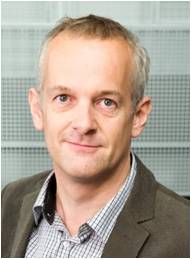
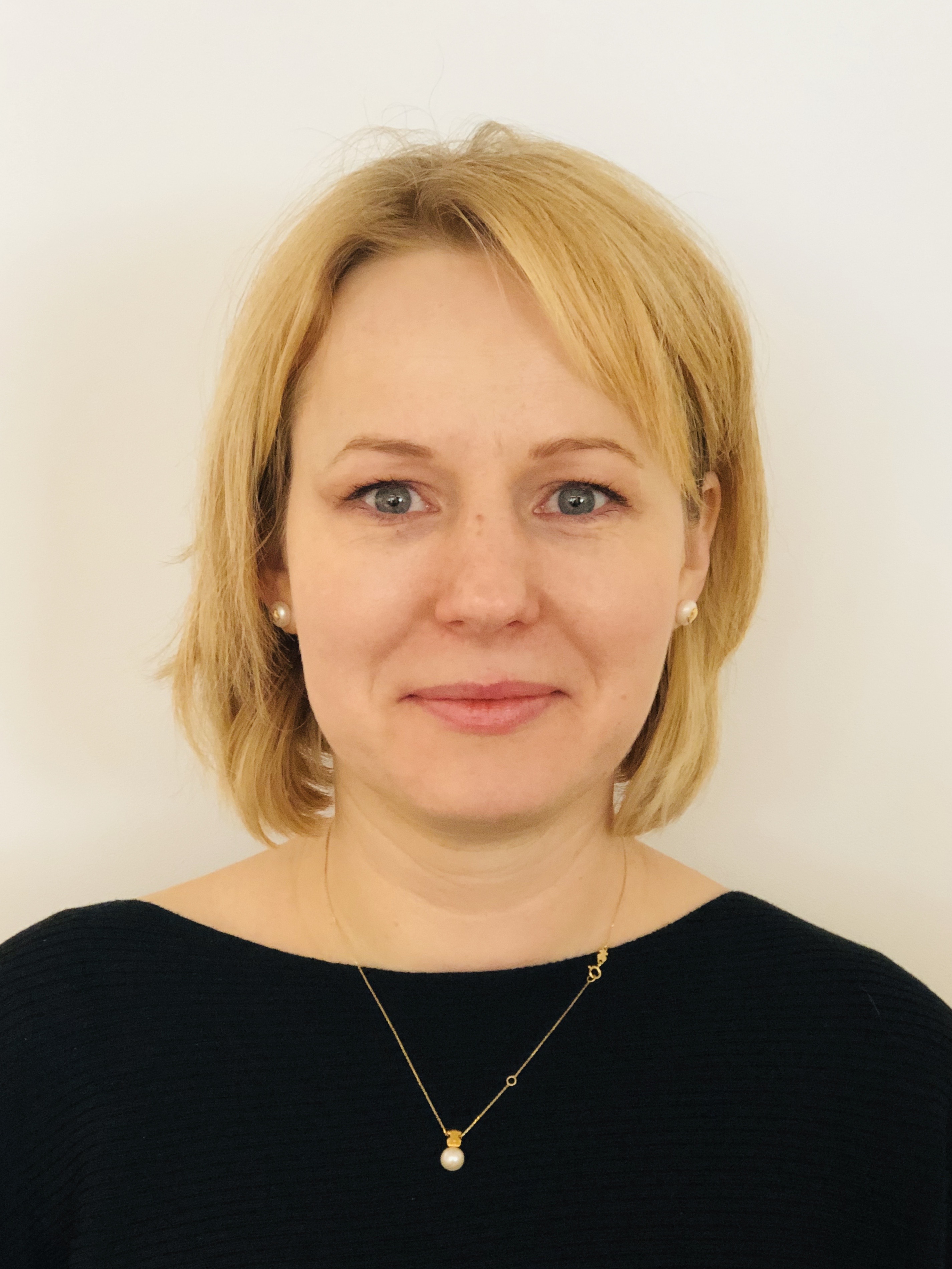
Mark Timmer is an Associate Professor at the University of Twente, affiliated with the ELAN Teacher Development department. He holds a PhD in Efficient Modelling, Generation and Analysis of Markov Automata (2013), an MSc in Science Education and Communication (2011), another MSc in Computer Science (2008), and a BSc in Telematics (2005), all from the University of Twente. His research spans computational thinking in mathematics education, formal methods in computer science, and curriculum development. He has received awards including the IPA Dissertation Award (2013) and Overijssel PhD Award (2014). His work emphasizes integrating computational thinking into secondary education, particularly through algorithmic concepts like Dijkstra’s algorithm and K-means clustering. He also explores formal verification techniques for probabilistic systems, contributing to the analysis of Markov automata. Timmer actively participates in international educational initiatives, such as the ICME-15 congress, and collaborates with educators to improve teaching methods. Publications highlight his dual focus on theoretical computer science (e.g., confluence reduction in Markov models) and practical educational applications (e.g., lesson study implementations). He has authored book reviews and contributed to educational journals, emphasizing pedagogical innovation and critical analysis of teaching materials.
Tim A.C. Willemse is an Associate Professor in the Formal System Analysis group at Eindhoven University of Technology (TU/e), Department of Mathematics and Computer Science. His research focuses on formal methods, model checking, and verification technologies, with applications in high-tech industries such as CERN and Dezyne. He holds a part-time affiliation with CERN as a software engineer and researcher. Key areas include parameterised Boolean equation systems, parity games, and mCRL2 toolset development. He has led projects like AVVA, VICTORIA, and VOCHS, supported by NWO and the European Commission. Education : PhD and MSc in Computer Science from TU/e. Former roles include researcher at ASML and Radboud University, Nijmegen. Served as Managing Director of IPA (2017) and is active in societies like ACM SIGACT and EATCS. Research Interests : Formal verification, model checking algorithms, industrial software reliability, and verification of real-time systems. His work bridges theoretical computer science with practical applications in high-tech and industrial software. Publications : Recent work emphasizes efficient evidence generation for model checking, formal methods in industry, and domain-specific language engineering. His articles reflect trends in scalable formal methods and industrial collaboration. Awards : Best Paper Awards (FACS 2018, EATCS 2020), FORTE Best Artefact Award (2022). Grants & Advising : Secured funding from NWO, EU, and industry partners. Supervised 47+ academic works. Teaches courses on Model Checking and Process Theory. Active in national and international research networks. Labs/Teams : Leads the Formal System Analysis group, contributing to mCRL2 toolset development and verification technologies for industrial tools like Dezyne.
Erik P. de Vink is an Associate Professor at Eindhoven University of Technology (TU/e), Department of Mathematics and Computer Science. He also serves as an Associated Research Fellow at CWI, the Dutch National Research Institute for Mathematics and Computer Science. His research focuses on formal methods, software product lines, dynamic system adaptation, and probabilistic process algebra. He has held roles such as Treasurer of Formal Methods Europe and organized symposia like the International Symposium on Formal Methods (2018). His academic background includes a PhD from VU Amsterdam, a Senior Researcher position at KPN, and prior teaching at Leiden University. Key research interests include formal modeling of software systems using tools like mCRL2 and Prism, analysis of feature-behavior interactions in software product lines, and validation techniques for dynamic system adaptation. He has co-promoted 9 PhD students in areas like denotational semantics, security, and probabilistic process algebra. His work integrates theoretical computer science with practical applications in distributed systems and concurrency. Recent articles explore topics such as formal methods education, bisimulation in polyhedral models, and probabilistic process analysis. He contributes to open-source tool development (e.g., mCRL2) and has published extensively in journals like Formal Aspects of Computing and Journal of Logical and Algebraic Methods in Programming .
Bas Luttik is an Associate Professor in the Department of Mathematics and Computer Science at Eindhoven University of Technology (TU/e), with a secondary appointment as an EAISI Foundational Associate Professor. His research focuses on concurrency theory, process algebra, and formal methods applied to railway systems. He holds an MSc and PhD from the University of Amsterdam, followed by postdoctoral work at Vrije Universiteit Amsterdam. His academic contributions include foundational work on parallel decomposition, process algebra semantics, and the integration of concurrency theory with automata theory, notably through the theory of Reactive Turing machines. Education background: MSc Computer Science (1996), University of Amsterdam PhD Computer Science (2002), University of Amsterdam (supervised by Jan Friso Groote at CWI) Research interests emphasize formal verification, process algebra, and practical applications in railway safety. Notable awards include the FMICS Best Paper Award (2018). He teaches courses like Logic and Set Theory, developing innovative digital tools for self-paced learning and homologation recommendation systems. Active in conference organization, he has chaired program committees for EXPRESS/SOS (2011–2013) and contributed to CONCUR, TTCS, and others. His work bridges theoretical foundations (e.g., bisimulation, executability) with applied systems (e.g., EULYNX railway interfaces). Supervised 30+ students, though specific names are not listed here. Research collaborations span international teams, focusing on concurrency, automata, and formal methods in critical systems.
Michael Hameleers is an Assistant Professor in the Department of Political Communication & Journalism at the University of Amsterdam's Faculty of Social and Behavioural Sciences. His research focuses on disinformation, misinformation, deepfakes, media trust, populism, and experimental methodologies in communication science. His publications demonstrate a strong emphasis on political communication effects, with recent work examining: Epistemic polarization and factual relativism in democratic contexts Cross-national comparisons of misinformation perceptions Visual disinformation in geopolitical conflicts Psychological effects of populist blame attribution Generative AI's impact on fact-checking practices Through experimental and comparative designs, his research program investigates how information disorders affect public trust, political attitudes, and democratic resilience across diverse cultural contexts.
Boris Schouten is a Lecturer at Erasmus MC, Erasmus University Rotterdam, affiliated with the Department of General Practice within the Faculty of Medicine. His work bridges clinical research and primary care, with a strong focus on chronic and degenerative conditions. His research interests include osteoarthritis , men's health , cardiovascular disease , and lower urinary tract symptoms . He has contributed to key longitudinal studies such as the Krimpen study and the CHECK cohort, investigating disease progression and early diagnosis in primary care settings. The recent publications highlight a consistent trend in prospective cohort studies , disease modeling , and clinical epidemiology , particularly in aging populations and degenerative joint disorders. His work often integrates musculoskeletal health with systemic conditions, suggesting a holistic approach to patient care. Boris Schouten has not received any explicitly mentioned scientific awards. His academic advising and grant activities are not detailed in the provided text. He is involved in major research initiatives including the Krimpen Study and the FOCUM cohort , which examine long-term health outcomes in aging, with a focus on osteoarthritis and menopausal transitions.
Remy Spliet is an Associate Professor in the Department of Econometrics at Erasmus School of Economics, Erasmus University Rotterdam. His research lies at the intersection of operations research, logistics, and mathematical optimization, with a strong emphasis on real-world applications in transportation and supply chain systems. His primary research interests include: Vehicle Routing Problems under uncertainty Stochastic demand modeling in logistics Dynamic time slot management for attended home delivery Inventory control strategies to reduce food waste Mathematical programming techniques such as column and row generation Integration of machine learning in operational decision-making The most recent articles highlight a consistent trend in solving complex logistical challenges using advanced optimization and data-driven methods. His work often addresses scalability, computational efficiency, and practical feasibility in dynamic environments, particularly in last-mile delivery and retail operations. Collaborations with researchers like N. Agatz and T. Visser indicate an active research network in transportation science. Remy Spliet has contributed to high-impact journals including Transportation Science , European Journal of Operational Research , and Omega . While no formal awards are listed in the provided text, his publications have accumulated citations and engagement across academic platforms. He is actively involved in supervising academic work, with five supervised projects documented. His research is applied in nature, often targeting improvements in service efficiency, cost reduction, and sustainability in logistics and retail. He has also presented his findings at academic events, such as a 2017 oral presentation on a branch-and-cut algorithm for time window assignment in vehicle routing. Remy Spliet is part of a vibrant research ecosystem at Erasmus School of Economics, contributing to both theoretical advances and practical implementations in operations research and econometrics.
Heerko Groefsema is an Assistant Professor at the Department of Distributed Systems, Bernoulli Institute, University of Groningen. He holds a PhD in Computer Science (2016) and has academic degrees from the same university and Hanzehogeschool Groningen. His research focuses on regulatory compliance verification, business process variability, and formal methods for business process models. He collaborates with CSIRO Data61 as a visiting researcher and serves as Interim Chair of the Board of Admissions for the MSc Computing Science program. Research interests include: business process compliance, formal verification techniques, process variability, service composition, and declarative specifications. His work addresses challenges in automated compliance checking, process model analysis, and variability management across industries. Recent articles emphasize online compliance monitoring for event streams, declarative process families, and cross-instance compliance evaluation. He has contributed to software tools like ProVariant and BPM Verification. He has supervised numerous master's and bachelor's projects, focusing on process modeling tools and compliance verification. His work has been published in top venues including CAiSE, TSE, and IEEE Transactions on Services Computing.
Clemens Dubslaff is an Assistant Professor in the Formal System Analysis group at TU Eindhoven (The Netherlands). His research focuses on improving the reliability and explainability of computing systems through formal methods, particularly probabilistic model checking and symbolic techniques. He holds a Ph.D. from TU Dresden (Germany) and has affiliations with TU Dresden's Cluster of Excellence CeTI and Collaborative Research Center CPEC. His work addresses challenges in analyzing complex configurable systems and enhancing system transparency through explainable AI approaches. Education: B.Sc. in Mathematics and Computer Science (TU Dresden) M.Sc. in Computational Logic (NOVA University Lisbon) Ph.D. in Formal Methods (TU Dresden) Research Interests: Formal methods and model checking Symbolic analysis techniques Configurable and reconfigurable systems Explainability in AI and verification Probabilistic systems analysis Recent Achievements: NWO VENI Grant (2023) Launched OxiDD decision diagram framework (2024) Key contributions to feature-based software analysis Labs/Teams: Formal System Analysis group at TU/e, collaborating with Dresden's CeTI and CPEC initiatives.
Herbert Hoijtink is a Professor of Methodology and Statistics at Utrecht University's Faculty of Social and Behavioural Sciences. He leads the Hoijtink Methodology and Statistics research group and specializes in Bayesian statistical methods, particularly the evaluation of informative hypotheses. His work focuses on improving empirical research through prior knowledge integration, with applications in psychology, education, and biomedical sciences. Research interests include Bayesian model comparison, multivariate statistics, and structural equation modeling. He has developed the bain software package for Bayesian evaluation of inequality-constrained hypotheses. Key contributions include advancing sample size determination for multilevel models and promoting open science practices through the Open Empirical Cycle . Hoijtink has secured significant grants, including NWO VICI and Gravity grants (€27.6 million), and holds fellowships like the NIAS-KNAW residency (2019). He co-authored influential papers on Bayesian replication studies and contributed to the Redefine Statistical Significance debate. His work bridges methodological innovation with practical applications in clinical, developmental, and educational research. Key Projects: Bayesian sample size calculation for longitudinal data, NWO-funded studies on child development Labs/Teams: Methodology and Statistics group at Utrecht University Awards: Psychometric Society Award (2016), VICI Grant (2005)
Erik Poll is an Associate Professor in the Digital Security (DiS) research group at the Institute for Computing and Information Science (ICIS), part of Radboud University's Faculty of Science. His work focuses on software security through formal methods and rigorous engineering approaches, addressing vulnerabilities in protocols like TLS, SSH, and payment systems (EMV, EV charging). He also explores applied security in smartcards, RFID, TEEs, and industrial IoT standards (OPC-UA). Research Interests: Core areas include secure input handling (LangSec), fuzzing techniques, cryptographic protocol analysis, and critical infrastructure security. He has pioneered protocol state fuzzing for analyzing implementations of OpenVPN, SSH, and TLS. Applied work spans smart grid security, automotive systems, and privacy in digital identity wallets. Teaching: Leads courses on Web Security, Software Security, and Security Protocol Projects in Radboud's Cyber Security and Software Science programs. Organizes the NymaCon hacking competition and maintains materials for cybersecurity education in Dutch high schools. Advising & Grants: Currently supervising four PhD students (listed above). Principal investigator on projects like Find2Fix (NWO 2025-2029), NOLAI (2022-2032), and INTERSECT (2020-2028). Collaborates with Dutch cybersecurity organizations like ACCSS and OWASP Netherlands. Labs/Teams: Active in ICIS's Digital Security group, leading the confidential contact team for PhD students. Co-developed open-source smartcard tools and contributes to standards like the Dutch National Cyber Security Research Agenda (NSCRA III).
Ileana Buhan is an Assistant Professor at Radboud University Nijmegen's Digital Security Group and a member of the CESCA Lab. Her research focuses on hardware security, particularly advancing tools for secure hardware design and mitigating side-channel vulnerabilities. She previously held roles at Riscure (2011–2020) as a security evaluation manager and product manager, and at Philips Research (2008–2010) as a senior scientist. She earned her Ph.D. in Cryptography with Noisy Data from the University of Twente in 2008, recognized with the 2008 EBF European Biometrics Research Industry Award. Her work emphasizes practical security evaluation methods, automated leakage modeling (e.g., ABBY tool), and hardware-software co-design for resistance against side-channel attacks. She actively contributes to conferences like CHES, FDTC, and CARDIS, often in program committee roles. Recent invited talks include topics such as AI-driven vulnerability prediction, architecture-level simulators for root cause analysis, and automated tools for cryptographic implementation security. Her research spans RISC-V processors, microarchitecture analysis, and the intersection of machine learning with hardware security. Notable contributions include frameworks for leakage detection, fault simulation, and explainable side-channel analysis. She balances academic rigor with industry relevance, aiming to bridge gaps between theoretical security and real-world implementation challenges.
Susan Niessen is a University Lecturer in the Faculty of Behavioural and Social Sciences at the University of Groningen, affiliated with the Psychometrics and Statistics department. Her work spans psychometrics, personnel selection, algorithmic decision-making, and talent identification in sports and education. Research Interests: Her research focuses on predictive validity, decision-making, organizational psychology, and educational assessment. She investigates how algorithms and psychological tests can improve fairness and accuracy in hiring and admissions. Her work also explores talent scouting in soccer and the use of multimodal data for personality assessment. Publication Trends: Her recent articles emphasize algorithmic transparency in hiring, athlete assessment using cognitive models, and longitudinal analysis of career pathways in sports. She combines psychometric rigor with real-world applications in education, HR, and sports science. Scientific Awards: Gratama Award (2024) ABBAS Dissertation Award (2019) Top Cited Paper Certificate, International Journal of Selection and Assessment (2018) BSS Science for Society Award (2016) Advising and Grants: She serves as co-supervisor for a PhD project on algorithmic fairness in secondary education admissions (2024–2029). She has contributed to consultancy projects, including the evaluation of selection procedures for R(h)io’s (2024). Her datasets on higher education performance and soccer talent are publicly available. She is an editor for the Journal of Personnel Psychology and actively participates in peer review and academic presentations. Labs and Teams: She collaborates closely with researchers like R.R. Meijer, M. Neumann, and R.J.R. den Hartigh. Her work is embedded in the Psychometrics and Statistics group at the University of Groningen, contributing to both academic research and societal impact through public engagement and policy-relevant studies.
Jan Friso Groote is a Full Professor and Chair of the Formal System Analysis group in the Department of Mathematics and Computer Science at Eindhoven University of Technology (TU/e). He also holds professorial roles in the EAISI Foundational and EAISI High Tech Systems institutes. Since 2016, he has been working part-time at ASML, contributing his expertise in formal verification to industrial applications. Education: Born in 1965, studied Computer Science at Twente University of Technology (now University of Twente), 1983–1988. PhD in 1991 from the University of Amsterdam with thesis 'Process algebra and structured operational semantics', based on research at CWI (Centrum Wiskunde en Informatica). Jan Friso Groote is a leading researcher in formal methods and software verification. His work focuses on enabling the development of flawless software through rigorous formal analysis. Key research areas include structural operational semantics, model checking, branching bisimulation, protocol verification, and the development of the mCRL2 toolset. His current goal is to integrate formal techniques into complete software system design, improving both development speed and quality. His research has demonstrated that formal methods can reduce development time by a factor of three and increase quality tenfold, with potential for zero-defect software. His recent publications demonstrate sustained contributions in formal verification, including work on mutual exclusion algorithms, industrial control system modeling, probabilistic systems, and efficient bisimulation algorithms. The articles span topics such as tunnel control systems, simulation lower bounds, and formal methods for critical systems, reflecting both theoretical depth and practical application. Scientific Awards: Best Paper Award FACS 2018 FMICS-AVoCS Best Paper Award (2017) Jan Friso Groote has held significant leadership roles in education, including Director of Education for Computer Science (2000–2010) and for multiple bachelor’s and master’s programs. He has advised numerous researchers and supervised a large body of research output (over 320 publications). He leads the Formal System Analysis group and has been involved in projects such as 'Composable Embedded Systems for Healthcare'. His work bridges academia and industry, particularly through collaborations with ASML and Rijkswaterstaat, and he has been a visiting researcher at institutions across Europe and China. He is a key contributor to the mCRL2 toolset, which supports modeling and verification of software behavior with data, time, and probabilities. His research fingerprints highlight strong expertise in model checking, transition systems, software design, and process algebra. He teaches courses such as System Validation, Embedded Software, and Capita Selecta in Formal System Analysis.
Dirk Fahland is an Associate Professor in Process Analytics on Multi-Dimensional Event Data at the Analytics for Information Systems group, Eindhoven University of Technology (TU/e), School of Mathematics and Computer Science. He combines formal methods with data-driven approaches to analyze complex distributed systems through event data. His current research focuses on process mining, data engineering, and multi-dimensional analysis of business processes. Academic Background: PhD from Humboldt-Universität zu Berlin and TU/e under Profs Wolfgang Reisig and Wil van der Aalst Post-Doc at TU/e on EU-funded ACSI project Research stays at Weizmann Institute, HPI Potsdam, and National University of Singapore Appointments: Assistant Professor (2013), Tenure (2016), Associate Professor (2019) Research Interests: Dirk's work centers on analyzing complex systems through event data by developing techniques for large-scale preprocessing, model synthesis, and multi-angle behavioral analysis. He explores object-centric process mining, anomaly detection, and knowledge graph applications for auditing. His research emphasizes balancing model accuracy with simplicity and integrating domain knowledge for explainable process analysis. Scientific Awards: Best Paper Award BIS 2011 Best Paper Award BPM 2011 Best Paper Award ICPM 2020 Best Paper Award ICPM 2021 Best Reviewer Award ICPM 2019 Educational Contributions: He manages the "Data Science in Engineering" Master's program, leads the "Data Challenge" course series at JADS, and teaches advanced process mining courses. He also contributes to BPMN visualization and performance monitoring education.