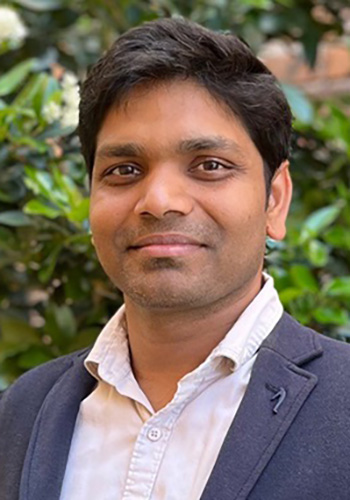
Ram Ratnakar - Adjunct Professor Ram Ratnakar holds the position of Adjunct Professor in the William A. Brookshire Department of Chemical and Biomolecular Engineering at the University of Houston, under the Cullen College of Engineering. His research focuses on energy systems, carbon capture and storage (CCS), fluid properties, and catalytic processes, with a strong emphasis on computational and experimental methods. Research Interests: Developing thermodynamic models for CO2 storage and geothermal applications Designing electrified reactors for hydrogen production and methane reforming Analyzing fluid properties in subsurface systems and well integrity Advancing machine learning approaches for fluid solubility and reservoir characterization Key Contributions: His work addresses challenges in decarbonization, including CCS risks, geothermal energy optimization, and hydrogen supply chain innovation. He has published extensively on topics such as gas solubility in brines, catalytic reactor modeling, and cryogenic storage solutions. Advising & Grants: While specific advisees are not listed, his research collaborations likely involve graduate students and industry partners. Funding sources are not detailed in the provided text. Labs/Teams: Engaged with the Cullen College's energy and materials research groups, contributing to interdisciplinary projects in sustainable energy and subsurface engineering.
Dr. Patrick Lott is a Deputy of the Chair of Chemical Technology and Senior Scientist at the Karlsruhe Institute of Technology (KIT), leading the 'Catalytic Reactors' group. His research focuses on sustainable technologies for reducing pollutants, hydrogen production, and carbon capture, with expertise in catalytic reactor design and heterogeneous catalysis. He holds a PhD from KIT (2019) and has authored over 40 peer-reviewed articles. Awards include the FCTKA Award (2023) and VAA Foundation Excellence Award (2020). His academic career includes roles as Visiting Researcher at the University of Houston (2019) and Junior Scientist at KIT (2016–2019). Research interests span methane oxidation catalysts, pyrolysis processes, and emission control for natural gas and hydrogen engines. Key projects include techno-economic assessments of carbon capture via pyrolysis and spatiotemporal analysis of catalytic reactor performance. Education: PhD in Chemistry (2019), KIT M.Sc. Chemistry (2016), KIT B.Sc. Chemistry (2014), KIT Research Highlights: Development of catalysts for methane oxidation and pyrolysis Dynamic reactor operation for low-temperature emissions Automated microkinetic modeling for heterogeneous reactions Awards: FCTKA Award 2023 VAA Foundation Excellence Award 2020 Dr. Lott collaborates extensively with automotive industries and institutions on emission control systems. His lab combines experimental, numerical, and in-situ characterization methods to advance catalyst design and decarbonization technologies.
Dr. Steffen Tischer serves as a Senior Scientist at Karlsruhe Institute of Technology (KIT), affiliated with the Institute for Chemical Technology and Polymer Chemistry (ITCP) and the Institute for Catalysis Research and Technology (IKFT). He coordinates the Helmholtz Research School for Energy-Related Catalysis, leading computational research on catalytic reactor systems for automotive and energy applications since 2010. His academic foundation includes a PhD in Chemistry from Heidelberg University (2004), an MS in Physics from Otto-von-Guericke-Universität Magdeburg (1999), and a BSc in Applied Physics from the University of Portsmouth (1996). Doctoral research focused on simulating catalytic monolith reactors using detailed chemistry and transport models under advisors Olaf Deutschmann and Jürgen Warnatz. Tischer specializes in computational modeling of reacting flows in structured multi-phase reactors, with core expertise in automotive catalytic converters (three-way catalysts, NOx-storage systems, diesel oxidation catalysts, soot filters), catalytic combustion, and steam reforming processes. His work pioneers washcoat modeling techniques, thermodynamic validation of surface reaction mechanisms, and parameter optimization frameworks that bridge molecular-scale kinetics with reactor-scale performance. Current research emphasizes multi-physics phenomena in solid oxide fuel cells and urea decomposition for emission control systems. Analysis of his publication record (2011-2016) reveals consistent focus on dual-layer catalyst systems, methane reforming kinetics, and aging effects in emission control catalysts. His work integrates computational fluid dynamics with microkinetic modeling to address transport-reaction coupling in monolithic structures, particularly examining spatial temperature profiles, catalyst deactivation mechanisms, and multi-phase interactions in energy conversion systems. Scientific recognition includes: Sophie-Bernthsen-award of Heidelberg University's Faculty for Chemistry and Geo-sciences (2004) As Coordinator of the Helmholtz Research School for Energy-Related Catalysis, Tischer oversees interdisciplinary training programs and collaborative research initiatives. His leadership role involves managing large-scale funding portfolios focused on catalytic technologies for sustainable energy. Long-term collaboration with Prof. Olaf Deutschmann's research group demonstrates sustained contribution to KIT's catalysis research ecosystem through joint publications and model development. Tischer operates within Prof. Deutschmann's research group at KIT, which maintains advanced computational infrastructure for reactor simulation. The team specializes in developing molecular-based modeling tools for heterogeneous catalysis, with applications spanning automotive after-treatment systems, fuel processing, and emission control technologies. Current projects emphasize real-time simulation capabilities and multi-scale modeling approaches for next-generation catalytic systems.
Emiel J.M. Hensen is a Full Professor of Inorganic Materials Chemistry at Eindhoven University of Technology (TU/e). He serves as Dean of the Department of Chemical Engineering and Chemistry and chairs the Netherlands Institute for Catalysis Research (NIOK). His academic journey includes a master's (1994) and PhD (2000) from TU/e, followed by roles at the University of Amsterdam and Shell Research. He has pioneered research in catalytic materials for sustainable energy, including Lewis acid-catalyzed biomass conversion and hierarchical zeolites. Research focuses on designing catalytic materials for renewable fuel/chemical production, using advanced operando characterization (XPS, XAS) and theoretical modeling (DFT). Key applications include methane activation, Fischer-Tropsch processes, and lignin upgrading. He has over 768 publications (41,997 citations) and led projects like 'Interface Catalysis for Advanced Sustainable Chemistry' (2021-2024). Prizes: NWO Vici (2013), Vidi (2007), Veni (2002), Casimir Laureate (2006) Affiliations: NIOK (Chair), ERIC (Board), MCEC Gravitation Program Teaching includes catalysis courses and supervising 187 research projects. His work addresses UN SDGs related to affordable clean energy and sustainable industry.
Carla Isabel Costa Pinheiro is an Assistant Professor at the Department of Chemical and Biological Engineering, Instituto Superior Técnico (IST), University of Lisbon. She specializes in sustainable process engineering with a focus on CO₂ capture technologies using calcium looping, thermochemical energy storage, and catalytic processes. Her work integrates computational modeling, process optimization, and control systems design. Education & Professional Background: PhD in Chemical Engineering (assumed based on academic rank) Postdoctoral experience in process systems engineering Research Interests: Her research addresses decarbonization challenges through innovative process designs, including utilization of industrial wastes as sorbents, solar energy integration in chemical processes, and advanced control strategies for complex systems. Key areas include: Calcium looping cycle optimization CO₂ capture from cement industry emissions Fluidized bed reactor modeling Process intensification via reactive distillation Dynamic simulation of FCC units Key Projects: CaReCI Project: Developed sustainable CO₂ capture solutions using calcium looping with industrial waste materials Modeling of ethyl tert-butyl ether (ETBE) production processes Control strategies for biodiesel extraction columns Thermal energy storage systems for CSP plants Teaching Contributions: Teaches Introduction to Process Control and integrates model predictive control projects into master's programs. Co-developed CAPE-based curriculum for chemical engineering education. Labs & Collaborations: Active in interdisciplinary teams at IST's Chemical Engineering Department, collaborating with industry partners on pilot-scale projects. Leads research groups focused on renewable energy systems and industrial sustainability.
Dr. Panagiotis Kechagiopoulos is a Reader in Chemical Engineering at the School of Engineering, University of Aberdeen, UK, where he has been affiliated since 2014, progressing from Lecturer (2014-2018) to Senior Lecturer (2018-2022) and Reader (2022-present). Education : Doctor of Chemical Engineering (Aristotle University of Thessaloniki), Master in Information Systems (Hellenic Open University), Diploma in Chemical Engineering (Aristotle University). Research Interests : Focus on chemical reaction engineering, microkinetic modeling, heterogeneous catalysis, and novel reactor design for methane and biomass conversion technologies. Key applications include low-temperature steam reforming for hydrogen production, oxidative coupling of methane, and plasma-catalytic systems. Publications Trends : Over 32 publications (2025-2004) spanning methane conversion, catalytic hydrogen production, and sustainable chemical processes. Collaborative work with institutions like Ghent University and industry partners, emphasizing computational modeling and experimental validation. Funding : Principal Investigator (PI) on EPSRC and Royal Society grants for plasma-catalysis and electrocatalysis research, alongside co-investigator roles on BEIS and other EPSRC projects. Teaching & Leadership : Sole contributor to Process Control and Process Plant modules, thesis supervisor for MEng/BEng students, and coordinator for international academic exchanges (Erasmus projects). Active reviewer for 20+ journals including AIChE Journal, Nature Catalysis, and Chemical Engineering Journal.
Efthymios Kantarelis is an Associate Professor at the Royal Institute of Technology (KTH) within the Division of Process Technology. His academic career focuses on applying chemical engineering principles to sustainable energy and material production, emphasizing environmental responsibility. Academic Rank: Associate Professor Institution: KTH - Royal Institute of Technology Research Unit: Division of Process Technology Research interests revolve around Chemical Reaction Engineering and Heterogeneous Catalysis , specifically targeting renewable processes and sustainable products. Key research activities include: Development of Liquid Organic Hydrogen Carriers (LOHC) for renewable hydrogen storage CO2 utilization and carbon capture technologies Selective hydrogenation and C-C coupling processes Aromatization & oligomerization of lower olefins and alkanes Green fuel synthesis from syngas Advanced catalytic cracking methodologies His research integrates dynamic reactor models , kinetics modeling using microkinetic and empirical LHHW frameworks, and innovative catalyst development. Current projects focus on sustainable aviation fuels, process design for industry, and risk management in chemical engineering. Notable affiliations include membership in: Swedish Gasification Centre Center for Production Utilization and Storage of Hydrogen (PUSH) CROSS Project consortium Teaching responsibilities include courses such as Chemical Engineering Principles , Chemical Reaction Engineering , and Risk Analysis and Management . His research group actively explores thermochemical treatment of biomass and waste materials, with emphasis on reactor design and process optimization.
Cecile Daniel is a Research Engineer in Analytical Chemistry at the Institute of Research on Catalysis and Environment of Lyon (IRCELYON), part of the French National Center for Scientific Research (CNRS). She holds a PhD in Chemistry from the University of Lyon (2017) and has been with CNRS since 2000, initially as a Design Engineer in Instrumentation before advancing to her current position in 2011. Her work focuses on developing and managing analytical platforms for adsorption studies, with expertise in both dynamic and static measurement setups. Dr. Daniel's research interests span adsorption techniques including Zero Length Column, volumetric instruments for vapors, and breakthrough instruments for specific applications. Her work has significant applications in heat pumps, material shaping, transport in microporous materials, and capture/separation processes. She possesses extensive technical skills in adsorption tools, porous material characterization, catalytic testing unit design, and high throughput experimentation. Her recent publications (2021-2025) demonstrate a strong focus on nanoporous materials, CO2 capture, and practical applications ranging from space decontamination to agricultural preservation. Her work shows consistent collaboration with researchers like David Farrusseng and Yves Schuurman, with research spanning fundamental material properties to industrial applications. The publications reveal a progression from fundamental adsorption studies toward practical implementations in environmental protection and industrial processes. Dr. Daniel has developed significant expertise in designing catalytic measurement setups and has contributed to numerous studies on material characterization and adsorption phenomena. Her work bridges fundamental research with practical applications, particularly in environmental technologies and sustainable chemistry.
David A. Bruce is Professor and Department Chair of Chemical and Biomolecular Engineering at Clemson University's College of Engineering, Computing and Applied Sciences. His research focuses on catalysis, kinetics, mass transfer, and molecular modeling, with applications in sustainable energy and materials. Key research areas include: Development of heterogeneous catalysts for methane dry reforming and syngas-to-alcohols conversion Selective transformation of lignin/cellulose into value-added chemicals Supercritical water and sonochemical waste treatment technologies Diffusion phenomena in polymers/catalysts Quantum mechanics modeling of catalyst structure-activity relationships His publication record demonstrates consistent focus on catalytic reaction engineering, with recent emphasis on sustainable chemical processes (2015-2024). Articles frequently integrate experimental kinetics with computational modeling and advance renewable fuel/chemical production from biomass and greenhouse gases.
Dr. Andreas Heyden is a distinguished faculty member at the University of South Carolina's Molinaroli College of Engineering and Computing (MCEC), serving as a Professor and Graduate Program Director in the Department of Chemical Engineering. His research focuses on computational modeling of nanomaterials and heterogeneous catalysis, aiming to design energy-efficient catalysts for renewable resource utilization and environmental sustainability. Heyden holds a Ph.D. in Chemical Engineering from Hamburg University of Technology (2005) and completed postdoctoral training at the University of Minnesota under Prof. Donald Truhlar. His academic roles include teaching ECHE 430 (Chemical Engineering Kinetics) and supervising a dynamic research group. Notable recognitions include being a Top 1% ACS Catalysis reviewer (2014) and a Top 2% reviewer (2015). Heyden's work bridges engineering, chemistry, and computer science, with contributions to multiscale modeling, solid-liquid interface reactions, and catalyst design for energy conversion systems. His research group develops novel computational tools (e.g., mixed-resolution modeling, Bayesian uncertainty quantification) and focuses on applications in plastic upcycling, biomass conversion, and solid oxide fuel cells. Key collaborations include projects on perovskite electrolytes and redox-stable anode materials. Heyden has advised over 20 graduate students and postdoctoral researchers, many now in academia and industry worldwide. Publications emphasize catalyst design (e.g., Pt/TiO2 for water-gas shift), solvent effects in reactions, and machine learning for catalysis. Current projects include studying polyolefin hydrogenolysis and developing AI-driven methods for reaction pathway prediction.
Professor Klaus Hellgardt holds the position of Professor of Chemical Engineering at Imperial College London's Department of Chemical Engineering, part of the Faculty of Engineering. His professional experience spans over three decades, including roles as Reader, Senior Lecturer, and Lecturer at Imperial and Loughborough Universities. He has held visiting professorships and conducted postdoctoral research at institutions like the University of Tokyo and Karlsruhe Institute of Technology (KIT). Professor Hellgardt's research focuses on sustainable reaction engineering, catalysis, biomass processing, and biofuel production. He leads projects in flow chemistry, supercritical fluids, and advanced materials, addressing challenges in energy systems and environmental engineering. His affiliations include the Centre for Rapid Online Analysis of Reactions, Industrial Biotechnology Hub, and the Leverhulme Centre for Cellular Bionics. His recent publications emphasize automation in kinetic modeling (e.g., SIMBA algorithm), photocatalytic CO₂ reduction, and sustainable hydrogen production via methane pyrolysis. He has pioneered methodologies for rapid exothermic reaction analysis and enantioselective separation techniques. As a supervisor in Imperial's Chemical Biology Centre (CDT), he mentors doctoral researchers exploring green chemistry and bioprocess engineering. His work integrates computational tools with experimental insights, driving innovation in both academia and industry.
Dr. Marco Sacchi is an Associate Professor and Royal Society University Research Fellow in Physical and Computational Chemistry at the University of Surrey's School of Chemistry and Chemical Engineering. He serves as Theme Leader in Sustainable Energy and Materials Research and coordinates the Energy and Materials Theme within his school. Dr. Sacchi is an elected member of the Council of the Faraday Division of the Royal Society of Chemistry and serves on the Editorial Board of Discover Molecules. MSc in Chemical Engineering PhD in Chemistry from École polytechnique fédérale de Lausanne (EPFL) Swiss National Science Foundation fellowship at University of Cambridge Royal Society University Research Fellowship since 2014 His research focuses on quantum effects in biological molecules (including DNA), surface dynamics, and 2D nanomaterials using first-principles computational methods. Dr. Sacchi leads significant projects on Quantum Tunnelling in DNA, Graphene & 2D-Materials Catalysis, and Surface Chemistry of Spent Nuclear Fuels as part of the EPSRC-funded TRANSCEND network. His work spans multiple Sustainable Development Goals related to clean energy and sustainable materials. Dr. Sacchi's recent publications (2023-2025) demonstrate expertise across quantum biology, surface science, and catalysis on 2D materials, with research trends showing increasing interdisciplinary work connecting quantum effects in DNA with materials science applications. His work on polar bear fur anti-icing properties and DNA mutation mechanisms has received significant media attention. Royal Society University Research Fellow Fellow of The Higher Education Academy Swiss National Science Foundation fellowship Dr. Sacchi actively supervises PhD students including Louie Slocombe, Max Winokan, and Neubi F. Xavier, with research grants supporting multiple projects in quantum biology and sustainable materials. His group maintains strong international collaborations and industry partnerships, particularly in the areas of hydrogen production and environmental catalysis. He is affiliated with the Leverhulme Quantum Biology Doctoral Training Centre, Materials Research Interest Group, Thomas Young Centre, and several national research networks including UK Catalysis Hub and CCP5.
Joe Gauthier is an Assistant Professor in the Department of Chemical Engineering at Texas Tech University, directing the Computational Catalysis Research Laboratory. His work bridges theoretical and applied research in sustainable energy technologies. His academic background includes: Ph.D. in Chemical Engineering, Stanford University (2020) B.S. in Chemical Engineering, The Ohio State University (2015) Dr. Gauthier's research focuses on structure-property relationships for catalyst design in renewable energy systems. His multidisciplinary approach integrates electrochemistry , heterogeneous catalysis , materials science , and data science to develop in-silico methods for understanding catalyst limitations and engineering novel materials. Key applications include ammonia synthesis, CO2 reduction, and nitrate electroreduction for energy storage and environmental remediation. Analysis of his 15 most recent publications (2025-2022) reveals dominant themes in computational electrocatalysis: electric double layer modeling, reaction selectivity optimization (particularly for urea and ammonia), and energy-efficient pathway design. His work consistently emphasizes high-current-density operation and scalability for industrial decarbonization. Dr. Gauthier actively mentors five doctoral researchers and has guided multiple undergraduates through research projects, reflecting his commitment to developing next-generation scientists. His laboratory maintains strong collaborations with experimental groups to validate computational predictions. The Computational Catalysis Research Laboratory operates as a multidisciplinary hub where quantum mechanical simulations meet practical energy challenges, driving innovation in sustainable chemical production.
Ivo Filot is Assistant Professor at TU Eindhoven, specializing in multiscale modeling of catalytic processes. His research combines quantum chemistry with microkinetics to optimize industrial reactions like Fischer-Tropsch synthesis. Key research themes: Reaction pathway analysis Catalyst structure-performance relationships Mesoscale simulation development Seminal work identifies performance principles for Fischer-Tropsch catalysts and mechanistic details of cobalt-catalyzed reactions. Honors: NWO Veni Award for mesoscale catalysis simulations (2017) Industry collaboration with Shell on catalytic process optimization.
Rozemarijn D.E. Krösschell is a Doctoral Candidate in the Department of Inorganic Materials & Catalysis at Eindhoven University of Technology (TU/e). She focuses on catalytic processes, particularly involving CO2 hydrogenation, electrochemical CO2 reduction, and structure-activity relationships in catalytic systems. Education: MSc in Chemical Engineering, TU/e (2020, thesis: Modelling porous catalysts: the effect of tortuosity on catalyst performance ) Research Interests: Her work employs computational methods like Density Functional Theory (DFT) and microkinetic modeling to study catalyst design, reaction mechanisms, and material properties. Key areas include: K promotion effects on Hägg carbide catalytic sites CO2 reduction on Cu/SnO2 surfaces Polymorph influence on TiO2-supported Ni clusters Role of hydrogen coverage in electrochemical systems Labs/Teams: Collaborates with groups led by Prof. Hensen and Dr. Filot, contributing to datasets on CO adsorption properties and catalytic material characterization.