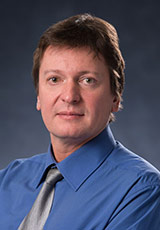
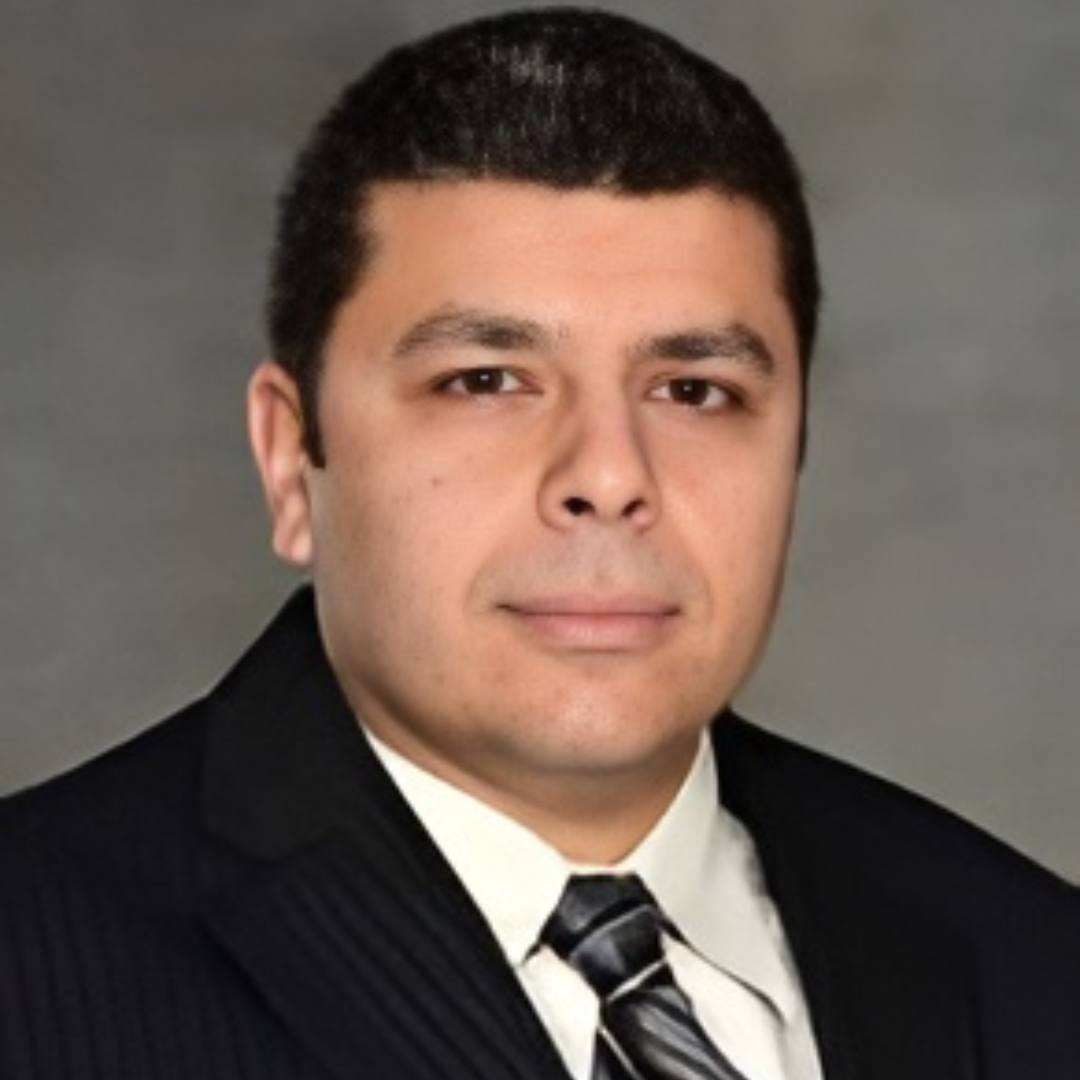
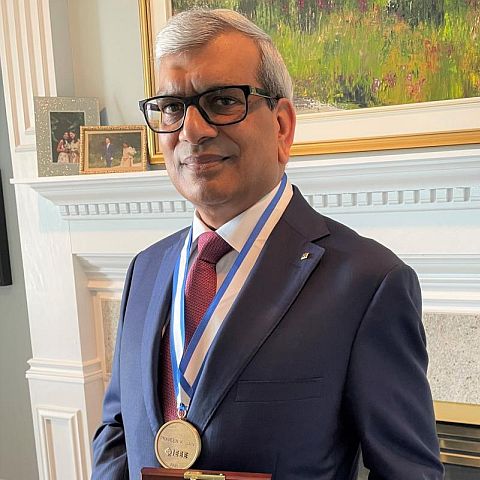
Magdy M. A. Salama is a Professor and University Research Chair at the University of Waterloo's Department of Electrical and Computer Engineering, Faculty of Engineering. He holds a P.Eng. license and is a Fellow of the IEEE. His research spans Energy Systems (Power Quality, Smart Grids, Renewable Energy) and Biomedical Engineering (Medical Imaging, Sleep Analysis). He has authored/co-authored over 460 publications and supervised numerous graduate students. Education: PhD (University of Waterloo), M.Sc. and B.Sc. (Cairo University). Awards include the IEEE Fellow distinction, University Research Chair, and multiple teaching/research awards from the University of Waterloo. Research trends in his articles focus on Smart Grid resiliency, renewable integration, cyber-physical security, and biomedical applications of AI. Notable projects include voltage sag mitigation, EV fleet electrification, and blockchain-based energy trading platforms. Scientific Awards: IEEE Fellow, University Research Chair, Teaching Excellence Award (2000) Grants/Consultation: Extensive industry and institutional collaborations on power systems and biomedical tech. Labs/Teams: Active in High Voltage Lab, Smart Grids Research Group, and Medical Image Processing Lab.
Mariana Resener is an Assistant Professor in the School of Sustainable Energy Engineering at Simon Fraser University (SFU). She holds a Ph.D. in Electrical Engineering (2016) from the Federal University of Rio Grande do Sul, Brazil, alongside M.Sc. (2011) and B.Sc. (2008) degrees in the same field. Her research focuses on optimizing power systems, particularly in distributed energy resources, energy storage, and volt/var control. She teaches courses like Power Electronics and Power Systems Analysis & Design. Her work emphasizes sustainable development in grid planning and energy infrastructure. As a Senior Member of IEEE and an Associate Editor for the Energy Systems Journal (Springer), she contributes to advancing smart grid technologies and renewable integration. Her research spans metaheuristic optimization, stochastic modeling, and grid resilience strategies for distributed systems. Recent projects include hybrid renewable energy systems for substations, EV charging station optimization, and fault analysis in unbalanced grids. She collaborates with industry on practical solutions for grid modernization and reliability enhancement.
Rajesh Karki is a Professor in the Department of Electrical and Computer Engineering at the University of Saskatchewan’s College of Engineering. He holds a B.E., M.Sc., and Ph.D. in related fields. His research focuses on power system reliability, renewable energy integration, and microgrid resilience, with particular emphasis on addressing challenges posed by extreme weather, cyber threats, and decarbonization targets. Dr. Karki’s work spans theoretical modeling, probabilistic analysis, and practical implementation strategies for smart grids, energy storage systems, and distributed generation. His educational background includes advanced degrees in electrical engineering, complemented by professional engineering licensure (P.Eng.). His research has explored diverse topics such as wind energy curtailment mitigation, energy storage optimization, and demand response mechanisms in developing economies like Nepal. He has authored numerous peer-reviewed publications on grid resilience, reliability economics, and cyber-physical system security. Key themes in his work include: (1) quantifying the reliability value of energy storage in active distribution systems, (2) modeling cyber-physical threats to microgrids, and (3) developing frameworks for extreme weather-resilient infrastructure. Despite the volume of his publications (over 50 articles), no specific awards or grants are explicitly listed in the provided materials. His research often intersects technical, economic, and policy dimensions of sustainable energy systems.
Lei Lei is an Associate Professor at the University of Guelph, specializing in Computer Engineering. Her research focuses on Machine Learning/Deep Reinforcement Learning, Internet of Things (IoT)/Internet of Vehicles (IoV), Mobile Edge Computing, and Smart Grid Optimization. She explores cutting-edge applications in energy-efficient systems, autonomous vehicles, and intelligent transportation networks. Her work integrates advanced AI techniques with real-world challenges in communication and control systems. Key research areas include optimizing electric vehicle charging schedules using hierarchical deep reinforcement learning and enhancing vehicular networks through 6G communication protocols. She has pioneered methods for joint communication-control systems, securing federated learning models, and developing robust resource allocation strategies in IoT and edge computing environments. Lei Lei’s publications emphasize interdisciplinary solutions, bridging computer science, electrical engineering, and transportation systems. Her recent work addresses challenges in smart grid security, multitimescale control systems, and the application of AI tools like ChatGPT in connected vehicles. She is affiliated with the AI Affiliated Faculty at the University of Guelph, reflecting her contributions to artificial intelligence research.
Claudio A. Cañizares is a University Professor in the Department of Electrical and Computer Engineering (ECE) at the University of Waterloo. He holds a PhD and MASc from the University of Wisconsin-Madison and an Engineering degree from Escuela Politécnica Nacional in Ecuador. He is an IEEE Fellow and a Professional Engineer (PEng). His research focuses on power and energy systems, including smart grids, microgrids, energy storage, and renewable integration. He has advised over 100 graduate students and postdoctoral fellows, contributing to groundbreaking work in microgrid control, energy management systems, and grid stability. Notable awards include the 2017 IEEE-PES Outstanding Power Engineering Educator Award and the 2022 Award for Excellence in Graduate Supervision. His software contributions include the PSAT (Power System Analysis Toolbox) and SRLS (Smart Residential Load Simulator), widely used for power system analysis and smart grid modeling. He teaches courses such as ECE 6613PD (Power System Analysis) and ECE 467 (Power System Operation and Markets). Key research areas include voltage and frequency stability, distributed energy resources, and transactive energy markets. Collaborations span international institutions and industry partners like the Canadian Renewable Energy Laboratory (CANREL).
Louis-A. Dessaint is a Professor at the Département de génie électrique at École de technologie supérieure (ÉTS). He holds B.Ing., M.Sc.A., and Ph.D. degrees from Polytechnique Montréal. His research focuses on power electronics, renewable energy integration, and smart grid technologies, with affiliations to the GREPCI research group. He has supervised numerous theses and projects, addressing topics like microgrid optimization, energy storage, and voltage stability. Education: B.Ing., M.Sc.A., Ph.D. (Polytechnique Montréal). Research interests include electric machines, power network dynamics, hybrid energy systems, and sustainable development. His recent work emphasizes real-time control of power systems, renewable energy integration, and smart building energy management. Publications highlight advancements in microgrid topology optimization, battery storage systems, and ADRC-based control strategies. Awards include IEEE Fellow (2013) and membership in the Canadian Academy of Engineering (2012). He has advised over 50 students and contributed to projects on smart grids, energy storage, and grid stability. His lab, GREPCI, focuses on power electronics and industrial control.
Akhtar Hussain serves as an Assistant Professor in the Department of Electrical and Computer Engineering at Laval University, Quebec. His research centers on AI-driven optimization of power and energy systems, with emphasis on microgrid resilience, distributed energy resource integration, and electric vehicle-grid interactions. He actively contributes to advancing grid reliability through innovative resource allocation and consumer satisfaction frameworks. Ph.D. in Electrical Engineering, Incheon National University, South Korea (2019) M.Sc. in Electrical Engineering, Myongji University, South Korea (2014) B.Sc. in Electrical Engineering, National University of Sciences and Technology, Pakistan (2011) Dr. Hussain's research spans power systems resilience, smart grid technologies, and equitable energy access. His work integrates artificial intelligence with traditional power engineering to address challenges in microgrid operation, electric vehicle integration, and renewable energy management. Key focus areas include developing algorithms for optimal resource utilization, enhancing grid stability during contingencies, and designing frameworks for fair energy distribution in diverse communities. His recent publications (2023-2025) reveal a strong trajectory toward AI-enhanced grid management, with recurring themes of resilience optimization, equity-focused resource allocation, and electric vehicle-grid synergies. The research demonstrates increasing sophistication in handling uncertainty through machine learning while addressing socio-technical dimensions of energy transition. Dr. Hussain currently supervises one Master's student and has guided five Ph.D. candidates to completion. His research is funded by a Natural Sciences and Engineering Research Council of Canada (NSERC) Discovery Grant ($160,000/year) for the project 'Grid Condition and Resilience-Aware Incentivization and Deployment of Distributed Energy Resources' (2024-2029), supplemented by a Springboard to Discovery award ($40,000) for 2024-2025. As an IEEE member, he collaborates with industry partners on real-world grid modernization initiatives, focusing on practical implementation of resilience strategies through microgrids and mobile energy resources.
Dr. Carl Ho (Ngai Man) is a Full Professor and Canada Research Chair in Efficient Utilization of Electric Power at the University of Manitoba's Price Faculty of Engineering, Department of Electrical and Computer Engineering. Appointed Associate Head (Electrical Engineering) in July 2021, he leads the Renewable-energy Interface and Grid Automation (RIGA) Lab established with CFI funding in 2014. His educational background includes: PhD in Electronic Engineering (2007), City University of Hong Kong MEng in Electronic Engineering (2002), City University of Hong Kong BEng in Electronic Engineering (2002), City University of Hong Kong Dr. Ho's research focuses on power electronics applications for sustainable energy systems, with particular expertise in power conversion technologies for electric vehicles, renewable integration, and smart grid infrastructure. His work bridges industrial application and academic innovation, evidenced by over 40 IEEE journal publications, 80 conference papers, and 20+ patents. Current research emphasizes wide-bandgap semiconductor applications, power hardware-in-loop validation, and DC microgrid architectures for remote communities. Analysis of his recent publications reveals a strong trend toward practical implementation of power electronics solutions, with increasing focus on GaN/SiC devices, grid-forming converters, and modular architectures for microgrids. His work consistently addresses real-world challenges in efficiency, reliability, and cost-effectiveness across renewable integration, electric transportation, and power quality domains. Notable awards include: Second Place Winner for 2018 IEEE Transactions on Power Electronics Prize Paper Multiple IEEE JESTPE Star Associate Editor Awards (2022-2023) IEEE TPEL AE Excellence Award (2023) Best Student Team Regional Award in IEEE Empower a Billion Lives 2019 As an active mentor, Dr. Ho supervises numerous graduate students across multiple cohorts and leads significant research initiatives including NSERC Discovery Grants, MITACS collaborations with Power Integrations Inc., Research Manitoba Innovation Proof-of-Concept Grants, and Natural Resources Canada projects on zero-emission heavy vehicles. His RIGA Lab serves as a hub for industry-academic collaboration with Manitoba Hydro and transportation sector partners. The RIGA Lab, completed in 2016 and renovated in 2019, houses specialized equipment for power electronics prototyping, real-time simulation, and hardware-in-loop testing. Current projects include advanced wireless EV charging, GaN-based controller development, and DC microgrid solutions for remote communities, with recent recognition including a visit from Prime Minister Justin Trudeau in April 2023.
Shivam Saxena is an Assistant Professor in the Department of Electrical and Computer Engineering at the University of New Brunswick, located in Head Hall D65, Fredericton. His research focuses on smart grid technologies, including distributed energy resource integration, blockchain applications for energy trading, electric vehicle-grid interactions, and resilient microgrid design. This work addresses decarbonization challenges through technological and market innovations. Publications demonstrate a strong emphasis on real-world implementation, with field-tested solutions for V2X integration, blockchain-based transactive energy, and distributed control systems. Recent work explores novel applications in agricultural energy management and trust mechanisms for decentralized systems.
Ramadan El Shatshat is an Associate Professor (Teaching Stream) and Director of the Electric Power Engineering Program at the University of Waterloo's Department of Electrical and Computer Engineering. He holds a PhD from the University of Waterloo (2001) and is a registered Professional Engineer in Ontario. His research focuses on distribution system engineering, smart grids, renewable energy integration, and electric vehicle impact analysis. Dr. El Shatshat has received multiple awards, including the James A. Field Teaching Excellence Award (2016) and the University of Waterloo Outstanding Performance Award (2010, 2017, 2021). He teaches courses like ECE 360 (Power Systems and Smart Grids) and ECE 668 (Distribution System Engineering). Education: PhD in Electrical Engineering, University of Waterloo (2001) MSc in Electrical Engineering, University of Garyounis, Libya (1992) BSc in Electrical Engineering, University of Garyounis, Libya (1984) Research Interests: Smart grids and microgrids Optimization for distribution systems Electric vehicles and renewable energy integration AI-based monitoring techniques Awards: 2021 University of Waterloo Outstanding Performance Award 2018 Marsland Faculty Fellowship 2016 James A. Field Teaching Excellence Award Advising & Grants: Supervised/co-supervised 26 students (undergraduate, master's, doctoral, and postdoctoral) His work spans over 50 peer-reviewed publications and patents in fault detection, voltage control, and EV integration.
Yevgen Biletskiy is a Professor in the Department of Electrical and Computer Engineering at the University of New Brunswick (UNB), Fredericton. His academic roles include serving as Co-Director of the RuleML Initiative and Program Co-Chair of RuleML-2007. He holds a Ph.D. and is a licensed Professional Engineer (P.Eng.) in New Brunswick. His teaching spans graduate and undergraduate courses in software engineering, digital systems, and power electronics, including EE 6263 (Knowledge Representation for Software Engineering) and EE 6213 (Advanced Digital Systems). Research Interests: His work focuses on Knowledge-Based Systems , Artificial Intelligence , Semantic Web , Information Extraction , FPGA-based Design , and Renewable Energy . He has supervised over 40 graduate and undergraduate students, including 3 active PhD candidates, 1 completed PhD, 9 Masters, and 30+ research-based Bachelors. Publications: Over 100 peer-reviewed articles, including recent contributions on smart grid optimization, fault diagnosis in power electronics, and ontology-driven systems. Notable works include frameworks for semantic interoperability, rule-based learning systems, and FPGA applications. Professional Activities: Served as a reviewer for NSERC grants, IEEE journals (e.g., TKDE, TE), and conferences (CDC, WTAS). He has chaired tracks at international conferences and contributed to industry partnerships through consulting roles with firms like Netsphare Solutions and Vox Interactif. Labs/Teams: Active in UNB’s research initiatives involving power systems, semantic web technologies, and e-learning systems. His lab collaborates on projects like SEMESIS (semantic search systems) and advanced manufacturing post-processing techniques.
Dr. Walid Morsi Ibrahim is a Professor in the Department of Electrical, Computer and Software Engineering at Ontario Tech University, Faculty of Engineering and Applied Science. His expertise includes Smart Grid design, power systems analysis, and signal processing. He holds a PhD from Dalhousie University (2009), with prior academic positions including Adjunct Professor at the University of Waterloo and Assistant Professor roles at Ontario Tech University and the University of New Brunswick. Education: PhD (2009, Dalhousie), MSc (2002, Suez Canal University), BSc (1998, Suez Canal University) His research focuses on Smart Grid technologies, including signal processing for power systems, automation, and distributed energy resources. Notable contributions include work on electric vehicle integration, transformer aging analysis, and nonintrusive load monitoring using wavelet transforms and machine learning. He has authored over 50 publications in top-tier IEEE conferences and journals. Recent articles highlight his work on electric vehicle load forecasting during the pandemic, fault detection in photovoltaic systems, and transactive energy frameworks for prosumers. Awards include the IEEE PEDG 2010 Best Paper Award and multiple poster awards at Ontario Tech University. Dr. Ibrahim teaches courses on smart grid fundamentals, power systems operation, and information technology for engineers. He has secured grants for research on smart grid monitoring systems and holds patents related to energy management solutions. His work bridges theoretical advancements with practical grid applications, emphasizing resilience and sustainability.
Praveen Jain is a Professor of Electrical and Computer Engineering at Queen's University, where he also serves as Director of the Centre for Energy and Power Electronics Research (ePOWER) and was a Tier 1 Canada Research Chair in Power Electronics from 2001 to 2022. His career spans over 35 years of groundbreaking contributions to power electronics technology and applications. Dr. Jain received his PhD from the University of Toronto in 1987. His research interests focus on power electronics and systems, with particular expertise in resonant power conversion, renewable energy integration, photovoltaic micro-inverters, and electric vehicle power systems. His work has significantly advanced the field through both theoretical contributions and practical implementations. His extensive publication record includes over 600 papers and more than 100 patents, reflecting his sustained innovation in power electronics. These publications demonstrate a strong trend toward renewable energy integration, particularly photovoltaic systems, electric vehicle applications, and advanced converter topologies that improve efficiency and power quality. 2021 IEEE Medal in Power Engineering 2017 IEEE Canada Electric Power Medal 2011 IEEE William Newell Power Electronics Award 2004 Engineering Medal of the Ontario Professional Engineers Fellow of the IEEE Fellow of the Royal Society of Canada Fellow of the Engineering Institute of Canada Fellow of the Canadian Academy of Engineering Dr. Jain has supervised over 100 graduate students, postdoctoral fellows, and power electronics engineers throughout his career. His industry engagement is exceptional, having founded two successful startups: CHiL Semiconductor (acquired by International Rectifier) and SPARQ Systems (listed on the TSX Venture Exchange in 2022). His research has been supported by significant industry partnerships and government funding, reflecting the practical impact of his work. As Director of the Centre for Energy and Power Electronics Research (ePOWER), Dr. Jain leads a vibrant research team focused on advancing power conversion technologies for renewable energy integration, electric transportation, and next-generation power systems. The center maintains strong industry partnerships and has produced numerous commercialized technologies.
Pirathayini Srikantha serves as Associate Professor in the Department of Electrical Engineering & Computer Science at York University's Lassonde School of Engineering, holding a Tier 2 Canada Research Chair in Reliable and Secure Power Grid Systems with critical national security implications for Canada's power infrastructure. Her academic foundation includes: B.A.Sc. in Systems Design Engineering from University of Waterloo (2009) M.A.Sc. in Electrical and Computer Engineering from University of Waterloo (2013) Ph.D. from University of Toronto's Edward S. Rogers Sr. Department of Electrical and Computer Engineering (2017) Professor Srikantha's research centers on game theory, large-scale optimization, and distributed control to enable adaptive power grid operations. Her work addresses cybersecurity vulnerabilities in smart grids through distributed coordination frameworks and develops transactive energy market mechanisms that incentivize grid support during congestion. By integrating AI breakthroughs, she focuses on creating systems that automatically infer, predict, and respond to power disturbances while enhancing infrastructure resilience against evolving threats. Her publication trajectory reveals consistent innovation in grid security and optimization, with increasing emphasis on AI-driven solutions for grid resilience since 2015. Key thematic evolution shows progression from foundational distributed control (2015-2017) to sophisticated cybersecurity applications (2018-2021), consistently appearing in premier venues like IEEE Transactions on Smart Grid. Her scholarly impact is recognized through: Best paper award at IEEE Smart Grid Communications Runner-up best poster award at ACM Women in Computing As Canada Research Chair holder, she directs a federally funded research program addressing critical grid vulnerabilities, while serving as Associate Editor for IEEE Transactions on Smart Grid. Her work bridges theoretical advances in game-theoretic security with practical grid applications, though specific student mentorship details aren't publicly enumerated in source materials. Her research group operates at the intersection of electrical engineering and computer science, developing next-generation tools for grid operators through collaborations with Canadian energy infrastructure stakeholders.
Yasser Mohamed is a Professor in the Civil and Environmental Engineering Department at the University of Alberta . His academic and professional focus revolves around construction engineering, discrete-event simulation, and process optimization for industrial and tunneling operations. He has also explored knowledge engineering techniques and the application of TRIZ (Theory of Inventive Problem Solving) to construction processes. Email: yaly@ualberta.ca Location: 7-269 Donadeo Innovation Centre For Engineering, Edmonton, AB Courses Taught: CIV E 603 (Construction Informatics), CIV E 606 (Design and Analysis of Construction Operations) His research emphasizes modeling construction processes using discrete-event simulation to optimize performance and develop synthetic environments for construction operations. Recent publications, however, indicate a shift toward power systems, focusing on DC microgrids , grid-forming converters , and renewable energy integration . Scientific Awards: None explicitly mentioned in the provided data. Advising and Grants: No formal advisees listed. A co-applicant on a CRD grant (2007–present) for synthetic environments in construction simulation.