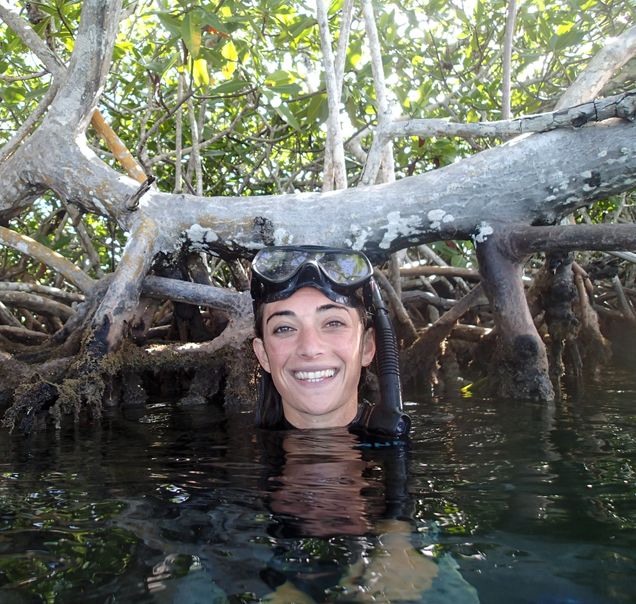
Karina Scavo Lord is a Lecturer in Biology and a core member of the Boston University Marine Program (BUMP) at Boston University. She holds a PhD from Boston University and conducts research in collaboration with the Finnerty and Novak labs. Her work focuses on coral adaptation and resilience in mangrove and seagrass ecosystems, as well as eelgrass thermal tolerance and coastal ecosystem restoration. Her research explores how corals interact with non-reef habitats like mangroves and seagrass meadows, emphasizing their role as 'resilience reservoirs' under climate change. In parallel, she investigates eelgrass populations' genomic responses to rising temperatures, informing conservation strategies. She teaches courses including MR 500: Marine Intertidal Ecology, MR 533: Scientific Diving, and BI 306: Biology of Global Change. Her recent studies highlight phenotypic and genetic differences in corals across habitats, the viability of mangrove-root coral populations, and microplastic impacts on eelgrass meadows. She actively seeks to expand research into New England's subtidal and intertidal ecosystems. Dr. Lord collaborates extensively with marine conservation initiatives and has advised undergraduate researchers in field and lab settings. Her work bridges ecological, genomic, and applied conservation approaches to address global marine challenges.
Loeske Kruuk is a Royal Society Research Professor at the University of Edinburgh and holds an Honorary Professorship at the Australian National University (ANU). Her research focuses on evolutionary ecology, particularly the interplay between genetics and environment in shaping life history variation. She completed her PhD in population genetics at the University of Edinburgh (1997) and conducted postdoctoral work at Cambridge and Edinburgh, studying long-term wild animal populations like red deer and Soay sheep. Her current projects include climate change impacts on evolution, quantitative genetics, and studies on superb fairy-wrens and mosquitofish. Education: BSc in Mathematics, PhD in Population Genetics (Edinburgh), postdoctoral fellowships at Cambridge and Edinburgh. Awards include Fellowship of the Royal Society (2023), ESEB President’s Award (2018), and ARC Future Fellowship (2012). She edits Proceedings of the Royal Society B and has held editorial roles for Evolution and Journal of Evolutionary Biology . Research interests span evolutionary processes, climate adaptation, senescence, and sexual selection. Her work emphasizes long-term studies to explore microevolutionary dynamics. Recent articles address aging in fairy-wrens, climate-driven breeding shifts, and genetic architecture of maternal effects in red deer. Grants include ARC Future and Laureate Fellowships. She collaborates on projects involving bird populations, geckos, and mosquitofish, with a focus on quantitative genetics and phenotypic plasticity. Her lab maintains ties with ANU through honorary roles and continues work on global biodiversity challenges.
Prof. Moran Yehu is a Professor at the Department of Ecology, Evolution and Behavior at the Hebrew University of Jerusalem, affiliated with the Alexander Silberman Institute of Life Sciences. He leads the Department as its elected head. His research focuses on molecular evolution, particularly in cnidarians, exploring microRNA roles, venom evolution, and antiviral systems. He holds a BSc (Tel Aviv University), MSc (Biochemistry, Tel Aviv University), and PhD (2010, Tel Aviv University), followed by postdoctoral research at the University of Vienna. His lab investigates cnidarian development, toxinology, and RNA pathways, contributing to understanding evolutionary mechanisms in complex systems. Research Interests: - MicroRNA regulation in cnidarian development - Evolution of venom and toxin delivery systems - Antiviral immunity in basal metazoans - Ion channel evolution and function Recipient of the ERC Consolidator Grant (2019) for studying antiviral systems in cnidarians. Leading projects on cnidarian viromes and functional genetics of venom components. Key Achievements: - Characterized venom diversity across life stages in sea anemones. - Discovered novel microRNA functions and evolutionary links with plants. - Elucidated mechanisms of cnidocyte biogenesis using CRISPR/Cas9. Awards: - ERC Consolidator Grant (2019) - Selected Exceeding Article award for Yaara Columbus-Shenkar's work (SMART grant). Lab Activities: - Hosts a multidisciplinary team including postdocs, PhD students, and technicians. - Collaborates internationally on venom evolution and antiviral systems.
Colette M St. Mary is a Professor and Associate Chair in the Department of Biology at the University of Florida. Her research focuses on behavioral and evolutionary ecology, particularly reproductive life history evolution, phenotypic plasticity, and the evolutionary aspects of cancer. She integrates field studies, lab experiments, and mathematical modeling, primarily using fish as model organisms. She actively mentors undergraduate and graduate students, emphasizing open communication and collaborative environments. Courses taught include ZOO 6308: Dynamic Optimization Modeling and PCB 4674: Evolution . Her lab explores evolutionary questions ranging from microevolutionary processes to applications in fisheries management. Research interests include animal personality, domestication, and the ecological context of evolutionary changes. Notable projects involve modeling male reproductive strategies in orb-web spiders and analyzing the impact of urbanization on northern cardinal behavior. She emphasizes undergraduate research opportunities and collaborative work with hobbyists and scientists. Her work often bridges theoretical and applied ecology, with publications addressing topics like stem cell niche dynamics and tumor evolution. Students under her supervision have pursued diverse topics such as life-history evolution, fisheries management, and behavioral ecology. Her lab’s recent work includes studies on autotomy in leaf-footed bugs and the evolutionary implications of small stem cell niches. Despite no explicit awards listed, her extensive publication record highlights her contributions to evolutionary and ecological research.
Shannon O'Leary serves as an Associate Professor in the Department of Biological Sciences at Saint Anselm College, contactable via soleary@anselm.edu or 1-603-641-7160. Her academic credentials include: Bachelor of Biological Sciences from Universität Konstanz, Germany PhD in Marine and Atmospheric Science from Stony Brook University, NY Dr. O'Leary specializes in molecular ecology and conservation genomics of marine fishes, utilizing genomic datasets to analyze population connectivity, environmental adaptation, and conservation applications. Her research integrates two primary frameworks: molecular identification techniques (DNA fingerprinting for aquaculture relationships, mixed stock analysis for natal habitat tracking, and genetic barcoding via environmental DNA) and microevolutionary process studies examining pollution/climate change impacts on genetic diversity. She actively incorporates data science methodologies into large-scale ecological analyses. Her research laboratory maintains an online presence at https://olab.netlify.app , supporting ongoing investigations in marine genomics and conservation.
Naomi M. Levine is a Professor at the University of Southern California , leading the Levine Laboratory in Biological Oceanography. Her work focuses on marine microbial ecology, climate-microbe interactions, and carbon cycling through interdisciplinary numerical models. BS in Environmental Science, Vietnam National University of Science, Hanoi (Valedictorian, 2013) PhD in Earth Science, University of Southern California (2017) Postdoctoral training at Princeton University and NOAA GFDL Gabilan Distinguished Professor of Biological Sciences and Earth Sciences Dr. Levine’s research spans microbial evolutionary strategies, phytoplankton-bacteria dynamics, and dissolved organic matter cycling. She integrates metagenomics, proteomics, and computational modeling to explore microbial roles in climate feedback loops and global biogeochemical cycles. Recent publications highlight microbial functional biogeography, DOM modeling, and trait trade-offs in diatoms. Her lab collaborates with CBIOMES and PriME, emphasizing predictive climate modeling and marine ecosystem resilience. Scientific Awards Gabilan Distinguished Professorship Her advisees, including Suzana Leles (UT Austin), Jessica Zaiss-Bowman (NASA), and Xiao Liu (NOAA), contribute to marine science globally. The lab welcomes graduate and postdoctoral researchers through USC’s Marine Biology & Biological Oceanography PhD program.
Professor Tomas Roslin is a prominent ecologist at the University of Helsinki, affiliated with the Faculty of Biological and Environmental Sciences and the Ecosystems and Environment Research Programme. His research focuses on the spatial dynamics of ecological communities, particularly insect-plant interactions and quantitative food webs. Roslin leads the Spatial Foodweb Ecology Group, which investigates how spatial context affects interactions between plants, herbivorous insects, and their natural enemies. Professor Roslin's research spans multiple ecological domains, with particular emphasis on spatial dynamics in food webs, habitat fragmentation, and metacommunity processes. His work demonstrates how spatial context affects not only ecological population dynamics but also microevolutionary processes such as local adaptation. Recent research has increasingly focused on quantitative food webs as descriptors of insect interactions with other trophic levels, addressing general patterns across multiple local food webs and linking food web structure to functioning. His studies often incorporate cutting-edge molecular techniques like metabarcoding to explore biodiversity patterns. Analysis of Professor Roslin's recent publications reveals a strong focus on climate change impacts on ecological communities, particularly in northern ecosystems. His work examines thermal homogenization of boreal communities, latitudinal gradients in species interactions, and the effects of climate warming on Arctic plant-fungus networks. There's also significant emphasis on methodological advances in biodiversity monitoring, including metabarcoding approaches for studying insect microbiota and airborne fungal DNA. His research increasingly addresses conservation applications, particularly for invertebrates. Professor Roslin has received several prestigious awards recognizing his contributions to ecology and mentorship: Academy of Finland Recognition Award (2005) Best tutor of undergraduate students in the Faculty of Biosciences (2007) Commendation for good thesis supervision (2011) Oskar Öflund Foundation "The Big Prize" (2011) Professor Roslin actively supervises students at multiple levels, serving as supervisor or co-supervisor for doctoral theses, pre-examiner of doctoral theses, and member of doctoral thesis committees. His research is supported by numerous projects, including "Mapping Mosquito-Borne Viruses" (2025-2026), "Näringsvävar i matsvamp" (2024-2025), and "Biodiversiteettimuutoksen mittarit ja ek" (2023-2027). He also leads the long-running "Spatial Foodweb Ecology Group" project since 2011. Professor Roslin leads the Spatial Foodweb Ecology Group, which employs innovative approaches to study ecological networks. The group has been instrumental in developing metabarcoding techniques for studying insect communities and their interactions. Recent work includes the Insect Biome Atlas project, which conducted a comprehensive metabarcoding survey of terrestrial arthropods in Sweden and Madagascar, and the Global Spore Sampling Project, which created a standardized dataset of airborne fungal DNA worldwide.
Richard Potts serves as Curator of Biological Anthropology and holds the Peter Buck Chair of Human Origins at the Smithsonian Institution's National Museum of Natural History. As founder and director of the Human Origins Program, he leads ongoing archaeological excavations in partnership with the National Museums of Kenya, focusing on the Rift Valley of southern Kenya and the Homa Peninsula. His interdisciplinary research bridges anthropology, earth sciences, and paleontology to investigate the relationship between environmental dynamics and human evolutionary adaptations. Dr. Potts received his B.A. from Temple University and earned his Ph.D. in biological anthropology from Harvard University in 1982. After teaching at Yale University, he joined the Smithsonian in 1985, where he has maintained a distinguished career spanning nearly four decades. He also serves as curator of the Smithsonian's Hall of Human Origins, which presents the story of human evolution to the public. Potts' research centers on the environmental variability hypothesis, which proposes that fluctuating environmental conditions were a key selective pressure driving human evolution. His work examines how ecological instability shaped hominin adaptations including tool use, dietary flexibility, and social behaviors. Through extensive fieldwork in East Africa, particularly in Kenya's Rift Valley, he has documented how shifting landscapes and climate patterns influenced early human development and dispersal patterns. His approach integrates geological, paleontological, and archaeological evidence to reconstruct ancient environments and their relationship to hominin evolution. Analysis of Potts' recent publications reveals a consistent focus on environmental dynamics and human evolution, with particular attention to Oldowan tool technology, hominin behavioral adaptations, and Pleistocene environmental reconstruction. His work increasingly incorporates interdisciplinary approaches, combining archaeological evidence with geological, paleontological, and climate data to build comprehensive models of human evolutionary processes. The geographic focus remains primarily on East Africa, with significant contributions to understanding the paleoenvironmental context of key hominin sites in Kenya. As director of the Human Origins Program, Potts has mentored numerous researchers and students, fostering collaborative international research projects that have advanced our understanding of human evolution. His work has been supported by multiple research grants that have enabled extensive fieldwork and laboratory analysis, contributing significantly to the development of paleoanthropological methodologies and theoretical frameworks. Potts leads active research teams conducting fieldwork in Kenya's Rift Valley, where they investigate Pleistocene archaeological sites and reconstruct ancient environments. His program collaborates with Kenyan institutions and researchers, maintaining long-term partnerships that support capacity building and knowledge exchange. The Human Origins Program also develops educational resources and public exhibits that translate complex scientific findings about human evolution for broader audiences.