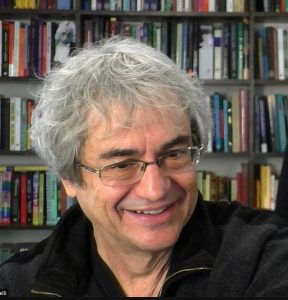
Carlo Rovelli is a Professeur de classe exceptionnelle in the Department of Physics at Aix-Marseille University, holding adjunct roles at Western University's Department of Philosophy and a Distinguished Visiting Research Chair at the Perimeter Institute. He founded the quantum gravity group at the Centre de Physique Théorique (CPT) and is an associate member of the Rotman Institute of Philosophy. His research focuses on loop quantum gravity, relational quantum mechanics, and the history/philosophy of science. He authored influential popular science books including Seven Brief Lessons on Physics (41 languages, 1M+ copies sold) and Helgoland: Making Sense of the Quantum Revolution . Rovelli's work bridges theoretical physics with philosophical inquiry, exploring foundational questions in quantum mechanics, spacetime structure, and the interpretation of physical theories. His recent publications address topics like quantum information theory, gauge symmetries, black hole evaporation, and cosmological implications of quantum gravity.
Simon Stern is a Professor at the University of Toronto Faculty of Law, where he has taught since 2007, holding progressively senior positions from Assistant to full Professor since 2019. He serves as Chair in Innovation Law (2020-present) and Director of the Center for Innovation Law & Policy (2012-present). His research bridges legal doctrines with literary/intellectual history, focusing on legal fictions, the "reasonable man" standard, and intersections between law and sexuality. Ph.D. in English (UC Berkeley), J.D. (Yale), B.A. in English (Yale, magna cum laude) Editor-in-Chief of Yale Journal of Law & Humanities during law school Research interests include: law and literature, legal history, sexuality and the law, criminal law, and intellectual property. His work examines narrative techniques in legal reasoning, evidentiary standards, and historical evolution of legal concepts through literary frameworks. Recent publications analyze legal fictions, reasonable person standard evolution, and 19th-century tort law narratives. He co-edits Oxford University Press' Law and Literature series and the New Rambler Review. 2012 SLS Partnership Award for student advocacy 2023-2026 President of academic organization Serves on SSHRC Insight Grants Committee and multiple editorial boards
Dr. Philippe Campeau is an Associate Clinical Professor in the Department of Pediatrics at the Faculty of Medicine, Université de Montréal. He is affiliated with CHU Sainte-Justine, a major pediatric hospital in Montreal, Quebec, where he works in the Medical Genetics Service. His clinical and research work focuses on genetic disorders affecting children, particularly in the areas of skeletal development and neurogenetics. Dr. Campeau obtained his Doctorate in Medicine from Laval University in Quebec (1998-2003) followed by specialty training in medical genetics at McGill University (2003-2008). He completed postdoctoral training at Baylor College of Medicine (2008-2013), which further developed his expertise in genetic research methodologies. His primary research interests include bone dysplasias , skeletal dysplasias , epilepsy , and epigenetic diseases . Dr. Campeau's laboratory identifies disease-causing genes, deciphers disease pathophysiology, and works to improve the management of children affected by these conditions. His work encompasses exome analysis , functional studies with cell lines and mouse models , and investigations into urea cycle abnormalities . He has made significant contributions to understanding genetic causes of conditions such as Genitopatellar syndrome (KAT6B), osteopetrosis, dysosteosclerosis (SLC29A3), osteogenesis imperfecta, early-onset osteoporosis (WNT1), Yunis-Varón syndrome (FIG4), and DOORS syndrome (TBC1D24). Dr. Campeau's publication record demonstrates a strong trajectory in medical genetics research, with numerous high-impact publications spanning from fundamental genetic discovery to translational research. His work spans skeletal disorders, neurodevelopmental conditions, and epigenetic mechanisms. Recent publications indicate an expanding focus on chromatin modifiers, DNA methylation patterns, and spliceosome function in neurodevelopmental conditions, reflecting the evolution of his research interests toward more complex molecular mechanisms. Dr. Campeau has received several research grants in recent years (6 starting in 2014) from organizations including the Fonds de la recherche en santé du Québec, Canadian Institutes of Health Research, and Fondation Grand Défi Pierre Lavoie. While specific students are not mentioned in the available information, as a clinical professor, he mentors medical students, residents, and research trainees in the Department of Pediatrics. His research is conducted as part of the 'Musculoskeletal Diseases and Rehabilitation' axis at CHU Sainte-Justine Research Center, where he collaborates with international research teams to identify disease-causing genes and develop better management strategies for children with genetic disorders.
David Chalmers is a University Professor of Philosophy and Neural Science at New York University and co-director of the Center for Mind, Brain, and Consciousness. He is also an Honorary Professor of Philosophy at the Australian National University and co-director of the PhilPapers Foundation. His work bridges philosophy, cognitive science, and emerging technologies. Research Interests: Chalmers is best known for his work on the 'hard problem of consciousness'—the challenge of explaining subjective experience. His research spans philosophy of mind, metaphysics, epistemology, philosophy of language, and the foundations of physics and AI. He actively explores the implications of virtual reality, simulation theory, and large language models for philosophy and consciousness studies. Recent Research Trends: His recent publications focus on AI consciousness, the ethical treatment of AI systems, the simulation hypothesis, and the nature of thought in language models. These works reflect a growing engagement with artificial intelligence and digital metaphysics, positioning philosophy at the forefront of technological inquiry. Scientific Awards: While no specific awards are listed in the provided text, Chalmers is widely recognized as one of the most influential contemporary philosophers, particularly in philosophy of mind. Advising and Grants: He mentors students and postdocs, though specific names are not listed. His leadership in the Center for Mind, Brain, and Consciousness and the PhilPapers Foundation suggests active grant-funded research and academic collaboration. Labs and Teams: He co-directs the Center for Mind, Brain, and Consciousness at NYU and the PhilPapers Foundation , both of which support research, publications, and global philosophical discourse in philosophy of mind and related fields.
Franz Huber is an Associate Professor in the Department of Philosophy at the University of Toronto (St. George campus). He holds an MA from the University of Salzburg, Austria, and a PhD from the University of Erfurt, Germany. His primary research areas include Formal Epistemology, Philosophy of Science, Philosophical Logic, and Metaphysics. Huber’s work focuses on belief revision, counterfactual reasoning, and means-end rationality, often employing formal methods to address philosophical problems. His publications include influential books like A Logical Introduction to Probability and Induction (2018) and Belief and Counterfactuals (2021), as well as numerous peer-reviewed articles in journals such as Synthese and Journal of Philosophical Logic . His research explores the foundations of epistemology and metaphysics, particularly through ranking theory and its applications to belief change, counterfactuals, and causal reasoning. Huber has also contributed to the philosophy of science, examining confirmation theory and the logic of scientific reasoning. His recent work emphasizes a means-end approach to philosophical problems, integrating instrumental rationality with normative theory. Huber’s publications demonstrate a commitment to bridging formal methods with traditional philosophical inquiry. His academic contributions include editing volumes on belief revision and co-authoring works on ranking theory. He maintains an active research agenda, reflected in his latest book Causality, Counterfactuals, and Belief (2025). His office is located in the Jackman Humanities Building, and he is affiliated with the University of Toronto’s philosophy faculty and research initiatives such as the Balzan Research Project on Styles of Reasoning.
Dr. Tim Labron is a Professor of Philosophy and Religious Studies at Concordia University of Edmonton, located within the Faculty of Arts' Department of Philosophy, Religious Studies, and Classics. His work bridges philosophy, theology, and religious studies with a focus on Wittgensteinian analysis. Education: PhD, University of Wales; MA, Memorial University; MDiv, Concordia Lutheran Seminary & Lutheran Theological Seminary, Hong Kong; BA, University of Calgary Labron's research focuses on Philosophy of Religion, Epistemology, Science-Religion Interface, Wittgenstein Studies, and World Religions. He has held visiting appointments at institutions like the Soren Kierkegaard Research Centre (University of Copenhagen, 2015) and Yale University (2012). His publications include 5 major books exploring theological philosophy, Wittgenstein's influence, and science-religion intersections, demonstrating sustained scholarly engagement across multiple disciplines. No formal advising or grant information is provided in the text, though his prolific publishing indicates active research collaboration.
Dr. Kenneth MacKendrick serves as Professor and Department Head in the Department of Religion at the University of Manitoba's Faculty of Arts, where his work bridges critical social theory, the study of evil across religious traditions, and the psychological dimensions of religious imagination including imaginary companions and fantasy gaming practices like LARPing. His academic credentials include: PhD in Critical Theory, Ethics, Hermeneutics, and Psychoanalysis (University of Toronto, 2005) MA in Critical Theory and Religion with Feminist Ethics focus (University of Toronto, 1996) BA in Religious Studies (University of Windsor, 1994) MacKendrick's research interrogates how humans inhabit imagined realities through religious frameworks, examining phenomena from Dungeons & Dragons world-building to theological conceptualizations of evil. His scholarship consistently applies Habermasian critical theory to deconstruct metaphysical assumptions in religious discourse while exploring the cognitive foundations of religious experience. His publication trajectory reveals persistent engagement with interdisciplinary methodologies, evolving from early analyses of Habermas's critical theory (2008) toward contemporary investigations of fan cultures and imaginary world-building (2018-2023). The thematic through-line connects theoretical rigor with practical religious phenomena, particularly through his seminal work on evil and its manifestations across global traditions. Actively mentoring graduate students in Master's and PhD programs, MacKendrick maintains robust scholarly productivity as evidenced by his ongoing publications and departmental leadership, though specific research grants remain undocumented in available materials.
Laura U. Marks is the Grant Strate University Professor in the School for the Contemporary Arts at Simon Fraser University (SFU), located on unceded Coast Salish territory. Her work bridges media art, philosophy, and environmental sustainability, with a focus on small-footprint media and intercultural studies. She is a Fellow of the Royal Society of Canada and has held visiting roles at institutions like Harvard University and Zurich University for the Arts. Education: PhD (1996) and MA (1994) in Visual and Cultural Studies from the University of Rochester; BA (1987) in Art History and Sociology from Swarthmore College. Research interests include experimental media, film theory, Islamicate visual traditions, and the environmental impact of digital media. Her recent projects, funded by a Guggenheim Fellowship, explore mitigating streaming media’s carbon footprint through small-file workflows. Key publications include The Fold: From Your Body to the Cosmos (2024) and Hanan al-Cinema: Affections for the Moving Image (2015). Recent talks include keynote addresses at the Eco Media Footprints workshop (Jönköping University, 2025) and the Saudi Film Festival (2025). She co-founded the Substantial Motion Research Network (2018) and the Small File Media Festival, advocating for low-carbon media practices. Awards include the College Art Association’s Mather Award (2017) and the SFU Leadership Award (2021). She actively participates in SFU’s Faculty for Palestine and Council on Islamophobia.
Dr. Troy Michael Bordun is a part-time lecturer in Film Studies at the University of Northern British Columbia and a researcher in contemporary art cinema, celebrity studies, and comics studies. He teaches courses at Concordia University, including Film Analysis and Sociology of Culture. PhD in Cultural Studies, Trent University His research spans superhero comics and philosophy, film theory, and cultural studies. He explores topics like Deleuzian ethics in superhero narratives, haptic visuality in art cinema, and the sociology of online pornography. Recent publications analyze superhero ethics, sensory aesthetics in European cinema, and celebrity authenticity. He curates film festivals and exhibitions on adult cinema and cultural themes. 2018 CUPE 3908-1 Award for Excellence in Teaching 2021 SSHRC Explore Grant 2023 Research Strategic Initiative Grant Bordun’s grants support his work on superhero philosophy and cultural studies. He has contributed to journals such as Studies in European Cinema , Porn Studies , and REDEN .
Dai Heide is a Senior Lecturer in the Department of Philosophy and Associate Dean, Learning and Teaching, in the Faculty of Arts and Social Sciences at Simon Fraser University. He holds a PhD from Ohio State University (2010) and a BA from Northwestern University (2003). His research focuses on Kant’s metaphysics and epistemology, particularly transcendental idealism, freedom, and rationalist philosophy in early modern and contemporary contexts. He teaches courses on 17th- and 18th-century philosophy, metaphysics, and the philosophy of religion. Education: B.A. Philosophy, 2003: Northwestern University Ph.D. Philosophy, 2010: Ohio State University Research Interests: Kantian metaphysics and epistemology Transcendental idealism Freedom and agency Early modern rationalism (Leibniz, Berkeley) Metaphysical and ethical theory His scholarly work engages with systematic unity in Kant’s Critique of Pure Reason , critiques of ontological arguments, and the unity of space in Kant’s pre-critical philosophy. He also explores divine causality and the principle of sufficient reason in early modern thought. Grants & Advising: No explicitly stated grants or advisees listed. He maintains an active role in academic administration through his Associate Dean position, focusing on pedagogical innovation and student learning initiatives.
Zeyad El Nabolsy is an Assistant Professor of Philosophy at York University's Faculty of Liberal Arts & Professional Studies. His research examines African philosophy, Marxist theory, and decolonial epistemology through historical and critical frameworks. Education includes: Ph.D. and M.A. from Cornell University M.A. from McMaster University B.Eng from McMaster University Research focuses on modern African philosophy, analyzing thinkers like Paulin Hountondji, Amílcar Cabral, and James Horton to reconstruct intellectual traditions challenging Eurocentric epistemology. Work emphasizes scientific dependency, Marxist historiography, and critiques of racial ideology. Publications bridge classical German philosophy (Kant/Hegel), Marxian theory, and African thought, exploring how epistemological frameworks shape liberation struggles. Recent articles examine decolonial science studies and the weaponization of theory in anti-colonial movements.
Angela Mendelovici is an Associate Professor in the Department of Philosophy at the University of Western Ontario , with a PhD from Princeton University (2010) and a BA from McGill University . She serves as Graduate Program Chair and is a Member of the Rotman Institute of Philosophy . Education: BA, McGill University PhD, Princeton University, 2010 Her research focuses on the intersection of Phenomenal Consciousness and Intentionality , challenging traditional views through her work on Phenomenal Intentionality Theory (PIT) . She argues for a radically internalistic theory of intentionality where mental states' contents are grounded in their phenomenal character. Recent work includes debates on Reliable Misrepresentation , Tracking Theories , and Combination Problems in Panpsychism. She has contributed to major handbooks and journals, often collaborating with David Bourget . Her publications span topics in Philosophy of Perception , Representationalism , and Non-Propositional Intentionality , with a forthcoming chapter in Non-Propositional Intentionality (Oxford University Press).
Corey W. Dyck is a Professor and Department Chair at the University of Western Ontario , specializing in the history of German philosophy with an emphasis on the 18th century. His work bridges metaphysics and the philosophy of mind from Leibniz to Kant, and he currently leads the UWO Kant Research Group , which maintains a digital archive of German philosophical texts. Academic Background: PhD in Philosophy, Boston College (2006) MA, Catholic University of Leuven (2001) BA, University of British Columbia (1999) His research focuses on Kantian philosophy , 18th-century German thought , and epistemology , particularly in how contemporary philosophy engages with Kant's ideas. He supervises graduate students in classical and contemporary German thought and is editing a monograph titled The First Fifty Years of German Metaphysics (1720-1770). Dyck's publications span edited works like Women and Philosophy in Eighteenth-Century Germany and articles in Journal of the History of Philosophy and Kant-Studien . Dyck contributes to academic communities through the North American Kant Society and Immanuel-Kant-Forum , and he has co-edited volumes such as Kant and his German Contemporaries . His work emphasizes digital preservation of historical texts and inclusive Enlightenment scholarship , particularly regarding feminist contributions in 18th-century Germany.
Alison Laywine is an Associate Professor at McGill University's Department of Philosophy. Her research focuses on Kant, early modern philosophy, and the history of political philosophy. She holds a PhD from the University of Chicago (1991), MA from Université de Montréal (1986), and a BSc from Université d'Ottawa (1984, magna cum laude). Current projects include a book analyzing Kant's philosophical development (1770–1787) and studies on music theory as mixed mathematics in antiquity. Her teaching covers Kant's metaphysics, natural philosophy, and moral philosophy, along with 18th-century scientific thought. Laywine has published widely on Kant's Critique of Pure Reason, early modern epistemology, and figures like Swedenborg and Malebranche. Recent work explores Kant's engagement with Lambert and the philosophical implications of aging. Her research spans multiple subfields including Kant studies, ancient Greek philosophy, and Jewish philosophy. Though no advising or grant details are provided, her CV highlights extensive peer-reviewed contributions and editorial engagements in leading journals such as Kantian Review and Journal of the History of Philosophy .
Professor Gabrielle McIntire is a faculty member in the Department of English Language and Literature at Queen’s University, within the Faculty of Arts and Science. She specializes in British and American literary modernism (1890-1945), with particular focus on poetry, poetics, eco-criticism, psychoanalytic theory, and theories of memory, desire, and the sacred. Education: PhD from Cornell University. She has held SSHRC grants including a Standard Research Grant at Queen’s and a Postdoctoral Fellowship at the University of Toronto. Notable fellowships include residencies at Banff Centre for the Arts and Holywell Manor, Balliol College, Oxford. Research Interests: Modernist poetry and prose Eco-critical approaches to literature Memory and desire in modernist texts Sacred narratives in literary modernism Psychoanalytic criticism Awards: W.J. Barnes Award for Distinguished Teaching (2004) Clark Award for Distinguished Teaching (Cornell University, 2002) SSHRC grants (2008-2012, 2023-2028) Editorial Roles: Editorial board member of Woolf Studies Annual , T.S. Eliot Studies Annual , Twentieth-Century Literature , and The A-Line . Creative Work: Published poetry collections include Unbound (2021) and numerous journal contributions. Her creative writing explores ecological themes, mysticism, and human experience. Teaching: Taught at Cornell University and the T.S. Eliot International Summer School. Known for innovative pedagogy recognized through teaching awards.