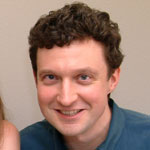
Anthony Hornof is a Professor in the Department of Computer Science at the University of Oregon, part of the College of Arts and Sciences. He has been a faculty member since 1999 and was granted tenure in 2005. His research is centered on human-computer interaction, with strong emphases on cognitive modeling, eye tracking, and assistive technology. He leads an active research laboratory and has secured substantial funding from the National Science Foundation and the Office of Naval Research. University: University of Oregon School: College of Arts and Sciences Department: Department of Computer Science Position: Professor Email: hornof@uoregon.edu, hornof@cs.uoregon.edu Office: 356 Deschutes Hall Phone: (541) 346-1372 Education: B.A. in Computer Science, Columbia University, 1988 M.S. in Computer Science and Engineering, University of Michigan, 1996 Ph.D. in Computer Science and Engineering, University of Michigan, 1999 Research Interests: Dr. Hornof's research lies at the intersection of human cognition and computing. He is particularly interested in understanding and modeling the perceptual, cognitive, and motor processes involved in human-computer interaction. His work uses eye tracking both as an evaluation tool for cognitive models and as a real-time input method for creative expression and accessibility. A major focus is assistive technology, especially developing tools like EyeDraw that enable children with severe motor impairments to create art using only eye movements. He also explores eye-controlled musical compositions, bridging technology and artistic expression. His research is grounded in participatory design, involving end-users directly in the development process. Publication Trends: His recent publications demonstrate a consistent focus on modeling human behavior in complex interactive tasks. Key themes include visual search strategies, dual-task performance, cognitive modeling using eye-tracking data, and accessibility. His work spans top venues in HCI (CHI, TOCHI), cognitive science (CogSci, ICCM), and specialized conferences like ETRA and NIME. There is a strong methodological thread involving data calibration, model validation, and the development of predictive tools for interface design. Scientific Awards: Best Paper Award (Top 1%) at CHI 2014 (two papers) Honorable Mention Paper (Top 5%) at CHI 2010 Siegel-Wolf Award for Best Applied Paper at ICCM 2010 Advising and Grants: Dr. Hornof actively seeks to mentor exceptional undergraduate students, graduate students, and postdoctoral researchers in his lab. He emphasizes rigorous and creative scientific research. He has been awarded over $2.9 million in single-investigator research grants from prestigious agencies including the National Science Foundation (NSF) and the Office of Naval Research (ONR). Notably, he served as an NSF Program Director from 2012 to 2014, contributing to funding decisions for approximately $65 million in research. Labs and Teams: He leads the Human-Computer Interaction Laboratory at the University of Oregon, where interdisciplinary research is conducted on cognitive modeling, eye tracking, and assistive technologies. His team has developed software such as VizFix for visualizing eye-tracking data and has ported the Eyegaze system to Macintosh. The lab fosters collaborations with new media artists and musicians, and engages in participatory design with children who have disabilities.