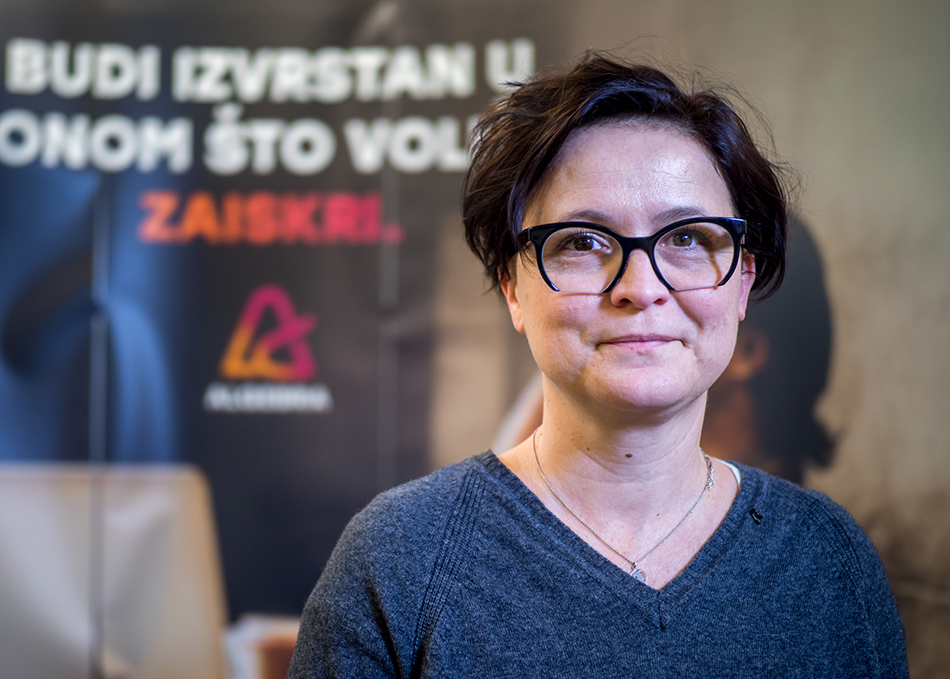
Marina Ninčević is a Senior Lecturer at the Faculty of Agriculture, University of Zagreb, where she has been employed since 2016. She previously held positions as a Scientific Fellow and Postdoctoral Associate at the University of Zagreb and the University of Split. She holds a PhD in Mathematics and a degree in Mathematics Engineering from the Faculty of Science, University of Zagreb. Current Role: Senior Lecturer in Mathematics and Informatics Education: PhD in Mathematics (2004–2012), Math Engineer (1999–2004) Teaching: Courses in Mathematics for agronomy and engineering students Her research focuses on Probability Theory and Dynamic Systems , with applications in mathematical optimization and statistical analysis. Recent publications emphasize educational tools, statistical tasks using R programming, and theoretical contributions to exponential sums and van der Corput sequences. Marina has coordinated projects such as Pripremne radnje za projekt primjene optimizacije proizvodnje obiteljskih poljoprivrednih gospodarstava , supported by the University of Zagreb. Her scientific contributions include fellowships at the University of Zagreb and Split.
Vanja Wagner serves as an Assistant Professor in the Department of Mathematics at the Faculty of Science, University of Zagreb, where she is affiliated with the Division of Probability Theory and Mathematical Statistics. Her academic responsibilities span undergraduate, graduate, and integrated educational programs within the department. Her research focuses on core theoretical and applied mathematical domains: Probability Theory: Stochastic processes and foundational probabilistic frameworks Mathematical Statistics: Statistical inference and data analysis methodologies Financial Mathematics: Quantitative modeling of financial systems Measure Theory: Advanced integration techniques and set functions Dr. Wagner teaches multiple courses including Measure and Integration (undergraduate and graduate levels), Statistics, and Financial Modelling, consistently serving as lecturer in charge. Her instructional portfolio demonstrates deep engagement with both theoretical and applied mathematics curricula. No scientific awards are documented in the available institutional records. Details regarding student supervision, research grants, or laboratory affiliations are not specified in the current departmental documentation.
Mladen Vuković is a Full Professor at the Department of Mathematics , Faculty of Science , University of Zagreb , Croatia. His primary research interests include Mathematical Logic , Modal Logic , and Set Theory . Bisimulation theory in generalized Veltman models Interpretability logic and its computational complexity Applications of mathematical logic in computer science His recent publications focus on modal completeness , generalized Veltman semantics , and logical analysis of hybrid systems . He has also contributed to interdisciplinary research on inflammatory bowel disease and anemia diagnosis . Scientific Awards : Awarded Teacher at the Faculty of Science, University of Zagreb Contact: vukovic@math.hr | Phone: +385 1 460 5899
Darija Korkut is a Senior Lecturer at Effectus University of Applied Sciences, specializing in Finance and Law. With a background in English Studies and a Master's degree from the University of Zagreb, she is currently pursuing a Ph.D. in the Information Society program at the Faculty of Information Studies in Novo Mesto, Slovenia. Education: Faculty of Humanities and Social Sciences (University of Zagreb, English Studies), Ph.D. candidate in Information Society (Faculty of Information Studies). Experience: 10 years at the Ministry of Foreign and European Affairs, 10-year internship at the Ministry of the Interior, and current teaching roles at Effectus University. Her research focuses on analytical methods , game theory , social network analysis (SNA) , and creativity in business environments . Recent publications explore AI perception, intelligence analysis techniques, and applications of SNA in counterterrorism. She has authored seven books and taught at NATO/US EUCOM workshops. Her scientific expertise spans from cognitive modeling to business intelligence, with a strong emphasis on structured analytical techniques and critical thinking. The 2025 article on AI perception in Croatia and 2022 works on security operations highlight her interdisciplinary approach combining technology, psychology, and management. Teaching Contributions: Undergraduate/graduate courses: Leadership Techniques, Knowledge and Innovation Management, Analytical Management, Critical Thinking International certification programs in analytical techniques Publications: Editor and author of "Economic Analysis of International Terrorism"; focus on creativity (4.0), game theory applications, and data science in telecommunications.
Dinko Zima is an Assistant Professor at the Biotechnical Department of the University of Slavonski Brod. With a career spanning over two decades, he has held academic positions at institutions like Polytechnic in Požega (1996–2016) and transitioned through roles such as Senior Lecturer, College Professor, and now Assistant Professor. His expertise bridges environmental science, botany, and sustainable practices. Education: Ph.D. in Biotechnical Sciences, Plant Protection (2012) Master of Science, Nature and Environmental Protection (2008) Professor of Biology and Chemistry (1996) Mathematician-Computer Scientist (1990) Zima's research focuses on ecology , plant protection , and sustainable waste management , with projects like monitoring canopy species in botanically significant areas and collaborations on international environmental education initiatives. His work emphasizes practical applications in conservation biology and rural environmental protection . Scientific activity is documented at CRO RIS , including publications on chemical calculations and botany practicums. He has managed projects such as "Monitoring of canopy species in Pliš-Mališćak-Turjak-Lapjak" for Papuk Nature Park and contributed to educational programs like the High School Environmental Laboratory in Požega. Memberships: Croatian Botanical Society Society of Agronomists Slavonski Brod
Mateja Đumić is an Assistant Professor at the School of Applied Mathematics and Informatics , Josip Juraj Strossmayer University of Osijek, Croatia. With a PhD in Computing from University of Zagreb (2020) and MSc/BSc in Mathematics from University of Osijek, she specializes in genetic programming , automated heuristic design , and combinatorial optimization problems. PhD in Computing (2020), University of Zagreb MSc in Mathematics (2014), University of Osijek BSc in Mathematics (2011), University of Osijek Her research focuses on solving container relocation problems and resource-constrained scheduling through evolutionary computation techniques. She has pioneered automated design of relocation rules using genetic programming , achieving superior performance over manual methods while exploring multi-objective optimization (including energy consumption), ensemble learning for heuristic improvement, and rollout algorithms to enhance solution quality. Recent work demonstrates how genetic programming can outperform traditional metaheuristics in maritime logistics, while her 2024 studies investigate multitask learning approaches for container relocation scenarios. She also explores fitness landscape analysis to optimize genetic programming parameters and develops automated priority rules for both static and dynamic scheduling environments. Professor Đumić teaches computer science , heuristic algorithms , database systems , and mathematical competitions at both undergraduate and graduate levels. She actively participates in international conferences including GECCO , CEC , and COST Action Training Schools .
Dr. Ljerka Jukić Matić is an Associate Professor at the School of Applied Mathematics and Informatics , Josip Juraj Strossmayer University of Osijek . As Head of the Geometry and Mathematics Education Group , her work focuses on: Teacher professional development Digital game-based learning (DGBL) Curriculum resource design and utilization Her recent publications examine: Non-routine task approaches in undergraduate mathematics Constructionist DGBL implementation challenges Longitudinal curriculum material interactions Systematic reviews of teacher professional development Research trends in her 15 most recent articles highlight: Integration of DGBL in secondary mathematics Teacher-student-textbook dynamics Cross-cultural comparisons of mathematical concepts Assessment of conceptual vs procedural knowledge retention She employs mixed-methods research designs, combining: Longitudinal case studies Triangulated data collection Frameworks like curricular noticing and Ref*AER Her work contributes to understanding: Mathematics teacher design capacity Textbook's role in educational reform Implementation of creativity-fostering tasks Remote education challenges during the pandemic
Dr. Sandra Kadum is an Associate Professor at the Department of Primary Education , Faculty of Education Sciences, Juraj Dobrila University of Pula. She has been employed since 2009 and actively contributes to teacher education programs. Born in Pula, completed primary/high school and two-year classroom teaching study at Faculty of Education in Pula Specializes in working with gifted students, didactic dokimology, and pedagogical research Active member of Istrian Mathematical Society as mentor teacher for gifted students Her academic work focuses on natural science education , mathematics pedagogy , and qualitative/quantitative educational research . Scientific Recognition: 2013 Best Student Award from University of Primorska's Faculty of Education Currently teaches courses including Methodology of Environment and Mathematical Concepts , Family Pedagogy , and Professional Practice modules.
Tin Klanjšček is the Head of the Laboratory for Informatics and Environmental Modelling at the Division for Marine and Environmental Research, Ruđer Bošković Institute (Zagreb, Croatia). He holds a Ph.D. in Biological Oceanography from the Woods Hole Oceanographic Institution and Massachusetts Institute of Technology joint program, where he developed expertise in Dynamic Energy Budget (DEB) theory applied to mariculture optimization and pollution impacts. His earlier education includes an engineering degree in physics from the University of Zagreb. His research integrates mathematical modeling with environmental science, focusing on: Dynamic Energy Budgets to analyze organismal growth under environmental stressors. Aquaculture sustainability , including fish nutrition, climate adaptation, and disease management. Ecological risk assessment of pollutants (e.g., nanomaterials, plastics) and invasive species. Marine conservation , particularly for endangered species like loggerhead turtles and bivalves. Recent publications (2022-2025) reveal a strong emphasis on mechanistic modeling of climate change impacts in aquaculture, Vibrio dynamics as water quality indicators, and meta-research on ecological methodology. Work consistently applies DEB theory to practical challenges like optimizing fish diets, predicting pathogen outbreaks, and reducing research inefficiencies. He leads interdisciplinary projects such as PerfeCt (aquaculture climate resilience) and collaborates globally on metabolic theory. His laboratory develops tools for environmental data analysis and ecological forecasting.
Jadranka Pečar Ilić is a Senior Research Associate and Associate Professor at the Ruđer Bošković Institute (RBI) in Zagreb, Croatia, where she works in the Division for Marine and Environmental Research, specifically in the Laboratory for Informatics and Environmental Modelling. She also serves as an Adjunct Associate Professor at the Faculty of Electrical Engineering and Computing (FER) at the University of Zagreb, a position she has held since 2012, having previously been an Adjunct Assistant Professor from 2007-2012. Dr. Pečar Ilić earned her Ph.D. in Technical Sciences, Electrical Engineering (Telecommunications and Informatics) from the Faculty of Electrical Engineering and Computing (FER), University of Zagreb (1996-2001), with her thesis completed at the Division for Marine and Environmental Research of the Ruđer Bošković Institute. She also completed postgraduate studies at FER (1991-1995) and earned her B.Sc. from the Faculty of Electrical Engineering (1985-1990). Her primary research interests focus on Environmental Informatics (Enviromatics), Intelligent Transport Systems (particularly for Inland Navigation), and the development of specialized information systems for environmental protection, river navigation, and river information services. She specializes in formal specification of complex information systems through the integration of GIS and object-relational databases using object-oriented approaches and the Unified Modeling Language (UML). Her work also includes developing interactive dynamic WebGIS applications and services. Dr. Pečar Ilić's publication record demonstrates a clear evolution from foundational work in GIS and database systems for environmental monitoring (particularly for the Danube River Basin) toward more contemporary research on climate change impacts on aquaculture, Vibrio dynamics in marine environments, and real-time environmental monitoring systems. Her recent work (2022-2024) shows a strong focus on climate change adaptation in aquaculture, with several publications analyzing how changing environmental conditions affect marine ecosystems and aquaculture productivity in the Adriatic Sea. Best scientific paper in application of GIS (2005), awarded by ESRI representative with "Cartographica Extraordinaire" "Silver medal Josip Lončar" awarded by the FER Faculty Council for distinguished Ph.D. Thesis (2001) Dr. Pečar Ilić has secured significant research funding through Croatian Science Foundation (HrZZ) projects, Croatian Ministry for Science, Education and Sports (MSES) projects, and international collaborations including INTERREG IIIB CADSES projects and Croatia-France programs. She has served as project leader for the "Adapting Marine Finfish Aquaculture to a Changing Climate - AqADApt" project (2018-2022) and co-leader for the "Assessment of Carrying Capacity for Tourist in Nature Protected Areas - ACCTA" project (2014-2017). Her expertise is recognized through her membership in professional organizations including IEEE and the International Society for Environmental Information Sciences (ISEIS). As part of the Laboratory for Informatics and Environmental Modelling at RBI, Dr. Pečar Ilić contributes to interdisciplinary research teams focused on environmental data management, climate change adaptation, and the development of innovative information systems for environmental monitoring and protection. Her work bridges computer science, environmental science, and practical applications for sustainable resource management.
Marko Bosiljevac is an Associate Professor at the University of Zagreb's Faculty of Electrical Engineering and Computing (FER), specifically within the Department of Communication and Space Technologies. He has held academic roles since 2006, progressing from Research Assistant to his current position. His research focuses on electromagnetic transmission structures, antennas, metasurfaces, remote sensing systems (including ground-based synthetic aperture radars and fiber optic sensors), and biomedical antenna applications. He has been recognized with the Silver Plaque 'Josip Lončar' for his doctoral work and scientific contributions. Affiliations: Member of FER's ERASMUS Committee since 2016, coordinator for Information and Communication Technologies student exchange programs, and elected member of the University of Zagreb Council for Technical Sciences since 2022. Education: PhD (2012) and MSc (2005) in Electrical Engineering from FER. Research Interests: Bosiljevac’s work spans advanced antenna design, metamaterials, biomedical sensors, and remote sensing. He has pioneered glide-symmetric metasurfaces and contributed to implantable antenna development. His research emphasizes practical applications in healthcare, telecommunications, and environmental monitoring. Articles: His publications reflect a focus on antenna innovation, biomedical applications, and radar systems. Recent trends include deep learning integration for object classification and optimizing antenna performance in complex environments. Awards: Silver Plaque 'Josip Lončar' (2012), and ongoing recognition for contributions to antenna theory and biomedical engineering. Advising & Grants: Manages a Croatian Science Foundation project and bilateral initiatives. He has supervised numerous projects and contributed to over 100 publications. His leadership roles include organizing workshops and editorial work for journals like Automatika . Labs & Teams: Co-founded the Applied Optics Lab (AOLab) at FER, focusing on optical sensors, nonlinear optics, and passive optical networks. Collaborates internationally with institutions like EPFL, KTH, and UC3M.
Petra Medvedova , a Lecturer at EFRI, specializes in teaching mathematical and quantitative methods for economics and business decision-making. She instructs courses such as Mathematical Analysis for Economists and Quantitative Methods for Business Decisions , focusing on equilibrium analysis, optimization, differential equations, econometric modeling, and simulation techniques.
Anita Lamprecht is an international lawyer, AI governance expert, and legal researcher based in Geneva. Affiliated with DiploFoundation , she contributes to the Digital Watch Observatory and teaches at the DiploAI Campus on topics like futures literacy , UN 2.0 , and governance applications of emerging technologies. As a consultant and facilitator of AI capacity-building programs, she bridges law and technology through custom AI agents, legal chatbots, and immersive learning experiences for international organizations. Focus on digital transformation's legal dimensions Specializes in AI, digital twins, and metaverse governance Emphasizes ethical alignment with institutional mandates Her research spans AI governance, internet governance, access to justice through technology, and the intersection of digital policy with international law. Notably, she explores how digital twins and virtual environments can reshape urban planning, legal systems, and global development frameworks. Recent publications analyze metaverse governance, AI's implications for diplomacy, and mathematical foundations of AI governance. She advocates for humAInism —a human-centric approach to AI integration in institutional settings. Anita also develops apprenticeship-style AI learning programs to equip professionals with technical and ethical competencies for the AI era.
Igor Weber is a Professor and Head of the Laboratory of Cell Dynamics at the Ruđer Bošković Institute's Division of Molecular Biology in Zagreb, Croatia. With a PhD in Biophysics from Technische Universität München (1995), an MSc in Biophysics from Zagreb University (1992), and a BSc in Physics from Zagreb University's Faculty of Natural Sciences and Mathematics (1988), Dr. Weber has established himself as a leading researcher in cell biology and biophysics. Dr. Weber's primary research focuses on cell motility, cytoskeleton dynamics, biophotonics and bioimaging, small GTPases, and cell signaling, using Dictyostelium discoideum as a model organism. His work has significantly advanced our understanding of how the actin cytoskeleton is regulated during cell migration and endocytosis. He has pioneered techniques for visualizing and quantifying GTPase activity in living cells, particularly focusing on Rac1 dynamics and its role in establishing cell polarity. Dr. Weber's laboratory has made groundbreaking contributions to understanding IQGAP-related proteins and their dual roles in regulating actin dynamics through both effector and sequestrator mechanisms with small GTPases. Analysis of Dr. Weber's recent publications reveals a strong focus on the molecular mechanisms of cell motility and endocytosis, with particular emphasis on the regulation of small GTPases like Rac1 and Ras. His work bridges biophysics, cell biology, and computational modeling, as evidenced by his studies on oscillatory dynamics of Rac1 activity and mathematical modeling of cell migration. The research spans from fundamental molecular mechanisms to potential biomedical applications, including studies on DNA damage response, cancer cell migration, and development of novel imaging probes. Dr. Weber has successfully secured multiple research grants including the current Croatian Science Foundation project (IP-2024-05) on dissecting Rac1 isoform redundancy in Dictyostelium , and the Croatian-Swiss Research Program (CSRP 2017-2023) on phagocytosis and macropinocytosis. As an educator, he teaches courses on Cytoskeleton and Cell Motility at the University of Zagreb, Cell Biophysics at the University of Split, and Advanced Light Microscopy at the University of Zagreb. Professional Leadership: President of Croatian Microscopy Society (2012-2016) Member of Executive Board, European Microscopy Society (2016-2025) President of Croatian Society for Theoretical and Mathematical Biology (2005-2006) Dr. Weber's laboratory serves as a hub for advanced microscopy techniques and cell dynamics research in Croatia. He has organized multiple international microscopy conferences including the Multinational Congress on Microscopy and European Light Microscopy Initiative meetings. His collaborative network spans internationally, with significant collaborations with Pierre Cosson at the University of Geneva and other European research groups.
Ariel Shwayder serves as an LEO Lecturer of Business Economics and Public Policy at the University of Michigan's Ross School of Business and teaches Managerial Economics in the MBA program at Luxembourg School of Business. His academic credentials include: B.A. in Mathematics with Honors, Harvard University Ph.D. in Economics, Northwestern University Shwayder's research centers on macroeconomics and finance, with concentrated expertise in commodities pricing dynamics and the interplay between commodity markets and household economic expectations. His industry background includes management consulting at McKinsey & Company for insurance and banking clients, alongside advisory service to the US Senate Health, Education, Labor, and Pensions committee, bridging policy and economic practice.