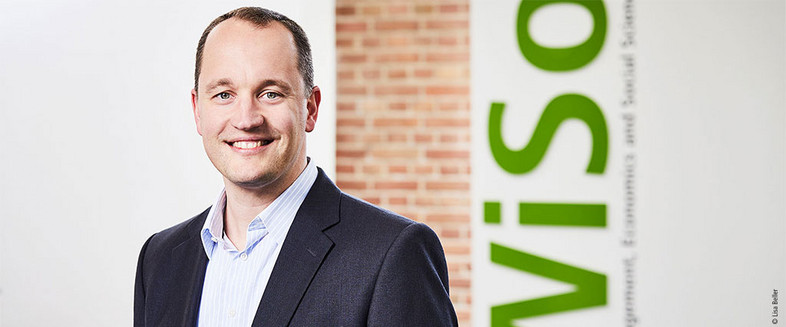
Prof. Dr. Michael Bosnjak leads the Department for Psychological Research Methods at the University of Trier, Germany, focusing on research synthesis methods, theory-driven machine learning, survey methodology, and experimental designs applied to personality psychology (HEXACO model), consumer behavior, and public health. His team includes Dr. Henning Silber (GESIS), Dr. Bernd Weiß (GESIS), and international collaborators at Utrecht University. Affiliation: University of Trier (Department of Psychology) Editorial Roles: Zeitschrift für Psychologie (Editorial Board), Social Science Computer Review (Associate Editor), Frontiers in Psychology (Review Editorial Board) Grants: DFG SFB 884 (co-applicant), DFG Project PaCO (2019-2024, principle investigator), BMBF-funded GESIS Panel Campus His recent publications analyze panel conditioning effects in longitudinal studies, e-commerce privacy dynamics, personality-trait interactions, and psychosis proneness measurement. Scientific awards include the 2016 BMBF infrastructure grant, 2011 Isaac Manasseh Meyer Fellowship, and 2003 Karin Islinger Award. Current projects address data quality in probability-based and opt-in panels, with experimental designs across eight groups testing measurement error mechanisms. He serves as a co-editor for multiple special issues on survey methodology and tourism psychology.
Prof. Marc Fischer is a Professor of Marketing Science and Analytics at the University of Cologne, holding the Morrison Faculty Fellowship at UCLA Anderson School of Management. His research focuses on marketing performance management, analytics, and brand strategy. He has held academic roles at institutions including the University of Technology Sydney and the University of Passau. His work bridges theoretical and applied marketing, with contributions to firm value optimization, dynamic pricing, and healthcare marketing. Education and Career: 2011–current: Full Professor at University of Cologne 2014–2020: Senior International Faculty at UTS Business School 2007–2010: Professor at University of Passau 2003–2007: Assistant/Associate Professor at Christian-Albrechts-University Kiel 2002–2003: Visiting Scholar at UCLA 2001–2002: Consultant at McKinsey & Company Research Interests: Prof. Fischer explores how marketing strategies impact firm value and brand equity. His work emphasizes marketing analytics, including econometric modeling of brand performance, advertising effectiveness, and cross-country marketing dynamics. He also investigates healthcare marketing, particularly in prescription drug markets and physician-patient interactions. Key Contributions: His research has been recognized with awards such as the VHB Best Paper Award and multiple nominations for the Paul E. Green Award. Notable articles include studies on brand leverage potential (Management Science, 2024) and corporate social irresponsibility (Journal of Marketing, 2020). Service and Leadership: Co-leads the Key Research Initiative “Analytics and Transformation” at Cologne CEMS Academic Director (global alliance of 34 business schools) Member of the Rector’s Advisory Commission on Bonus Systems, University of Cologne Advisory Board Member of Analyx GmbH and the Marketing Accountability Standards Board (MASB) Labs and Collaborations: Active in interdisciplinary projects like the HPDnet Emerging Group (healthcare networks for pediatric care), funded by the DFG. Collaborates with institutions such as UCLA, the University of Bonn, and multinational corporations through CEMS.
Fabian J. Sting is a Full Professor and Director of the Department of Supply Chain Management - Strategy and Innovation at the University of Cologne since 2016. He also holds a tenured Associate Professorship in Operations Management at the Rotterdam School of Management, Erasmus University since 2014. His academic journey includes a Ph.D. in Productions Management (summa cum laude) from WHU-Otto Beisheim School of Management in 2008 and postdoctoral work at INSEAD in 2008–2010. University of Cologne : Chair of Supply Chain Strategy and Innovation (2016–present) Rotterdam School of Management : Associate Professor (2014–present), Assistant Professor (2010–2014) Education : Ph.D. (2005–2008), M.Sc. in Applied Mathematics (2005–2007), Diploma in Management Science (2002–2005) Sting’s research bridges operations management, innovation strategy, and supply chain dynamics. Key areas include: Supply chain coordination under uncertainty Employee-driven process innovation and cognitive biases Strategic capacity planning and risk hedging Industry 4.0 implementation challenges Interdisciplinary integration of behavioral and technical elements in operations Recent publications focus on dual sourcing strategies, fairness in operational decisions, and employee mobility’s impact on innovation. He contributes to high-impact journals like Management Science and Production and Operations Management . Sting participates in institutional research initiatives such as: ECONtribute: Markets & Public Policy – a Cluster of Excellence addressing digital transformation, inequality, and market failures through interdisciplinary economics, political science, and law Excellent Research Support Programme (ERSP) – supporting collaborative projects like HPDnet (improving pediatric kidney disease care via health networks)
Dubravko Radic serves as Professor of Service Management at the University of Leipzig's Faculty of Business and Economics since 2009, while simultaneously holding the position of Deputy Head of the Price and Service Management group at the Fraunhofer Center for International Management and Knowledge Economics IMW since 2013. His academic career spans multiple institutions including the University of Wuppertal where he completed his habilitation, and the University of Frankfurt am Main where he earned his doctorate in statistics and econometrics. Doctorate (Dr. rer. pol. summa cum laude): Johann Wolfgang Goethe-Universität Frankfurt a.M. (2004) Habilitation: Bergische Universität Wuppertal (2009) Diplom-Volkswirt: Johann Wolfgang Goethe-Universität Frankfurt a.M. (1999) Research Stay: University of California Davis (2008) Professor Radic's research centers on the intersection of empirical methods and business management, with particular emphasis on service pricing modeling, applied microeconometrics, and social interactions in service contexts. His work bridges theoretical econometric approaches with practical business applications, especially in the healthcare sector where he has led multiple Fraunhofer IMW projects including ASARob, NurMut, and ATMoSPHÄRE. His research methodology combines quantitative modeling with real-world case studies to address strategic and operational decisions in service organizations. His recent publications demonstrate a consistent focus on discrete choice modeling, game theory applications in marketing, and service innovation frameworks. The 2025 paper "Discrete Games in Marketing Research" presented at the Global Marketing Conference in Hong Kong exemplifies his approach of applying advanced econometric techniques to practical marketing problems, particularly in digital service contexts. His work shows an evolving trajectory from foundational service management concepts toward increasingly sophisticated modeling of strategic interactions in service markets. Professor Radic has extensive experience advising major corporations including Metro AG, Lilly Deutschland, IMS Health, Berlin Chemie, and Augustinum gGmbH. His practical projects at Fraunhofer IMW focus on translating academic research into actionable business solutions, particularly in healthcare digitization and service innovation. He has led the TRAIN@MINE project developing training tools for Vietnam's mining sector and contributed to studies on Big Data applications in health insurance. At the University of Leipzig, he leads research activities through the Institute for Service and Relationship Management, supervising multiple research projects that connect academic inquiry with industry applications. His team collaborates with international partners including the University of California Davis, University of Maryland, Northwestern University, and the Technion Israel Institute of Technology, creating a robust research ecosystem focused on service management innovation.
Prof. Jörn Meissner, PhD, is a Full Professor of Supply Chain Management & Pricing Strategy at Kühne Logistics University (KLU) since 2011. He holds a PhD and Master’s in Management Science from Columbia Business School and a Diploma in Business from University of Hamburg . As an academic and entrepreneur, he founded Manhattan Review and Lancaster Executive . Education: PhD in Management Science, Columbia University (2005) Master of Philosophy, Columbia University (2005) Diplom-Kaufmann, University of Hamburg (1997) Research Expertise: Focus on stochastic and dynamic decision-making using mathematical optimization and machine learning Key projects: Global supply chain optimization , Inventory control , Revenue management , and Operations & service management Industry collaborations with British Telecom , British Airways , Apple Europe , and SAP Germany Publication Trends: Recent work addresses intermittent demand forecasting for spare parts, lateral transshipment optimization , and risk-sensitive capacity control Historical contributions include progressive interval heuristics for multi-item lot sizing and dynamic pricing with customer choice models Teaching Experience: Previously held academic positions at Lancaster University Management School , University of Hamburg , and University of Mannheim Developed MBA electives in Advanced Decision Models , Supply Chain Management, and Revenue Management
Prof. Dirk Junker is a Professor at the Osnabrück University of Applied Sciences , Faculty of Agricultural Sciences and Landscape Architecture. He serves as Academic Coordinator for International Study Projects and Head of the Eye-Tracking Laboratory. Urban & Open Space Planning European City Morphology Perception-Based Design Research Focus: His work explores the intersection of urban design and public space through the lenses of European city patterns, modernist ideals, and sensory perception. Key themes include: City-body human spatial behavior Phenomenology of streets Intuitive planning methods Domestication of urban spaces Publications address topics like urban light rituals, post-war city transformations, and experimental housing models. He investigates the dual relationship between landscape and city, emphasizing the courtyard as a foundational urban element. Engagements: Co-founder of the Council for European Urbanism (Germany), Vice-Chair of the Friends of the Dominikanerkirche Art Hall, and advocate for alternative housing models through DAKSBAU cooperative in Dessau.
Martin Schmidt is a Full Professor (W3) for Nonlinear Optimization at the Department of Mathematics, Trier University, since 2019. He has held leadership roles in research training groups and international committees, focusing on mathematical modeling and optimization of energy systems, gas networks, and market equilibria. His work bridges mixed-integer nonlinear optimization , bilevel optimization , and robust methods with applications to real-world energy challenges. Education: PhD in Mathematics (2013), Diplom in Mathematics (2008), both from Leibniz University Hannover. Editorial Roles: Editorial Board member of Journal of Optimization Theory and Applications and Optimization Letters , Associate Editor for OR Spectrum and EURO Journal on Computational Optimization . His research integrates complex physical systems (e.g., gas transmission networks) with game-theoretic models to analyze energy markets. Recent publications emphasize robust optimization , decomposition techniques , and machine learning integration in bilevel frameworks. Awards highlight his contributions to gas market feasibility , linear bilevel optimization , and practical applications in energy systems. Collaborations span institutions like Universidad Zaragoza, Sapienza University, and Forschungszentrum Jülich.
Andrea Walther is a Professor of Mathematical Optimization at the Humboldt University of Berlin, holding a position within the Faculty of Mathematics and Natural Sciences. She leads the Mathematical Optimization research group at the Institute of Mathematics, focusing on algorithmic differentiation, nonlinear optimization, and applied mathematics. Her academic journey includes a Diploma in Business Mathematics (1996, University of Bayreuth), a PhD (1999, TU Dresden), and habilitation (2008, TU Dresden). She has held roles such as Junior Professor at TU Dresden (2007–2008) and Professor at the University of Paderborn (2009–2019) before joining Humboldt in 2019 as a MATH+ Professor. Education : 1991–1996: Studies in Business Mathematics, University of Bayreuth 1996: Diploma in Business Mathematics, University of Bayreuth 1999: PhD in Mathematics, TU Dresden 2008: Habilitation, TU Dresden Her research interests center on optimization methods, particularly algorithmic differentiation (e.g., ADOL-C software), nonsmooth optimization, and applications in engineering and machine learning. She leads initiatives like the Cluster of Excellence MATH+ and contributes to projects such as the Transregio 154. Key Projects: Co-PI of DFG Project 'Mixed-integer non-smooth optimization for gas market problems' (2020–2022) Principal Investigator in MATH+ Projects (EF3-7, AA2-7) Co-developer of ADOL-C, a widely used tool for algorithmic differentiation Notable awards include being a SIAM Fellow. Her work bridges theoretical advancements and practical applications, with contributions to energy sector optimization, inverse problems, and computational frameworks for solving complex systems.
Prof. Dr.-Ing. Jochen Linßen is a Professor at the Institute of Climate and Energy Systems (ICE) , specifically within the Jülich Systems Analysis (ICE-2) group at the Research Center Jülich GmbH. His work focuses on advancing energy systems modeling, renewable energy integration, and hydrogen technology. Key research areas include the techno-economic analysis of energy transition pathways, hydrogen cost-potentials, and the interplay between energy systems and transportation networks. His expertise spans climate policy, infrastructure planning, and the development of frameworks for long-term mobility demand modeling. He has contributed to high-resolution assessments of renewable energy resources and the evaluation of green hydrogen’s role in decarbonizing industries. Recent work emphasizes AI-driven risk mitigation in energy systems and the impact of natural hazards on energy infrastructure resilience. Research Interests: Modeling of energy systems and hydrogen networks Renewables integration and curtailment challenges Transportation electrification and hydrogen fueling infrastructure Climate policy and decarbonization strategies Key Projects: ETHOS. MODE. regional framework for mobility demand analysis Global assessments of wind and solar power potentials Hydrogen supply chain optimization for Germany and Europe His collaborative approach bridges engineering, economics, and environmental science to address systemic challenges in energy transitions. Ongoing efforts include participatory mapping of green hydrogen potentials in sub-Saharan Africa and analysis of automated driving’s impact on road networks.
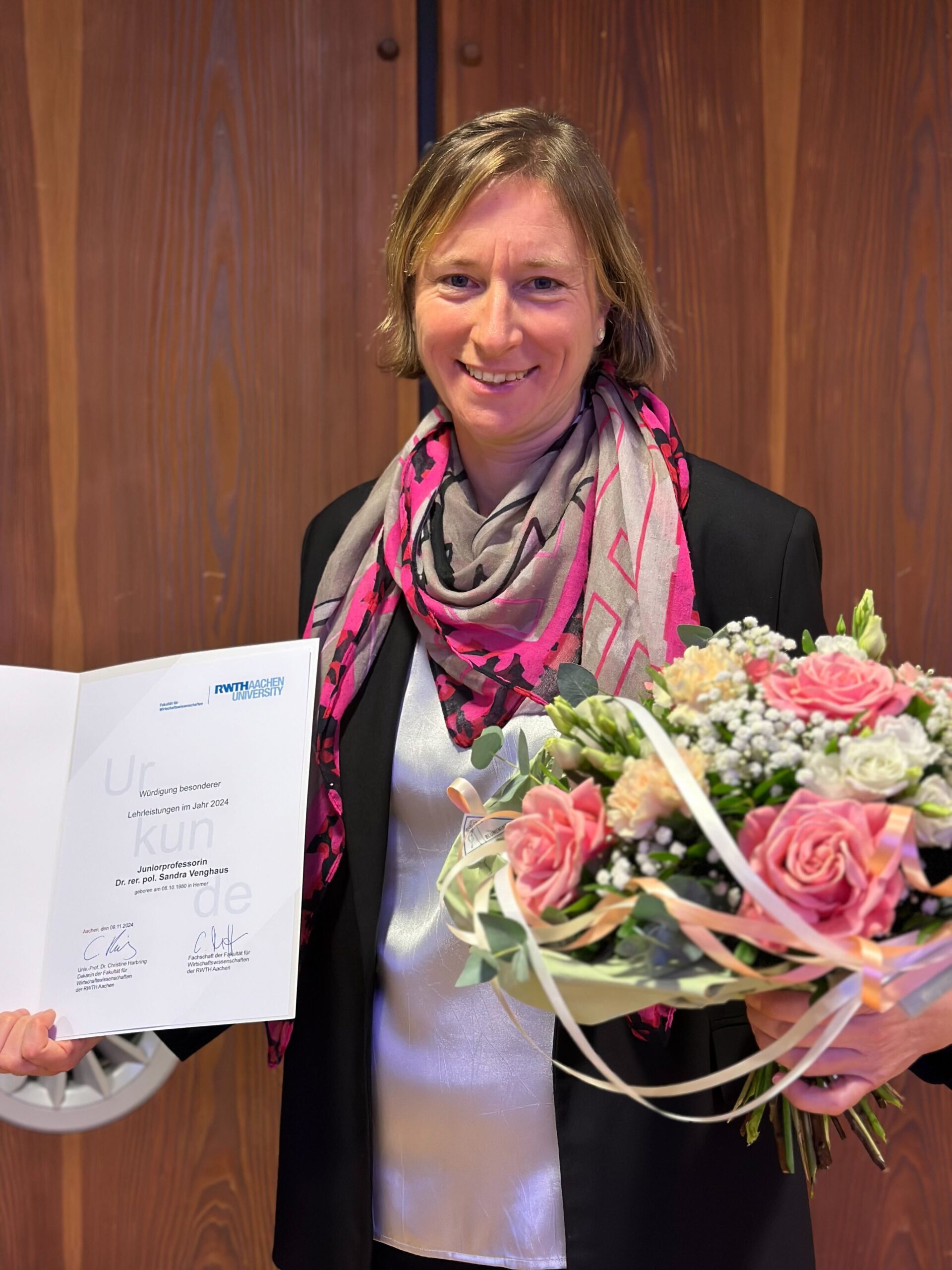
Sandra Venghaus serves as Assistant Professor for Decision Analysis and Socio-Economic Assessment at RWTH Aachen University's Faculty of Business and Economics, leading the dedicated research group in this field. She additionally coordinates the BioSC Competence Platform "Transform2Bio: Integrated Transformation Processes and their Regional Implementations: Structural Change from Fossil Economy to Bioeconomy". Her academic foundation includes: Environmental Science and Public Policy studies at Harvard University (2000-2004) Doctoral degree in Complex System Innovations from Leibniz University Hannover Professor Venghaus's research centers on quantitative modeling of complex socio-ecological systems , specifically analyzing how political decisions impact social, economic, and ecological outcomes. Her work spans critical domains including: Governance of the Sustainability Transformation Innovation in Socio-Ecological Systems Computational Resource Economics Decision Analysis Sustainability Assessment Bioeconomy development Markets, Circular Economy, and Water-Energy-Land Nexus dynamics Recent publications (2023-2024) demonstrate evolving focus on renewable energy market barriers, bioeconomy's climate mitigation potential, and sustainability-digitalization intersections. Her interdisciplinary work integrates energy economics, environmental science, and policy analysis within German and European contexts, emphasizing quantitative assessment frameworks for resource security and transformation pathways. She has received recognition through the Faculty of Business and Economics Teaching Prize. Teaching Prize of the Faculty of Business and Economics Information regarding her advisees and grant funding specifics was not provided in available sources. Professor Venghaus leads the Decision Analysis and Socio-Economic Assessment research group while coordinating the Transform2Bio platform, which drives integrated strategies for transitioning from fossil-based economies to sustainable bioeconomies through regional implementation frameworks.
Dr. Matthias Meckel is a Senior Lecturer in the School of Business, Social & Decision Sciences at Constructor University. Previously, he held academic positions at the University of Central Lancashire, including Principal Lecturer (2020-2023), Senior Lecturer (2007-2020), and Lecturer (2004-2007). His research focuses on e-business strategies for SMEs, organizational technology adoption barriers, and survey methodology. He holds a PhD in e-business strategies for SMEs from the University of Central Lancashire, alongside an MSc in Business Administration with IT (Distinction) and a Diplom-Informatiker (FH) degree. His research interests include digital transformation frameworks for SMEs, healthcare information systems, and cross-channel survey techniques. Notable work includes developing a hospital resource management system using real-time data and analyzing organizational barriers in e-Banking adoption. His publications span journals like Strategic Change and conferences such as the International Conference on Systems and Informatics. Teaching expertise spans business management, information systems, and technology strategy. He has advised numerous projects on SME digitalization and contributed to academic events globally. Currently based at Constructor University's Bremen campus, he continues advancing knowledge in business innovation and technology adoption.
Prof. Dr. Göran Kauermann is a Full Professor of Statistics at the Ludwig-Maximilians-University Munich , holding the Chair of Applied Statistics in Social Sciences, Economics and Business . His research spans nonparametric models, generalized linear models, and network data analysis, with applications in economics, epidemiology, and data science. Education: Diplom in Economic Mathematics (1991, TU Berlin), PhD in Statistics (1994), Habilitation (Venia Legendi) in Statistics (2000) Kauermann’s research interests focus on penalized regression , network analysis , and statistical modeling in economics, social sciences, and public health. Recent work explores label uncertainty in machine learning , spatio-temporal conflict diffusion , and dynamic network models for economic and social data. Scientific trends in his publications include penalized splines for nonlinear modeling, network flow estimation in social and economic contexts, and label variation analysis in machine learning. His collaborations span climate zone classification , Covid-19 mortality modeling , and smart city parking analytics . Scientific Awards: Bruce Russett Award (2020) for political network research Leadership Roles: He served as Dean of the Faculty of Mathematics, Informatics and Statistics (2019–2021), Speaker of the Elite Master Program in Data Science (2016–2026), and Chair of the German Statistical Society (2005–2013). He also held editorial roles in journals like AStA Advances in Statistical Analysis and Statistical Modelling .
Max Planck Institute for Innovation and CompetitionGermany
Prof. Dr. Sabine Pfeiffer holds the Chair of Sociology (Technology – Work – Society) at the Nuremberg Campus of Technology, part of Friedrich-Alexander University Erlangen-Nuremberg. She is an active researcher and thought leader in the sociology of work, with particular expertise in digital transformation, Industry 4.0, and labor capacity. Her work bridges academic research and practical applications in industry, with significant collaborations including the Volkswagen study and advisory roles with government bodies. Professor Pfeiffer's research interests focus on how digitalization transforms work structures and qualifications across various sectors including mechanical engineering, office work, and critical infrastructure. She has developed the Labouring Capacity Index (AV-Index) as a tool to measure living labor capacity and experience as resources for Industry 4.0 transition. Her work examines the intersection of technology, work organization, and social inequality, with particular attention to how workers navigate digital transformation in different occupational contexts. Her recent publications reveal consistent research trends examining the dual transformation of digitalization and sustainability, with particular focus on Volkswagen as a case study. The work explores transformation experience, resources, and readiness across multiple dimensions. She also investigates how AI is perceived and integrated in workplaces, the evolution of office work in digital environments, and the measurement of work through wearables and digital assistance systems. Best Paper Award for keynote speech on 'Work 4.0' at VET Conference in Rostock (2017) Nominated for 'Influencer of the Year 2013' by the Strategy Circle for Mechanical and Plant Engineering Professor Pfeiffer serves on the Council of the World of Work appointed by the Federal Ministry of Labour and Social Affairs, and recently joined the board of directors at bidt (Bavarian Institute of Technology Assessment). She previously served on the Research Advisory Board of the Industry 4.0 Platform and advisory boards at CIDAS. Her research is frequently funded through collaborations with institutions including BIBB (Federal Institute for Vocational Training), WZB Berlin Social Science Center, and industry partners like VDMA. Her work is conducted through the Labouratory research group at the Nuremberg Campus of Technology, which focuses on empirical studies of work in the digital age. The team employs mixed methods approaches including representative surveys, qualitative case studies, and workplace observations to understand the changing nature of work. Recent projects include the diGAP project on good agile project work and studies on digital transformation in mechanical engineering and office work sectors.
Pia Manz is a Researcher at the Department of Energy Technologies and Energy Systems at Fraunhofer ISI since 2017, focusing on energy system transformation pathways with an emphasis on district heating, excess heat utilization, and GIS-based modeling. She holds a PhD from Utrecht University (2024) on 'Towards climate-neutral district heating in the EU,' awarded for her dissertation exploring decarbonization strategies for heating systems. Her educational background includes a Bachelor's in Renewable Energy Technology and Systems Engineering from Nordhausen University of Applied Sciences, complemented by international experience at the University of Dundee, Scotland. During her studies, she gained hands-on research experience as a research assistant at Nordhausen's Institute for Renewable Energy Technology. Manz's research bridges technical analysis and policy design, addressing challenges such as cost-effective integration of renewable and excess heat into district heating systems, hydrogen infrastructure needs in decarbonized energy systems, and spatial analysis of heat potentials. Her work frequently employs geographic information systems (GIS) to model demand sectors and assess policy instruments. Her publication trends show a consistent focus on EU-wide decarbonization pathways, with contributions to studies like 'Achieving climate neutrality in district heating' (2025) and 'Hydrogen Infrastructure in the Future CO2-Neutral European Energy System' (2025). She collaborates extensively with institutions like Utrecht University and the German state of Baden-Württemberg on energy transition scenarios and congestion management strategies. Key contributions include developing the FORECAST model for bottom-up industry sector analysis and pioneering georeferenced databases for industrial excess heat potentials. Her interdisciplinary approach integrates technical, economic, and policy dimensions to advance climate-neutral energy systems.
Prof. Dr. Daniel Piazolo is a Professor for Real Estate Management and Risk Management at the Mittelhessen University of Applied Sciences (THM) . He also serves as Deputy Spokesperson of the Competence Center for Business and Management Science (WuMS) and as a member of the Appraisal Committee for Real Estate Values in Bad Homburg. Previously, he was a Visiting Scholar at Bayes Business School, City University London. Doctorate from Christian-Albrechts-University of Kiel MSc in International and Development Economics from Yale University BSc(Hons) in Economics from London School of Economics His research focuses on real estate sustainability , climate change impacts , digitalization in property management , and risk assessment . Recent studies analyze energy efficiency financial returns, digital twin applications, and automation risks in real estate jobs. Key article trends include: Climate-resilient building strategies (2024) Illiquidity trade-offs in mixed-asset portfolios (2022) Digitalization-driven operational transformation (2019) Energy efficiency benchmarking frameworks (2021) Scientific recognition includes: INservFM Best Paper Awards (2018, 2017) EACES Dissertation Prize (2002) European Investment Bank Special Merit Prize (1999) Daeyang Prize for Economic Integration (1998) He contributes to institutional initiatives like the Competence Center WuMS and collaborates with institutions such as Bayes Business School and University of Stuttgart . His work bridges academia and industry through roles at IPD Investment Property Databank (MSCI) and the DVFA Real Estate Commission.