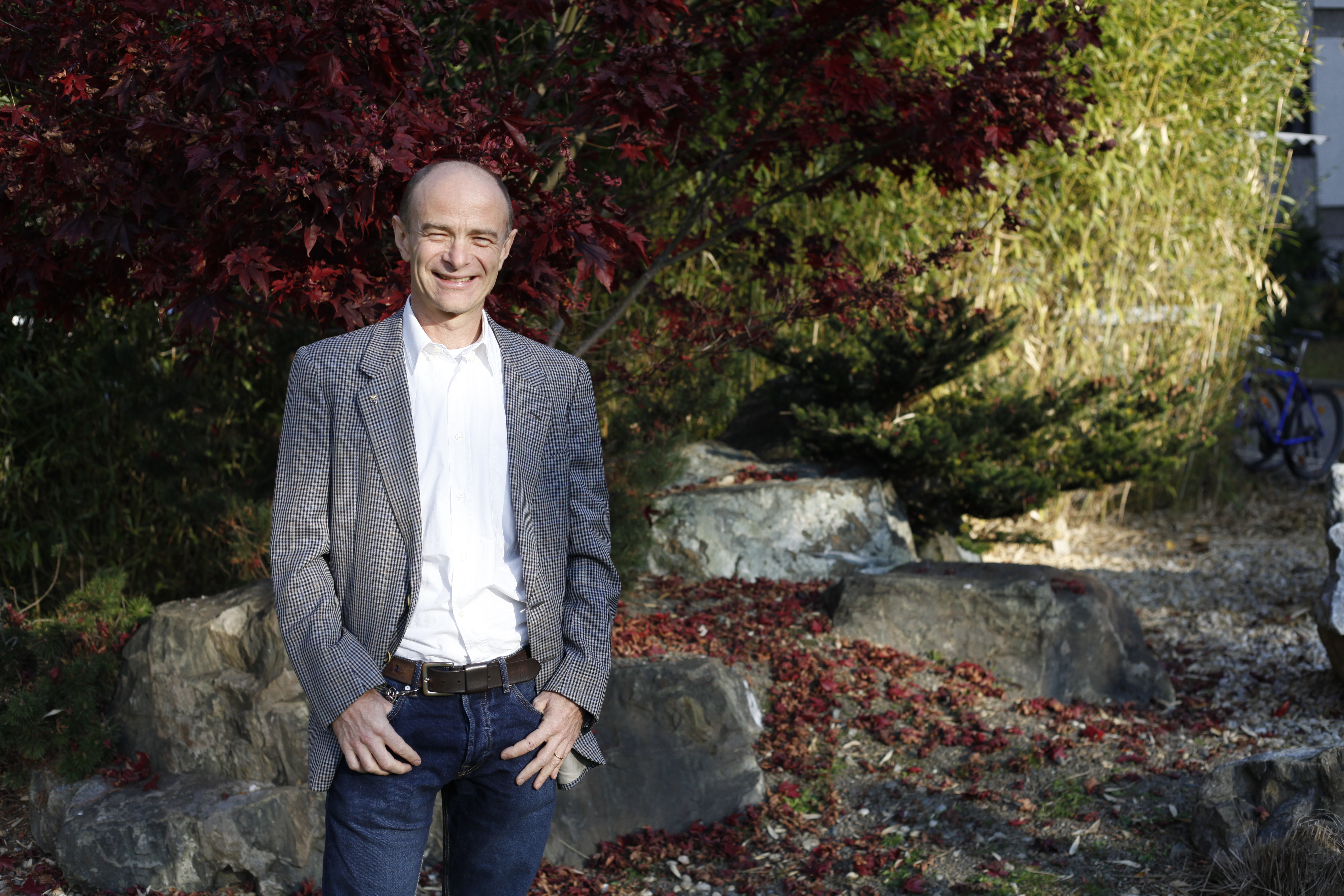
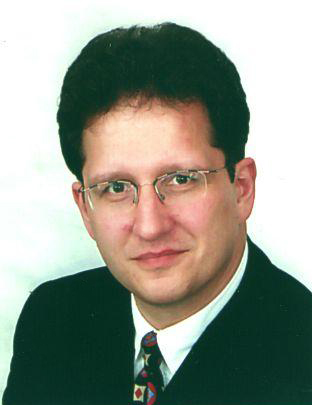
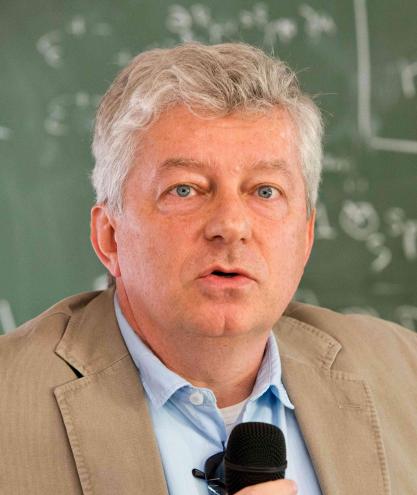
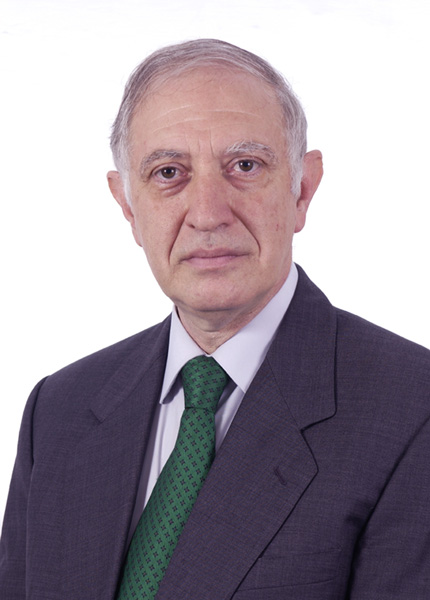
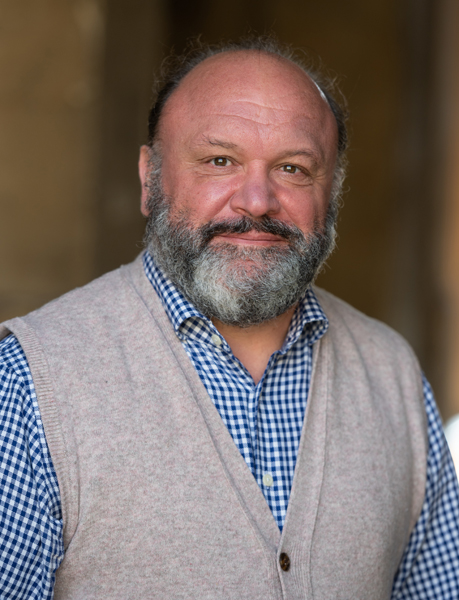
Enrico Arrigoni is a Professor at the Institute of Theoretical Physics - Computational Physics at Graz University of Technology (TU Graz). His research focuses on correlated quantum systems, many-body physics, and nonequilibrium dynamics, with applications to Mott insulators, quantum transport, and photovoltaic systems. He teaches courses such as 'Green's functions in Many-Particle Physics' and 'Atom Physics - Quantum Mechanics'. Recent work explores phonon effects in Mott systems, neural network approaches to quantum states, and impact ionization processes in photodriven materials. His methods include auxiliary master equation techniques and variational cluster approaches. Publications span topics like nonequilibrium steady states, quantum impurity models, and disordered systems. While no specific awards are listed, his contributions to theoretical physics and computational methods are evident through his prolific research output. Advising and grants details are not explicitly mentioned, though his involvement in graduate theses and research projects is implied via available master's and bachelor's thesis topics.
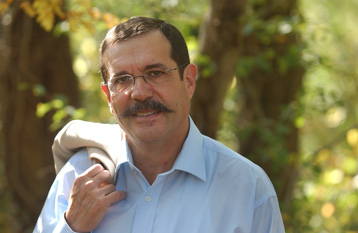
Alain Aspect is a renowned Professor at École Polytechnique and Augustin Fresnel Professor at Institut d'Optique, holding the rank of CNRS distinguished scientist (directeur de recherche de classe exceptionnelle). He has led the Atom Optics group at Laboratoire Charles Fabry since 1992. His career spans roles from assistant lecturer (1969–1971) to distinguished academic positions across institutions, including the Collège de France and international academic fellowships. His research focuses on quantum optics, foundational tests of quantum mechanics (e.g., Bell's theorem experiments), laser cooling, and ultra-cold atoms. Notably, his groundbreaking work violating Bell’s inequalities earned him the 2022 Nobel Prize in Physics. His contributions also include pioneering quantum information science and atom optics. Aspect has received over 30 prestigious awards, including the Balzan Prize, Wolf Prize, and multiple honorary doctorates. He is a member of the French Académie des Sciences, the Royal Society, and the U.S. National Academy of Sciences. His lectureship engagements include the Elliott W. Montroll Lecture (U of Rochester) and the Asher Peres Memorial Lecture (Technion). Aspect’s research groups at Laboratoire Charles Fabry have advanced Bose-Einstein condensates, quantum correlations, and Anderson localization of matter waves. His work bridges experimental quantum optics with foundational physics, influencing both theoretical and applied quantum technologies.
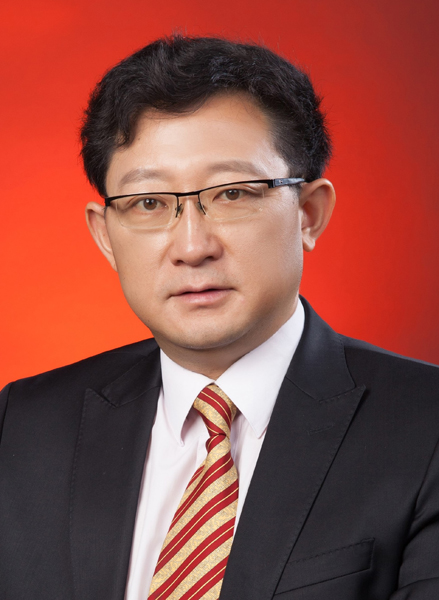
Jie Meng is a Professor at the School of Physics, Peking University (1997–present), Cheung Kong Professor (2000–present), and Professor of Extraordinary at Stellenbosch University (2006–present). He has held visiting positions at the University of Edinburgh, GSI Helmholtz Centre, Tohoku University, and Kyoto University, among others. Education: Ph.D. in Theoretical Nuclear Physics, Peking University (1988–1991) M.Sc. and B.Sc. in Physics, Southwest China Normal University (1982–1988) His research focuses on theoretical nuclear physics , particularly energy density functional theory , exotic nuclei (e.g., neutron halos), nuclear structure , nuclear chirality , and nuclear astrophysical applications like r-process nucleo-cosmochronology. He has also contributed to computational physics and effective field theories for triaxially deformed nuclei. His publications span 400+ refereed articles , with highlights including studies on relativistic Hartree-Bogoliubov theory , neutron halos , chiral nuclear rotation , pygmy dipole resonances , and isoscalar-isovector splitting . His work bridges nuclear structure theory with experimental nuclear physics and nuclear astrophysics . Scientific awards and honors: 2017 Top ten scientific and technological progress of Chinese universities for 2016 2014 First Prize for Natural Science in Chinese Universities, Ministry of Education 2012 American Physics Society (APS) Fellow 2010 GENCO Membership Award, GSI Exotic Nuclei Community 2009 Achievement in Asia Award (ROBERT T. POE PRIZE) 2008 Khwarizmi International Award (Iran) 2007 WU You-xun Prize, Chinese Physics Society 2001 & 2000 multiple National Science Foundation awards He has supervised over 40 Ph.D. students and postdocs and serves on editorial boards including International Journal of Modern Physics E . His leadership roles include Founding Dean at Beihang University and chairing the Nuclear Structure Division of the Chinese Physics Society.
Prof. Dr. Hunger Brezinova is an Assistant Professor at TU Wien's Institut für Theoretische Physik. Her research focuses on quantum many-body systems, strong-field atomic physics, and reduced density matrix methods. She leads projects on adaptive quantum propagation techniques and two-particle density matrix theories for attosecond correlation dynamics. Main Affiliation: E136 - Institut für Theoretische Physik Key Research Areas: Attosecond Science, Quantum Correlations, Non-Equilibrium Dynamics, Strong Laser Fields Her work bridges theoretical developments with computational methods, particularly in simulating ultrafast electron dynamics in atoms and condensed matter systems. Recent studies include ionization processes in helium, fermionic Hubbard models, and coherence effects in Bose-Einstein condensates. Publications highlight advancements in density matrix formalisms and their applications to non-equilibrium systems. She advises PhD students like Stefan Donsa and Fabian Lackner, contributing to foundational studies in quantum many-body theory.
Eivind Osnes is a Professor in the Department of Physics at the University of Oslo, Norway, where he has held a faculty position since 1985. He previously served as Department Chair during two periods (1991-1997 and 2003-2008). His academic career began with a Docent position at the same institution in 1977. Osnes is a member of the Norwegian Academy of Science and Letters and was awarded the King's Medal of Merit in gold in 2009 for his contributions to theoretical nuclear physics. His primary research focuses on theoretical nuclear physics, particularly in the areas of nuclear structure, shell model calculations, and effective interactions. Osnes has made significant contributions to understanding nucleon-nucleon interactions, pairing correlations in nuclear systems, and the application of realistic effective interactions to various nuclear systems. His work spans from fundamental theoretical developments to practical applications in nuclear spectroscopy and the study of exotic nuclei, including extensive research on tin isotopes and doubly-magic nuclei like 100Sn. Analysis of Osnes' publication record spanning over four decades reveals consistent focus on developing and applying microscopic nuclear models. His research shows evolution from early work on particle-rotor models to sophisticated large-scale shell model calculations, particularly for tin isotopes and other regions near shell closures. A notable trend is his sustained collaboration with researchers like Morten Hjorth-Jensen and Torgeir Engeland, producing influential work on effective interactions and nuclear many-body theory that bridges fundamental physics with computational implementations. His scientific recognition includes: Member of the Norwegian Academy of Science and Letters King's Medal of Merit in gold (2009) While specific details about research grants and student supervision aren't explicitly documented in the provided materials, Osnes' extensive publication record with numerous collaborators suggests significant research leadership. His work has involved both theoretical developments and computational implementations that would typically require substantial research funding and student involvement in nuclear physics research. His long-standing position at the University of Oslo indicates deep integration within the institution's nuclear physics research environment, contributing to theoretical nuclear structure physics through both individual scholarship and collaborative efforts.
David Bernhard Blaschke is a Full Professor at the Institute for Theoretical Physics, University of Wroclaw, Poland. He also holds positions as Leading Scientist at the Bogoliubov Laboratory for Theoretical Physics at JINR Dubna, Russia, and has held numerous visiting positions at universities including Rostock, Bielefeld, and Rostock. He is an elected member of Academia Europaea (2012) and serves as Editor in Chief of the European Physical Journal A (2018-2025). Blaschke's research focuses on quantum field theory at finite temperature, dense hadronic matter and QCD phase transitions, quark matter in heavy-ion collisions and compact stars, and pair production in strong fields with applications to high-intensity lasers. His work has established important connections between theoretical physics, nuclear physics, and astrophysics, particularly in understanding the properties of matter under extreme conditions. His recent publications reveal a strong focus on the equation of state for dense matter and its implications for neutron star observations, QCD phase diagram studies constrained by compact star data, quantum kinetics of particle production, and the physics of the first observed compact star merger event. These works demonstrate his interdisciplinary approach spanning theoretical physics, nuclear physics, and astrophysics. Chair of the European Science Foundation Research Networking Programme 'Physics of Compact Stars' (2008-2013) Vice Director of the Bogoliubov Laboratory for Theoretical Physics of JINR Dubna (2001-2007) Elected Member of Academia Europaea (2012) Editor in Chief of European Physical Journal A (2018-2025) Blaschke has led multiple significant research grants including an NCN Maestro Grant on 'Dynamics of correlations in dense hadronic matter' (2012-2017), an NCN Opus Grant on 'Quantum kinetics of particle production in strong fields' (2015-2018), and an NCN Opus Grant on 'Neutron stars: birth, structure and mergers' (2020-2023). He coordinates the Falling Walls Lab Wroclaw and has served as MC Representative for multiple COST Actions including 'NewCompStar', 'THOR', and 'PHAROS'. He is actively involved in organizing major international conferences and workshops on compact stars, strong correlations in dense matter, and quantum field theories at extreme conditions, maintaining a strong international research network spanning Europe, Russia, and beyond.
Liviu Chioncel is a Senior Lecturer at the Institute of Theoretical Physics (Computational Physics Department) at Graz University of Technology. His research focuses on theoretical and computational approaches to many-particle physics systems.
Ubirajara van Kolck is a Professor in the Department of Physics at the University of Arizona, holding Affiliate Professor positions at the University of Washington and the Institute of Theoretical Physics, Universidade Estadual Paulista. His academic journey includes roles such as Directeur de Recherche at CNRS (2012–present), and他曾担任美国能源部杰出初级研究员(2001–2004)。他的研究聚焦有效场论(EFT)在核物理和粒子物理的交叉应用,特别是在强相互作用系统和轻核结构方面。 研究兴趣 : 多体问题、单位原子系统、有效场论、强相互作用、轻核、基本对称性。 奖项 : 包括2020年赫尔曼·费希巴赫理论核物理学奖、2015年保罗·朗之万奖,以及美国物理学会会士(2004)。 他的研究团队参与国际核理论协作,如核理论组(University of Washington)和南美基础物理国际理论中心(巴西)。研究重点包括从量子色动力学推导核力、时间反演违反现象,以及有效场论在原子核和粒子物理中的应用。
Christopher Albert is an Associate Professor at Graz University of Technology, specializing in plasma physics and computational material science. His research focuses on magnetic confinement fusion, particularly in stellarators and tokamaks, with emphasis on guiding-center orbits, neoclassical transport, and MHD equilibrium modeling. He leads experimental initiatives like ALPES (Adaptable Lab for Plasma Experiments in Stellarators) and contributes to international fusion projects including EUROfusion and Wendelstein 7-X. Research Themes: Plasma dynamics, symplectic integration methods, magnetic perturbation effects, and fusion reactor diagnostics. Key Projects: ALPES lab development, EU-DEMO 3D coil optimization, and kinetic-MHD coupling models. Publication Trends: Recent work spans stellarator transport modeling, uncertainty quantification for MHD reconstructions, and resonant magnetic perturbation analysis across 15 articles (2023-2025).
Dr. Robert Keil is a Research Fellow at the Department of Experimental Physics, University of Innsbruck, Austria. His research focuses on quantum optics, many-particle interference, and hybrid quantum networks. He teaches courses in photonics and electromagnetism, including 'Photonik' and 'Physik2 - Elektromagnetismus und Optik'. Academic Role: Senior Scientist (Research Fellow) Affiliation: University of Innsbruck, Department of Experimental Physics Research Interests: Quantum Optics: Investigating non-interacting particles and photon interference phenomena Hybrid Quantum Networks: Developing photonic interfaces for quantum communication Quantum Mechanics Tests: Precision multi-path interferometry experiments Funding: Current projects include FWF-funded research on single-photon spectra and hybrid photonic circuits. Previous grants include studies on many-particle interference and foundational quantum tests.
Rainer Blatt is a University Professor at the University of Innsbruck , affiliated with the Department of Experimental Physics . He also contributes to research at the Institute for Quantum Optics and Quantum Information of the Austrian Academy of Sciences. His work focuses on quantum computing, quantum simulation, and quantum optics using trapped ions. Research Interests: Blatt specializes in advancing quantum technologies through trapped ion systems. His research encompasses quantum gate operations, entanglement engineering, and simulation of complex many-body physics. He explores error-corrected architectures and topological phases for scalable quantum computing. Recent Publications: His articles highlight a strong emphasis on trapped ion quantum processors, lattice gauge theories, and entanglement dynamics. Topics include fault-tolerant error correction, symmetry-protected phases, and suppression of spontaneous emission, reflecting cutting-edge contributions to quantum information science. Collaborations: Blatt is associated with the Department of Experimental Physics and the Institute for Quantum Optics and Quantum Information , both based in Innsbruck, Austria. His research integrates experimental and theoretical quantum technologies.
Yanliang Guo is a Researcher at the Department of Experimental Physics, University of Innsbruck, Austria, with office location at Technikerstraße 25/4.OG, Raum 4/21. His work centers on cutting-edge experimental quantum physics within the research group led by Univ.-Prof. Hanns-Christoph Nägerl. His research focuses on Ultracold Quantum Gases , Bose-Einstein Condensation , and Many-Body Quantum Dynamics . Key investigations include anyonization phenomena in 1D bosonic systems, dimensional crossovers in strongly interacting gases, and many-body dynamical localization . His experimental approach utilizes novel trap geometries like ring and shell configurations to probe exotic quantum states. Recent publications (2021-2025) reveal a consistent trajectory in quantum simulation, particularly in observing theoretically predicted phenomena such as Bethe strings and anomalous cooling via dimensional reduction. The work demonstrates Austria's leadership in ultracold atom research through the University of Innsbruck's experimental facilities.
Francesco Iachello is the J.W. Gibbs Professor of Physics at Yale University, a position he has held since 1990. He is a distinguished theoretical physicist with a career spanning over five decades, having previously held professorships at Rijksuniversiteit Groningen in the Netherlands and Politecnico di Torino in Italy. He is a Foreign Member of the Academy of Europe (elected 2013) and holds memberships in numerous prestigious scientific societies. His educational background includes: Dott. Ing. Nucl. (Nuclear Engineering) from Politecnico di Torino (1964) Ph.D. in Theoretical Physics from Massachusetts Institute of Technology (1969) Iachello is renowned for his groundbreaking work in nuclear physics, particularly in developing algebraic models for complex quantum systems. His research primarily focuses on nuclear structure, dynamical symmetries, and phase transitions in nuclei. He pioneered the Interacting Boson Model, which has become a fundamental framework in nuclear structure physics and has been extended to molecular physics and other areas of quantum many-body systems. His work connects group theory with physical phenomena, providing powerful mathematical tools for understanding complex quantum systems. His publication record is exceptional, with over 310 original papers in high-impact journals, accumulating more than 16,000 citations and an h-index of 56. His research shows a clear trajectory from fundamental nuclear structure studies to broader applications of algebraic methods across physics disciplines, with particular emphasis on phase transitions and critical phenomena in quantum systems. His numerous scientific honors include: AKZO Prize (1981) Eugene Wigner Medal (1990) Tom Bonner Prize from the American Physical Society (1993) Lise Meitner Prize from the European Physical Society (2002) Italian National Medal of Science (2007) Enrico Fermi Prize from the Italian Physical Society (2010) Multiple honorary doctorates from universities worldwide Iachello has received significant research support throughout his career, including the Eminent Scientist Award from RIKEN in Tokyo (2000). His work has established entire research directions in theoretical physics, with the Interacting Boson Model and its extensions becoming standard tools in nuclear structure physics. He has mentored numerous students and collaborators who have gone on to make significant contributions in theoretical physics. His research continues to influence new generations of physicists studying quantum many-body systems across multiple disciplines.
Jose Antonio Carrillo De La Plata is a Professor of the Analysis of Nonlinear Partial Differential Equations at the Mathematical Institute, University of Oxford, and a Tutorial Fellow in Applied Mathematics at The Queen’s College. He holds an ERC Advanced Grant and is a SIAM Fellow, IMA Fellow, and member of the European Academy of Sciences. His academic career spans institutions including Imperial College London, Universitat Autònoma de Barcelona, and Universidad de Granada. PhD in Mathematics, University of Granada (1996) His research focuses on partial differential equations (PDEs) with applications to mathematical biology, nonlinear diffusion, hydrodynamic models, kinetic equations, and many-body systems. He has pioneered analysis of nonlocal interaction equations, aggregation-diffusion models, and optimal transport methods. Key publication trends include nonlinear PDEs for complex particle dynamics, pattern formation, synchronization, and biological systems. His work spans theoretical analysis, numerical schemes, and applied modeling. Echegaray Medal (2022) Foreign Member of the Royal Academy of Sciences of Spain (2021) ERC Advanced Grant (2020) Wolfson Research Merit Award (2012-2017) Richard von Mises Prize (2006) SEMA Young Researcher Prize (2003) He has supervised PhD students at Imperial College London (2016 SACA Award) and collaborated on grants including the ERC Advanced Grant. His visiting roles span IPAM, MSRI, and institutions in Singapore, China, France, and the US.
Tristan Kraft is a Research Fellow at the University of Innsbruck's Institute of Theoretical Physics, actively contributing to the Many-Body Quantum Optics research group. His work focuses on theoretical frameworks for quantum systems with applications in quantum computing and simulation. His core research spans: Theoretical Physics Quantum Physics Quantum Optics Many-Body Physics Dr. Kraft investigates complex particle interactions in quantum optical environments, advancing foundational knowledge for next-generation quantum technologies. Contact details: email Tristan.Kraft@uibk.ac.at, phone +43 512 507 52249, room 1S02 ITP.