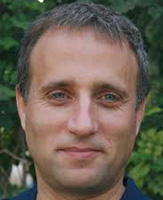
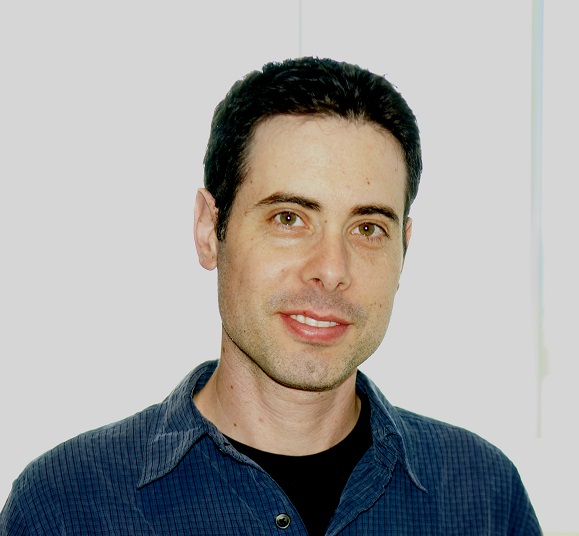
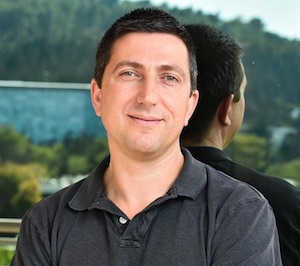
Prof. Yair Weiss is a faculty member at the School of Computer Science and Engineering, The Hebrew University of Jerusalem . He holds a PhD in Brain and Cognitive Sciences from MIT and an MSC in Applied Mathematics from Tel-Aviv University. Education: MSc in Applied Mathematics, Tel-Aviv University (1993) PhD in Brain and Cognitive Sciences, MIT (1998) His research focuses on Human and Machine Vision , Machine Learning , Bayesian Methods , and Neural Computation . Recent work explores adversarial examples, generative models, and robustness in neural networks. Recent publications highlight trends in: Understanding neural network representations Advancements in GANs and adversarial training Image restoration and translation techniques Perceptual distance modeling Bayesian approaches to computer vision Mathematical analysis of deep learning architectures
Aryeh Kontorovich is a Professor in the Computer Science Department at Ben-Gurion University. His research primarily focuses on theoretical machine learning, with expertise in probability, statistics, Markov chains, and metric spaces. His research interests span theoretical machine learning, with particular emphasis on: Probability theory and concentration inequalities Statistical learning theory Markov chains and mixing time estimation Metric space learning Kernel methods Sample compression schemes Professor Kontorovich's recent publications (2021-2025) demonstrate a continued focus on theoretical foundations of machine learning. His work shows strong trends in statistical estimation for Markov processes, distribution learning, metric space analysis, and sample compression. Many papers explore the intersection of probability theory and machine learning, particularly examining concentration inequalities, minimax optimality, and theoretical guarantees for learning algorithms. His research consistently bridges abstract mathematical theory with practical machine learning applications. Scientific awards and recognitions: Distinguished contribution award at MLG 2007 for "A Universal Kernel for Learning Regular Languages" Professor Kontorovich has advised numerous students and collaborated extensively with researchers in theoretical machine learning. His work spans both theoretical foundations and practical applications, with significant contributions to understanding the mathematical limits of learning algorithms. While specific grant information isn't provided in the source material, his extensive publication record in top venues suggests successful funding for his research programs. He maintains active collaborations with researchers worldwide, including prominent names like L. Gottlieb, D. Berend, and S. Hanneke.
Shie Mannor is a Professor at the Technion - Israel Institute of Technology in the Department of Electrical Engineering. He also holds a visiting professorship at Cornell-Tech in New York City and is affiliated with the Technion Machine Learning Center and the Grand Technion Energy Program . Key Research Interests: Machine Learning: Theory, algorithms, and applications to high-dimensional data and dynamics modeling. Reinforcement Learning and Markov Decision Processes: Adaptive control in large stochastic systems. Learning and control under uncertainty: Robust/stochastic optimization frameworks. Game Theory: Stochastic, dynamic, and network games applied to power markets and resource allocation. Multi-agent systems: Online learning and designing economic systems with optimal equilibria. Power Grid: Data-driven reliability, pricing, and decision-making in smart grids (e.g., EU-funded GARPUR project). Applications: Communication network optimization, mobile health, LDPC codes, and large-scale optimization problems. He actively seeks postdocs, graduate, and undergraduate students with strong mathematical or programming skills for projects in mobile phone programming and complex system optimization. Contact: shie.mannor@ee.technion.ac.il | Phone: ++972-4-829-3284
Lihi Zelnik-Manor is a Professor at the Faculty of Electrical and Computer Engineering at the Technion - Israel Institute of Technology . Her research focuses on digitizing the sense of touch, integrating Haptics , Robotics , and Computer Vision to create digital representations of physical properties and develop haptic feedback devices for virtual interactions. Executive Vice President for Innovation and Industry Relations (2023-2026) Vice Dean for Graduate Studies (2022-2023) General Chair: CVPR’21, ECCV’22 Her work spans Neural Architecture Search (NAS) , 3D Reconstruction , and Image Processing , with recent publications on haptic devices (2025), diffusion models (2025), and soft-tissue simulation (2024). She actively contributes to academic leadership through roles in top conferences and community initiatives like the Schmidt Postdoctoral Award steering committee.
Omri Abend is an Associate Professor at The Hebrew University of Jerusalem, affiliated with the School of Computer Science and Engineering and serving as Chair of the Department of Cognitive and Brain Sciences. His research lies at the intersection of Computational Linguistics, Natural Language Processing, and Cognitive Science, with a focus on semantic representation and language acquisition modeling. His primary research interests include: Computational modeling of child language acquisition Semantic representation frameworks, particularly Universal Conceptual Cognitive Annotation (UCCA) Statistical learning and machine translation Unsupervised grammar learning and lexical relation induction Cross-lingual and cross-domain alignment in language models Evaluation methodologies for NLP systems His recent publications demonstrate a strong trend toward analyzing large language models (LLMs), exploring human-like patterns in AI, improving evaluation metrics, and applying NLP to humanitarian domains such as Holocaust testimony analysis. His work combines theoretical linguistic insights with practical machine learning applications. Scientific awards include: Outstanding Paper Award at ACL 2017 Area Chair Award for Best Paper in the Track at ACL 2023 He has supervised and collaborated with numerous researchers and students across projects in semantic parsing, machine translation, and cognitive modeling. His work has been supported by community-wide initiatives such as the MRP shared tasks, which he co-organized. He also leads research on ethical AI, open human feedback, and the computational analysis of historical narratives. Omri Abend leads several research teams focused on: The development and application of the UCCA framework for semantic annotation Cross-lingual and cross-domain knowledge representation in LLMs Computational modeling of language acquisition Evaluation and improvement of NLP systems Application of NLP to digital humanities and historical testimony analysis
Jonathan Kahana is a Researcher in the Computer Science department at the Hebrew University of Jerusalem . His research spans Machine Learning and Computer Vision , focusing on Weight Space Learning , Representation Learning , and Zero-Shot Model Search . He develops methods for probing neural network weights to extract information, including ProbeGen and Spectral DeTuning . His recent work includes mapping model weights into shared embedding spaces (ProbeX), recovering pre-fine-tuning weights of generative models, and improving zero-shot labeling with distribution priors. He contributes to open-source implementations, such as the ProbeGen GitHub repository. Research trends from his publications emphasize: Weight space analysis (ProbeGen, DSiRe) Model retrieval and classification (ProbeLog, Model Atlas) Disentanglement and invariance (Contrastive Objective, Red PANDA) Efficiency in probing (30-1,000x FLOPs reduction in ProbeGen) His work has been accepted at top-tier conferences including ICML , ICLR , and ECCV , with arXiv preprints covering topics like dataset size recovery and model tree analysis.
Prof. Roni Katzir is a faculty member in the Department of Linguistics at Tel Aviv University, affiliated with the School of Languages. He specializes in formal semantics, computational linguistics, and linguistic theory, with a focus on grammar induction, neural networks, and Minimum Description Length principles. His research integrates theoretical linguistics with cognitive science, exploring topics like large language models (LLMs), scalar implicatures, and phonological learning. He collaborates extensively with researchers such as Nur Lan, Emmanuel Chemla, and Danny Fox, contributing to venues like Linguistic Inquiry , Natural Language Semantics , and ACL conferences. Education details are not explicitly listed, but his work reflects advanced expertise in linguistics and computational methods. Research interests emphasize cognitive plausibility in grammar learning, communicative stability, and the application of computational models to linguistic theory. Publications span over two decades, with recent focus on LLMs' implications for linguistic cognition, neural network generalization, and MDL-based frameworks. His work bridges formal semantics, syntax, and phonology, addressing challenges in language learning and processing. Prof. Katzir's contributions include pioneering the use of Minimum Description Length in linguistic learning models and advancing understanding of logical operators' typological distribution. He maintains an active research lab and collaborates internationally, as evidenced by his co-authored works and conference presentations.
Prof. Liran Carmel is a Professor of Genetics at the Hebrew University of Jerusalem's Alexander Silberman Institute of Life Sciences (Faculty of Science). His lab focuses on ancient DNA analysis to study human evolution, paleo-epigenetics, and molecular evolution. Recent work includes reconstructing Denisovan anatomy through epigenetic maps and analyzing Bronze Age population dynamics in the Southern Levant. Research Interests: Decoding genetic and epigenetic changes driving human evolution Reconstructing ancient DNA methylation patterns Studying RNA biology mechanisms like splicing and nonsense-mediated decay Developing computational tools for paleogenomics (e.g., RoAM, Gene ORGANizer) Key Achievements: Identified Denisovan morphological traits through epigenomic analysis Discovered Neolithic-era metabolic adaptations via ancient methylation studies Received the 2021 Massry Prize and 2020 Science Breakthrough award Lab Activities: Current members: 4 PhD students, 1 MSc student, lab managers, and programmers Alumni include 19 researchers now in academia and industry roles worldwide Hosts annual retreats and collaborates internationally on projects like the Punic genome study
Ido Dagan is a Professor at the Department of Computer Science at Bar-Ilan University , Israel, and founder of the Natural Language Processing (NLP) Lab . He is a Fellow of the Association for Computational Linguistics and served as ACL President (2010) and Executive Committee member (2008–2011), leading the establishment of Transactions of the Association for Computational Linguistics . Dagan’s research focuses on applied semantic processing , including textual entailment , natural semantic representation , multi-text information consolidation , and interactive text summarization . His recent work addresses attributable text generation , summary-source alignment , and cross-sentence argument detection , with applications to fact verification and hallucination detection. Key trends in his publications include cross-document coreference resolution , question-answering systems , semantic parsing , and interactive summarization . Notable collaborative projects involve UI trajectory analysis and long-context QA with Arman Cohan and Jacob Goldberger. Scientific Awards Fellow, Association for Computational Linguistics (ACL) President, ACL (2010) Executive Committee, ACL (2008–2011) Advising & Collaborations Dagan has supervised numerous PhD, MSc, and postdoctoral students since 1997, including Shachar Mirkin and Shmuel Amar . He collaborates with researchers like Ori Ernst , Avi Caciularu , and Aviv Slobodkin , with grants from institutions like IBM Haifa Scientific Center and AT&T Bell Laboratories .
Eran Treister is an Assistant Professor at the Ben Gurion University of the Negev in the Department of Computer Science. He completed his postdoctoral fellowship at the University of British Columbia (2014-2016) and earned his PhD from the Technion in 2014 under Prof. Irad Yavneh. His research spans computational science, numerical methods, and machine learning, with a focus on: Scalable algorithms for inverse problems Graph Neural Networks (GNNs) optimization Seismic and optical imaging via PDE solvers Low-precision deep learning acceleration Multilevel preconditioning techniques Recent work explores: Graph neural networks for PDEs with adaptive meshes Deep learning approaches to Helmholtz equation modeling 3D shape reconstruction via parametric level sets He serves on editorial boards: SIAM Journal on Scientific Computing (2024-) Copper Mountain Conference on Multigrid Methods (2025) International Conference on Machine Learning (ICML) as Area Chair (2025) Current teaching: Optimization Methods for Data Science (Spring 2025) Deep Learning Mini-Project (Winter 2024/5) Advanced Numerical Optimization (Spring 2025)
Hila Peleg is an Assistant Professor in the Department of Computer Science at the Technion – Israel Institute of Technology, where she co-leads the TecSE lab with Prof. Shachar Itzhaky. Her research lies at the intersection of Programming Languages, Software Engineering, and Human-Computer Interaction, focusing on program synthesis and interactive developer tools. Her research interests center on creating intelligent, theory-driven tools that enhance programmer productivity and correctness. She explores interaction models that integrate formal methods like separation logic into practical synthesis systems, enabling more versatile and reliable code generation. Her work spans both foundational models and real-world applications, from web layout synthesis to computational crafting. The trend in her recent publications shows a strong focus on interactive and practical program synthesis, blending formal verification with user-centered design. She investigates how synthesis can be made more usable through live programming, best-effort results, co-design of tools and languages, and integration with developer workflows. Her work increasingly emphasizes the human aspect of programming tools. Distinguished Paper Award, PLDI 2021 Distinguished Artifact Award, SPLASH 2020 Hila Peleg advises multiple graduate students, including PhD and MSc candidates, and leads the ERC-funded EXPLOSYN project, which supports advanced research in program synthesis. She has taught advanced courses such as User-Centered Programming Tools and seminars in programming languages, and is actively involved in the academic community through conference service and organization. She is a core member of the TecSE lab, which focuses on advancing software engineering through programming language theory and interactive systems. The lab fosters interdisciplinary research at the boundary of formal methods and human-centered tool design.
Tomer Michaeli is an Associate Professor at the Faculty of Electrical and Computer Engineering, Technion – Israel Institute of Technology. His research focuses on interdisciplinary areas bridging computer vision, machine learning, and signal processing methodologies. Research Interests Computer Vision Machine Learning Image Processing Signal Processing
Eran Yahav is a Professor in the Computer Science Department at the Technion, Israel Institute of Technology, and serves as CTO at Tabnine. His research bridges programming languages, software engineering, program analysis, and machine learning, focusing on program synthesis, verification, and code intelligence. Research Interests: His work spans program synthesis , abstract interpretation , verification of concurrent systems , binary analysis , and AI for code . He leads the PRIME project, which uses machine learning and static analysis to enable programming with millions of examples, improving code completion, search, and prediction. The recent publications reflect a strong trend toward integrating neural models with program analysis—using structured representations of code (e.g., AST paths) for property prediction, generating sequences from code (code2seq), learning distributed representations (code2vec), and interpreting neural networks via automata extraction. His work consistently appears in top-tier venues such as POPL, PLDI, ICSE, OOPSLA, and ICLR. Scientific Awards: Best paper award at ISSTA'07 Best paper award at ISSTA'06 Advising and Grants: He has advised numerous PhD and Master’s students, many of whom have published in premier conferences and now hold academic or industry positions. While specific grants are not mentioned, his sustained high-impact research and leadership in major projects (e.g., PRIME, Fender, SAFE) imply significant funding support. He has served on program committees for PLDI, POPL, CAV, OOPSLA, and VMCAI, reflecting his standing in the programming languages and verification communities. Labs and Teams: He leads a research group focused on program analysis and synthesis, with strong collaborations, particularly with Martin Vechev and others, on concurrency, synthesis, and machine learning for code. The group has developed influential tools such as PRIME, code2seq, code2vec, TRACY, and SAFE.
Shay Moran is an Associate Professor at the Faculty of Mathematics , Technion - Israel Institute of Technology, with affiliations to the Faculties of Computer Science and Data and Decision Sciences . They are also affiliated with Google Research in Tel Aviv . Shay's research interests center on mathematical problems inspired by learning theory and computer science , particularly in areas like machine learning theory, differential privacy, algorithmic stability, and online learning . Their work bridges abstract mathematics with practical algorithm design. Recent publications highlight trends in reductions between learning models, geometric interpretations of learning problems, and privacy-preserving algorithms . Key themes include sample compression, PAC learnability, boosting mechanisms, and adversarial robustness . Best Paper Runner-up , COLT 2021 Best Paper Award , COLT 2020 Final Award for Outstanding Paper in Machine Learning Shay has supervised numerous PhD and Master's students, including Vanessa Kosoy, Liza Nesterova, Hilla Schefler, Alexander Shlimovich, Tom Waknine , and Iska Tsubari . Former advisees include Idan Mehalel (PhD, co-advised with Yuval Filmus) and Zachary Chase (Postdoc) .
Dr. Eyal Tytler is a researcher in the Department of Industrial Engineering and Management at Ben-Gurion University of the Negev, affiliated with the Faculty of Engineering Sciences. His research focuses on integrating adaptive learning tools with classical algorithms to enhance decision-making in autonomous systems such as vehicles and robots. He completed his postdoctoral studies at the University of Toronto in artificial intelligence and decision-making, following a Ph.D. in autonomous systems and robotics at the Technion. His work emphasizes interdisciplinary collaboration to balance flexibility and safety in complex environments. Dr. Tytler’s research interests span artificial intelligence, robotics, and control systems, with a particular focus on combining modern learning techniques with traditional algorithmic frameworks. His academic journey reflects a dedication to advancing autonomous technologies through hybrid methodologies.