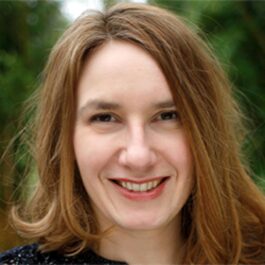
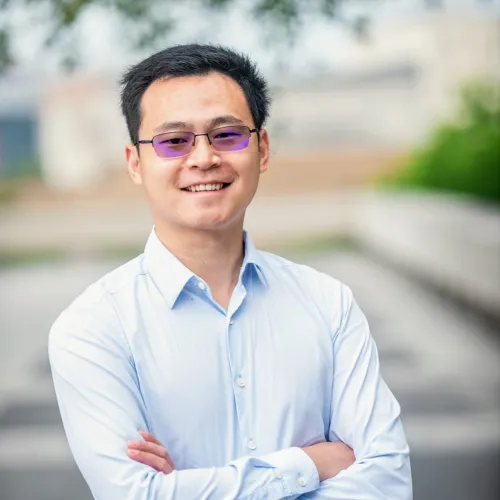
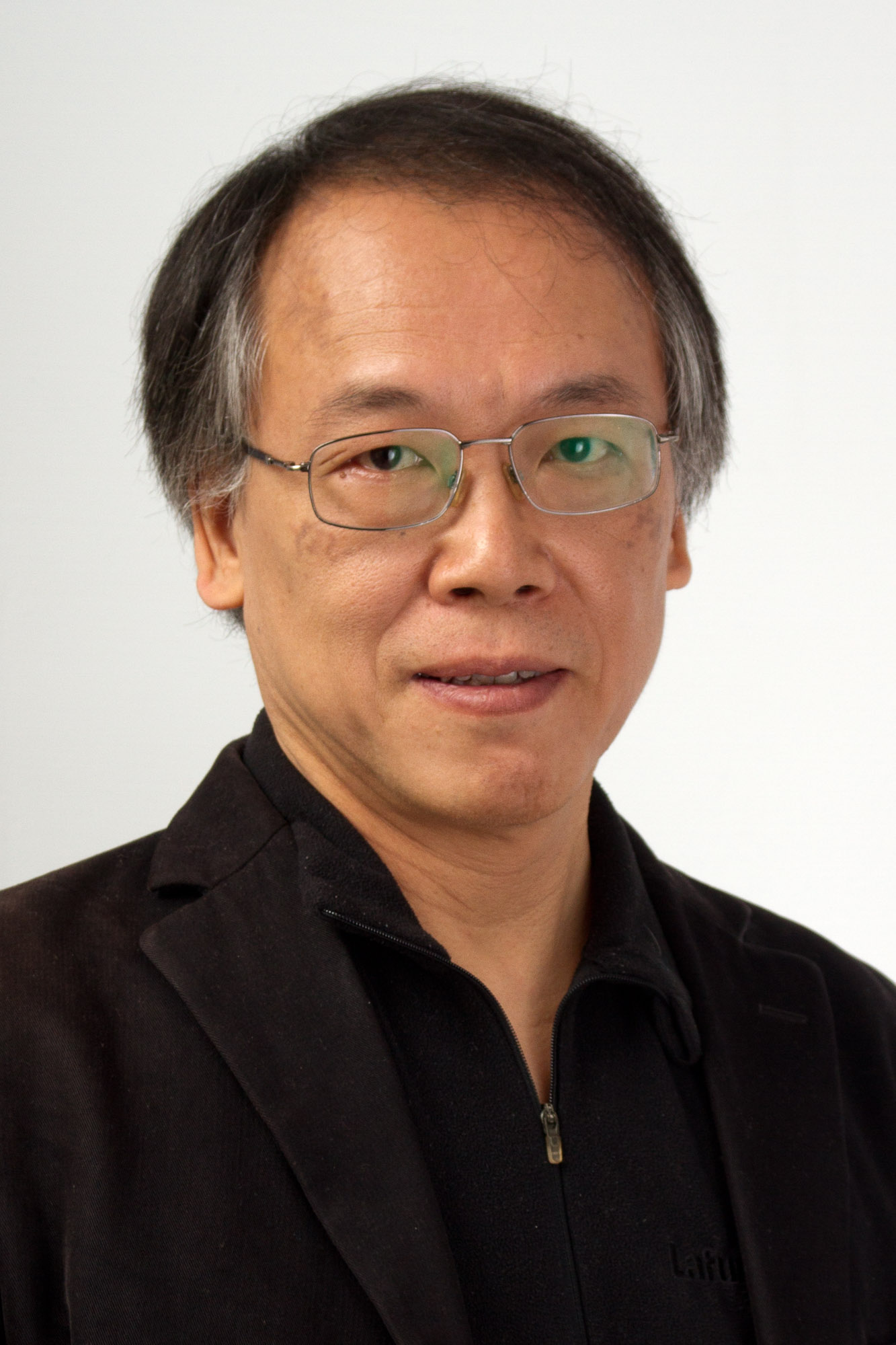
Shuhao Fu is a Program Postdoctoral Fellow at the Santa Fe Institute (SFI) researching the intersection of machine learning and cognitive science. He completed his Ph.D. in Psychology at UCLA under advisors Hongjing Lu and Ying Nian Wu, following a B.S. in Computer Science and Mathematics from Hong Kong University of Science and Technology. His research examines human-like relational reasoning in AI systems through cognitive modeling and computational approaches. Research focuses on: Bridging human-machine reasoning gaps via analogical mapping Developing explicit relational representations in vision models Structural cognitive modeling for compositional understanding Multimodal reasoning and scene interpretation Relational knowledge representation in biological and artificial systems Publication trends show concentrated work in computational cognitive science (2021-2025), with evolving focus from visual analogy fundamentals to applications in 3D recognition, social interaction modeling, and mental health diagnostics. Recent work demonstrates increased emphasis on transformer architectures, multimodal integration, and human-AI comparative studies. Professional experience includes research internships at Google X and Mineral.ai, with prior affiliation at Johns Hopkins University's CCVL lab under Alan Yuille. Currently serves as reviewer for ICML, ICCV, and Cognitive Science Society conferences.
Dr. Abdullahi Tasiu Abubakar is a Senior Lecturer and Director of the PhD Programme in the Department of Journalism at City St George's, University of London. He holds a PhD in Journalism and Mass Communications from the University of Westminster, awarded with no corrections. His professional background includes roles as a producer at BBC World Service (London) and Bureau Editor in Nigeria, alongside reporting for major Nigerian newspapers covering conflicts across West Africa. Research Focus: Dr. Abubakar specializes in media audiences, strategic communications, conflict reporting, and journalism ethics. His work critically examines how global media interacts with African audiences, the ethics of crisis journalism, and the communication strategies of insurgent groups like Boko Haram. Publication Trends: His scholarly output (2011-2024) demonstrates consistent focus on media in conflict zones, digital audience engagement, and African media landscapes. Recent works explore colonial legacies in broadcasting and mobile technology's impact on media consumption. A 2021 computational study represents an interdisciplinary divergence. Awards & Honors: Nigeria’s Best Newspaper Reporter of the Year NUJ Certificate for Professional Excellence Fellow, Higher Education Academy (AdvanceHE, UK) Professional Activities: He supervises PhD, MA, and undergraduate dissertations, has secured multiple research grants, and advises governmental/NGO bodies. As External Examiner at King's College London, he contributes to academic quality assurance. He regularly presents at major conferences (e.g., IAMCR, ICA) on extremism reporting and decolonization of media.
Jessica Hullman is the Ginni Rometty Professor of Computer Science at Northwestern University's McCormick School of Engineering and a Faculty Fellow at the Institute for Policy Research. Her research develops theoretical frameworks and interfaces for human-AI collaboration, focusing on uncertainty quantification, statistical modeling, and decision-making in domains like scientific research and AI-assisted analysis. Education: PhD in Information (Visualization), University of Michigan (2013) MS in Information Analysis, University of Michigan (2008) BA in Comparative Studies, Ohio State University (2003) Tableau Postdoctoral Fellowship, UC Berkeley (2015) Research Focus: Hullman's work bridges formal models of rational inference (e.g., Bayesian decision theory) with real-world applications. Key areas include: human-AI complementarity in decision-making, visualization of uncertainty, statistical reform, and LLM applications in behavioral science. Her research consistently addresses the alignment of data-driven interfaces with human cognitive capabilities. Publication Trends: Recent work demonstrates a strong emphasis on human-AI collaboration frameworks, decision-theoretic evaluation of visualizations, and methodological rigor in machine learning and social science. Key themes include uncertainty quantification (conformal prediction, privacy tradeoffs), behavioral experiments in AI-assisted tasks, and critical analyses of scientific practices. Awards & Honors: Microsoft Faculty Fellow (2019) Google Faculty Award NSF CAREER, Medium, and Small Awards Multiple best paper/honorable mention awards at top HCI/visualization venues (CHI, VIS) Funding & Labs: Principal Investigator for NSF-funded projects including HCC: Medium on visualization tools. Previously affiliated with University of Washington's Interactive Data Lab and DataLab. Current research includes NSF-supported work on improving data visualization for reasoning about analytical assumptions.
Tania Lombrozo serves as the Arthur W. Marks ’19 Professor at Princeton University, leading the Concepts and Cognition Lab where she investigates the psychological and philosophical dimensions of human reasoning. Her work uniquely integrates empirical methods from cognitive science with conceptual frameworks from analytic philosophy. Her academic background includes a Ph.D. from Harvard University, establishing her foundation in interdisciplinary research approaches. Lombrozo's research centers on the human drive to explain, examining why we seek explanations for certain phenomena but not others, how explanation-seeking affects learning, and whether explanatory processes serve epistemic goals or introduce reasoning errors. She explores connections between causal reasoning, moral responsibility, and intuitive theories of knowledge, drawing from cognitive, social, and developmental psychology alongside philosophy of science and moral philosophy. Her methodology emphasizes experimental rigor while addressing normative questions about ideal reasoning. Analysis of her 2024-2025 publications reveals dominant themes in explanation evaluation across scientific and moral contexts, with significant attention to jargon in science communication, simplicity principles (Ockham’s razor), and moral responsibility in collective action. Her work increasingly addresses AI-human interaction, particularly how explanations influence trust in large language models and the cognitive effects of chain-of-thought reasoning. Notable honors include: Arthur W. Marks ’19 Professorship Excellence in Mentoring Graduate Students Award Lombrozo actively mentors graduate students including Sarah Joo, Casey Lewry, and Sebastian Montesinos, with research supported by interdisciplinary grants spanning cognitive science, ethics education, and technology policy. Her Concepts and Cognition Lab functions as a collaborative hub where philosophical questions are tested through behavioral experiments, contributing to both theoretical advances and practical applications in science communication and AI design.
Professor Massimiliano Tani Bertuol is a distinguished academic specializing in economics at UNSW Canberra's School of Business, where he has served as Professor since 2015. His professional affiliations extend beyond UNSW as he is an Associate Investigator/Member at CEPAR; Ageing Futures; uDASH; AI Institute; and Cyber security (IFCYBER). Additionally, he maintains international connections as a Research Fellow at the Institute for the Future of Labor (IZA) in Germany since 2005, an Associate Member at Macquarie University's Centre for Workforce Futures since 2018, and a Research Fellow at the Global Labor Organization (GLO) in Maastricht since 2016. His educational background reflects a strong foundation in economics and business, having earned a PhD in Economics from the Australian National University (2003), a Master of Science in Economics from the London School of Economics (1992), and a Bachelor's degree in Business/Economics from Bocconi University in Milan, Italy (1989). His academic journey has positioned him as a leading researcher in human capital economics with international recognition. Professor Tani Bertuol's research centers on human capital development and its economic implications. His work examines how human capital can be fostered, efficiently transferred internationally through migration, and how it affects productivity, innovation, and economic growth at both firm and national levels. His research spans multiple regions including Australia, Europe, the US, Africa, and China, with particular focus on migration economics, labor market outcomes, and the economic impacts of education and skills. His current research agenda includes non-pecuniary incentives, behavioral/financial decisions in China, occupational licensing, language skills and economic assimilation, AI-human interactions in health contexts, and labor mobility and productivity. Analysis of his recent publications reveals significant interdisciplinary trends bridging economics with public health, environmental science, and technology. His work connects migration dynamics with economic outcomes, examines household financial behaviors through gender lenses, and investigates the complex relationships between environmental factors like air pollution and economic activities including education investment and entrepreneurship. More recent work explores AI applications in health and the economic implications of pandemic responses, demonstrating his ability to address contemporary challenges through rigorous economic analysis. 2023: UNSW ARC Postgraduate Council (Arc PGC) award for excellence in research supervision 2011: Vice-Chancellor Award for Teaching Excellence 2011: Faculty Award for Teaching Excellence for teaching economics Professor Tani Bertuol has successfully supervised 4 PhD students to completion, with 1 submitted dissertation and 5 currently under supervision. His active research program is supported by significant grant funding including an ARC Linkage Project (2023-27) on regional Australia's skills shortages and high-skill refugees' employment ($354,811), an ARC Discovery Project (2019-23) on migrant aging and wellbeing ($478,000), and a NUW Alliance grant (2021-23) on hearing screening and academic outcomes ($73,367). He serves as Associate Editor for Social Indicators Research and Higher Education Research & Development, contributing to scholarly discourse in his fields of expertise. His teaching portfolio includes courses in data analytics, finance, and professional executive education focused on cost-benefit analysis and data communication. He teaches ZBUS2333 Data Analytics and Visualisation, ZBUS8105 Finance and Investment Appraisal, and ZBUS8149 Introduction to Finance, demonstrating his commitment to developing the next generation of economics professionals with both theoretical knowledge and practical skills.
Kathryn Stolee is an Associate Professor in the Department of Computer Science at North Carolina State University. She received her Ph.D. in Computer Science from the University of Nebraska-Lincoln under Sebastian Elbaum after graduating from the Jeffrey S. Raikes School of Computer Science and Management. Her research spans multiple perspectives in software engineering: technical (program analysis), human (human aspects of software engineering, software product management), and educational (comparative comprehension of algorithms). Notable contributions include work on regular expression refactoring for improved comprehension, constraint solvers for code reuse identification, and cross-language code-to-code search to aid developers learning new languages. Dr. Stolee has secured over $2,000,000 in federal grants, including an NSF CAREER award. Her research combines analysis techniques (refactoring, semantic code search, code-to-code search) with human factors (comprehension, reuse, learning). Her scholarly contributions have been recognized with a National Science Foundation Faculty Early CAREER Award (2018) and a Best Paper Award at the International Symposium on Empirical Software Engineering and Measurement (ESEM, 2011). Actively engaged in the software engineering research community, Dr. Stolee serves as an author, reviewer, and organizer at top conferences. She is committed to mentoring the next generation of computer scientists and has developed educational interventions focused on software testing and code comprehension.
Dr. Anh Nguyen Nguyen Duc serves as Full Professor at the University of South-Eastern Norway and the Norwegian University of Science and Technology (NTNU), with visiting scholar positions across Norwegian, Finnish, Italian, and Vietnamese institutions. His academic work centers on software engineering with emphasis on human, process, and ecosystem dimensions of development. Education: MS: Technical University of Kaiserslautern and Blekinge Institute of Technology (double degree) PhD: Norwegian University of Science and Technology Research fingerprint analysis reveals dominant focus on software startups (27%), supplemented by software processes (6%) and engineering education (5%). His expertise spans cybersecurity, global software development, business-driven methodologies, and software analytics, consistently addressing human-organizational challenges in dynamic development environments. Recent publications (2024-2025) demonstrate accelerating integration of AI in software engineering, particularly through large language models for startup assistance, generative AI adoption frameworks, and autonomous agent systems. Concurrently, he investigates risk management in software ventures and fairness in educational ML applications, reflecting interdisciplinary work bridging software engineering with business, AI ethics, and educational technology.
Ji Ma is an Assistant Professor at the Lyndon B. Johnson School of Public Affairs at the University of Texas at Austin, with affiliate appointments at the Center for East Asian Studies, School of Information, and Asia Policy Program. He also serves as a Visiting Researcher at the Gradel Institute of Charity, University of Oxford. Dr. Ma received his PhD from Indiana University, establishing a foundation for his interdisciplinary work at the intersection of computational methods and social science. Dr. Ma's research centers on three interconnected streams: computational approaches to social science, knowledge production for evidence-based policymaking, and state-society relations in China. His work bridges advanced technologies with public affairs, developing innovative methods to analyze nonprofit sectors and civil society dynamics. He has pioneered the application of computational social science in nonprofit studies, creating valuable research infrastructure for the field. His recent publications show a clear trend toward integrating AI and computational methods with traditional social science questions. He has made significant contributions to understanding citation patterns in policy communities, consensus formation in academic fields, and the dynamics of state-society relations in China. His work often combines large-scale data analysis with theoretical insights from multiple disciplines. Dr. Ma actively contributes to teaching through courses like "Computational Social Science Methods" and "Data Management and the Research Life Cycle," helping students develop skills in data analysis and research methodology. His teaching emphasizes practical applications of computational methods in public affairs research. Among his notable projects are pracademia.one (an information aggregation platform), npoclass (a nonprofit classifier), and the Research Infrastructure of Chinese Foundations (RICF). These projects reflect his commitment to developing methodological tools that advance research in public administration and nonprofit studies, creating valuable resources for scholars worldwide.
Stuart E. Middleton is a Professor in the Electronics and Computer Science (ECS) department at the University of Southampton, where he has been employed since 2003. His research bridges artificial intelligence with practical applications in social science, mental health, and security domains. He leads multiple research projects funded by DTP and CISDnS CDT, focusing on multimodal natural language processing and large language models for social good applications. Professor Middleton's research interests center on Natural Language Processing, Large Language Models, and Human-in-the-loop AI systems. His work spans mental health applications (particularly suicide risk detection and mood change analysis), social media analysis for crisis mapping, geoparsing for location extraction, and argument mining in political discourse. He has developed numerous open-source NLP projects and datasets including CPIQA for climate science, ConversationMoC for mental health monitoring, and M-Arg for multimodal argument mining. His research demonstrates how AI can effectively support human decision-making in critical domains like mental healthcare, defense applications, and crisis management. His recent publications reveal a strong trend toward applying LLMs to high-impact societal challenges, particularly in mental health monitoring and climate science verification. He has pioneered methods for detecting suicidal ideation in social media, identifying moments of mood change, and developing context-aware question answering for climate papers. His work consistently emphasizes the importance of human oversight in AI systems, with numerous publications on responsible AI, regulation, and human-in-the-loop approaches. Ranked 1st in ECAL-2024 shared task on suicidal ideation detection Ranked 1st in NAACL-2022 shared task on suicide risk and mood change classification Winner of 'best paper' award at WWW2002 Semantic Web Workshop Professor Middleton actively supervises PhD students through multiple funded projects including 'Multimodal Natural Language Processing for Computational Social Science', 'Large Language Models for Military Veteran Mental Health', and 'Large Language Models for Human/AI Information Foraging to Combat Digital Human Trafficking into Terrorism'. He has secured significant funding from UKRI, DSTL, and other sources to support his research in responsible AI applications. He organizes major workshops including the RAI UK Workshops on Responsible AI for Mental Health and AIUK workshops on AI for Data Rescue and Defense applications. His research group maintains numerous GitHub repositories with open-source NLP tools and datasets that have been widely adopted by the research community.
Dr. Elisa Pellegrino is a senior Post-Doc in Phonetics at the Department of Computational Linguistics , affiliated with Zeppelin University and the Digital Society Initiative of the University of Zurich . Her research focuses on voice individualization, vocal accommodation, and the role of speaker-specific information in speech temporal variability. Role: Senior Post-Doc in Phonetics University: Zeppelin University School: Faculty of Arts and Social Sciences Department: Department of Computational Linguistics Email: elisa.pellegrino@uzh.ch Research Interests: Prosody and speech rhythm in native and second language acquisition Vocal accommodation in cross-dialectal interactions Speaker individuality and forensic phonetics Age-related speech temporal variability Speech disorders and Parkinson’s disease Applications of speech technology in linguistics and education
Egor Kostylev serves as an Associate Professor in the Department of Informatics within the Faculty of Mathematics and Natural Sciences at the University of Oslo. His research focuses on the theoretical foundations connecting symbolic and sub-symbolic artificial intelligence, particularly examining relationships between formal logic systems and machine learning approaches. His educational background includes an MSc (Specialist, 2005) and PhD (Candidate, 2009) from Lomonosov Moscow State University under Prof. Vladimir A. Zakharov. He subsequently held research positions at the University of Edinburgh (2010-2013) and the University of Oxford (2013-2020) before joining the University of Oslo in 2020. Kostylev's research interests center on bridging symbolic AI formalisms with sub-symbolic approaches. He investigates connections between various logics (Description Logics, Temporal Logics, Datalog), query languages (SPARQL, Regular Path Queries, OTTR), and machine learning formalisms (Graph Neural Networks, Markov Logic Networks). His work addresses critical challenges in Explainable, Trustworthy, and Green AI through theoretical foundations that connect different AI paradigms. His publication record demonstrates consistent high-impact contributions in theoretical computer science and AI, with numerous publications in top venues including AAAI, LICS, Journal of the ACM, and ICLR. His recent work shows a clear trajectory toward unifying logical reasoning with neural network approaches, particularly through graph neural networks and their connections to logical formalisms. The research spans theoretical foundations of knowledge representation, temporal reasoning in knowledge bases, and the logical expressiveness of modern neural architectures. As a research leader, Kostylev supervises multiple PhD students including Shuwen (Aurora) Liu, Maximilian Pflüger, Roxana Pop, Dongzhuoran Zhou, and Erik Snilsberg. He serves as a Research Theme Leader for the Integreat SFF: Norwegian Centre for Knowledge-driven Machine Learning. His teaching responsibilities include IN3020/4020 Database Systems courses. He leads the Data and Knowledge Management (DKM) research group at the University of Oslo, which focuses on foundational aspects of knowledge representation, database theory, and the intersection with modern machine learning techniques. The group actively collaborates with international researchers and contributes to advancing theoretical understanding of how symbolic and neural approaches to AI can complement each other.
Oliver Li is a Researcher at Uppsala University's Center for Multidisciplinary Research on Religion and Society (CRS) and Department of Theology, Ethics and Philosophy of Religion division. His interdisciplinary work merges theological inquiry with cutting-edge artificial intelligence ethics, establishing him as a distinctive voice at the technology-religion intersection. Li's research traverses Theology , Philosophy of Religion , Ethics , and Artificial Intelligence , with specialized focus on panentheism and process theism. He critically examines how these frameworks address contemporary AI challenges including artificial suffering, moral development in human-AI systems, and consciousness implications. His investigations extend to literary analysis of AI subjectivity in works like Ishiguro's Klara and the Sun , alongside philosophical explorations of infinity and mathematical theology. Analysis of Li's 15 most recent publications reveals a pronounced trajectory toward technology-theology dialogue, particularly through 2023-2024 works interrogating AGI development ethics. Recurring themes include the morality of creating sentient machines, theological responses to AI-induced cognitive changes, and reimagining divine action in computational contexts. This cohesive body of work positions him at the vanguard of emerging academic discourse on spiritual dimensions of technological advancement. Li actively contributes to Uppsala University's interdisciplinary ecosystem through the Center for Multidisciplinary Research on Religion and Society (CRS), where he engages in cross-departmental projects examining religion's evolving societal role. His collaborative publications with scholars like Johan Eddebo demonstrate substantive engagement with research teams addressing technology's anthropological and ethical implications, particularly through media interventions like the 2023 Aftonbladet debate on AI's cognitive impacts.
Isabelle Augenstein is a Professor at the University of Copenhagen, Department of Computer Science (DIKU), where she heads the Copenhagen Natural Language Understanding (CopeNLU) research group and the Natural Language Processing section. She is also a co-lead of the Danish Pioneer Centre for Artificial Intelligence, Denmark's largest research center initiated by the Danish Ministry of Higher Education and Science. In October 2022, she became Denmark's youngest ever female full professor. Dr. Augenstein earned her undergraduate degree in Computational Linguistics and Psychology from Heidelberg University, followed by a Master's in Computational Linguistics. She completed her PhD in Computer Science at the University of Sheffield under the supervision of Dr. Diana Maynard and Prof. Fabio Ciravegna. In 2021, she earned a Habilitation at the University of Copenhagen in Explainable Fact-checking. Professor Augenstein's primary research focuses on fair and accountable Natural Language Processing, with particular emphasis on explainability, factuality, and bias detection. Her work spans multiple subfields including automated fact-checking, stance detection, gender bias analysis, and cultural bias in language models. She has pioneered research in explainable fact-checking, developing methods that not only predict claim veracity but also provide meaningful explanations of the decision-making process. Her research group has produced numerous influential papers on measuring model fragility, quantifying gender biases, and developing robust fact-checking systems that account for distribution shifts. Her significant contributions have been recognized with several prestigious awards: ERC Starting Grant on 'Explainable and Robust Automatic Fact Checking' DFF Sapere Aude Research Leader fellowship on 'Learning to Explain Attitudes on Social Media' Karen Spärck Jones Award from the British Computing Society and Bloomberg Hartmann Diploma Prize from the Hartmann Foundation Member of the Royal Danish Academy of Sciences and Letters since 2024 Professor Augenstein has secured significant research funding including her ERC Starting Grant supporting five years of blue-sky research. She actively mentors PhD students and postdoctoral researchers through her 'ExplainYourself' project. She served as President of SIGDAT (which organizes the EMNLP conference series), having previously held leadership roles as Vice President and Vice President-Elect. She is a co-founder of Widening NLP (WiNLP), an initiative to increase diversity in the NLP community, and maintains the BIG Directory of underrepresented groups in NLP. She leads the Copenhagen Natural Language Understanding (CopeNLU) research group, which relocated to the historic Østervold Observatory in Copenhagen's Botanical Gardens in 2023. The group focuses on developing methods for explainable and robust natural language understanding, with applications in fact-checking, bias detection, and social media analysis. Professor Augenstein also co-leads the Speech and Language collaboratory at the Pioneer Centre for Artificial Intelligence, where her team investigates how language models can better serve diverse populations while maintaining accountability and transparency.
Jason Nelson is a Professor of Digital Culture in the Department of Linguistic, Literary and Aesthetic Studies at the University of Bergen, Norway. He is a creator of digital poems and fictions, builder of surrealist and politically focused art games and digital creatures. His work is exhibited widely in galleries and journals around the globe at FILE, ACM, LEA, ISEA, SIGGRAPH, ELO and numerous other venues. Nelson serves on organizational boards including the Australia Council Literature Board and the Electronic Literature Organization. Nelson's research focuses on the intersection of digital technology, creative writing, and artistic expression. He explores how AI and machine learning can be harnessed for creative purposes, developing new forms of digital literature and interactive art. His work often involves building expansive visual worlds through collaborative AI processes, creating interactive digital poetry, and developing novel approaches to digital narrative. Nelson's research spans digital humanities, electronic literature, AI-generated art, and interactive media, with particular emphasis on how these technologies transform creative processes and experiences. Over the past decade, Nelson's work has increasingly focused on the creative potential of AI technologies, especially in the areas of text-to-image generation and multimodal authorship. His projects often blend game engines with poetic expression, creating immersive experiences that challenge traditional boundaries between human and machine creativity. Recent works explore themes of multispecies futures, time perception, and the transformation of physical spaces through augmented reality. Nelson has received numerous scientific awards and fellowships including: Fulbright Fellowship at the University of Bergen Moore Fellowship at the National University of Ireland Winner of the Digital Writing Prize, Queensland Literary Awards (15,000 AUD) Winner of the Woollahra Library Digital Poetry Prize (5,000 AUD) Runner-Up Prize at the Videomedeja digital art exhibition Finalist for the Turn-on Literature Prize Finalist for the Queensland Literary Awards, Digital Writing Category Multiple finalist nominations for the New Media Writing Prize Nelson actively participates in academic advising and has secured significant research funding, including a 125,000 AUD grant from the Australia Council of the Arts, Literature Board for his project "Cube Cryptext and Nomencluster," which was recognized as the world's largest interactive art-game. His work "Nine Billion Branches" received multiple awards including the Digital Writing Prize from the Queensland Literary Awards. He has also received a 75,000 NOK grant for the "Flood Mosaic Artwork" project featured in the Floodlines Exhibition at the State Library of Queensland. Nelson is affiliated with the Center for Digital Narrative at the University of Bergen, where he collaborates with researchers like Scott Robert Rettberg and Alinta Krauth. Together they form EphemerLab, exploring new creative processes that move beyond simple "ask and generate" AI methods. Their work involves stitching together hundreds of individual image fragments and components into cohesive visual and narrative concepts, pushing the boundaries of what's possible with current AI technologies.
Jieh Hsiang is a Distinguished Professor at National Taiwan University , with affiliations in the Department of Computer Science and Information Engineering, the Digital Archives and Automatic Inference Laboratory, and the Digital Humanities Research Center. He holds concurrent roles at the Institute of Information Science, Academia Sinica, and the Higher Education Research & Development Office, National Taiwan University. Education PhD in Computer Science, University of Illinois at Urbana-Champaign (1979–1982) BS in Mathematics, National Taiwan University (1972–1976) Research Interests Hsiang's work spans automated reasoning , digital libraries , digital humanities , and information retrieval . His research focuses on integrating computational methods with cultural heritage preservation , particularly through tools like DocuSky and databases such as the Taiwan Historical Digital Library . He explores AI applications in patent analysis , historical text mining , and semantic relationships in legal documents . Recent Trends in Publications His recent articles highlight advancements in BERT and GPT-2 fine-tuning for patent classification , LARGE language models for legal automation , and GIS-based analysis of historical archives . Themes include digital preservation , AI-driven legal text analysis , and cross-disciplinary computational tools for humanities scholars. Scientific Awards 2019 Ministry of Science and Technology Distinguished Research Fellow 2009 National Taiwan University Outstanding In-House Service Award 2008 Chinese Library Association Special Contribution Award 2006 IEEE Test-of-Time Award 1997 & 1999 National Science Council Outstanding Research Award 1997 Ministry of Education Outstanding Industrial-Academic Collaboration Award 1998–2001 Founder and First Chair of IFIP WG1.6 Labs and Collaborations Hsiang leads the Digital Archive and Automatic Inference Laboratory , developing platforms like DocuSky for digital humanities, Taiwan Historical Digital Library , and QGIS Cloud Maps for spatial analysis. His team collaborates internationally on projects involving historical document digitization , patent automation , and cross-domain knowledge integration .