Prof. Wim Desmet is a full professor at the Faculty of Engineering Science and head of the Department of Mechanical Engineering at KU Leuven . His research focuses on advanced modeling techniques for mechanical systems, including: noise and vibration control in automotive and industrial systems computational acoustics and interval field uncertainty modeling metamaterials for broadband vibroacoustic performance AI-driven diagnostic systems in renewable energy and manufacturing Current research projects address challenges in electric vehicle drivetrains, wind turbine monitoring, and multi-physical digital twin development. He actively contributes to academic governance as: Managing Director of KU Leuven Head of Subdivision HIST Chair of multiple executive committees Member of 15+ academic and administrative councils
Marina S. Leite is a Professor in the Department of Materials Science and Engineering at the University of California, Davis. Her research focuses on novel materials for renewable energy, optical devices, and materials under extreme environments. She leads the Leite Lab, pioneering work in perovskite photovoltaics, thermophotovoltaic emitters, and transient photonics using machine learning for accelerated materials discovery. Her group combines advanced characterization techniques with computational methods to address challenges in energy harvesting and optical material performance. PhD: Not explicitly listed in provided text Her research interests include: Machine learning-driven materials discovery Halide perovskites for stable solar cells High-temperature optical materials Transient photonics using magnesium-based systems Thermophotovoltaic emitter design Key research trends from recent articles emphasize AI integration for predicting material behaviors, environmental stressor impacts on optoelectronics, and alloy systems for dynamic optical properties. Her lab has developed methods for automated experimentation and spectral selectivity in emitters. 2025 Optica Fellow 2025 SPIE Fellow Advising: Supervises students like Hannah Darr. Active in DARPA cross-disciplinary projects and editorial roles in energy journals. Leads grants focused on machine learning in materials science and photonic device development. The Leite Lab collaborates on projects involving transient materials and high-temperature photonics. Future work includes scaling superabsorber technologies, developing eco-friendly Pb-free perovskites, and advancing AI tools for material property prediction.
Toby Davies is an Associate Professor in Criminal Justice Data Analytics at the University of Leeds, School of Law. His work focuses on quantitative criminology, spatial analysis, and computational methods to inform crime prevention. He holds a Mathematics degree from the University of Oxford (2008) and a PhD from University College London (UCL), followed by postdoctoral research on the EPSRC-funded Crime, Policing and Citizenship project. Before joining Leeds in 2023, he was at UCL’s Department of Security & Crime Science. His research spans interdisciplinary topics including urban form and crime, crime modeling, social networks, and cybercrime. He has collaborated with police agencies (West Yorkshire, Thames Valley, West Midlands Police) and governmental bodies (UK Home Office, London Mayor’s Office). A strong advocate for Open Science, he co-founded JDI Open to promote open practices in crime science. His recent work emphasizes policy interventions like phasing out pointed kitchen knives to reduce knife crime, leveraging data-driven approaches. He publishes widely in criminology, physics, network science, and general science journals, and has guest-edited special issues. His applied research aims to bridge theory and practice, developing tools deployed operationally in policing. Current interests include financial crime dynamics, social contagion of crime, and street network configurations’ impact on crime patterns.
Miroslava Kavgic is an Associate Professor in the Department of Civil Engineering at the University of Ottawa. She holds a Ph.D. (United Kingdom), M.Sc. (United Kingdom), and B.Sc. (Serbia), and is a Professional Engineer (P.Eng.). Her research focuses on sustainable building engineering, carbon-negative materials, and energy-efficient design for remote communities. She leads the Centre for Indigenous Community Infrastructure at uOttawa, emphasizing culturally appropriate solutions. Education: Ph.D. in Environmental Design and Engineering (University College London, 2013) M.Sc. in Environmental Design and Engineering (University College London, 2006) B.Sc. in Mechanical Engineering (Serbia) Research Interests: Carbon capture building materials (e.g., hempcrete composites) Bioclimatic design strategies for net-zero buildings Urban energy modeling to decarbonize cities Renewable energy systems integration Advanced HVAC controls and energy efficiency Her recent publications (2021–2025) emphasize: Phase change material applications in building envelopes Machine learning for energy demand prediction Optimization algorithms like MEVO for building performance Hybrid renewable energy systems Labs/Teams: Active in the Centre for Indigenous Community Infrastructure, focusing on Northern communities' sustainable infrastructure. Collaborates with industry on building design innovations.
Shunyuan Zhang is an Assistant Professor at Harvard Business School with research focusing on AI algorithms, economic inequality, and computer vision applications in business contexts. His work examines how algorithmic systems impact economic outcomes, particularly in sharing economy platforms like Airbnb. His research interests include AI algorithms, economic inequality, pricing algorithms, machine learning, computer vision, and the sharing economy. Zhang's work often combines technical computer vision approaches with economic analysis to understand platform dynamics. Zhang's recent publications demonstrate a strong focus on the intersection of AI, fairness, and economic outcomes. His work analyzes how algorithmic pricing affects racial disparities on platforms like Airbnb, and how visual content impacts demand in the sharing economy. His research employs sophisticated methodologies including deep learning, structural modeling, and causal inference. He has published in top journals and working paper series, with notable work including 'Can an AI Algorithm Mitigate Racial Economic Inequality? An Analysis in the Context of Airbnb' and 'What Makes a Good Image? Airbnb Demand Analytics Leveraging Interpretable Image Features.' Zhang collaborates extensively with leading researchers at Carnegie Mellon University and University of Toronto, particularly on topics related to algorithmic fairness and platform economics. His work has significant implications for both academic understanding and practical policy recommendations regarding algorithmic systems in marketplace contexts.
Prof. Penny Kyburz is a Professor and Associate Director (Engagement & Impact) at the School of Computing, Australian National University. She leads the GameFlow Lab and teaches Game Development, focusing on AI, human-AI interaction, and game design. Her work bridges academia and industry, with 20+ award-winning games including four BAFTA nominations. She holds a PhD, B.InfoTech(Hons), G.C.Ed.(Higher Ed.), and G.C.Acad.Prac. Education: Ph.D. B.InfoTech(Hons) Graduate Certificate in Education (Higher Education) Graduate Certificate in Academic Practice Research Interests: Video games, game design, and player experience AI and human-AI collaboration Virtual Reality and Mixed Reality applications Technology policy and digital rights Educational games and accessibility Awards: 4 BAFTA nominations for game contributions High critic scores for usability-tested AAA games Grants/Projects: IDEATE (2024–2028) MEC23: Advanced Biometrics (2023) C2 Sociotechnical Collaboration (2022–2024) Role-Based Deception in Games (2020–2021) Her GameFlow model and book on emergence in games are foundational in player experience research. She advocates for diversity in tech and has advised on digital rights in the Senate.
Dr. Bharanidharan Shanmugam is an Associate Professor in Information Technology at Charles Darwin University's Faculty of Science and Technology. He specializes in cybersecurity, IoT security, and cyber risk management in microgrids. His research focuses on addressing real-world challenges in IoT, smart grids, and medical devices to enhance community impact. **Research Interests:** - IoT Security - Cyber Risk Assessment in Microgrids - Network and Information Security - Applied Cybersecurity Solutions - Blockchain and Privacy-Preserving Technologies **Key Projects (2019–2025):** - Cyber Territory Skills Hub (2023–2025) - Renewable Energy Microgrid Hub (2021–2024) - Blockchain-Based Digital Identity (2019–2020) **Publications:** Focuses on IoT security frameworks, intrusion detection systems, and AI-driven cybersecurity solutions. Recent works include studies on smart grid load forecasting, medical IoT threat detection, and water leakage detection using machine learning. **Grants & Supervision:** Principal Investigator on multiple ARC-funded projects. Supervises PhD students in DevSecOps and IoT security. Active in organizing workshops on digital awareness for indigenous communities.
Marco Toffolon is a Full Professor at the University of Trento's Department of Civil, Environmental and Mechanical Engineering, where he leads the Physical Limnology Laboratory. He serves as Deputy Director for International Relations and previously directed the Environmental Engineering programs. His research spans ecohydraulics, sediment transport, lake hydrodynamics, and environmental modeling. He investigates physical limnology, tidal morphodynamics, and stratified flows using analytical and numerical approaches. His work integrates field measurements with machine learning for water quality prediction and climate impact assessment. His publications focus on lake dynamics, river morphodynamics, and sustainable water management, with recent emphasis on climate-driven changes in alpine systems. Research demonstrates strong interdisciplinary linkages between hydraulics, ecology, and climate science. Awards: 2016 Coastal Engineering Journal Award 2013 Enrico Marchi Lecture invitation He leads international collaborations with institutions like EPFL and Sun Yat-sen University, and organizes conferences including the Physical Processes in Natural Waters workshop series.
Fernando Sánchez-Figueroa is a Full Professor at the University of Extremadura's Department of Computer Systems Engineering and Telematics. He is a co-founder of Homeria Open Solutions, a spin-off engaged in R&D projects under EU frameworks. His research focuses on Software Engineering, Machine Learning, Data Visualization, and Ambient Intelligence. He has authored over 50 scientific articles and led numerous R&D contracts with public and private entities. Key roles include: Academic: Full Professor at University of Extremadura Entrepreneur: Co-founder of Homeria Open Solutions Research: Participation in EU-funded projects and development of AI-driven solutions for healthcare, smart cities, and education Research Interests: Machine Learning applications in healthcare, predictive analytics for education, and sustainable smart city technologies. His work bridges theoretical advancements with practical implementations, such as medical image segmentation using SAM models and cost-efficient UAV systems. Publications: Recent works include decision support systems for employability analysis, zero-shot learning in medical imaging, and recommender systems for education. He emphasizes data-driven approaches and model-driven engineering in software development. Impact: Developed tools like CompareML for preliminary data analysis and LiveSankey for advanced web visualization. His contributions span academia and industry, addressing challenges in healthcare, urban sustainability, and educational technology.
Dr. Saer Samanipour is a Visiting Professor at the Van 't Hoff Institute for Molecular Sciences, part of the Faculty of Science at the University of Amsterdam. His research focuses on advanced analytical techniques for environmental and biomedical applications, with a strong emphasis on non-targeted analysis, mass spectrometry, and machine learning integration. He leads efforts in developing open-source tools like GcDUO and jHRMSToolBox to enhance data interpretation in complex chemical datasets. Key areas include environmental contaminant detection, chemical exposure assessment via wastewater-based epidemiology, and proteomic analysis of snake venoms. His work bridges computational methods with experimental chemistry to address global challenges in environmental health and toxicology. Primary affiliation: Van 't Hoff Institute for Molecular Sciences Research themes: Non-targeted LC-HRMS workflows, machine learning applications in analytical chemistry, PFAS analysis, and exposome research Software contributions: GcDUO (GC×GC-MS), jHRMSToolBox (HRMS data processing) His publications highlight innovations in data-driven approaches for compound prioritization, toxicity prediction, and method optimization. Recent work explores chemical space exploration and chemometric strategies for complex mixture analysis, with applications to environmental monitoring and forensic science.
Paul Zhou is a Senior Lecturer in the Department of Management at Monash University. He holds a PhD in Supply Chain and Operations Management from Hong Kong Polytechnic University (2018), a Master’s in Electronic Commerce from the University of Hong Kong, and a Bachelor’s in Global Supply Chain Management from Hong Kong Polytechnic University. His research focuses on Sustainable Operations Management, Global Supply Chain Networks, and applications of Big Data Analytics/Machine Learning in business operations. He has led projects such as 'Supply Chain Governance Solutions for the Gig Economy' (2025-2028) and 'Machine Learning for Civil Construction Safety' (2019-2022). His work has been featured in top journals like Production and Operations Management and Journal of Operations Management . Notable achievements include the 2017 IACMR Presidential Award for his study on environmental incidents’ market impacts. Zhou’s research explores sustainable supply chain practices, DEI commitments’ market effects, and geopolitical influences on global operations. He serves as Oceania Co-Editor for Journal of Supply Chain Management and reviewer for multiple journals including Production and Operations Management .
Lappeenranta-Lahti University of Technology LUTFinland
Falah Alobaid is a Full Professor (Tenured) at LUT School of Energy Systems, LUT University, specializing in energy systems engineering. He holds a Ph.D. from the Technical University of Darmstadt (2013), recognized with the university's Energy Special Prize (2014), and completed habilitation in Energy Systems (2018) with the title of Privatdozent (2019). His research focuses on power plant technologies, including combustion, gasification, and CO₂ capture, with expertise in modeling, simulation, and pilot-scale experimentation. Education: Ph.D. (Energy Systems), Technical University of Darmstadt, Germany (2013) Habilitation (Energy Systems), Technical University of Darmstadt, Germany (2018) Research interests emphasize sustainable energy solutions: Fluidized bed combustion and gasification CO₂ capture and storage technologies Renewable energy integration Process simulation and dynamic modeling of power systems Thermal energy storage systems His work bridges experimental and computational approaches, with contributions to EU projects such as SCARLET and OptiMaDyn. Publications reflect advancements in fluidized bed systems, CFD-DEM modeling, and operational flexibility of thermal power plants. Recent trends include integrating artificial intelligence for process optimization and exploring novel materials for carbon capture. Awards include the Energy Special Prize (2014) and recognition for his habilitation work. He leads the Institute of Energy Systems and Technology research group, focusing on bioenergy, waste-to-energy systems, and low-carbon technologies. Grants and collaborations span EU-funded initiatives and national projects. Advising focuses on graduate students in energy systems, though no specific names are listed. Laboratory work includes managing the Institute of Energy Systems and Technology, where experimental setups for fluidized beds and solar thermal systems are developed. Future research targets net-negative CO₂ emissions via chemical looping gasification and enhanced renewable energy storage.
Dr. Yara Khaluf is an Assistant Professor in the Information Technology Group at Wageningen University & Research, Department of Social Sciences. She holds a PhD (2014, Paderborn University, cum laude) on robot swarm task allocation, followed by postdoctoral research at Paderborn University (2014–2015) and Ghent University’s IDLab (2015–2021). Her work focuses on computational social science, hybrid human-agent societies, and distributed artificial cognition, leveraging agent-based modeling and systems dynamics for behavior prediction/modulation. She leads European-funded projects like ChronoPilot (EU Horizon2020 FET) and DELICIOS (FWO, 2019–2022). Her research explores interactions between artificial agents and humans, developing cognitive capacities for seamless interaction via social feedback networks. Notable contributions include collective foraging algorithms, time perception modeling, and agent-based simulations for public health interventions. Awards include competitive IGS and DFG fellowships. She collaborates with leading experts in swarm intelligence (Dorigo, Stuetzle), collective decision-making (Hamann, Marshall), and experimental psychology (Johansson, Vatakis). Current projects investigate modulating human time perception and delegation of conflict-of-interest decisions to AI agents. Teaching includes courses on model thinking, agent-based modeling of complex systems, and data science applications in food/consumer science. Her work bridges computational methods with societal challenges, emphasizing scalable solutions for hybrid systems.
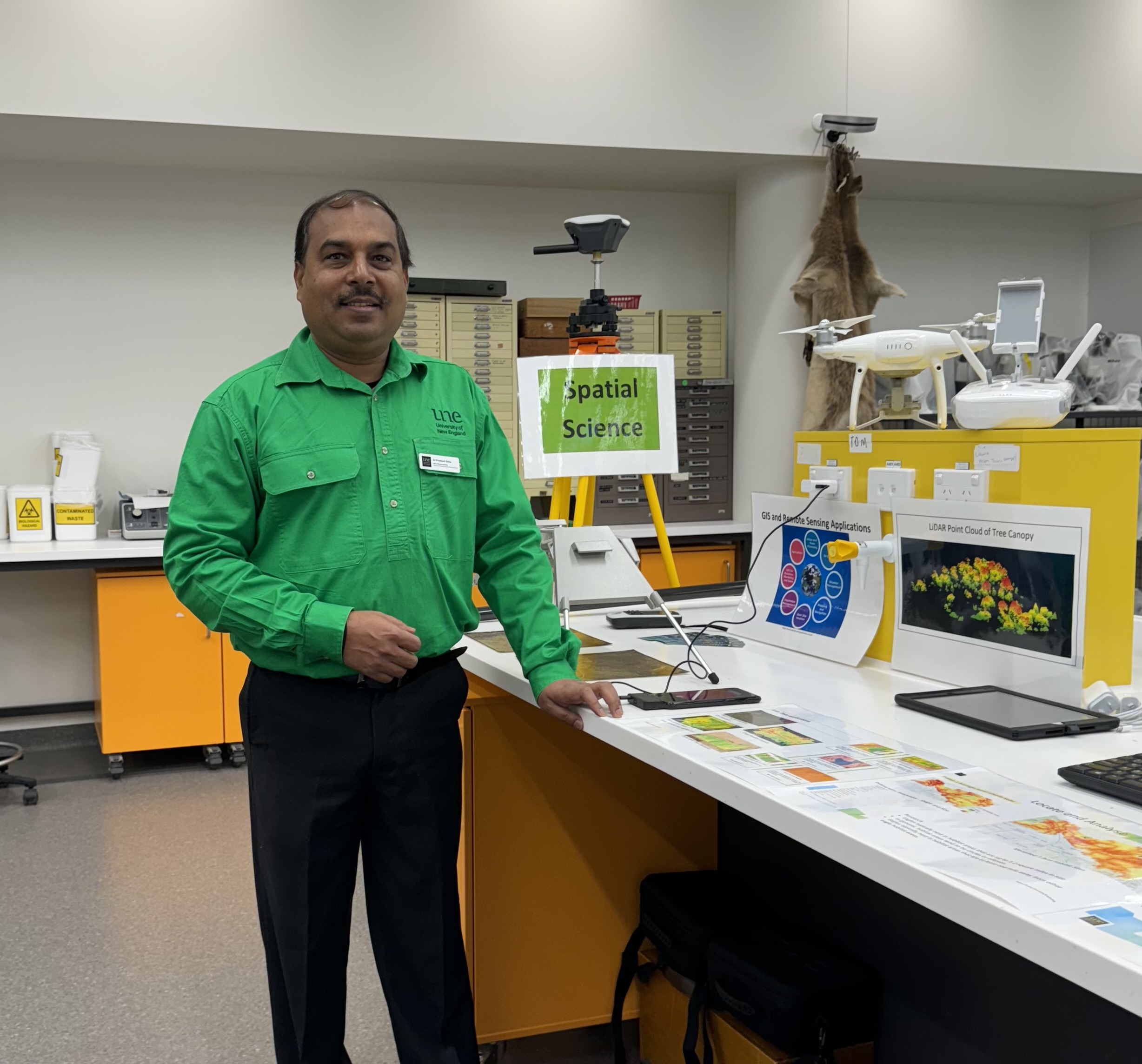
Dr. Priyakant Sinha is a Senior Lecturer in Spatial Science at the University of New England's School of Environmental and Rural Science, with over 20 years of research experience in remote sensing and geospatial science. He specializes in applying remote sensing technologies to agriculture, environmental monitoring, and natural resource management. His research focuses on: Advanced agricultural remote sensing and precision agriculture Time-series crop monitoring and yield prediction UAV/Drone-based 3D imaging for farm management Vegetation species mapping and change detection Hyperspectral and LiDAR data analysis Dr. Sinha teaches courses in GIS, spatial analysis, precision agriculture, and remote sensing applications. He has successfully supervised multiple PhD students in areas ranging from flood hazard mapping to drought monitoring using earth observation data. Technical expertise includes advanced digital image processing, GIS analysis and modeling, and specialized software including ENVI, ArcGIS, QGIS, and Pix4D. He develops innovative methods for temporal change analysis using machine learning and Google Earth Engine.
Aaron Maxwell is an Associate Professor in the Department of Geology and Geography at West Virginia University (WVU). He serves as the principal investigator of West Virginia View, a member of AmericaView, and director of the WV GIS Technical Center. His research focuses on spatial predictive modeling, geohazard mapping, machine/deep learning applications in remote sensing, and thematic map accuracy assessment. He holds degrees from Alderson Broaddus University (B.S. in Biology, Chemistry, Environmental Science) and WVU (M.S. and Ph.D. in Geology), with a GIS Professional (GISP) certification. Education: Bachelor of Science in Biology, Chemistry, and Environmental Science – Alderson Broaddus University Master of Science in Geology – West Virginia University Doctor of Philosophy in Geology – West Virginia University Research Interests: Dr. Maxwell’s work emphasizes computational methods to extract insights from geospatial data. Key areas include: Deep learning for geomorphic feature extraction (e.g., LIDAR-based semantic segmentation) Machine learning applications in forest fuel load estimation and slope failure modeling Best practices for assessing deep learning outputs in remote sensing Synthetic data generation for predictive modeling Community flood resiliency and participatory GIS Publications: His recent work highlights advancements in geospatial deep learning (e.g., the geodl R package), accuracy assessment metrics for imbalanced datasets, and modeling post-mining landscape evolution. Articles often blend theoretical frameworks with applied case studies across environmental and geotechnical domains. Grants & Funding: Supported by NSF (CAREER Award) and AmericaView, his work trains students and develops open-source geospatial tools. Current projects include synthetic forest stand modeling and flood resiliency initiatives. Labs & Teams: Leads WV View, fostering remote sensing education and data sharing. Collaborates on geospatial workforce development and open-source software initiatives (e.g., GIScience courses, ArcGIS Pro labs).