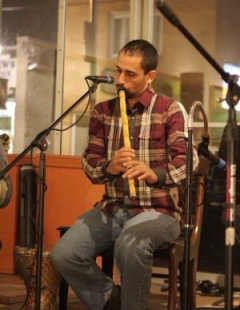
Nicholas Ragheb is a Ph.D. candidate and Lecturer in Ethnomusicology at the University of California, Santa Barbara. He holds an M.Mus. in Ethnomusicology from the University of Texas at Austin. His research focuses on the sacred music traditions of the Coptic Orthodox Church of Egypt and their adaptation in North American diaspora communities, particularly through web-based archives, social media, mobile applications, and digital educational tools. His academic background includes private studies at the Music College of Helwan University in Cairo, Egypt, where he specialized in traditional Arabic music performance. He teaches music theory and performs on instruments such as the n?y (reed flute), ‘ud (lute), and darb?kah/?abla (hand drums).
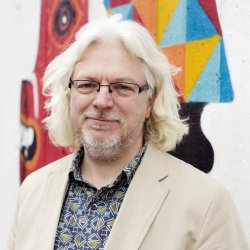
Stephen Goss is Professor of Composition and Director of the International Guitar Research Centre at the University of Surrey, and also holds a professorship at the Royal Academy of Music. His compositions are widely performed at major venues such as Wigmore Hall, Carnegie Hall, and Tchaikovsky Hall, and have been recorded on over 100 albums by labels including Decca, EMI, and Naxos. Professor of Composition, Department of Music and Media, University of Surrey Director, International Guitar Research Centre (IGRC) Professor of Guitar, Royal Academy of Music Board Member: Incorporated Society of Musicians, Guitar Foundation of America, International Guitar Foundation Goss’s research and compositional practice centers on pluralism in music, the late 20th and early 21st centuries, guitar history and repertoire, and performance practices. His work is marked by a fascination with time, place, and the juxtaposition of contrasting styles, often blurring the lines between composition, transcription, and improvisation. As a performer and collaborator, he has worked with composers such as Tōru Takemitsu and Peter Maxwell Davies, and performers including John Williams and Dame Evelyn Glennie. His recent compositions, such as Wynwood Walls , Landscape and Memory , and The Alchemist , reveal a continued exploration of narrative, visual art, and intercultural dialogue. These works often feature hybrid instrumentation and programmatic themes, reflecting his eclectic and forward-looking approach. Scientific Awards and Honors: Ivor Novello Award nomination (2021) for Still Life Fellow of the Royal Academy of Music (FRAM, 2018) Honorary Associate of the Royal Academy of Music (ARAM, 1999) Julian Bream Prize (Royal Academy of Music) Goss has supervised over 25 PhD students in areas including contemporary composition, guitar pedagogy, performance practice, and cross-cultural collaborations. He has received commissions from leading artists such as Nicola Benedetti, Ian Bostridge, and David Russell. He is also an active speaker and keynote lecturer at international conferences, addressing topics such as collaboration, improvisation, and the politics of nostalgia in music. He leads the International Guitar Research Centre, fostering global research and innovation in guitar studies. He is a D’Addario artist and an Arsenal FC season ticket holder.
Pedro Sperb is an Adjunct Professor and doctoral candidate at Eastman School of Music, where he specializes in historical and contemporary guitar performance. His academic mission emphasizes Latin-American Baroque music representation and historical music awareness. He concurrently serves as Chapter Leader for the Lute Society of America, directing the Lute4KIds educational initiative. Education: Master of Arts in Music Performance, Azusa Pacific University (2018) Master of Arts in Lute/Guitar, University of California, Irvine (2022) Doctoral candidate at Eastman School of Music (current) Research Focus: Pedro's work explores Early Music revival, Latin-American Baroque traditions, and pedagogical innovation for plucked-string instruments. His interdisciplinary approach integrates performance practice, musicology, and cross-cultural studies, with emphasis on democratizing access to historical repertoires. Awards & Honors: Finalist in Brazil's prestigious Souza Lima Guitar Competition (age 17) Teaching & Outreach: Has delivered Early Music Appreciation lectures at universities across California, South Carolina, and Colorado. Served as Teaching Assistant for advanced courses including Counterpoint, Harmony, and Orchestral Studies. Leads community engagement through Lute4KIds.
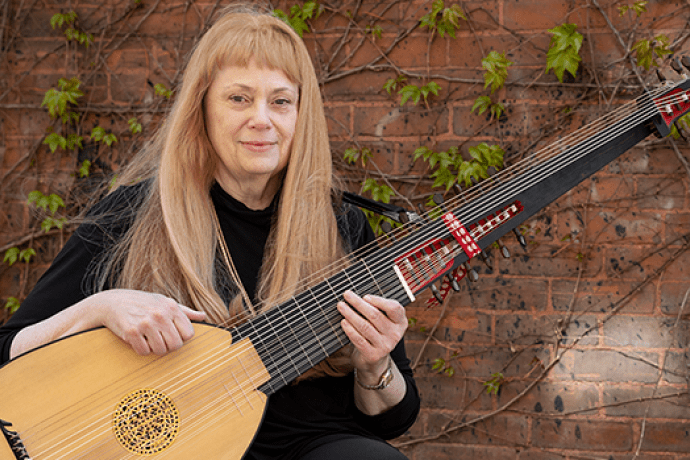
Meg Pash serves as Visiting Assistant Professor in Music at Mount Holyoke College and faculty member in the Five College Early Music Program, where she instructs Lute and Renaissance/Baroque dance while directing ensembles including the Renaissance and Baroque Dance Band, 17th-Century Song Seminar, and Lute Ensemble. Education Bachelor's in Vocal Performance, New England Conservatory Master's in Early Music Performance (voice/viola da gamba), New England Conservatory (mentored by Daniel Pinkham) Master's in Historical Dance and Lute, New England Conservatory (studied with Dr. Julia Sutton) Research Focus centers on late medieval, Renaissance, and early Baroque repertoires with specialized expertise in historical dance reconstruction. Her interdisciplinary approach examines music-dance symbiosis through performance practice, integrating folk traditions and Americana. Current work analyzes embodied cognition in 16th-century dance notation and cross-genre performance methodologies. Scholarly Trends reveal deep engagement with Renaissance performance practice, particularly dance-music interdependence. Her 2024 symposium presentation demonstrates rigorous reconstruction methodology applied to primary sources, bridging musicology and dance anthropology while challenging modern interpretive frameworks. Awards Noah Greenberg Award (American Musicological Society) for distinguished contribution to early music performance Professional Engagement spans 50+ years of ensemble direction, educational outreach, and cross-institutional collaboration. She developed curricula for the Boston Early Music Festival's Educational Outreach Program and directed choirs at Palmer High School for 21 years, teaching guitar, music technology, and intellectual property. Her Orff-Schulwerk certification informs innovative pedagogy. Ensemble Leadership includes co-founding AyreCraft (early music quartet) and Muse3.1 (folk trio), with historic collaborations including Sequentia's Ordo Virtutem tour and Boston Renaissance Ensemble's award-winning performances. Current liturgical work features as soloist at South Congregational Church (Springfield).
Pierre Pitzl is a Lecturer at the Faculty of Music, Music and Arts Private University of the City of Vienna. He is a renowned viola da gamba and baroque guitar specialist, active as a soloist, chamber musician, and ensemble leader (PRIVATE MUSICKE). His career spans performances at prestigious European festivals and collaborations with ensembles like Concerto Köln and Concentus Musicus Wien. Education: Guitar studies at University of Music and Performing Arts Vienna (soloist diploma cum laude at 19), lute/chamber music/basso continuo at Schola Cantorum Basiliensis, and viola da gamba at Conservatorium The Hague. As a recording artist, his CDs with ORF Edition Alte Musik, ACCENT, and Deutsche Grammophon have earned critical acclaim, including the Diapason d'Or. Recently, he has expanded into directing baroque vocal and operatic projects. His teaching career includes viola da gamba instruction at Vienna University of Music and Performing Arts, and baroque guitar positions at both Vienna University of Music and Performing Arts Vienna and Bremen University of Music (2017/18).
Sean Shibe is a Guitar Professor at Guildhall School of Music and Drama, specializing in classical and contemporary repertoire expansion. His innovative approach blends Baroque transcriptions with modern compositions, earning acclaim through BBC Radio 3’s New Generation Artists program and Borletti-Buitoni Trust support. He holds dual roles as performer and educator, actively commissioning works by composers like Thomas Adès and Cassandra Miller. Education includes studies under Allan Neave at Royal Conservatoire of Scotland and Paolo Pegoraro in Italy. His research focuses on expanding guitar’s expressive potential through interdisciplinary collaborations, featuring works by David Lang, Julia Wolfe, and Shiva Feshareki. Recent highlights include residencies at Wigmore Hall, debuts with Australian Chamber Orchestra, and the Leonard Bernstein Award (2022). Performance venues span Concertgebouw Amsterdam, Philharmonie de Paris, and Carnegie Hall. Awards include Gramophone and Opus Klassik honors, with discography on Pentatone and Delphian Records. His 2024/25 season features Boulez centenary performances, premieres of Mark Simpson and Tyshawn Sorey’s works, and tours with mezzo-soprano Ema Nikolovska.
Professor Dr. Habil Mariana Bouleva-Petrova is a faculty member at the Department of Music , Faculty of Fine Arts , St. Cyril and St. Methodius University of Veliko Turnovo . Her research focuses on music theory, harmony, and pedagogy. Research Interests : Music theory, harmony, polyphony, music semiotics, music psychology, aesthetics, philosophy of music, music arranging, and music education. Projects : Principal investigator in the project "Theological and Philosophical Ideas in the Byzantine and Balkan Cultural Space (7-12th c.)." Key Publications include studies on Scriabin's piano sonatas, Byzantine musical systems, and the evolution of Bulgarian music education. She has authored textbooks on harmony and written extensively on 20th-century Bulgarian composers. Contact: m.bouleva@ts.uni-vt.bg | mar_bul@abv.bg
Assoc. Prof. Dr. Ramazan KAMİLOĞLU is a Turkish musicologist at Inönü University's State Conservatory, Department of Music, since 2011. He specializes in Turkish religious music, Sufi traditions, and Ottoman musical heritage. PhD in Turkish Religious Music from Ankara University (2007) MA in General Turkish History from İnönü University (1998) BA in Theology from Erciyes University (1990) His research focuses on Sufi music , makam analysis , and historical intersections between anatolian folklore and Ottoman traditions . Publications examine TRT archives, Armenian-Turkish musical exchange, and 19th-century composers. Recent works include analysis of Mevlevi order influences ( 2024 ), Neşet Ertaş's compositions ( 2022 ), and archival studies of Cemil Bey's instrumental works ( 2020 ). Collaborations span 20+ universities including Marmara, Amasya, and Istanbul University. Head of Department (2011-2020) Deputy Conservatory Director (2020-) Advisor for 6 MA theses on regional music analysis Active in ethnomusicology and historical preservation , he has performed internationally in Tasavvuf Müziği Konseri events (2016-2019) and contributed to TRT repertory analysis.
Clément Stagnol is a French lutenist, musicologist, and associate professor (professeur agrégé) currently completing a PhD in musicology at Sorbonne University . From 2019 to 2024 he taught musicology in the UFR of Music and Musicology at Sorbonne, holding successively a doctoral teaching contract (2019–2023) and an ATER position (2023–2024). In 2025 he took up the post of Professor of Artistic Education – history of music and musical analysis – at the Regional Conservatory of Grenoble (CRR) . Education & Training 2019 → PhD in Music & Musicology, Sorbonne University (in progress) 2020 Agrégation de Musique (3rd/30) 2014 Master Recherche Musique & Musicologie, Sorbonne University 2019 Master Musique – Musicien-interprète (lute), CNSMD Lyon 2017 Master Musique – Culture musicale, CNSMD Lyon 2021 Certificat de piano complémentaire, CNSMD Paris 2025 Prix de Polyphonie XVe–XVIIe s., CNSMD Paris DEM guitare & formation musicale, CRD L’Haÿ-les-Roses (2011) Research Interests Stagnol’s scholarship centres on 17th-century French opera (especially the works of Cambert and Collasse immediately before and after Lully), lute music , the social history of music under the Ancien Régime , and historically-informed performance practice . His doctoral dissertation, supervised by Raphaëlle Legrand, investigates the tragédies en musique produced by the collaboration between Bernard de Fontenelle and Pascal Collasse (1689–1690) through the lens of the Quarrel of the Ancients and the Moderns. Performance & Ensemble Leadership As a professional lutenist, he co-founded the ensemble ApotropaïK , devoted to medieval repertoires and currently in residence at the Fondation Royaumont . The ensemble has released the CD Bella Donna (2023) and collaborates regularly with major French festivals. Scientific Awards & Distinctions 2020: Lauréat boursier, Adami (Society for performers’ rights) 2009: Premier prix, Concours Général Jury – Éducation musicale 2025: Prix de Polyphonie des XVe–XVIIe siècles, CNSMD Paris (unanimous TB) Grants & Doctoral Support Doctoral contract & teaching mission, Sorbonne University (2019→) ATER (Attaché temporaire d’enseignement et de recherche), Sorbonne (2023–2024) Vacation grant, French Ministry of Culture – programme Sequentia , IReMus (2015) Research Centre & Affiliations Doctoral studies are carried out within the Institute for Research in Musicology (IReMus, UMR 8223) , a joint unit of the National Library of France and Sorbonne University.
Bettina Pahn is a Lecturer in Historical Singing at the University of the Arts Bremen since 2017. She specializes in Early Music performance, Baroque vocal techniques, and historically informed interpretation. Her teaching integrates weekly lessons for Bachelor and Master students, focusing on vocal agility, stylistic expression, and period performance practices. Collaborations with renowned artists like Dame Emma Kirkby and Ton Koopman enrich her pedagogy. Education: Studied cello initially, then voice at the Hanns Eisler School of Music Berlin and Frankfurt/Main under Prof. Elsa Cavelti. Since 2012, trained under Margreet Honig, a leading historical voice pedagogue. Research emphasizes Baroque ornamentation (e.g., Rognoni's diminutions) and Romantic lied interpretation. Her performances with Ton Koopman’s ensemble earned the Echo-Klassik-Preis 2009. Recent projects include recordings of C.P.E. Bach lieder (2017) and Telemann’s moral cantatas (2020). She co-leads student mentorship with Benno Schachtner, guiding participation in competitions like the Bovicelli Competition (student Erika Tandiono won Young Talent Award in 2020). Key collaborations: Duo with Joachim Held (lute), Naxos recordings, and international masterclasses in Holland, Austria, and Italy. Upcoming engagements include a lecture-recital on 19th-century lied ornamentation at the AEC Congress (2021).
Jorge Torres is an Associate Professor of Music and Department Head at Lafayette College, directing the Marquis Consort early music ensemble. He holds a Ph.D. and M.M. from Cornell University and a BFA from California Institute of the Arts. His teaching focuses on interdisciplinary music studies, including courses like War and Peace: Music of the 1960s and Music, Culture, Context, which explores global musical traditions and the role of technology in music consumption. Education: Ph.D./M.M., Cornell University; BFA, California Institute of the Arts His research interests span 17th-century French lute music, Latin American popular music from the 1920s–1950s, and the social contexts of musical performance. Torres emphasizes collaborative learning through the Marquis Consort, which performs pre-1750 works by underrepresented composers like Matthew Locke and John Dowland. He engages in community work through the Lehigh Valley Friends, addressing cash bail inequities and supporting refugee resettlement efforts with Lafayette’s RefAct club.
Tom Coult is a Professor of Composition at the Royal Northern College of Music (RNCM). Since 2021, he has served as Composer-in-Association with the BBC Philharmonic Orchestra, producing works performed by leading orchestras worldwide. His opera Violet (2022), co-written with Alice Birch, received critical acclaim and multiple awards, including the International Opera Award and South Bank Sky Arts Award. Coult’s compositions blend playful and seductive elements with rigorous craft, spanning orchestral, chamber, vocal, and operatic works. Education: Bachelor’s/Master’s studies at University of Manchester (with Camden Reeves and Philip Grange) King’s College London (with George Benjamin) Trinity College Cambridge (Visiting Fellow Commoner, 2017–2019) Research Interests: Coult explores transformation of historical musical forms (e.g., Byzantine chants, Baroque lute pieces) into modernist frameworks. His works often involve textural experimentation, collaborative storytelling, and interdisciplinary approaches. Awards: Paul Hamlyn Award for Artists Lili Boulanger Memorial Fund Prize Royal Philharmonic Society Composition Prize International Opera Award (Violet) Grants & Labs: He has been Composer-in-Residence at Aldeburgh Festival, Musikdorf Ernen Festival, and Oxford Lieder Festival. His work is frequently commissioned by institutions like BBC Proms, Lucerne Festival, and Britten Pears Arts.
Jon Mendle is a faculty member at the San Francisco Conservatory of Music’s Pre-College program, specializing in classical guitar, lute, and historical plucked instruments. His expertise bridges performance and historical authenticity, with affiliations to ensembles such as The Silk Road Ensemble with Yo-Yo Ma and the San Francisco Guitar Quartet. PSC, San Francisco Conservatory of Music MM, San Francisco Conservatory of Music BM, San Francisco Conservatory of Music Mendle’s research and performance interests center on classical guitar, lute repertoire, and historical interpretations of Renaissance and baroque plucked instruments. His work emphasizes the interplay between structured composition and improvisatory freedom, particularly in works by Bach, Dowland, and Weiss. Jon Mendle’s awards include Second Prize in the 2021 Maurizio Pratola International Lute Competition and solo performances at Carnegie Hall and the 2014 Guitar Foundation of America Festival. His debut album L’infidele was praised by Soundboard magazine as a “beautiful disc.” Mendle has performed with ensembles like The Silk Road Ensemble (2010), The Pacific Guitar Ensemble (2010–2013), and the San Francisco Guitar Quartet (2009–2014). Outside music, he enjoys fine whiskies, coffee, history, and boxing, and maintains a daily practice routine of 1–3 hours.
Stefan Hagel serves as Privatdozent and Deputy Head of the Department of Ancient Sciences at the Austrian Academy of Sciences (ÖAW), where he leads the Research Group Ancient Music. His academic appointment is formally affiliated with the University of Vienna, reflecting his dual institutional presence in Austria's scholarly ecosystem. Institution: Austrian Academy of Sciences / University of Vienna Position: Privatdozent, Deputy Department Head, Group Leader Research Focus: Ancient Music Archaeology and Digital Humanities Hagel's research bridges classical philology, archaeology, and computational methods to reconstruct ancient musical practices. His work centers on Greek and Roman music theory, instrument reconstruction (particularly lyres and auloi), and the application of digital tools to analyze ancient musical systems. His methodology combines physical reconstructions with textual analysis and software development, creating interdisciplinary pathways for understanding antiquity's sonic dimensions. Hagel frequently demonstrates his findings through international lecture-concerts, making ancient music tangible for academic and public audiences alike. His recent publications reveal a trajectory toward increasingly sophisticated technological integration, examining water organs, solmisation systems, and cross-cultural musical exchanges across the Mediterranean and Near East. Hagel's scholarship demonstrates how computational approaches can resolve longstanding questions about instrument mechanics, tuning systems, and performance practices that traditional philological methods alone cannot address. Major Projects: 'Ancient Music Beyond Hellenisation', 'DiAGRAM' (Digitising Aspects of Graphical Representation in Ancient Music) Software Development: Classical Text Editor (critical editions platform), MultiKey (keyboard utility) As an active participant in the European Music Archaeology Project, Hagel collaborates internationally to reconstruct ancient soundscapes. His work with physical instrument reconstructions provides empirical data for theoretical models, while his digital humanities initiatives create infrastructure for future research. Though not explicitly mentioned in the materials, his leadership position suggests involvement in mentoring junior researchers and securing research funding for his specialized field.
Jason Yoshida is a part-time lecturer in Early Music at the University of Southern California's Thornton School of Music, specializing in lutes and historical guitars. He is an internationally recognized performer with acclaimed recordings and collaborations across major early music festivals and ensembles. Education: Doctorate of Musical Arts in Early Music Performance, USC Thornton School of Music Master of Music in Classical Guitar, USC Thornton School of Music Bachelor of Music, UC Santa Barbara Yoshida's artistic focus centers on historical plucked instruments , with expertise in solo lute repertoire, Baroque/Renaissance guitar performance, and continuo practice. His work emphasizes 16th-17th century music and improvisation, highlighted by the world premiere recording of Scheidler’s Variations on a theme by Mozart for baroque lute on his internationally recognized CD Mozart Encomium . Awards and Recognition: Yoshida received international acclaim for Mozart Encomium and Ciaramella's Dances on Movable Grounds . He was selected by Early Music America for the 2011 Boston Early Music Festival Ensemble. Performance Activities: As a core member of Ciaramella (directed by Adam and Rotem Gilbert), he has performed at the Getty Museum, Berkeley Early Music Festival, and Da Camera Society. He serves as continuo player for L.A. Opera, UCSB/USC Opera departments, and Bach Collegium San Diego, with additional collaborations including Les Surprises Baroques and Angeles Consort.