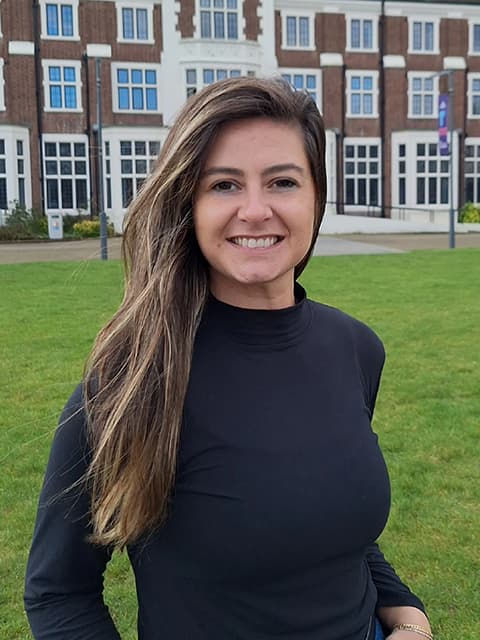
Sabrina Furtado is a Lecturer in Sport Management and Dean’s Associate Fellow at Loughborough University’s School of Sport, Exercise and Health Sciences. She holds a BSc, MSc, and PhD. Previously, she taught at the Federal University of Paraná and State University of Santa Catarina in Brazil, focusing on sport management, sports law, and entrepreneurship in the sports sector. Her research focuses on sports governance, strategic planning, and policy development in public and private sports entities. Key areas include Olympic and Paralympic federations, sports financing, and the impact of media representation on disability inclusion. She contributes to the Sport, Business and Society and Lifestyle for Health and Wellbeing research groups, as well as the Inteligência Esportiva Research Institute . Recent work analyzes governance structures in Santa Catarina municipalities, business intelligence applications in sports management, and modernization processes in Brazilian Olympic federations. Her publications span topics like Paralympic organizational roles, media stigma in disability sports reporting, and funding mechanisms for sports initiatives. No scientific awards are mentioned. Sabrina advises master’s students on sport management and policy but no grant details are provided. Her current projects aim to strengthen sports policies and enhance stakeholders’ engagement in the sport system.
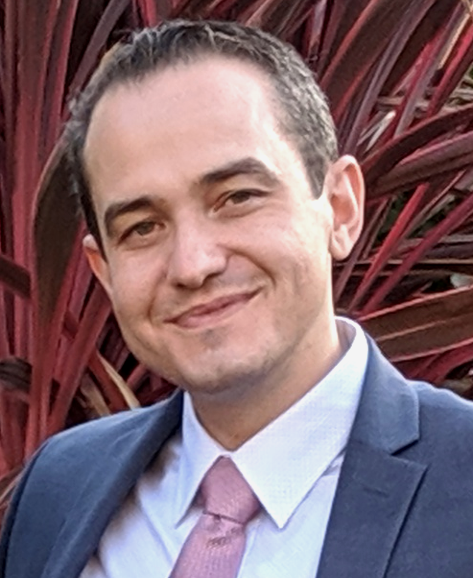
Christopher Kanan is a tenured Associate Professor of Computer Science at the University of Rochester, leading the AI Initiative within the Hajim School of Engineering & Applied Sciences. He holds secondary appointments in Brain and Cognitive Sciences, the Goergen Institute for Data Science and AI (GIDS-AI), and the Center for Visual Science. His research focuses on deep learning systems for artificial general intelligence (AGI), including continual learning, medical computer vision, and visual question answering. Previously, he was an Associate Professor at RIT’s Carlson Center for Imaging Science and a leader at Paige.AI, contributing to the FDA-cleared Paige Prostate system. Kanan earned his PhD from UC San Diego, completed postdoctoral work at Caltech, and worked at NASA JPL. Education: PhD in Computer Science, UC San Diego MS in Computer Science, University of Southern California Bachelor’s in Philosophy and Computer Science, Oklahoma State University Research Interests: Kanan’s work spans foundational AI capabilities like continual learning, medical imaging (pathology and radiology), multi-modal reasoning, and cognitive science-inspired models. His lab develops bias-robust AI systems and applies deep learning to healthcare and fusion research. Articles Trends: His recent work emphasizes out-of-distribution generalization, foundation models in pathology, and stability in continual learning. Key themes include AI applications in healthcare, model robustness, and neuroscience-inspired algorithms. Awards: NSF CAREER Award Senior Member, AAAI and IEEE DoE and NSF grants totaling $5M+ DARPA/ARL awards Advising & Grants: Mentored over 10 PhD students, including Robik Shrestha and Usman Mahmood. Secured grants for AI in nuclear fusion and medical imaging. Led RIT’s Center for Human-aware AI (CHAI) as Associate Director. Labs & Teams: Heads the University of Rochester AI Initiative, collaborates with Paige.AI, and leads teams advancing AI in pathology and robotics. His lab’s KLab (klab.cis.rit.edu) focuses on vision and learning systems.
Kristin Bernard, Ph.D. (University of Delaware, 2013), is an Associate Professor of Clinical Psychology at Stony Brook University’s Department of Psychology. Her research focuses on the neurobiological consequences of early adversity, parent-child relationships, and the efficacy of early parenting interventions such as Attachment and Biobehavioral Catch-up (ABC). She collaborates with Power of Two, a NYC-based nonprofit, and leads the Developmental Stress and Prevention Lab. Current grants include studies on epigenomics, maternal attachment representation, and community-based ABC interventions. Dr. Bernard’s work bridges clinical and developmental psychology, emphasizing prevention science and translational research. Education: Ph.D. in Clinical Psychology, University of Delaware, 2013. Research Interests: Child maltreatment, neurobiological impacts of early adversity, parenting interventions, psychobiology of attachment, and intervention efficacy. Her lab investigates mechanisms linking caregiving quality to child outcomes, including cortisol regulation, brain development, and behavioral compliance. Lab & Partnerships: Directs the Developmental Stress and Prevention Lab, focusing on high-risk populations. Collaborations include Power of Two for ABC implementation and NYC agencies like the Administration for Children’s Services. Current projects explore neighborhood influences on parenting (Geography of Parenting Study) and neural correlates of parenting behavior (SNAP study). Grants & Funding: Principal Investigator on NIH-funded projects (R03 HD099372, R01 MH119310) and co-PI on Stony Brook’s seed grants. Projects examine accelerated aging biomarkers and intervention effectiveness in community settings. Publications: Over 50 peer-reviewed articles and a co-authored book on ABC interventions. High-impact journals include Psychoneuroendocrinology , Development and Psychopathology , and Child Development .
Maren Toft is a Professor in the Department of Sociology and Human Geography at the University of Oslo's Faculty of Social Sciences. Her academic career has progressed from Research Assistant (2013-2014) to PhD Candidate (2014-2018), Postdoctoral Fellow (2018-2022), Associate Professor (2022), and now Professor. Her research focuses on: Class theory and theory of elites Social mobility and class structuration Segregation and urban inequality Social capital and networks of power Advanced quantitative methods including social sequence analysis and correspondence analysis Toft's publication record shows a consistent focus on elite formation, wealth accumulation, and class reproduction. Her work frequently employs longitudinal approaches to examine how social origins influence life trajectories, particularly among the upper classes. She has made significant contributions to understanding how class structures persist in Scandinavian welfare states, challenging assumptions about equality in these societies. Her major scientific awards include: His Majesty the King's Gold Medal for her 2018 PhD dissertation 'Biographies of privilege' Norwegian sociological association's award for best international publication in 2020/2021 Norwegian sociological association's award for best international publication in 2017 Kunnskap Oslo's award for best Oslo-related Research in 2015 Norwegian sociological association's award for research dissemination in 2018 Toft actively supervises PhD students including Iselin Hewitt (studying urban planning and gentrification), Marte Lund Saga (examining business-politics networks), and Stian Uvaag (researching sibling similarities in mobility). She serves on the board of both the Department of Sociology and Human Geography and the Norwegian Sociological Association. She is involved in several major research projects including HISTCLASS, The Oslo Register Data Classification (ORDC), The Salmon Elite (SALELITE), and Weaving the fabric of Elite Bonds (WEB), which collectively examine various dimensions of elite formation, power structures, and social inequality in Norway and internationally.
Dr. Kristen M George serves as an Assistant Professor of Epidemiology in the Department of Public Health Sciences at the University of California, Davis, School of Medicine. Her academic journey includes a BA in Political Science with minors in Public Health and Anthropology from Washington University in St. Louis, followed by an MPH and PhD in Epidemiology with a minor in Biostatistics from the University of Minnesota (completed in 2015 and 2019 respectively). Dr. George's research program focuses on lifecourse vascular contributions to dementia and cognitive aging, with particular emphasis on race and sex disparities. She investigates how social determinants lead to inequities in cardiovascular risk factors and disease, which subsequently contribute to disparities in cognitive aging and dementia outcomes. Her work bridges epidemiology, neurology, and social determinants of health to address critical gaps in understanding dementia disparities. Analysis of her recent publications reveals a strong focus on African American health, life course epidemiology, and structural determinants of cognitive aging. Her research frequently examines how historical and contemporary social factors impact neurological outcomes in diverse populations, with particular attention to cardiovascular pathways to dementia. Professional recognition includes: Center for the Advancement of Multicultural Perspectives on Science (CAMPOS) Scholar, UC Davis (2021) NIH Travel Award (2020) JB Hawley Student Research Award, University of Minnesota (2016) Dr. George is an active member of the Alzheimer's Association International Society to Advance Alzheimer's Research and Treatment and the Methods in Longitudinal Dementia Research community, contributing to both national and international efforts to understand and address dementia disparities through rigorous epidemiological approaches.
Airo Hino is a Professor at the Faculty of Political Science and Economics , Waseda University. He holds a Ph.D. in Government from the University of Essex and MA/BA in Political Science from Waseda University. His work spans Comparative Politics , Voting Behavior , and Political Communication , with a focus on populism , authoritarian values , and Twitter-based well-being indicators . Education: Ph.D. (University of Essex), MA/BA (Waseda University) His research explores electoral systems , party polarization , and social media's role in politics , including the development of the SWB-J index for measuring subjective well-being via Twitter. His 2021-2024 publications analyze populist attitudes, conspiracy theories, and electoral dynamics in Japan and global contexts. Scientific awards include: 2021 - Best Paper Award, International QCA Paper Development Workshop 2016 - Waseda Research Award (High-Impact Publication) 2015 - Okuma Memorial Academic Award 2015 - Best Article Award, Japanese Association of Electoral Studies He has received JSPS KAKENHI grants (2020-2025) for studies on political polarization and populism , and 2017-2022 grants for research on electoral system impacts .
David Lindlbauer is an Assistant Professor at the Human-Computer Interaction Institute (HCII) of Carnegie Mellon University, where he leads the Augmented Perception Lab and co-directs the CMU Extended Reality Technology Center. His research bridges human perception, extended reality (AR/VR), and computational interaction techniques, focusing on developing systems that dynamically adapt interface elements based on environmental context, user cognition, and task requirements. He completed his PhD at TU Berlin under Prof. Marc Alexa and held a postdoctoral position at ETH Zurich's Advanced Interactive Technologies lab. His work has been published extensively at top venues including ACM CHI, UIST, and IEEE VR, with research themes spanning gaze tracking, spatial audio optimization, haptic feedback, and multimodal notification systems. Media outlets like MIT Technology Review and Fast Company Design have featured his innovations. Dr. Lindlbauer has received prestigious grants from Meta, NSF, and ETH Zurich, and serves on program committees for CHI, UIST, and ISMAR. He has been recognized with Best Paper awards at ISS 2023 and CHI 2016, and his lab develops tools like MineXR for personalized XR interfaces and RealityReplay for temporal change visualization in mixed reality environments.
Tae-Ho Lee is an Associate Professor in the Department of Psychology at Virginia Tech, with affiliated appointments in the School of Neuroscience and Translational Biology, Medicine, and Health. His research focuses on affective and cognitive neural development across the lifespan, neurodegeneration, and family-based neural dynamics. PhD in Brain and Cognitive Science, University of Southern California M.A. in Clinical Psychology, Korea University B.A. in Psychology, Korea University Dr. Lee’s work explores brain connectome dynamics, dyadic neural concordance in families, and age-related attentional control. He employs neuroimaging techniques to study how familial and environmental factors shape emotional and cognitive outcomes in adolescents and older adults. Recent publications highlight trends in longitudinal studies , parent-child neural similarity , and functional connectivity in emotion regulation . Key areas include autism spectrum disorder, substance misuse risk, and the role of socioeconomic factors in brain development. Rising Star , Association for Psychological Science (2020) Dr. Lee is not currently accepting students and leads the Affective Neurodynamics and Development (AND) Lab at Virginia Tech.
Professor Nikos Tzavidis is a Professor of Statistical Methodology at the University of Southampton . He has held academic positions at institutions including University College London and the University of Manchester, and currently leads research initiatives integrating statistical methodology with geospatial and survey data. His work focuses on Small Area Estimation, official statistics, and poverty mapping, with applications across global development and public policy. Research interests: Small Area Estimation and Official Statistics Outlier Robust Inference Quantile and M-quantile Models Geospatial Data Analysis Poverty Mapping Machine Learning Applications in Statistics Recent research trends emphasize machine learning integration, geospatial data utilization, and advanced quantile modeling for poverty and demographic studies. His publications span journals like the Journal of Official Statistics and the Journal of the Royal Statistical Society . Scientific awards: ISI Fellow (2013) American Statistical Association (2004) Vice Chancellor's Teaching Award (2013) Johann von Spix Professor (2023) He supervises PhD students in social statistics, demography, and geography, and serves on editorial boards for journals including the Journal of Official Statistics . Externally, he has held leadership roles in the International Statistical Institute and contributed to United Nations and World Bank projects.
Peter Seele is a Full Professor at the Faculty of Communication, Culture and Society at Università della Svizzera italiana (USI). He is affiliated with the Center for Climate Finance and Sustainability (CCFS), Ethics and Communication Law Center (ECLC), and the Luxury Observatory Lugano (LOLugano). His research focuses on Corporate Social Responsibility (CSR), Business Ethics, Digital Ethics, Greenwashing, and Machinewashing. Dr. Seele holds dual PhDs in Economics (University of Witten/Herdecke, Germany) and Philosophy (University of Düsseldorf, Germany). He previously served as an Assistant Professor at the University of Basel and conducted post-doctoral research at the Institute for Advanced Studies in the Humanities (KWI) in Essen. His educational background includes studies at the University of Oldenburg and Delhi School of Economics, followed by two years as a business consultant in Frankfurt. His research explores ethical challenges in digitalization, sustainability, and technology. Notable themes include AI ethics governance, ethicswashing in corporate communication, and the interplay between blockchain and business ethics. Recent work addresses greenwashing trends, the ethical implications of algorithmic systems, and sustainable practices in luxury industries. Publications highlight critical analyses of digital ethics frameworks, sustainability backlashes, and the societal impact of emerging technologies. His interdisciplinary approach bridges philosophy, business studies, and environmental science, with a focus on practical solutions for ethical dilemmas in modern organizations. Peter Seele collaborates across academic and industrial sectors, emphasizing real-world applications of ethical theories. He advises on CSR strategies, digital transparency, and regulatory frameworks for sustainable business practices.
Stephen Billings is an Associate Professor of Finance at the Leeds School of Business, University of Colorado Boulder, where he holds the Global Real Estate Capital Markets Chair position. He serves as the faculty director of the MS in Real Estate program and research director for the CU Real Estate Center. His work spans multiple research centers including the Center for Research on Consumer Financial Decision Making and the Michael A. Klump Center for Real Estate. Billings received his PhD in Economics from the University of Colorado, a MS in urban planning from the University of North Carolina, and a BS in economics from Georgetown University. Prior to joining CU Boulder in 2016, he was faculty at the University of North Carolina Charlotte with appointments in both economics and public policy, where he also served as faculty director for the real estate center. His research focuses on the intersection of housing, schools, neighborhoods and crime, addressing critical policy issues including the impact of public investment in light-rail transit on neighborhoods, school segregation's influence on academic achievement and crime, neighborhood gentrification causes, lead-based paint in low-income housing, and the effects of sea level rise and natural disasters on neighborhood sorting and household finances. Billings employs sophisticated analysis of large micro-datasets with studies based on data and policies in Charlotte, NC and Denver, CO. His work connects urban economics with public policy, demonstrating how neighborhood environments shape individual outcomes across multiple dimensions. Billings' recent publication record demonstrates a consistent focus on neighborhood effects, school choice impacts, crime economics, and housing market dynamics. His work frequently examines the intersection of race, housing, and economic outcomes, with particular attention to policy implications. He has developed innovative methodological approaches to studying residential amenities and neighborhood spillovers, with increasing attention to climate change impacts on housing markets. His research appears in top journals including The Quarterly Journal of Economics, American Economic Review: Insights, and Journal of Urban Economics. As an educator, Billings teaches undergraduate and masters classes in real estate finance and economics, as well as doctoral and masters level courses on cost-benefit analysis and statistical methods. He has extensive consulting experience conducting economic impact studies, including assessments of North Carolina's public higher education system, affordable housing needs in Colorado communities, and the economic effects of marijuana legalization on property markets. His practical policy work complements his academic research, creating a bridge between theoretical insights and real-world applications. Billings leads significant research initiatives through the CU Real Estate Center, where he directs studies examining the impact of business improvement districts and other urban development policies. His work bridges academic research with practical policy applications, making substantial contributions to our understanding of how housing, education, and neighborhood environments shape individual outcomes and community development. His December 2023 memo on the HUD Officer Next Door Program exemplifies his engagement with current housing policy issues.
Peter Werner is a Full Professor of Behavioral Economics and Policy Design at Maastricht University's School of Business and Economics, where he leads research in the Department of Economics (Microeconomics & Public Economics section). He progressed from Assistant Professor (2016-2017) to Associate Professor (2018-2023) before attaining his current full professorship, demonstrating sustained academic contribution within the institution. His educational foundation includes: Ph.D. in Economics, University of Cologne (2005-2009), thesis: 'Behavioral Economics and Agency Problems: Empirical Studies' Diplom-Volkswirt in Economics, University of Cologne and Stockholm School of Economics (1999-2005) Werner's research centers on applying behavioral insights to real-world systems , with dual focus on fundamental social preference mechanisms and practical policy design. His work bridges laboratory experiments with field applications, particularly in wage transparency , pension decision architecture , and organizational incentive structures . Recent methodological innovations integrate population-level surveys with experimental economics to measure preference stability during crises like the COVID-19 pandemic. Analysis of his 2022-2025 publications reveals expanding scope from traditional labor economics into climate behavior and intergenerational solidarity, while maintaining core expertise in experimental methodology. Key trends include increased focus on Dutch pension systems, risk communication frameworks, and cross-generational discrimination patterns using nationally representative samples. His primary recognition includes: Marie Skłodowska-Curie Individual Fellowship (2017-2019) for 'Wage transparency in companies' (Horizon 2020 Grant 745894) Werner actively secures competitive funding through major initiatives: Current: Netspar Theme Project on risk preference measurement (Instituut Gak) Recent: Netspar pension savings project (2019-2023) Past: Marie Curie Fellowship (2017-2019) He coordinates the UM Behavioral Insights Center and co-organizes the M-BEES/M-BEPS symposia series, fostering research-practice integration. As co-director of the UM Behavioral Insights Center—one of the university's research spearheads—Werner leads interdisciplinary teams applying experimental economics to public policy challenges, with particular emphasis on pension communication and labor market transparency through partnerships with Dutch governmental and financial institutions.
Rik Crutzen is a Full Professor at the Faculty of Health, Medicine and Life Sciences, Maastricht University, specializing in health promotion and digital interventions. His research focuses on leveraging technology to improve health behaviors across diverse populations, including adolescents, older adults, and immigrant communities. He leads projects in the CAPHRI research group for Promoting Health & Personalised Care. Research trends include: Digital health innovations (e.g., helplines, apps, algorithms) Chronic disease management (post-COVID-19, dementia risk) Health equity in immigrant populations (cervical cancer, maternal care) Behavioral interventions (physical activity, sleep, STI prevention) Systematic reviews and mixed-methods studies He has supervised 22 academic works and contributed to datasets on activity patterns and sleep-activity correlations. His work spans public health policy, health education, and technology integration.
Scott D. Landes is a Professor in the Sociology Department at Syracuse University's Maxwell School of Citizenship and Public Affairs. He holds affiliations with the Aging Studies Institute, Lerner Center for Public Health Promotion, and Center for Aging and Policy Studies. Landes earned his Ph.D. in Sociology from the University of Florida in 2014. His research focuses on disability mortality disparities, veteran health outcomes, and the intersection of disability with medical and social theory. Education: Ph.D. in Sociology, University of Florida, 2014 Research Interests: Landes investigates mortality trends for disabled adults and veterans, disability theory integration with life course frameworks, and data equity in disability measurement. His work addresses systemic undercounting of disability in federal surveys and explores racial/ethnic disparities in lifespan outcomes for individuals with intellectual/developmental disabilities (IDD). Recent Research Trends: His publications analyze pandemic impacts on IDD populations, combat veteran longevity, and diagnostic overshadowing in mortality reporting. Recent work critiques Washington Group disability measures' limitations and advocates for improved data collection methods. Awards: 2025 Excellence in Graduate Education Faculty Recognition Award O’Hanley Faculty Scholar (Syracuse University) NIH-funded research projects on aging policy and mortality disparities Advising & Grants: Recipient of multiple National Institutes of Health grants. Advises on disability data equity initiatives and participates in interdisciplinary teams addressing veteran health disparities. Supervises graduate research on IDD lifespan trajectories and pandemic vulnerability. Labs/Teams: Core member of Syracuse’s Aging Studies Institute and Lerner Center for Public Health Promotion. Collaborates with the Center for Aging and Policy Studies on federal health data projects. Engages with national disability advocacy groups through research briefs and policy consultations.
Karin Allor Pfeiffer is a Professor in the Department of Kinesiology at Michigan State University (MSU) and Director of the Institute for the Study of Youth Sports. She holds additional membership in the Center for Physical Activity and Health. With a Ph.D. from MSU, her research focuses on physical activity measurement methodologies and population health interventions, particularly among children and adolescents. Her work addresses obesity prevention, environmental design impacts on activity levels, and sociocultural factors influencing youth sport participation. Education: Ph.D. in Kinesiology from Michigan State University Her research interests emphasize: - Quantitative methods for physical activity assessment - Schoolyard redesign strategies and their health impacts - Cardiometabolic risk factors in pediatric populations - Longitudinal tracking of physical fitness and health outcomes Recent work explores accelerometer fragmentation metrics, GPS-linked activity tracking, and disparities in sedentary behavior across demographic groups. She has pioneered interdisciplinary approaches integrating spatial analysis, wearable technology, and policy evaluation. Key contributions include developing the Observational System for Recording Physical Activity in Children and advancing consensus methods for accelerometer data interpretation. Her studies frequently highlight socioeconomic and environmental determinants of health behaviors. Dr. Pfeiffer collaborates with public health agencies and urban planners to translate research into actionable policies. Her lab focuses on scalable interventions for underserved communities, leveraging community-engaged methods to address greenspace accessibility and safety concerns.