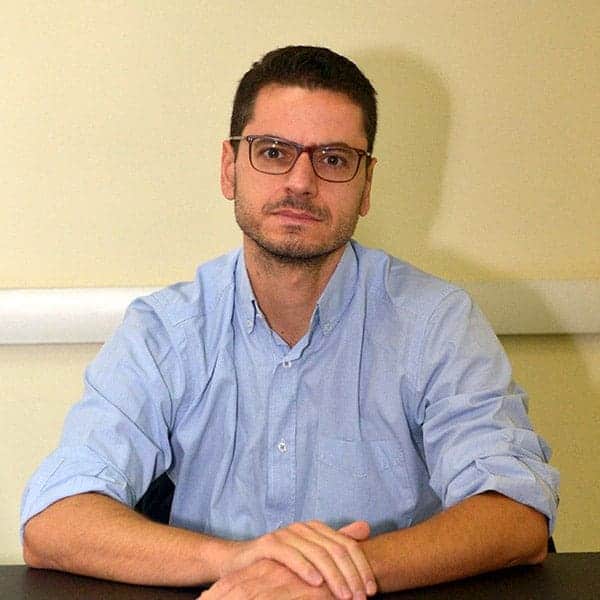
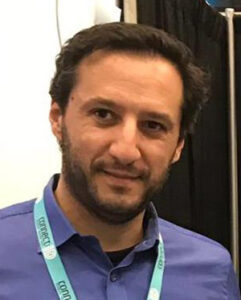
Evgenia Foustoukou is an Assistant Professor in the Department of Informatics at the Athens University of Economics and Business (AUEB). She has been teaching and conducting research at AUEB since 2006, with a focus on Mathematical Logic and its applications in Computer Science. She actively collaborates with the Inter-university Graduate Program in Logic, Algorithms and Computation (MPLA) and serves as a collaborating instructor at the Hellenic Open University. Education: Studied Mathematics, Philosophy, and Informatics in Paris. PhD from the University of Orsay - Paris Sud. Her research explores intersections between Mathematical Logic and Computer Science, particularly in Database Theory, Query Languages, Logic Programming, Algorithms, Computational Complexity, Ontologies, Automata Theory, Program Verification, and Temporal Logics. The selected publications highlight her work on Temporal Logics, Datalog, Computability, and Complexity, with methodological approaches rooted in Mathematical Logic and Database Theory. These papers address foundational challenges in Computation Theory and Formal Verification.
Panagiotis Katsaros is an Associate Professor at the Department of Informatics, Aristotle University of Thessaloniki. His research spans formal verification, model-based system design, dependability, security, and simulation-based performance analysis. He contributes to rigorous methods for embedded systems, IoT, and fault-tolerant computing. His work focuses on Formal verification and model checking Model-based design for multi-core and embedded systems Dependability and security of distributed systems Probabilistic analysis of security risks He has published extensively on these topics, with recent works addressing reactive streaming software, IoT systems, and cloud elasticity. His research often bridges theoretical rigor with practical applications in real-time and safety-critical domains. Scientific awards include BEST PAPER AWARD at 17th Panhellenic Conference on Informatics (PCI 2013) BEST PAPER AWARD at 15th Panhellenic Conference on Informatics (PCI 2011) He collaborates with international institutions and has supervised students in software verification and distributed systems. His contributions to conferences like ETAPS, DSN, and COMPSAC highlight his expertise in systems analysis and software reliability.
Alexander Artikis is an Associate Professor at the Department of Maritime Studies, University of Piraeus. His academic work bridges artificial intelligence, distributed systems, and maritime informatics, with a focus on complex event recognition and temporal reasoning. PhD in Multi-Agent Systems from Imperial College London Research areas include: Artificial Intelligence and Machine Learning Distributed and Real-Time Systems Event Calculus and Temporal Reasoning Maritime Data Analytics Recent publications highlight advancements in: Knowledge Graph Inconsistency Detection and Resolution Tensor-Based and Symbolic Register Transducer Formalisms Human-in-the-Loop Visual Analytics Temporal Specification Optimization Large Language Model Applications in Event Recognition Scalable Event Processing for Maritime Mobility He contributes to the academic community through program committee roles at premier conferences like AAMAS, IJCAI, and AAAI.
Dimitris Sotiropoulos is an Assistant Professor at the Department of Electrical and Computer Engineering, University of Peloponnese, specializing in Engineering Mathematics . He holds a B.Sc. in Mathematics (1995) and a Ph.D. (2005) in Mathematical Programming and Numerical Analysis. Over 20 years of higher education teaching Author/co-author of 36+ scientific articles Supervised 20+ postgraduate theses Research Interests focus on computational mathematics, global optimization algorithms, and machine learning. Specific areas include interval analysis for automatic result verification, large-scale optimization, nonlinear equation solving, and artificial neural network training. His scientific work spans sustainability assessments for aerospace components, uncertainty quantification in composite materials, and stress modeling in human-computer interaction. Articles highlight applications of interval analysis to optimization problems and neural network training improvements via BFGS methods. Teaching roles include lectures at Ionian University's Department of Informatics and University of Peloponnese's Department of Computer Science and Technology. He also serves on Hellenic Open University's Supervisory Board since 2009, mentoring postgraduate students in computational mathematics.
Karafyllidis Ioannis is a Professor at the Department of Electrical and Computer Engineering, School of Engineering, Democritus University of Thrace. His work focuses on microelectronics, nanoelectronics, quantum computing, and bioelectronics. He has extensive academic experience, including collaborations with institutions like UC Berkeley, TiiMS, and the Institute of Nanotechnology. Researcher in 12 national/international programs Editor for 3 international journals 42+ reviewer roles in scientific journals 95+ publications with 2,100+ citations Research Trends: His recent publications highlight interdisciplinary work at the intersection of quantum computing, graphene-based electronics, and biological systems modeling. Key themes include memristive devices for neuromorphic computing, quantum cellular automata architectures, and simulations of bacterial communication mechanisms. Teaching: Offers undergraduate courses in Microelectronics and Quantum Computers, and postgraduate courses in Nanoelectronics and Quantum Information Processing. Laboratory: Works in the Integrated Circuits Laboratory, focusing on design, modeling, and simulation of micro/nanoelectronic components and systems.
Karlis Athanasios serves as Associate Professor, Director of the Electrical Machines Laboratory, and Vice President at the Department of Electrical and Computer Engineering (THMMY) of the Aristotle University of Thessaloniki. He holds Senior Member status in IEEE and serves on the Board of Directors of the Hellenic Institute of Electric Vehicles (ELINHO). His research spans electromobility, electrical machines, renewable energy systems, smart grids, and energy automation . Key focuses include diagnostic methods for electrical machines, microgrid integration, and techno-economic evaluation of power generation systems. He pioneered the donation of an electric car (Jmstar MBG3000 EV) to the Electrical Machines Laboratory for student research. Awarded the 2015 IEEE Outstanding Branch Chapter Advisor Award (Region 8) and 2016 IEEE IAS Outstanding Student Branch Chapter Advisor Award , he organized the 23rd International Conference on Electrical Machines (ICEM 2018) with 450 participants from 45 countries. His publication trends emphasize real-time energy management, fault diagnosis in motors, and renewable integration using AI-driven control systems. 2015 IEEE Outstanding Branch Chapter Advisor Award, Region 8 2016 IEEE IAS Outstanding Student Branch Chapter Advisor Award He supervises three doctoral theses and leads the Electrical Machines Laboratory, which focuses on control and diagnostic methods for electrical machines. His research program PRENED '97 investigated small hydroelectric stations, and he maintains active collaborations with international institutions including Virginia Tech and Friedrich-Alexander-Universität Erlangen-Nürnberg.
Christos Schinas is a Professor at the Department of Electrical and Computer Engineering, Democritus University of Thrace (DUTH), serving since 2003. He also directs the Interdepartmental Postgraduate Program 'Organization and Management of Technical Systems' (DUTH and Aristotle University of Thessaloniki) since 2015. Education: PhD in Applied Informatics (University of Macedonia, 1998), MSc in Mathematics (University of Rhode Island, 1992), BSc in Mathematics (Aristotle University of Thessaloniki, 1991) His research focuses on Difference Equations , Differential Equations , Dynamical Systems , and Fuzzy Logic , with applications in mathematical modeling and network protocols. His work includes over 50 publications with 400+ citations and four academic textbooks. The 2021-2019 publications highlight his expertise in stability analysis of difference equations, bifurcation theory, and network protocol optimization. Keywords span Mathematics , Applied Mathematics , and Computer Science , reflecting interdisciplinary contributions. Scientific Awards: IKY State Scholarships Fellowship Teaching Assistantship from University of Rhode Island He has participated in European and national research projects including MathIND (2001-03), Practical Training DUTH (2015-16), and DASTA (2018). As Director of the Mathematical Study Center, he contributes to academic and research activities.
Panagiota Tselenti is a Lecturer in the Department of Informatics and Computer Engineering at the University of West Attica. She holds a PhD in Computer Science from Kingston University (UK, 2017), specializing in artificial intelligence algorithms, social network analysis, and recommender systems. Her teaching spans undergraduate and postgraduate programs since 1995, covering Robotics, Artificial Intelligence, Information Retrieval, and Natural Language Processing. She actively contributes to the Lab Teaching Staff, integrating academic rigor with practical applications. Her research focuses on artificial intelligence, data mining, and robotics, with notable work on trust-based recommendation systems and fuzzy logic methodologies. Education: PhD in Computer Science (Kingston University, UK, 2017) MSc in Data Communication Automation Engineering (BSc) Research interests include Recommender Systems, Social Network Analysis, Knowledge Management, and Robotics. Her work bridges machine learning techniques with real-world applications in education and energy systems. Recent publications explore trust models, deep learning for electric load forecasting, and policy development in maritime education using fuzzy cognitive maps. Her teaching spans over two decades, emphasizing both theoretical foundations and hands-on experience in informatics disciplines. Professional contributions are documented in her CV and personal website.
Paraskevas (Paris) Kitsos is a Professor in the Department of Electrical and Computer Engineering at the University of Peloponnese. He holds a Physics degree and a PhD in Electrical Engineering and Computer Technology from the University of Patras. His expertise spans hardware security, cryptography, and FPGA/ASIC design. He collaborates with the Industrial Systems Institute of the ATHINA research center and has extensive teaching experience across multiple institutions, including the University of Patras and the Hellenic Open University. Research interests include hardware Trojan detection, cryptographic algorithm implementations, hardware acceleration of machine learning, and VLSI design. He has participated in over 15 European and national research projects, published over 120 articles, and received 1 grant with 1700+ citations. He reviews for prestigious journals and conferences and serves on program committees. His work focuses on secure hardware architectures, embedded systems, and IoT security. He advises on research projects and contributes to academic and industrial collaborations in telecommunications and network technologies.
Kostis Sagonas is an Associate Professor in the Department of Information Technology and Computers at the National Technical University of Greece. His research focuses on software engineering, programming languages, and program verification, with particular attention to logics and semantics. He holds a Ph.D. in Computer Science from the State University of New York, USA (1996), an M.S. from the same institution (1994), and a degree in Informatics and Telecommunications from the National and Kapodistrian University of Athens (1991). Education: Ph.D., Computer Science, State University of New York, USA, 1996 Master's Degree, Computer Science, State University of New York, USA, 1994 Undergraduate Degree, Informatics and Telecommunications, National and Kapodistrian University of Athens, Greece, 1991 His research interests span foundational and applied aspects of programming languages, including translator design, software verification, and advanced software development methodologies. He teaches undergraduate and postgraduate courses such as Programming Languages I, Translators, and Research Topics in Programming Language Implementation. No specific scientific awards or grants are listed in the provided information. Further details about his academic contributions may be found through his personal website or institutional profiles.
Dimitrios Skarlatos is a Professor in the Department of Physics at the University of Patras, specializing in Micro-Nanoelectronics and Semiconductor Physics with applications in Microelectronics. His academic career spans over two decades, with progressive appointments from Assistant Professor to his current position as full Professor since August 2023. He maintains extensive research collaborations with institutions including EKETE Demokritos, international universities, and semiconductor research centers across Europe. Skarlatos earned his Doctoral Degree from the Department of Physics of the School of Sciences at Aristotle University of Thessaloniki in 2000, with a thesis on "The role of point and extended silicon defects in the operation of MOS transistors." Prior to this, he completed a Postgraduate Diploma in Condensed Matter Physics from the University of Crete (1993) and his undergraduate degree in Physics from the University of Athens (1990). His research focuses on Group IV semiconductor materials (Silicon, Strained Silicon, Germanium) for CMOS technology applications. Key areas include experimental study of extended defects, ion implantation and dopant diffusion/activation, MOS gate dielectric development, and novel memory device architectures (nanocrystal memories, MANOS, ReRAM). His work combines advanced cleanroom processing techniques with electrical characterization and simulation methods. Analysis of his recent publications reveals a strong focus on germanium-based semiconductor devices, with particular attention to dopant behavior, interface engineering, and memory applications. His research has evolved from traditional silicon processing to emerging germanium technologies and novel memory architectures, demonstrating consistent innovation in semiconductor materials science. Skarlatos has supervised 3 completed doctoral dissertations (with 1 in progress), 5 postgraduate theses, and 12 undergraduate theses. He has led multiple research projects including EU-funded initiatives (ESPRIT, GROWTH, IST) and national research programs (GGTE, HERACLES II), focusing on semiconductor front-end processes, memory technologies, and solar cell applications. His laboratory work involves advanced cleanroom processing (ALD, thermal processing, optical lithography), electrical characterization (C-V, G-V, I-V), and collaboration with TEM facilities. He maintains strong connections with semiconductor research centers including CEMES/CNRS in Toulouse and has extensive experience with TCAD simulation tools.
Krassadaki Lia is a Researcher affiliated with the School of Production Engineering and Management at the Technical University of Crete. She is a member of the ERGASYA (Decision Support Systems Laboratory), contributing to research and teaching support activities. Her work focuses on decision analysis methodologies, educational technology, and applications in healthcare and agriculture. Location: Office Δ5.010, DPEM Building (Ground Floor) Email: ekrasadaki@tuc.gr Her research interests span multicriteria decision analysis (MCDA), fuzzy set qualitative comparative analysis (fsQCA), and the integration of ICT in education. She has explored topics such as ICT adoption in higher education during crises, customer satisfaction frameworks, and strategic decision-making in agriculture and healthcare. Her recent publications highlight trends in leveraging advanced analytical techniques to address challenges in education, healthcare quality, and corporate sustainability. She has developed decision support systems, including the Skills Evaluator tool for IT skill assessment. Her contributions include frameworks for measuring student experiences, analyzing training needs in banks, and evaluating information technology qualifications through MCDA approaches.
Evangelos Sakkopoulos is an Associate Professor at the Department of Informatics, University of Piraeus. He holds a PhD from the Department of Mechanical Engineering and Informatics at the University of Patras. His research interests include personalized software technology, mobile programming, web systems, and their applications in education, healthcare, maritime safety, and legal informatics. He has over 60 international publications and actively participates in EU technical committees for internal affairs regulations. His teaching portfolio includes postgraduate courses on Software Technology and undergraduate programming subjects like Java. Education PhD in Mechanical Engineering and Informatics from the Patras University of Technology (University of Patras Polytechnic). Research Interests Evangelos focuses on interdisciplinary research in: AI-driven cultural e-learning (e.g., LYRICEL system for song lyrics analysis). Privacy-preserving data mining techniques, including frequent itemset hiding and database anonymization. Mobile and web-based systems for healthcare monitoring (Care@HOME), maritime surveillance (Mobile Data Fusion), and government services (Olympus architecture). Natural Language Processing for legislative documents and low-resource languages. Personalized identity management solutions and secure digital service frameworks. Articles Trends Recent publications emphasize AI in education, privacy-protecting data algorithms, and mobile/web systems for critical sectors like healthcare and maritime safety. His work addresses challenges in legal informatics, cultural preservation, and EU digital standardization. Awards No scientific awards explicitly mentioned in the provided texts. Advising & Grants Evangelos has collaborated in European and national research programs, including projects on: Ethnicity/naturalization process digitalization (Greek Citizenship Test). Healthcare personnel rostering solutions. Cultural artifact damage assessment systems (Data Engineering for Materials Identification). Labs & Teams He contributes to the MODIP Quality Assurance Unit and participates in research teams developing systems like HappyCruise for maritime safety and OLYMPUS for secure digital identity management.
Chrysafiadi Konstantina is an Assistant Professor in the Department of Informatics at the University of Piraeus's School of Information and Communication Technologies. Her work bridges fuzzy logic, artificial intelligence, and educational technology to develop adaptive systems for diverse applications. Research Interests: Her primary focus includes fuzzy logic-driven personalization, intelligent tutoring systems, and machine learning applications in education and safety. Key areas are: Design of adaptive educational games and e-learning platforms AI-enhanced cultural analysis using large language models Smart home safety systems with fuzzy-based emergency alerts Personalized recommendation engines for tourism and entertainment Publication Trends: Recent work (2023-2025) demonstrates extensive use of fuzzy logic combined with machine learning to create context-aware systems. Dominant themes include personalized education (e.g., programming tutors, adaptive quizzes), cultural heritage analysis (e.g., song/poem interpretation with GPT), and safety solutions (e.g., fire prevention in smart homes).
Emmanouel Marakakis is a Professor at the Department of Electrical and Computer Engineering, Hellenic Mediterranean University (HMU). He serves as director of the HMU research laboratory 'Artificial Intelligence and Systems Engineering.' Educated in Mathematics (University of Ioannina, 1979), Computer Science (Concordia University, 1984), and Computer Science PhD (University of Bristol, 1997) His research focuses on core areas of Artificial Intelligence including logic programming, knowledge systems, automated software engineering, natural language processing, semantic web, and statistical relational learning. He has contributed extensively to academic literature through journal articles, conference papers, book chapters, and a textbook adopted by Greek universities. Marakakis previously worked at the Institute of Computer Science (FORTH-Hellas) during European research programs (1986-1992) and served as academic staff at the Technological Educational Institute of Crete (1989-2019) before transitioning to HMU in 2019.