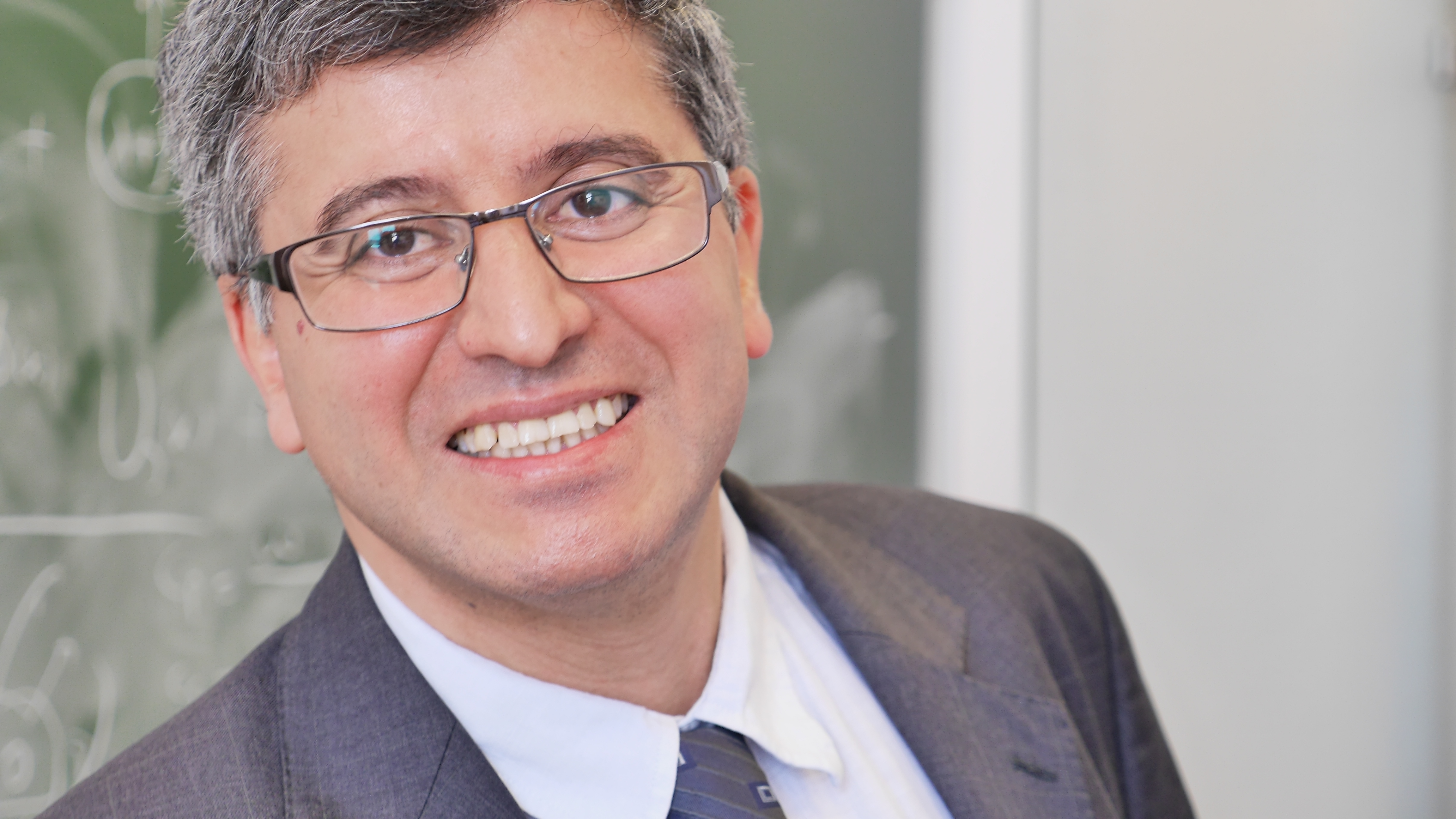
Giovanni Samaey is a Professor of Applied Mathematics and Mathematical Engineering at KU Leuven's Faculty of Engineering Science. He leads research in computational and multiscale methods, focusing on plasma edge modeling for nuclear fusion reactors, Bayesian inversion, and Monte Carlo algorithms. Appointed in 2011, he currently supervises ten PhD students and has held a five-year membership in the Young Academy. His work bridges academic research with societal impact, co-founding Platform Wiskunde Vlaanderen to strengthen mathematics in Flanders. Education: Graduated in Computer Science (specializing in applied mathematics) from KU Leuven (1996), completed a PhD in 2001 under Prof. Dirk Roose, supported by an NFWO fellowship. He transitioned from engineering studies due to a passion for mathematics' societal impact, initially avoiding academia but ultimately embracing teaching and research. Research Interests: Development of numerical methods for multiscale phenomena, including micro-macro acceleration algorithms, multilevel Monte Carlo techniques, and hybrid fluid-kinetic models. His work addresses challenges in plasma physics, fusion energy systems, and inverse problems. Key contributions include the X-Factor book (with Joos Vandewalle) promoting mathematics outreach and advancing computational tools for plasma edge simulations. Awards/Honors: Member of the Young Academy (2016-2021), NFWO Aspirant Fellowship (2001-2002). His efforts in STEM advocacy and mathematics promotion through Platform Wiskunde Vlaanderen highlight his dedication to education and public engagement. Advising & Leadership: Supervises a team of PhD students in applied mathematics and computational science. Active in curriculum development and interdisciplinary collaborations, particularly in fusion energy modeling. His research group contributes to codes like EMC3-EIRENE for plasma edge simulations. Labs/Teams: Leads projects in multiscale numerical methods and plasma simulation within KU Leuven's engineering faculty. Collaborates internationally on fusion reactor modeling and Monte Carlo algorithm design, emphasizing computational efficiency and scalability.