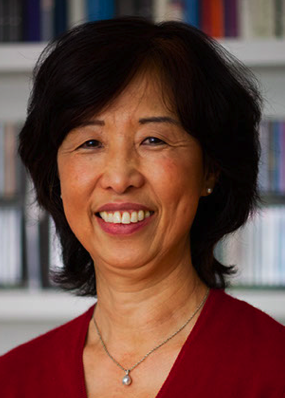
Dr. Soonja Choi is a Research Professor in the Comparative Psycholinguistics Group at the University of Vienna and Director of the Korean Studies Program at San Diego State University (SDSU), where she holds the title of Professor Emerita of Linguistics. She earned her Ph.D. in Linguistics from the University of Buffalo (1986) and holds advanced degrees from institutions in France and South Korea. Her research focuses on language and thought, semantics, spatial language, and Korean linguistics, with a particular emphasis on cross-linguistic studies of spatial categorization and its cognitive implications. Research Contributions: Her work has explored how language influences spatial perception and cognition, notably through long-term collaborations with the Max Planck Institute for Psycholinguistics and the National Science Foundation. Key contributions include studies on spatial term development in Korean/English children and cross-linguistic comparisons of spatial semantics between German, Korean, and English. Grants & Awards: Secured over $1.4M in grants including a EUR 600,000 Vienna Science Fund grant (2016-2020) and multiple NSF awards. Elected to the Academy of Europe (2019) as an Ordinary Member. Professional Roles: Served as Chair of SDSU's Department of Linguistics and Oriental Languages (1997-2000, 2001-2002), Graduate Advisor (multiple terms), and editorial board member for Language, Interaction, and Acquisition . Active in academic governance and international linguistic organizations.
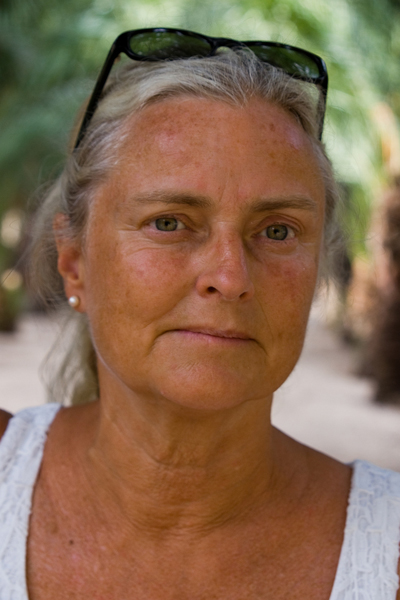
Carita Paradis is a Professor Emerita at Lund University's Centre for Languages and Literature, specializing in English Linguistics. She holds a PhD from Lund University (1997) and has held leadership roles including Chair of the Swedish Research Council's Linguistics panel (2010–2015). She coordinates the Language, Cognition and Discourse@Lund (LCD@L) research group, focusing on discourse meaning, language acquisition, and sociocultural variation. Her research spans cognitive linguistics, discourse analysis, semantics, and sensory language. She has authored/co-authored over 100 refereed publications, 5 books, and edited 10 journal volumes. Awards include membership in Academia Europaea (2016) and leadership roles in Scandinavian linguistic associations. She has supervised 14 PhD students and 8 postdocs, taught at all academic levels, and participated in numerous national/international research projects. Her editorial roles include serving on Cognitive Semantics, Languages, and Human Cognitive Processing series.
Dirk Geeraerts is a full Professor of Linguistics at the University of Leuven (KU Leuven), where he has held a faculty position since 1993. He studied Germanic languages (Dutch and English) and holds a bachelor's degree in Philosophy, earning his PhD in 1981. His academic career includes professorships at the Kortrijk campus of the University of Leuven (1986–1993) and the University of Leiden (1985–1986), as well as foundational research at the Instituut voor Nederlandse Lexicologie (1977–1985). Research Focus : Geeraerts specializes in lexical semantics , lexicology , and cognitive linguistics , particularly examining social variation , diachronic change , and empirical semantic methods . His work bridges theoretical and applied lexicography, notably through his editorial role in the Van Dale Groot woordenboek van de Nederlandse taal (1995–2005). Scientific Contributions : Founded the international journal Cognitive Linguistics Co-editor of The Oxford Handbook of Cognitive Linguistics Managing editor of the Cognitive Linguistics Research monograph series Honors and Awards : 1978: L.K. Engels Award 1992: Flemish Government Award for Wat er in een woord zit 2003: Member of the Royal Academy for Dutch Language and Literature (KANTL) 2020: Matthias de Vries Medal for Dutch lexicology contributions Labs and Teams : Established the Quantitative Lexicology and Variational Linguistics (QLVL) research group at the University of Leuven, advancing empirical approaches to lexical and semantic studies.
Stefan-Michael Newerkla is a University Professor of West Slavic Linguistics at the Department of Slavonic Studies, Faculty of Philology and Cultural Studies, University of Vienna. He has served as Head of the Institute of Slavic Studies since 2022, following previous leadership roles as Deputy Head (2018-2022) and Head (2005-2008). His academic leadership extends to significant positions including Member of the Academy Council of the Austrian Academy of Sciences (2022-2026), Member of the International Board of Palacký University Olomouc (2022-2026), and Member of the Scientific Council of the Czech Academy of Sciences (since 2013). Professor Newerkla earned his doctorate in 1998 with a dissertation on "Intended and actual linguistic reality in Bohemia. Diglossia in the school system of the Czech-speaking countries of the Habsburg Monarchy 1740–1918 using the example of the West Bohemian district town of Plzeň (Pilsen)" and completed his habilitation in 2003 on "Language Contacts Czech – German – Slovak. German Loanwords in Czech and Slovak: Historical Development, Evidence, Previous and New Interpretations." His academic journey began with studies in Slavic Studies, English Studies, and American Studies at the University of Vienna from 1992-1998. His research focuses on West Slavic linguistics with particular emphasis on contact linguistics, areal linguistics, linguistic geography, and historical sociolinguistics. He investigates the development of linguistic contacts between German, Hungarian and Slavic languages, examining Central Europe as a linguistic area with special attention to Austriazisms and Internationalisms research. His work also explores the school system and language teaching in the Habsburg Monarchy, analyzing language legislation versus language reality and diglossia or polyglossia in the educational system. Additional research interests include the National Renewal in the Bohemian Lands, Vienna's role in the Czech National Renewal, the Slovak national awareness process, and the grammatology and grammarography of West Slavic languages. Analysis of his recent publications (2023-2025) reveals a continued focus on historical language contact in Central Europe, particularly examining multilingualism in the Habsburg Monarchy and linguistic heritage. His work increasingly incorporates interdisciplinary approaches, connecting linguistic analysis with historical, educational, and cultural studies perspectives. Recent publications show particular attention to Czech language in Austria, language teaching methodologies, and the reconstruction of historical language contact phenomena, with several multilingual publications reflecting his expertise in cross-cultural communication. Professor Newerkla's scientific achievements have been recognized with numerous prestigious awards: Medal of the Minister for Foreign Affairs of the Czech Republic (August 7, 2024) for Services to Diplomacy Premia Bohemica for 2023 for outstanding contribution to promoting Czech literature abroad Josef-Dobrovský-Ehrenmedaille of the Czech Academy of Sciences (April 25, 2017) Full member of the Austrian Academy of Sciences (since 2018) Corresponding Member of the Austrian Academy of Sciences (since 2014) Member of the Academic Assembly of the Czech Academy of Sciences (since 2010) Award from University of Vienna for Innovative Teaching (June 22, 2001) As an academic leader, Professor Newerkla has supervised numerous theses across various levels of study. His research is supported by significant grants, most notably his role since 2016 as consortium member and board member of the Special Research Programme "German in Austria. Variation – Contact – Perception" (SFB F 60-G23), where he heads Task Cluster C and subprojects 05 and 06. He also led the research project "Slavists in Exchange: Austria and Russia 1849-1939" (2021-2025). His administrative roles have included Chairman of the Curricular Commission of the Senate of the University of Vienna (2010-2016) and Member of the Senate of the University of Vienna (2009-2016). Professor Newerkla is actively involved in multiple international research teams and collaborations, including the Permanent Conference of Austrian and Czech Historians on Common Cultural Heritage (SKÖTH), which he has co-chaired since 2009. His research group at the University of Vienna's Institute of Slavic Studies focuses on West Slavic linguistics, with particular expertise in historical language contact phenomena and the linguistic heritage of Slavic languages in Central Europe. He has also served as editor for numerous publications including the Vienna Slavic Yearbook (New Series) since 2013.
Martina Werner is a Senior Postdoc and Research Fellow at the Austrian Centre for Digital Humanities (ÖAW), affiliated with the Institute of German Studies at the University of Vienna's Faculty of Philology and Cultural Studies. She holds a habilitation in German Linguistics from the University of Vienna (2019) and a PhD from LMU Munich (2009). Her academic appointments include visiting professorships at Universität Würzburg (2024–2025) and LMU Munich (2019–2020), along with a guest professorship at the University of Vienna (2017/2018). Research Focus: Werner specializes in morphology, historical linguistics, and corpus-based approaches. Her work explores grammar theory, language change, syntax-morphology interfaces, and digital humanities methodologies. Current projects include FWF-funded research on relational adjectives in historical German (RAHiG) and the diachrony of nominalized infinitives. Publication Trends: Her recent articles (2016–2025) predominantly analyze diachronic morphology in German, focusing on nominalization patterns, compound structures, and suffix evolution. Corpus linguistics methodologies underpin her investigations into grammaticalization, language variation, and comparative Germanic linguistics. A strong interdisciplinary thread connects linguistic theory with empirical data analysis. Awards & Grants: FWF Project Funding: RAHiG – Relational Adjectives in the History of German (2019–2026) Elise Richter Project Grant: Diachrony of the Nominalized Infinitive in German (2014–2019) LMUMentoring Excellence Program (2008–2011) HWP Doctoral Scholarship (2005–2006) Academic Service: Werner co-leads research teams at ÖAW's Digital Humanities Centre, collaborates internationally on Germanic linguistics projects, and supervises academic initiatives through the Vienna Linguistic Society. Her teaching covers historical linguistics, morphology, and language development at undergraduate and graduate levels.
Roman Krivko is an Associate Professor at the Department of Slavonic Studies , University of Vienna. His research focuses on Old Church Slavonic , Byzantine hymnography , and historical linguistics of Slavic languages. Specializes in medieval Slavic epigraphy and liturgical text analysis Key contributor to studies on Christian traditions in Slavic contexts Active editor and researcher in international Slavic studies Research Themes include: Quantitative analysis of loanwords in Slavic Gospels Textological studies of service menaia and kontakia Historical development of Old Bulgarian language Linguistic networks in Central/Eastern Europe Scientific Contributions span Editorial work on Slověne journal Notable publications on the Temnić inscription and Samuil's epigraph Collaborations with institutions like Vinogradov Russian Language Institute
Professor Kriszta Eszter Szendröi is a distinguished academic at the University of Vienna, where she serves as Professor of Theoretical and Experimental Linguistics in the Department of Linguistics within the Faculty of Philology and Cultural Studies. Her extensive teaching portfolio includes courses on morphology, syntax, Yiddish language, and information structure across multiple semesters including upcoming 2025W and 2025S terms. Professor Szendröi's primary research interests span theoretical and experimental linguistics with a specialized focus on Yiddish linguistics. Her groundbreaking work documents significant grammatical changes in Contemporary Hasidic Yiddish (CHY), including the complete loss of morphological gender and case marking across global Hasidic communities. She has conducted extensive fieldwork resulting in over 100 hours of recordings with speakers from Israel, New York, Montreal and London, examining both theoretical linguistic analysis and sociolinguistic context. Her scholarly output reveals a consistent focus on the syntax-prosody interface, particularly regarding focus movement and its acquisition across languages. Szendröi has pioneered research on CHY as a distinct linguistic variety, examining innovations in its pronominal system and the Hebrew/Aramaic component within the language. Her work also extends to community engagement, notably translating critical health information during the COVID-19 pandemic for Hasidic communities worldwide. Professor Szendröi has secured significant research funding through an AHRC-funded project on Contemporary Hasidic Yiddish conducted with Lily Kahn. The project involved international collaboration and extensive fieldwork across multiple countries, resulting in numerous publications in top linguistics journals and edited volumes. She has mentored doctoral students including Riccardo Pulicani (on quantifier raising and information structure) and Cecile Larralde (on focus effects on negation-disjunction interactions). Her collaborative research network spans international institutions, working with scholars from the University of Edinburgh, University of Potsdam, and others on language acquisition studies involving children in Hasidic communities. Professor Szendröi leads the YUNG YiDiSH WIEN initiative, a dedicated space for Yiddish language and culture in Vienna that serves both the academic community and local Yiddish-speaking Orthodox populations. Her research team has made significant contributions to documenting and analyzing Contemporary Hasidic Yiddish as a living, evolving language variety, establishing it as a distinct linguistic phenomenon worthy of scholarly attention.
Miriam Butt is a Professor (W3) for General and Computational Linguistics at the Department of Linguistics, University of Konstanz since 2019. Previously, she held a Professor (C3) position at the same department from 2003 to 2019. Earlier roles include a Lecturer at the Centre for Computational Linguistics, UMIST (2002-2003), and Research Scientist positions at the University of Konstanz, Universität Stuttgart, and Universität Tübingen. Education: PhD and MA in Linguistics from Stanford University (1988-1993), BA in Language Studies and Computer Science from Wellesley College (1984-1987). Her research focuses span Morphology, Lexical Semantics, Digital Humanities, Historical Linguistics, Computational Linguistics, and Syntax. She has contributed to projects such as SFB471 (Variation and Change in the Lexicon), ParGram (grammar development for German), and Verbmobil (tense analysis in German-English translation). She has served on advisory boards and consulted for projects including NSF's Hindi/Urdu treebank initiative and CRULP's Urdu machine translation system.
Overview Enikő Németh T. is a Full Professor and Head of the Department of General Linguistics at the University of Szeged's Faculty of Humanities and Social Sciences since 2017. She has held leadership roles including Head of the Doctoral School of Linguistics (2018–present), Head of the Hungarian Research Centre for Pragmatics (2012–present), and Chair of the Theoretical Linguistics PhD Program (2007–present). She earned her Candidate's degree (PhD equivalent) in 1992 and became a Doctor of the Hungarian Academy of Sciences in 2017. Education 1987: MA in Russian Language and Literature and General/Applied Linguistics (University of Szeged) 1992: Candidate's degree (PhD equivalent) in Linguistics 2017: Doctor of the Hungarian Academy of Sciences in Linguistics Research Interests Her work focuses on pragmatics , discourse analysis , and the interaction between grammar and pragmatics . She explores implicit arguments in Hungarian, perspectives in language use , and cognitive pragmatics . Her research emphasizes empirical methodologies and theoretical frameworks to understand linguistic phenomena like pro-drop, anaphora, and lexical semantics. Awards & Honors 2020: Hungarian Academy of Sciences Publication Award 2013: Hajdú Péter Guest Researcher Fellowship 2004–2007: Bolyai János Research Fellowship 2000–2003: Széchenyi Professor Fellowship Academic Leadership & Grants She leads major initiatives like the MTA-DE-SZTE Research Group for Theoretical Linguistics (2006–present) and has directed national and international research projects. Her grants include long-term fellowships from the Hungarian Academy of Sciences. Labs & Teams Directs the Hungarian Research Centre for Pragmatics and oversees the MTA-DE-SZTE Research Group for Theoretical Linguistics , fostering collaborative research in pragmatics and theoretical linguistics.
Elena Anagnostopoulou is a Professor of Theoretical Linguistics at the University of Crete since 2009, with prior roles as Associate Professor (2005-2009) and Assistant Professor (1998-2005). She has held visiting positions at MIT and a fellowship at the University of Stuttgart. Education : PhD in Linguistics, University of Salzburg (1994). Research Interests : Theoretical and comparative syntax, formal typology, argument structure, case/agreement theory, clitics, control/anaphora, and historical linguistics. Her work bridges syntax, morphology, and lexicology. Scientific Impact : Over 7,500 citations (Google Scholar), h-index 37. Recipient of the 2013 Humboldt Foundation's Friedrich Wilhelm Bessel Award for sustained research excellence. Grants & Projects : Co-Investigator in the AHRC-funded project on diachronic case variation (2017-2019), Principal Investigator for the UCrete project applying evolutionary biology to language relationships (2019-2021). Collaborated with German institutions via Humboldt funding.
Univ.-Prof. Dr. Alexandra Lenz is a Professor of German Linguistics at the University of Vienna's Department of German Studies. Her research focuses on Austrian German dialects, lexical variation, and sociolinguistic dynamics, particularly through digital methods and corpus-based approaches. Key Research Areas: Austrian German dialects, lexical variation, sociolinguistic perception, and digital humanities. Projects: Leading contributions to the Special Research Programme 'German in Austria (DiÖ): Variation–Contact–Perception' and LexAT21 lexicon atlas. Methodology: Specializes in corpus linguistics, syntactic variation analysis, and experimental elicitation techniques. Recent Trends: Articles from 2025–2020 explore lexical responses to crises (e.g., pandemic language), grammaticalization pathways, and dialect syntax through comparative and interdisciplinary frameworks.
Alexandra N. Lenz is a Professor of German Linguistics at the University of Vienna and a Full Member of the Austrian Academy of Sciences. She serves as Director of the Austrian Centre for Digital Humanities and Cultural Heritage (ACDH-CH) and Spokesperson for the Collaborative Research Center 'German in Austria: Variation – Contact – Perception' (FWF F060). Her work spans dialectology, variationist linguistics, syntax, sociolinguistics, and digital humanities. Ph.D. in German Linguistics (University of Marburg, 2002) DFG Fellowship (1998–2001) Rosalind Franklin Fellowships (2005–2009) Her research focuses on Austrian German dialects, lexical variation, syntactic change, language contact, and the interplay between standard and non-standard varieties. She leads the LexAT21 project, analyzing 21st-century lexical variation in Austria, and explores diaglossic repertoires through corpus-based and experimental methods. Recent publications examine lexical dynamics in Austrian media during the pandemic, relativizer variation in Austria, and the evolution of possessive constructions. She has organized major conferences like ICLaVE12 and 'AI meets Humanities & Social Sciences' in 2025. Full Member, Austrian Academy of Sciences (2019) Elected Corresponding Member, Austrian Academy of Sciences (2013) Vidi-Grant (NWO, 2009) [unaccepted] Hugo-Moser-Prize (2009) Lenz mentors through networks like 'Sprachwissenschaftliche Dissertationsprojekte der Wiener Germanistik & Friends' and contributes to editorial boards of journals such as Zeitschrift für Dialektologie und Linguistik . Her leadership roles include chairing the ÖAW Research Department 'Linguistics' and co-founding initiatives like the 'Bairisch Across Borders' network. She directs labs and teams at ACDH-CH, focusing on digital humanities infrastructure and language variation corpora. Her work bridges traditional dialectology with computational methods, emphasizing Austria's unique linguistic landscape.
Teresa Fanego is a Full Professor of English Language and Linguistics at the University of Santiago de Compostela since 1990. Her academic career includes roles as Associate Professor (1984-1990) and Lecturer (1976-1984) at the same institution. She holds a PhD in English Linguistics (1978) and an MA in Germanic Philology (1971), with a 1975-1976 research stay at University College London. Research focuses on historical linguistics, corpus-based studies, grammaticalization, and Shakespearean grammar. She coordinates the Inter-university Master in Advanced English Studies since 2016 and led the Research Unit for Variation, Linguistic Change and Grammaticalization since 1990. Her work involves international collaborations including projects with KU Leuven and Edinburgh University. Notable awards include six 'sexenios' (highest Spanish research assessment), the 2016 American Publishers Excellence Award for co-authored The Cambridge Guide to the Worlds of Shakespeare , and the 2017 Galician Research Award. She has supervised 22 doctoral students, many of whom hold academic positions globally.
Louise McNally is a Professor of Linguistics at Universitat Pompeu Fabra (UPF) in Barcelona, Spain. She holds a Ph.D. in Linguistics from the University of California, Santa Cruz (1992) and a Postgraduate Diploma in Computational Linguistics from UPF (2002). Her research focuses on semantic/pragmatic theory, morphosyntax-semantics-pragmatics interfaces, and computational semantics, with recent explorations into vector-based and information-theoretic models of meaning. McNally has held senior administrative roles at UPF, including Vice Rector for the Organization and Academic Project (2015–2017), Vice Rector for Faculty Affairs (2011–2015), and Vice Rector for Research (2009–2011). She is co-Editor-in-Chief of Semantics and Pragmatics and affiliated with the Grammar and Cognition Lab and Computational Linguistics and Linguistic Theory groups. Her work bridges formal semantics with experimental perspectives, addressing issues like nominalization, scalar implicatures, and idiomatic expressions. Key honors include the Alexander von Humboldt Research Prize (2017) and multiple ICREA Academia Awards (2008, 2013, 2018). Her publications span theoretical linguistics, computational semantics, and experimental studies, emphasizing cross-disciplinary collaboration.
Katharina Gerhalter is a Lecturer at the Department of Romance Linguistics within the Institute of Romance Studies at the University of Graz. Her academic work focuses on the intersections of syntax , semantics , and pragmatics , particularly in the diachronic development of discourse functions in Romance languages. Education: Mag. Dr.phil. Bakk.phil. (equivalent to MA and BA in philosophy/philology) Her research includes the adjective-adverb interface in Spanish (dissertation, 2018) and a current habilitation thesis on topicalized infinitives in Spanish, French, and Portuguese. She contributes to the creation of annotated corpora for comparative studies in Romance languages. Recent publications analyze quantifiers in Spanish/Portuguese , NLP processing of infinitive structures , and historical pragmatics . Her work bridges theoretical linguistics with digital corpus methodologies, emphasizing cross-linguistic variation.